

Recent from talks
Jacobson radical
Knowledge base stats:
Talk channels stats:
Members stats:
Jacobson radical
In mathematics, more specifically ring theory, the Jacobson radical of a ring is the ideal consisting of those elements in that annihilate all simple right -modules. It happens that substituting "left" in place of "right" in the definition yields the same ideal, and so the notion is left–right symmetric. The Jacobson radical of a ring is frequently denoted by (or the variant ), (or variants like or ), or ; the former notation will be preferred in this article to avoid confusion with other radicals of a ring or a maximal ideal. The Jacobson radical is named after Nathan Jacobson, who was the first to study it for arbitrary rings in Jacobson 1945.


The Jacobson radical of a ring has numerous internal characterizations, including a few definitions that successfully extend the notion to non-unital rings. The radical of a module extends the definition of the Jacobson radical to include modules. The Jacobson radical plays a prominent role in many ring- and module-theoretic results, such as Nakayama's lemma.
There are multiple equivalent definitions and characterizations of the Jacobson radical, but it is useful to consider the definitions based on if the ring is commutative or not.
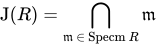
In the commutative case, the Jacobson radical of a commutative ring R is defined as the intersection of all maximal ideals . If we denote Specm R as the set of all maximal ideals in R then

This definition can be used for explicit calculations in a number of simple cases, such as for local rings (R, ), which have a unique maximal ideal, Artinian rings, and products thereof. See the examples section for explicit computations.

For a general ring with unity R, the Jacobson radical J(R) is defined as the ideal of all elements r ∈ R such that rM = 0 whenever M is a simple R-module. That is, This is equivalent to the definition in the commutative case for a commutative ring R because the simple modules over a commutative ring are of the form R / for some maximal ideal of R, and the annihilators of R / in R are precisely the elements of , i.e. AnnR(R / ) = .

Understanding the Jacobson radical lies in a few different cases: namely its applications and the resulting geometric interpretations, and its algebraic interpretations.
Hub AI
Jacobson radical AI simulator
(@Jacobson radical_simulator)
Jacobson radical
In mathematics, more specifically ring theory, the Jacobson radical of a ring is the ideal consisting of those elements in that annihilate all simple right -modules. It happens that substituting "left" in place of "right" in the definition yields the same ideal, and so the notion is left–right symmetric. The Jacobson radical of a ring is frequently denoted by (or the variant ), (or variants like or ), or ; the former notation will be preferred in this article to avoid confusion with other radicals of a ring or a maximal ideal. The Jacobson radical is named after Nathan Jacobson, who was the first to study it for arbitrary rings in Jacobson 1945.
The Jacobson radical of a ring has numerous internal characterizations, including a few definitions that successfully extend the notion to non-unital rings. The radical of a module extends the definition of the Jacobson radical to include modules. The Jacobson radical plays a prominent role in many ring- and module-theoretic results, such as Nakayama's lemma.
There are multiple equivalent definitions and characterizations of the Jacobson radical, but it is useful to consider the definitions based on if the ring is commutative or not.
In the commutative case, the Jacobson radical of a commutative ring R is defined as the intersection of all maximal ideals . If we denote Specm R as the set of all maximal ideals in R then
This definition can be used for explicit calculations in a number of simple cases, such as for local rings (R, ), which have a unique maximal ideal, Artinian rings, and products thereof. See the examples section for explicit computations.
For a general ring with unity R, the Jacobson radical J(R) is defined as the ideal of all elements r ∈ R such that rM = 0 whenever M is a simple R-module. That is, This is equivalent to the definition in the commutative case for a commutative ring R because the simple modules over a commutative ring are of the form R / for some maximal ideal of R, and the annihilators of R / in R are precisely the elements of , i.e. AnnR(R / ) = .
Understanding the Jacobson radical lies in a few different cases: namely its applications and the resulting geometric interpretations, and its algebraic interpretations.
Recent media