Hubbry Logo
Local ringLocal ringMain
Open search
Local ring
Community hub
Local ring
logo
7 pages, 0 posts
0 subscribers
Be the first to start a discussion here.
Local ring
Local ring
from Wikipedia

In mathematics, more specifically in ring theory, local rings are certain rings that are comparatively simple, and serve to describe what is called "local behaviour", in the sense of functions defined on algebraic varieties or manifolds, or of algebraic number fields examined at a particular place, or prime. Local algebra is the branch of commutative algebra that studies commutative local rings and their modules.

In practice, a commutative local ring often arises as the result of the localization of a ring at a prime ideal.

The concept of local rings was introduced by Wolfgang Krull in 1938 under the name Stellenringe.[1] The English term local ring is due to Zariski.[2]

Definition and first consequences

[edit]

A ring R is a local ring if it has any one of the following equivalent properties:

  • R has a unique maximal left ideal.
  • R has a unique maximal right ideal.
  • 1 ≠ 0 and the sum of any two non-units in R is a non-unit.
  • 1 ≠ 0 and if x is any element of R, then x or 1 − x is a unit.
  • If a finite sum is a unit, then it has a term that is a unit (this says in particular that the empty sum cannot be a unit, so it implies 1 ≠ 0).

If these properties hold, then the unique maximal left ideal coincides with the unique maximal right ideal and with the ring's Jacobson radical. The third of the properties listed above says that the set of non-units in a local ring forms a (proper) ideal,[3] necessarily contained in the Jacobson radical. The fourth property can be paraphrased as follows: a ring R is local if and only if there do not exist two coprime proper (principal) (left) ideals, where two ideals I1, I2 are called coprime if R = I1 + I2.

In the case of commutative rings, one does not have to distinguish between left, right and two-sided ideals: a commutative ring is local if and only if it has a unique maximal ideal. Before about 1960 many authors required that a local ring be (left and right) Noetherian, and (possibly non-Noetherian) local rings were called quasi-local rings. In this article this requirement is not imposed.

A local ring that is an integral domain is called a local domain.

Examples

[edit]
  • All fields (and skew fields) are local rings, since {0} is the only maximal ideal in these rings.
  • The ring is a local ring (p prime, n ≥ 1). The unique maximal ideal consists of all multiples of p.
  • More generally, a nonzero ring in which every element is either a unit or nilpotent is a local ring.
  • An important class of local rings are discrete valuation rings, which are local principal ideal domains that are not fields.
  • The ring , whose elements are infinite series where multiplications are given by such that , is local. Its unique maximal ideal consists of all elements that are not invertible. In other words, it consists of all elements with constant term zero.
  • More generally, every ring of formal power series over a local ring is local; the maximal ideal consists of those power series with constant term in the maximal ideal of the base ring.
  • Similarly, the algebra of dual numbers over any field is local. More generally, if F is a local ring and n is a positive integer, then the quotient ring F[X]/(Xn) is local with maximal ideal consisting of the classes of polynomials with constant term belonging to the maximal ideal of F, since one can use a geometric series to invert all other polynomials modulo Xn. If F is a field, then elements of F[X]/(Xn) are either nilpotent or invertible. (The dual numbers over F correspond to the case n = 2.)
  • Nonzero quotient rings of local rings are local.
  • The ring of rational numbers with odd denominator is local; its maximal ideal consists of the fractions with even numerator and odd denominator. It is the integers localized at 2.
  • More generally, given any commutative ring R and any prime ideal P of R, the localization of R at P is local; the maximal ideal is the ideal generated by P in this localization; that is, the maximal ideal consists of all elements a/s with aP and sR - P.

Non-examples

[edit]
  • The ring of polynomials over a field is not local, since and are non-units, but their sum is a unit.
  • The ring of integers is not local since it has a maximal ideal for every prime .
  • /(pq), where p and q are distinct prime numbers. Both (p) and (q) are maximal ideals here.

Ring of germs

[edit]

To motivate the name "local" for these rings, we consider real-valued continuous functions defined on some open interval around of the real line. We are only interested in the behavior of these functions near (their "local behavior") and we will therefore identify two functions if they agree on some (possibly very small) open interval around . This identification defines an equivalence relation, and the equivalence classes are what are called the "germs of real-valued continuous functions at ". These germs can be added and multiplied and form a commutative ring.

To see that this ring of germs is local, we need to characterize its invertible elements. A germ is invertible if and only if . The reason: if , then by continuity there is an open interval around where is non-zero, and we can form the function on this interval. The function gives rise to a germ, and the product of is equal to . (Conversely, if is invertible, then there is some such that , hence .)

With this characterization, it is clear that the sum of any two non-invertible germs is again non-invertible, and we have a commutative local ring. The maximal ideal of this ring consists precisely of those germs with .

Exactly the same arguments work for the ring of germs of continuous real-valued functions on any topological space at a given point, or the ring of germs of differentiable functions on any differentiable manifold at a given point, or the ring of germs of rational functions on any algebraic variety at a given point. All these rings are therefore local. These examples help to explain why schemes, the generalizations of varieties, are defined as special locally ringed spaces.

Valuation theory

[edit]

Local rings play a major role in valuation theory. By definition, a valuation ring of a field K is a subring R such that for every non-zero element x of K, at least one of x and x−1 is in R. Any such subring will be a local ring. For example, the ring of rational numbers with odd denominator (mentioned above) is a valuation ring in .

Given a field K, which may or may not be a function field, we may look for local rings in it. If K were indeed the function field of an algebraic variety V, then for each point P of V we could try to define a valuation ring R of functions "defined at" P. In cases where V has dimension 2 or more there is a difficulty that is seen this way: if F and G are rational functions on V with

F(P) = G(P) = 0,

the function

F/G

is an indeterminate form at P. Considering a simple example, such as

Y/X,

approached along a line

Y = tX,

one sees that the value at P is a concept without a simple definition. It is replaced by using valuations.

Non-commutative

[edit]

Non-commutative local rings arise naturally as endomorphism rings in the study of direct sum decompositions of modules over some other rings. Specifically, if the endomorphism ring of the module M is local, then M is indecomposable; conversely, if the module M has finite length and is indecomposable, then its endomorphism ring is local.

If k is a field of characteristic p > 0 and G is a finite p-group, then the group algebra kG is local.

Some facts and definitions

[edit]

Commutative case

[edit]

We also write (R, m) for a commutative local ring R with maximal ideal m. Every such ring becomes a topological ring in a natural way if one takes the powers of m as a neighborhood base of 0. This is the m-adic topology on R. If (R, m) is a commutative Noetherian local ring, then
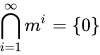
(Krull's intersection theorem), and it follows that R with the m-adic topology is a Hausdorff space. The theorem is a consequence of the Artin–Rees lemma together with Nakayama's lemma, and, as such, the "Noetherian" assumption is crucial. Indeed, let R be the ring of germs of infinitely differentiable functions at 0 in the real line and m be the maximal ideal . Then a nonzero function belongs to for any n, since that function divided by is still smooth.

As for any topological ring, one can ask whether (R, m) is complete (as a uniform space); if it is not, one considers its completion, again a local ring. Complete Noetherian local rings are classified by the Cohen structure theorem.

In algebraic geometry, especially when R is the local ring of a scheme at some point P, R / m is called the residue field of the local ring or residue field of the point P.

If (R, m) and (S, n) are local rings, then a local ring homomorphism from R to S is a ring homomorphism f : RS with the property f(m) ⊆ n.[4] These are precisely the ring homomorphisms that are continuous with respect to the given topologies on R and S. For example, consider the ring morphism sending . The preimage of is . Another example of a local ring morphism is given by .

General case

[edit]

The Jacobson radical m of a local ring R (which is equal to the unique maximal left ideal and also to the unique maximal right ideal) consists precisely of the non-units of the ring; furthermore, it is the unique maximal two-sided ideal of R. However, in the non-commutative case, having a unique maximal two-sided ideal is not equivalent to being local.[5]

For an element x of the local ring R, the following are equivalent:

  • x has a left inverse
  • x has a right inverse
  • x is invertible
  • x is not in m.

If (R, m) is local, then the factor ring R/m is a skew field. If JR is any two-sided ideal in R, then the factor ring R/J is again local, with maximal ideal m/J.

A deep theorem by Irving Kaplansky says that any projective module over a local ring is free, though the case where the module is finitely-generated is a simple corollary to Nakayama's lemma. This has an interesting consequence in terms of Morita equivalence. Namely, if P is a finitely generated projective R module, then P is isomorphic to the free module Rn, and hence the ring of endomorphisms is isomorphic to the full ring of matrices . Since every ring Morita equivalent to the local ring R is of the form for such a P, the conclusion is that the only rings Morita equivalent to a local ring R are (isomorphic to) the matrix rings over R.

Notes

[edit]

References

[edit]

See also

[edit]
[edit]
Revisions and contributorsEdit on WikipediaRead on Wikipedia
from Grokipedia
In commutative algebra, a local ring is a commutative ring RR that admits exactly one maximal ideal mR\mathfrak{m}_R, which consists precisely of all non-unit elements of RR. The residue field of such a ring is the quotient R/mRR / \mathfrak{m}_R, often denoted κ(R)\kappa(R), and elements of RR outside mR\mathfrak{m}_R are invertible. This structure captures the "local" behavior of more general rings, where the non-units form an ideal, distinguishing local rings from rings with multiple maximal ideals. Local rings arise naturally through the process of localization: for any AA and pA\mathfrak{p} \subset A, the localization ApA_\mathfrak{p} is a local ring with pAp\mathfrak{p} A_\mathfrak{p} and residue field the fraction field of A/pA / \mathfrak{p}. Fields are trivial examples of local rings (with mR={0}\mathfrak{m}_R = \{0\}), and more generally, the spectrum Spec(R)\operatorname{Spec}(R) of a local ring consists of a unique closed point corresponding to mR\mathfrak{m}_R, which is closed in the Zariski topology because the maximal ideal mR\mathfrak{m}_R is not properly contained in any other prime ideal, making the closure of the corresponding point the point itself. Equivalent characterizations include the condition that for every element xRx \in R, either xx or 1x1 - x is invertible (assuming RR is not the zero ring), highlighting the dichotomy between units and non-units. Local rings are foundational in , serving as the "bread and butter" for studying schemes and varieties by focusing on behavior at individual points. They enable key tools like completions (yielding complete local rings for in p-adic analysis) and homological methods, such as , which governs the structure of finitely generated modules over local rings. Important subclasses include discrete valuation rings (regular local rings of dimension 1), regular local rings (where the maximal ideal is generated by a of length equal to the ), and Gorenstein rings (with finite injective dimension). These structures underpin local cohomology, dimension theory, and resolutions in both and .

Definition and Basic Properties

Definition

In , a is a with unity that possesses exactly one , denoted m\mathfrak{m}. The elements of m\mathfrak{m} are precisely the non-units of the ring, and the R/mR / \mathfrak{m} forms a field, known as the of RR, often denoted kk. This definition assumes familiarity with basic concepts in , such as rings equipped with a multiplicative identity, ideals, and maximal ideals, where a maximal ideal is a proper ideal not contained in any larger proper ideal. In the non-commutative setting, a ring RR with unity is local if its Jacobson radical J(R)J(R), the intersection of all maximal left ideals, coincides with the set of non-units and R/J(R)R / J(R) is a . Equivalently, RR has a unique maximal left ideal (or, symmetrically, a unique maximal right ideal), which serves as the Jacobson radical.

Characterization and Consequences

In a ring RR with identity, the non-units form an ideal if and only if RR is local, meaning it possesses a unique maximal (two-sided) ideal m\mathfrak{m}, which coincides precisely with the set of all non-units. Equivalently, RR is local if the sum of any two non-units is itself a non-unit, a condition that ensures every element of RR is either a unit or belongs to m\mathfrak{m}. This characterization extends to one-sided ideals: RR is local if and only if it has a unique maximal right ideal or a unique maximal left ideal. A direct consequence of this structure is that if a+ba + b is a unit in RR, then at least one of aa or bb must be a unit; otherwise, both would lie in m\mathfrak{m}, implying their sum also belongs to m\mathfrak{m} and thus cannot be a unit. Furthermore, the unique maximal ideal m\mathfrak{m} is the Jacobson radical J(R)J(R) of RR, as it is the of all maximal ideals (of which there is only one). Local rings also admit no non-trivial idempotents: the only idempotent elements are 00 and 11. In the commutative case, the set of non-invertible elements is exactly the unique m\mathfrak{m}, reinforcing that units are precisely the elements outside m\mathfrak{m}. The R/mR/\mathfrak{m} then forms a field, known as the of RR. In the commutative case, to see that m\mathfrak{m} comprises all non-units, suppose xRx \in R is a non-unit not in m\mathfrak{m}; then the ideal generated by xx and m\mathfrak{m} is proper (as xx is non-invertible), hence contained in some , but by uniqueness this must be m\mathfrak{m}, implying xmx \in \mathfrak{m}, a contradiction. For the unit sum property, assume neither aa nor bb is a unit, so both are in m\mathfrak{m}; their sum lies in m\mathfrak{m} by ideal closure, hence is non-invertible. The absence of non-trivial idempotents follows from the fact that a non-trivial idempotent ee would allow a decomposition R=ReR(1e)R = Re \oplus R(1-e) as modules over RR, contradicting the local property (indecomposability). Fields provide the trivial local ring example, where m=(0)\mathfrak{m} = (0) is the unique maximal ideal. The zero ring, however, is excluded from consideration as local, since it lacks a unique maximal ideal (or violates the identity requirement in standard definitions).

Examples

Commutative Examples

One fundamental example of a commutative local ring is the ring of k[]k[] over a field kk. This ring consists of all infinite series i=0aixi\sum_{i=0}^\infty a_i x^i with coefficients aika_i \in k, equipped with the usual addition and multiplication of series. It is a local ring with unique (x)(x), generated by xx, and the is k[]/(x)kk[]/(x) \cong k. Another class of examples arises from quotients of rings. For a field kk and n1n \geq 1, the ring k/(xn)k/(x^n) is commutative and local, with unique (x)/(xn)(x)/(x^n), and k/(xn)/((x)/(xn))kk/(x^n)/((x)/(x^n)) \cong k. Elements outside this are units, confirming the local structure. The ring of pp-adic integers Zp\mathbb{Z}_p, for a prime pp, provides a key example from . Defined as the completion of Z\mathbb{Z} with respect to the pp-adic valuation, Zp\mathbb{Z}_p is a commutative local ring with unique pZpp\mathbb{Z}_p, and Zp/pZpFp\mathbb{Z}_p / p\mathbb{Z}_p \cong \mathbb{F}_p. The localization of the ring of integers Z\mathbb{Z} at the prime ideal (2)(2), denoted Z(2)\mathbb{Z}_{(2)} or equivalently Z[1/3,1/5,1/7,]\mathbb{Z}[1/3, 1/5, 1/7, \dots], is a commutative local ring. Its elements are rational numbers of the form a/ba/b where the denominator bb is odd (not divisible by 2). The unique maximal ideal consists of those fractions where the numerator aa is even. This ring is a discrete valuation ring with the 2-adic valuation. In , local rings appear as coordinate rings at points on varieties. Consider the affine plane over a field kk, with coordinate ring k[x,y]k[x,y]; the localization at the (x,y)(x,y) yields the local ring k[x,y](x,y)k[x,y]_{(x,y)}, which is and local with unique (x,y)k[x,y](x,y)(x,y)k[x,y]_{(x,y)}, and isomorphic to kk. This ring captures the local structure at the origin (0,0)(0,0). A general construction of commutative local rings uses localization at s. For any RR and pR\mathfrak{p} \subset R, the localization RpR_\mathfrak{p} is a commutative local ring with unique pRp\mathfrak{p} R_\mathfrak{p}, and Rp/pRpFrac(R/p)R_\mathfrak{p} / \mathfrak{p} R_\mathfrak{p} \cong \mathrm{Frac}(R/\mathfrak{p}). This process inverts all elements outside p\mathfrak{p}, ensuring the local property.

Non-Commutative Examples

In non-commutative algebra, division rings provide the simplest examples of local rings, as they possess no proper nonzero left ideals, making the zero ideal the unique maximal left ideal (with Jacobson radical zero). For instance, the quaternions over the reals form a non-commutative that is local in this sense. Full matrix rings Mn(D)M_n(D) over a DD with n>1n > 1 are not local, as they admit multiple maximal left ideals; their Jacobson radical is zero (being simple Artinian rings), but the semisimple Mn(D)M_n(D) has n2n^2 pairwise non-isomorphic simple left modules, corresponding to distinct maximal left ideals. In contrast, when n=1n=1, M1(D)DM_1(D) \cong D recovers the local division ring case. Group rings offer another class of non-commutative local rings: if kk is a field of characteristic p>0p > 0 and GG is a finite pp-group, then the group ring k[G]k[G] is local, with the augmentation ideal Δ(k[G])={gGagggGag=0}\Delta(k[G]) = \{ \sum_{g \in G} a_g g \mid \sum_{g \in G} a_g = 0 \} serving as the unique maximal left ideal (and Jacobson radical). This ideal is nilpotent of index G|G|, and the quotient k[G]/Δ(k[G])kk[G]/\Delta(k[G]) \cong k is a division ring. Artinian local rings provide finite-dimensional examples beyond group rings. Consider the ring Tn(D)T_n(D) of n×nn \times n upper triangular matrices over a DD with constant diagonal entries (i.e., all diagonal elements equal). This ring is non-commutative for n>1n > 1 and local, with Jacobson radical consisting of the strictly upper triangular matrices ( of index nn), and the quotient Tn(D)/J(Tn(D))DT_n(D)/J(T_n(D)) \cong D a , ensuring a unique maximal left ideal. The Weyl algebra A1(k)=kx,A_1(k) = k\langle x, \partial \rangle over a field kk (with relation xx=1\partial x - x \partial = 1) is a non-commutative example where the Jacobson radical is zero (as it is simple), but it is not local in the strict sense, possessing infinitely many distinct maximal left ideals despite the unique maximal two-sided ideal being zero.

Non-Examples

Rings that fail to be local provide insight into the structural conditions required for locality, primarily by exhibiting either no maximal ideals or more than one. A fundamental reason for non-locality is the presence of multiple maximal ideals, which often arises from the ring's ability to "decompose" into components corresponding to distinct "points" or prime elements. This contrasts with local rings, where all non-units are contained in a single maximal ideal, enabling focused study of local behavior such as completions or valuations. Below, several canonical non-examples are discussed, drawn from standard commutative algebra. Consider the polynomial ring kk over a field kk. If kk is infinite, kk possesses infinitely many distinct maximal ideals of the form (xa)(x - a) for each aka \in k; even for finite kk, there are k|k| such ideals, exceeding one unless k=1|k| = 1. These maximal ideals correspond to at distinct points, reflecting the affine line's multiple points in , which makes kk suitable for global properties like unique factorization but precludes locality. Direct products of rings illustrate another common failure mode. For nonzero rings RR and SS each with at least one , the product ring R×SR \times S has at least two , including m×S\mathfrak{m} \times S for any m\mathfrak{m} of RR and R×nR \times \mathfrak{n} for any n\mathfrak{n} of SS. This multiplicity stems from the ring's decomposition into independent components, useful for studying direct sums or disjoint unions but incompatible with the unified non-unit structure of local rings. The , where the additive and multiplicative identities coincide (i.e., 0=10 = 1), admits no proper s whatsoever and thus has no maximal ideals, failing the condition for being . Similarly, certain rings with zero divisors, such as Z/2Z×Z/2Z\mathbb{Z}/2\mathbb{Z} \times \mathbb{Z}/2\mathbb{Z}, exhibit exactly two maximal ideals: the principal ideals generated by (1,0)(1,0) and (0,1)(0,1), respectively. These examples highlight rings where the absence or proliferation of maximal ideals disrupts the unique "local" focus, yet they remain valuable for modeling trivial or discrete structures without a dominant non-unit . Integral domains like the Z\mathbb{Z} also serve as non-local examples, featuring infinitely many maximal ideals (p)(p) for each pp. This infinitude arises from the abundance of prime elements, allowing Z\mathbb{Z} to capture arithmetic globally across all primes, in contrast to local domains that zoom in on a single prime. In general, non-locality often signals a ring's capacity for multiple irreducible components or points, making such rings essential for broader algebraic and geometric investigations despite lacking a unique maximal ideal.

Commutative Local Rings

Valuation Rings

A valuation ring is an RR with fraction field KK equipped with a valuation v:K×Γv: K^\times \to \Gamma, where Γ\Gamma is a totally ordered , such that R={xKv(x)0}{0}R = \{ x \in K \mid v(x) \geq 0 \} \cup \{0\} and the is m={xKv(x)>0}\mathfrak{m} = \{ x \in K \mid v(x) > 0 \}. The valuation vv satisfies v(xy)=v(x)+v(y)v(xy) = v(x) + v(y) and v(x+y)min(v(x),v(y))v(x + y) \geq \min(v(x), v(y)) for all x,yK×x, y \in K^\times. Valuation rings are local rings with maximal ideal m\mathfrak{m}, and the residue field k=R/mk = R / \mathfrak{m} is a field. The valuation induces a topology on KK, known as the valuation topology, where the basic open sets are defined using balls around elements based on vv. Moreover, RR is a normal domain, meaning it is integrally closed in KK. An equivalent characterization is that RR is a valuation ring if and only if for every xK×x \in K^\times, either xRx \in R or x1Rx^{-1} \in R. Another equivalent condition is that RR is an integral domain such that for any a,bRa, b \in R, either aa divides bb or bb divides aa in RR. Examples include discrete valuation rings (DVRs), which arise from rank-one valuations where ΓZ\Gamma \cong \mathbb{Z}. The ring Z(p)={a/bQpb}\mathbb{Z}_{(p)} = \{ a/b \in \mathbb{Q} \mid p \nmid b \} for a prime pp, with valuation vpv_p, is a DVR. Similarly, the formal power series ring k[]k[] over a field kk, with valuation v(t)=1v(t) = 1, is a DVR. In scheme theory, the spectrum SpecR\operatorname{Spec} R of a valuation ring RR consists of a totally ordered chain of prime ideals corresponding to the convex subgroups of Γ\Gamma, featuring a closed point (the maximal ideal m\mathfrak{m}) and the generic point (the zero ideal).

Rings of Power Series and Germs

In commutative algebra, the ring of formal power series k[[x1,,xn]]k[[x_1, \dots, x_n]] over a field kk in nn indeterminates is a fundamental example of a local ring, with unique maximal ideal m=(x1,,xn)\mathfrak{m} = (x_1, \dots, x_n) consisting of series with zero constant term. This ring is complete with respect to the m\mathfrak{m}-adic topology, meaning every Cauchy sequence in this topology converges, which endows it with a natural topological structure suitable for studying limits of ideals and modules. Rings of germs arise in analytic contexts as local models for functions near a point. For instance, the ring of germs of holomorphic functions at the origin in Cn\mathbb{C}^n, denoted OCn,0\mathcal{O}_{\mathbb{C}^n, 0}, comprises equivalence classes of holomorphic functions defined in neighborhoods of the origin, where two functions are equivalent if they agree on some common neighborhood. This ring is local, with maximal ideal m\mathfrak{m} formed by germs vanishing at the origin, i.e., functions ff such that f(0)=0f(0) = 0. Similarly, the ring of germs of CC^\infty functions at a point in Rn\mathbb{R}^n is local, with maximal ideal consisting of smooth functions vanishing at that point, capturing infinitesimal behavior in differential geometry. The construction of these rings distinguishes formal power series from convergent ones in . k[[x1,,xn]]k[[x_1, \dots, x_n]] allow arbitrary coefficients without convergence requirements, serving as algebraic completions, whereas the ring of convergent power series C{x1,,xn}\mathbb{C}\{x_1, \dots, x_n\} consists of series with positive , forming a that embeds densely into the formal series ring. These rings exhibit strong algebraic properties: k[[x1,,xn]]k[[x_1, \dots, x_n]] is Noetherian, meaning every ideal is finitely generated, and has nn, equal to the number of indeterminates. Moreover, if kk is a field of characteristic zero, this ring is excellent, ensuring good behavior under completions and localizations, such as finite integral extensions remaining Noetherian. The ring of holomorphic germs OCn,0\mathcal{O}_{\mathbb{C}^n, 0} shares these traits, being Noetherian and of dimension nn. Geometrically, the local ring OX,p\mathcal{O}_{X,p} at a point pp on an algebraic variety XX is the stalk of the structure sheaf, isomorphic to a ring of power series or germs that models the infinitesimal neighborhood of pp, encoding tangent spaces and higher-order approximations via the maximal ideal powers mk\mathfrak{m}^k. This structure facilitates the study of singularities and deformations, where formal power series capture algebraic aspects and germs incorporate analytic ones. A related notion involves étale local rings, which refine these models through étale morphisms, providing étale neighborhoods that locally resemble power series rings while preserving exactness in cohomology.

Discrete Valuation Rings

A discrete valuation ring (DVR) is a valuation ring whose value group is isomorphic to the integers Z\mathbb{Z}. It is a (PID) that is , with its unique nonzero m\mathfrak{m} generated by a uniformizer π\pi, so m=(π)\mathfrak{m} = (\pi). The associated valuation v:K×Zv: K^\times \to \mathbb{Z} on the fraction field KK satisfies v(π)=1v(\pi) = 1, and every nonzero ideal of the DVR is of the form (πn)(\pi^n) for some n0n \geq 0. DVRs are Noetherian integrally closed domains of Krull dimension 1. As PIDs, all their ideals are principal, and their fraction fields are equipped with the discrete valuation that extends additively and respects the minimum property for sums. They are regular local rings, meaning the maximal ideal is generated by a regular sequence of length equal to the dimension. Prominent examples include the ring of formal power series k[]k[] over a field kk, where tt serves as the uniformizer and the maximal ideal is (t)(t). Another is the ring of pp-adic integers Zp\mathbb{Z}_p, the completion of Z(p)\mathbb{Z}_{(p)} at the prime pp, with uniformizer pp and residue field Fp\mathbb{F}_p. In algebraic number theory, the localization of the ring of integers OK\mathcal{O}_K of a number field KK at a nonzero prime ideal p\mathfrak{p} yields a DVR, with uniformizer a uniformizing element of p\mathfrak{p} and residue field the finite field OK/p\mathcal{O}_K / \mathfrak{p}. In a DVR with uniformizer π\pi, every nonzero element xKx \in K can be uniquely expressed as x=uπex = u \pi^e, where uu is a unit in the DVR and e=v(x)Ze = v(x) \in \mathbb{Z} is the order of xx. This decomposition facilitates unique factorization and enables Euclidean-like algorithms for computing greatest common divisors in the ring. A Noetherian local domain of dimension 1 is a DVR if and only if it is regular. Equivalently, it is normal (integrally closed) and has a principal . By the Cohen structure theorem, every complete Noetherian DVR of dimension 1 is isomorphic to a power series ring over a field or a Cohen ring (a complete DVR with prime uniformizer). Thus, complete DVRs are precisely the complete regular local rings of dimension 1.

General Local Rings

Nakayama's Lemma

Nakayama's lemma is a fundamental result in module theory over local rings, providing a criterion for when submodules or ideals can be lifted from the residue field back to the original module. Let (R,m)(R, \mathfrak{m}) be a local ring with maximal ideal m\mathfrak{m} and residue field k=R/mk = R/\mathfrak{m}. For a finitely generated RR-module MM, the lemma states that if mM=M\mathfrak{m}M = M, then M=0M = 0. More generally, if ImI \subseteq \mathfrak{m} is an such that IM=MIM = M, then M=0M = 0. A useful follows: if M=N+IMM = N + IM for some submodule NMN \subseteq M, then M=NM = N. These statements hold because m\mathfrak{m} is contained in the Jacobson radical of RR, ensuring that elements of 1+m1 + \mathfrak{m} are units in RR. The proof of the basic form proceeds in two ways. First, using the Cayley-Hamilton theorem or a argument: since MM is finitely generated, say by y1,,yny_1, \dots, y_n, the relation yi=jzijyjy_i = \sum_j z_{ij} y_j with zijIz_{ij} \in I yields a matrix A=(δijzij)A = ( \delta_{ij} - z_{ij} ) with entries in 1+I1 + I. The f=det(A)f = \det(A) lies in 1+I1 + I, hence is a unit, and applying the shows fM=0fM = 0, implying M=0M = 0. Alternatively, assume a minimal generating set {u1,,un}\{u_1, \dots, u_n\} for M0M \neq 0. Then unIM=aiuiu_n \in IM = \sum a_i u_i with aiIma_i \in I \subseteq \mathfrak{m}, so un(1an)i<naiuiu_n (1 - a_n) \in \sum_{i < n} a_i' u_i. Since 1an1 - a_n is a unit, this contradicts minimality unless n=0n=0, hence M=0M=0. Important corollaries include the invariance of the minimal number of generators: if {x1,,xd}\{x_1, \dots, x_d\} minimally generate MM, then {xˉ1,,xˉd}\{\bar{x}_1, \dots, \bar{x}_d\} form a basis for the kk-vector space M/mMM/\mathfrak{m}M, so d=dimk(M/mM)d = \dim_k (M/\mathfrak{m}M). This quantity, often denoted μ(M)\mu(M), is the minimal number of generators of MM. Another consequence concerns supports: for finitely generated MM, the annihilator AnnR(M)\mathrm{Ann}_R(M) contains no prime ideal disjoint from the support of M/mMM/\mathfrak{m}M. Nakayama's lemma is crucial for proving the Hilbert basis theorem, which states that if RR is Noetherian, then so is RR, by showing that ideals lift appropriately from residue fields. It also facilitates the study of syzygies in minimal free resolutions over rings, ensuring that relations modulo m\mathfrak{m} determine the structure. The lemma extends to non-commutative rings: for a ring RR with Jacobson radical J(R)J(R), and a finitely generated right RR-module MM, if J(R)M=MJ(R)M = M, then M=0M = 0. This holds in particular for non-commutative rings, defined as rings with a unique maximal right ideal (which coincides with J(R)J(R)), provided J(R)J(R) is Artinian to ensure the proofs adapt via or nilpotency arguments.

Localizations and Completions

In , localization at a provides a fundamental construction for obtaining rings. Given a RR and a pR\mathfrak{p} \subseteq R, the localization RpR_{\mathfrak{p}} is formed by inverting the multiplicative set S=RpS = R \setminus \mathfrak{p}, yielding the ring of fractions S1RS^{-1}R. This ring RpR_{\mathfrak{p}} is , with unique maximal ideal pRp\mathfrak{p} R_{\mathfrak{p}}, consisting of fractions a/sa/s where apa \in \mathfrak{p} and sSs \in S. The natural map RRpR \to R_{\mathfrak{p}} sends elements of SS to units, and RpR_{\mathfrak{p}} satisfies a universal property: for any ring homomorphism f:RBf: R \to B such that f(S)f(S) consists of units in BB, there exists a unique extension f~:RpB\tilde{f}: R_{\mathfrak{p}} \to B with f~(r/1)=f(r)\tilde{f}(r/1) = f(r) for all rRr \in R. Moreover, if RR is an integral domain, then RpR_{\mathfrak{p}} is flat over RR. Completion offers another key method to construct or refine local rings, particularly in the Noetherian setting. For a Noetherian local ring (R,m)(R, \mathfrak{m}), the m\mathfrak{m}-adic completion R^\hat{R} is the inverse limit R^=limnR/mn\hat{R} = \lim_{\leftarrow n} R / \mathfrak{m}^n, equipped with the m\mathfrak{m}-adic topology. The canonical map RR^R \to \hat{R} is flat, and if m\mathfrak{m} lies in the Jacobson radical, it is faithfully flat. This completion preserves Noetherianity and exactness for finite modules, making R^\hat{R} a useful tool for studying properties preserved under completion, such as those verified via Nakayama's lemma in one sentence. The Cohen structure theorem provides a precise description of complete local Noetherian rings. For a complete local Noetherian ring (R,m)(R, \mathfrak{m}) with residue field k=R/mk = R / \mathfrak{m}, if m\mathfrak{m} is finitely generated, then RR is isomorphic to a quotient of a power series ring over a coefficient ring: specifically, RΛ[[x1,,xd]]/IR \cong \Lambda [[x_1, \dots, x_d]] / I, where Λ\Lambda is either a field or a complete discrete valuation ring (Cohen ring) with residue field kk, and II is an ideal. This theorem classifies such rings up to their embedding dimension dd and highlights their quotient structure from regular local rings. In the non-commutative setting, analogous notions of localization and completion exist but are more complex due to the lack of commutativity. For non-commutative rings, localization requires the Ore condition on the multiplicative set to ensure well-defined fractions, and completions, such as I-adic completions for ideals I, preserve Noetherianity under additional hypotheses like polycentrality of I. Ore extensions, which adjoin indeterminates with derivations or automorphisms to a base ring, provide examples of non-commutative rings where such completions can be studied, often leading to structures with similar local properties but requiring careful handling of left and right ideals. Many prominent local rings emerge from these constructions: for instance, rings of germs arise as localizations of coordinate rings at maximal ideals corresponding to points, while p-adic integers form the completion of Z\mathbb{Z} at the prime (p). These processes underscore the role of localization and completion in generating local rings central to and .

Krull Dimension

In , the Krull dimension of a local ring (R,m)(R, \mathfrak{m}) is defined as the supremum of the lengths of strictly ascending chains of contained in m\mathfrak{m}, which coincides with the height of the m\mathfrak{m}. This measure captures the "size" of the ring in terms of its prime ideal structure and is finite for Noetherian local rings. For Noetherian local rings, the Krull dimension equals the transcendence degree of the fraction field of RR over the fraction field of R/mR/\mathfrak{m}, assuming R/mR/\mathfrak{m} is a field. By the Hilbert-Krull theorem, this dimension also equals the Krull dimension of a of a over the residue field R/mR/\mathfrak{m} in dd variables modulo some ideal, where dd relates to the embedding . In regular local rings, the Krull dimension equals the embedding dimension, defined as the minimal number of generators of m\mathfrak{m}. A Cohen-Macaulay local ring satisfies the condition that its depth equals its , where depth is the length of the longest in m\mathfrak{m}. The Auslander-Buchsbaum formula relates these invariants: for a finitely generated module MM over a commutative Noetherian local ring RR with finite projective dimension, pdRM=depthRdepthM\mathrm{pd}_R M = \mathrm{depth} R - \mathrm{depth} M. Examples illustrate these concepts: the power series ring k[[x,y]]k[[x, y]] over a field kk has 2, as it admits a of primes (0)(x)(x,y)(0) \subset (x) \subset (x, y). A has dimension 1, with prime ideals (0)(0) and the maximal ideal. Fields, as local rings with m=(0)\mathfrak{m} = (0), have 0. For non-commutative local rings, the is less standard and often replaced by invariants like the left global dimension, which measures the supremum of projective dimensions of left modules; in regular cases, it may coincide with a chain length when definable.

References

Add your contribution
Related Hubs
User Avatar
No comments yet.