
Recent from talks
Jacquard machine
Knowledge base stats:
Talk channels stats:
Members stats:
Jacquard machine
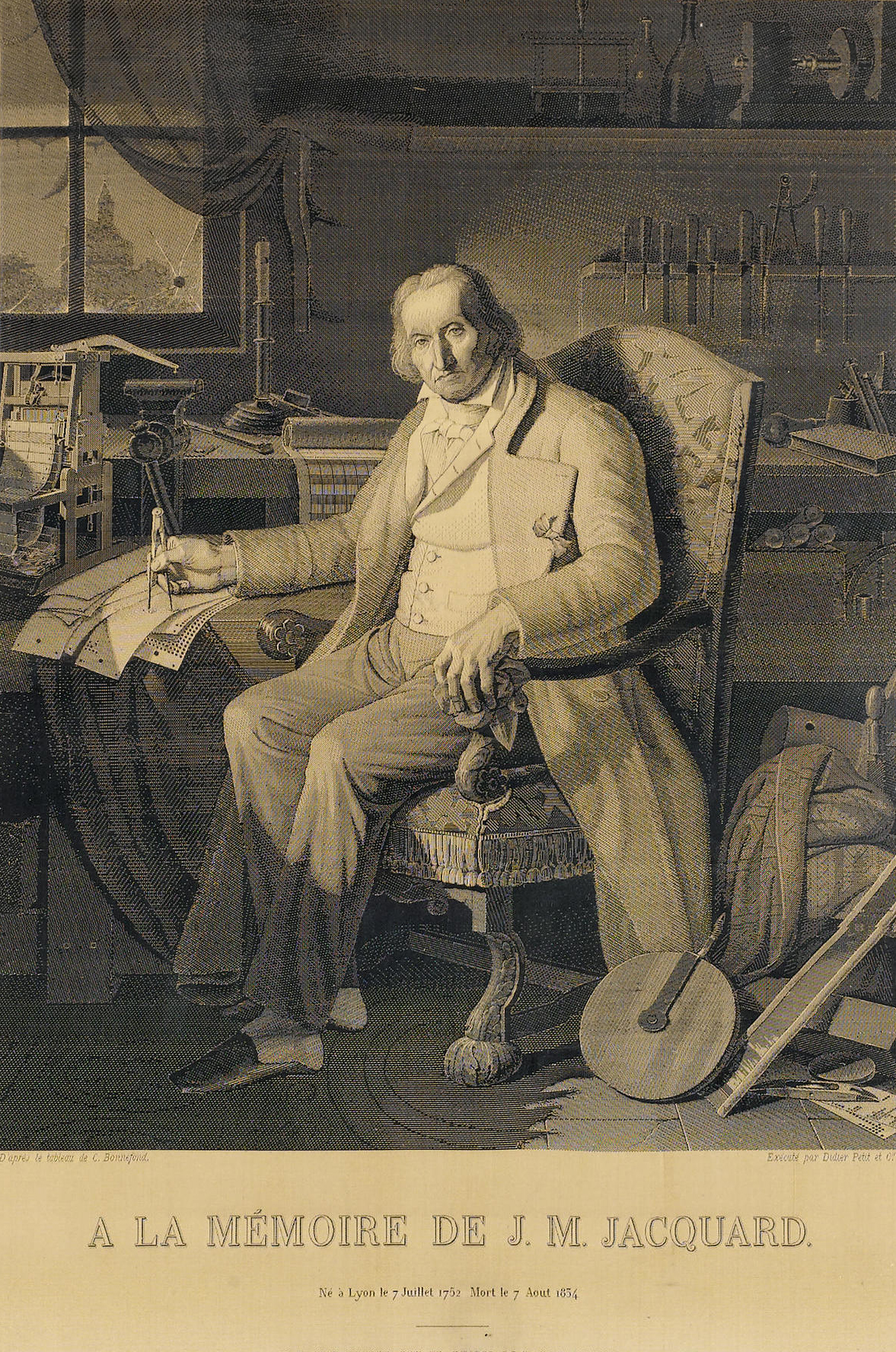
The Jacquard machine (French: [ʒakaʁ]) is a device fitted to a loom that simplifies the process of manufacturing textiles with such complex patterns as brocade, damask and matelassé. The resulting ensemble of the loom and Jacquard machine is then called a Jacquard loom. The machine was patented by Joseph Marie Jacquard in 1804, based on earlier inventions by the Frenchmen Basile Bouchon (1725), Jean Baptiste Falcon (1728), and Jacques Vaucanson (1740). The machine was controlled by a "chain of cards"; a number of punched cards laced together into a continuous sequence. Multiple rows of holes were punched on each card, with one complete card corresponding to one row of the design.
Both the Jacquard process and the necessary loom attachment are named after their inventor. This mechanism is probably one of the most important weaving innovations, as Jacquard shedding made possible the automatic production of unlimited varieties of complex pattern weaving. The term "Jacquard" is not specific or limited to any particular loom, but rather refers to the added control mechanism that automates the patterning. The process can also be used for patterned knitwear and machine-knitted textiles such as jerseys.
This use of replaceable punched cards to control a sequence of operations is considered an important step in the history of computing hardware, having inspired Charles Babbage's Analytical Engine.
Traditionally, figured designs were made on a drawloom. The heddles with warp ends to be pulled up were manually selected by a second operator, the draw boy, not the weaver. The work was slow and labour-intensive, and the complexity of the pattern was limited by practical factors.
The first prototype of a Jacquard-type loom was made in the second half of the 15th century by an Italian weaver from Calabria, Jean le Calabrais, who was invited to Lyon by Louis XI. He introduced a new kind of machine which was able to work the yarns faster and more precisely. Over the years, improvements to the loom were ongoing.
An improvement of the draw loom took place in 1725, when Basile Bouchon introduced the principle of applying a perforated band of paper. A continuous roll of paper was punched by hand, in sections, each of which represented one lash or tread, and the length of the roll was determined by the number of shots in each repeat of pattern. The Jacquard machine then evolved from this approach.
Joseph Marie Jacquard saw that a mechanism could be developed for the production of sophisticated patterns. He possibly combined mechanical elements of other inventors, but certainly innovated. His machine was generally similar to Vaucanson's arrangement, but he made use of Jean-Baptiste Falcon's individual pasteboard cards and his square prism (or card "cylinder"): he is credited with having fully perforated each of its four sides, replacing Vaucanson's perforated "barrel". Jacquard's machine contained eight rows of needles and uprights, where Vaucanson had a double row. This modification enabled him to increase the figuring capacity of the machine. In his first machine, he supported the harness by knotted cords, which he elevated by a single trap board.
One of the chief advantages claimed for the Jacquard machine was that unlike previous damask-weaving machines, in which the figuring shed was usually drawn once for every four shots, with the new apparatus, it could be drawn on every shot, thus producing a fabric with greater definition of outline.
Hub AI
Jacquard machine AI simulator
(@Jacquard machine_simulator)
Jacquard machine
The Jacquard machine (French: [ʒakaʁ]) is a device fitted to a loom that simplifies the process of manufacturing textiles with such complex patterns as brocade, damask and matelassé. The resulting ensemble of the loom and Jacquard machine is then called a Jacquard loom. The machine was patented by Joseph Marie Jacquard in 1804, based on earlier inventions by the Frenchmen Basile Bouchon (1725), Jean Baptiste Falcon (1728), and Jacques Vaucanson (1740). The machine was controlled by a "chain of cards"; a number of punched cards laced together into a continuous sequence. Multiple rows of holes were punched on each card, with one complete card corresponding to one row of the design.
Both the Jacquard process and the necessary loom attachment are named after their inventor. This mechanism is probably one of the most important weaving innovations, as Jacquard shedding made possible the automatic production of unlimited varieties of complex pattern weaving. The term "Jacquard" is not specific or limited to any particular loom, but rather refers to the added control mechanism that automates the patterning. The process can also be used for patterned knitwear and machine-knitted textiles such as jerseys.
This use of replaceable punched cards to control a sequence of operations is considered an important step in the history of computing hardware, having inspired Charles Babbage's Analytical Engine.
Traditionally, figured designs were made on a drawloom. The heddles with warp ends to be pulled up were manually selected by a second operator, the draw boy, not the weaver. The work was slow and labour-intensive, and the complexity of the pattern was limited by practical factors.
The first prototype of a Jacquard-type loom was made in the second half of the 15th century by an Italian weaver from Calabria, Jean le Calabrais, who was invited to Lyon by Louis XI. He introduced a new kind of machine which was able to work the yarns faster and more precisely. Over the years, improvements to the loom were ongoing.
An improvement of the draw loom took place in 1725, when Basile Bouchon introduced the principle of applying a perforated band of paper. A continuous roll of paper was punched by hand, in sections, each of which represented one lash or tread, and the length of the roll was determined by the number of shots in each repeat of pattern. The Jacquard machine then evolved from this approach.
Joseph Marie Jacquard saw that a mechanism could be developed for the production of sophisticated patterns. He possibly combined mechanical elements of other inventors, but certainly innovated. His machine was generally similar to Vaucanson's arrangement, but he made use of Jean-Baptiste Falcon's individual pasteboard cards and his square prism (or card "cylinder"): he is credited with having fully perforated each of its four sides, replacing Vaucanson's perforated "barrel". Jacquard's machine contained eight rows of needles and uprights, where Vaucanson had a double row. This modification enabled him to increase the figuring capacity of the machine. In his first machine, he supported the harness by knotted cords, which he elevated by a single trap board.
One of the chief advantages claimed for the Jacquard machine was that unlike previous damask-weaving machines, in which the figuring shed was usually drawn once for every four shots, with the new apparatus, it could be drawn on every shot, thus producing a fabric with greater definition of outline.
Recent media