
Recent from talks
Jacques Anquetil
Knowledge base stats:
Talk channels stats:
Members stats:
Jacques Anquetil
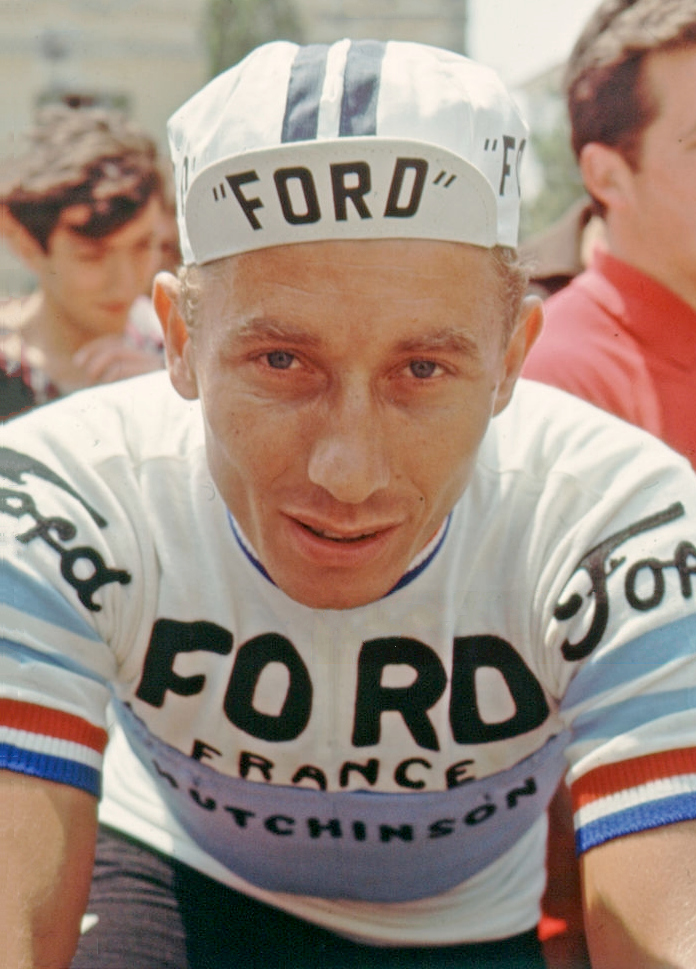
Jacques Anquetil (pronounced [ʒak ɑ̃k.til]; 8 January 1934 – 18 November 1987) was a French road racing cyclist and the first cyclist to win the Tour de France five times, in 1957 and from 1961 to 1964.
He stated before the 1961 Tour that he would gain the yellow jersey on day one and wear it all through the tour, a tall order with two previous winners in the field—Charly Gaul and Federico Bahamontes—but he did it. His victories in stage races such as the Tour were built on an exceptional ability to ride alone against the clock in individual time trial stages, which lent him the name "Monsieur Chrono".
He won eight Grand Tours in his career, which was a record when he retired and was surpassed only by Eddy Merckx and Bernard Hinault.
Anquetil was born on 8 January 1934 in a clinic in Mont-Saint-Aignan, a suburb of Rouen in Normandy situated next to Bois-Guillaume, where his parents had a house at the time. His father Ernest was the grandson of a Prussian soldier called Ernst, who died in the Franco-Prussian War after having an affair with Melanie Grouh, Ernest's grandmother. Melanie later married Frédéric Anquetil, who adopted her son Ernest Victor, Jacques' grandfather, who would later die in World War I, leaving Jacques' father Ernest as the head of the family at the age of 11. On 25 May 1929, Ernest married Jacques' mother Marie, who had been orphaned since the age of 2 and been raised by nuns in an orphanage. Jacques had a younger brother, Philippe.
Anquetil received his first bike from his father at the age of 4. When Jacques was seven, his father Ernest returned from his service in World War II and, unable to find building work except for the German occupying forces, moved with the family to Le Bourguet close to Quincampoix to become a strawberry farmer. It was here that the young Anquetil attended school, receiving good grades, particularly in mathematics. Ernest Anquetil often became violent after excess alcohol consumption, and Jacques' mother eventually moved into an apartment in Paris, leaving her sons with their father. As his second bike grew too small for him, Anquetil needed a new one at the age of 11. With his father being unable to afford it, Jacques argued successfully to allow him to replace one of the workers on the strawberry fields, earning him the necessary money to buy a Stella bicycle on his own. At the age of 14, he began to attend Technical College in Rouen's southern district of Sotteville to become a metalworker. It was here that he met and befriended Maurice Dieulois, who rode amateur bike races on the weekends and whose father had been president of the local cycling club AC Sottevillais. Through him, Anquetil got into bicycle racing, signing up to the club under the tutelage of André Boucher late in the summer of 1950. Since it was too late to participate in any more races that year, he instead focussed on getting into shape for the coming season. Boucher recognized Anquetil's talent and offered him two bikes, one for training and one for races, as well as free supply of tyres, bike maintenance and a performance bonus. At the end of 1950, Anquetil gained his diploma and by the end of January 1951 had taken a job in a workshop in Sotteville, for a meager pay of 64 francs an hour. Since his employer would not allow him Thursday evening off, which the club used for training rides, he quit his position at the beginning of March, moving back to working on his father's farm while pursuing a career in cycling.
Anquetil's first race as an amateur was in Le Havre on 8 April 1951. While Dieulois won, Anquetil finished in the field. He took his first victory in his fourth race, the Grand Prix Maurice Latour on 3 May of the same year. Over the remaining course of the season, he won a total of eight races, including winning the Normandy team time trial championships with his teammates in July. Ending the season was his first ever individual time trial, which was also the last race of the season-long maillot des jeunes competition for local amateur riders. Setting off last as the leader of the competition, four minutes after Dieulois, Anquetil showed reluctance to catch and overtake his friend, but eventually did so, winning both the race and the competition as a whole.
For his second amateur season in 1952, Anquetil moved up from the junior into the senior ranks. The year produced another eleven victories and five more top-three placings. During the regional championship race for Normandy, he was marked the entire race by rival riders from the powerful cycling club from Caen. 120 km (75 mi) from the finish, frustrated by his opponents' tactics, Anquetil was ready to retire, but Boucher urged him on. Anquetil then pretended by untie his toe-straps, falling back in the group, causing his opponents to assume he would retire. He then attacked from the back of the group, left the competition behind, bridged a five-minute gap to the leading group and won. He was also victorious in the Grand Prix de France time trial, winning the event by a significant 12-minute margin. His first ever appearance at a national race came at the qualification event for the Olympic Games, he came third. Shortly after, he won the French amateur championships in Carcassonne, securing a call-up for the French squad at the Helsinki Olympic Games later in the year. On 3 August, he lined up for road race at the 1952 Summer Olympics, but was disappointed to only finish twelfth. He fared better in the team race, taking the bronze medal alongside Alfred Tonello and Claude Rouer. Next, he competed in the amateur road race at the 1952 UCI Road World Championships in Luxembourg, which also featured future stars such as Charly Gaul and Rik van Looy. The course, being run over a flat terrain, did not suit Anquetil, and he finished in the bunch, being ranked in equal eighth place with all finishers in his group.
For his final season as an amateur, Anquetil took a licence as an "independent", a category between amateur and professional, which was abolished in 1966. This allowed him to enter races with young professionals to further test himself. After winning the independent championship of Normandy, his first race against professional competition came in August at the three-stage Tour de la Manche. On the first stage, he finished second, 24 seconds behind future World Champion Jean Stablinski. In the following day's 38.6 km (24.0 mi) time trial, Anquetil won by almost 2 minutes, taking the lead of the race. On the final stage to Cherbourg, the riders on the rival teams tried to dislodge him, going so far as to force him into crashing into a ditch. Anquetil was then helped by another independent rider, Maurice Pelé, who disapproved of the others' tactics and assisted Anquetil in getting back into the group. Anquetil went on to finish safely in the peloton and won the race overall. In the amateur category, Anquetil was leading the season-long maillot des As competition run by the newspaper Paris–Normandy. The last race of the competition was a 122 km (76 mi) time trial on 23 August 1953. Anquetil won the event by a margin of nine minutes over second-placed Claude Le Ber at an average speed of 42.05 km/h (26.13 mph), a speed unheard of from an amateur rider. This led journalist Alex Virot from Radio Luxembourg to joke that "In Normandy there can only be 900 metres in a kilometre!". Following this exploit, Anquetil was invited to race in the Circuit de l'Aulne, the most prestigious criterium race in France, which that year included Tour de France winner Louison Bobet. Anquetil finished in the leading group but during the final sprint was held by the jersey by another, unknown rider, preventing him from victory, which went to Bobet.
Hub AI
Jacques Anquetil AI simulator
(@Jacques Anquetil_simulator)
Jacques Anquetil
Jacques Anquetil (pronounced [ʒak ɑ̃k.til]; 8 January 1934 – 18 November 1987) was a French road racing cyclist and the first cyclist to win the Tour de France five times, in 1957 and from 1961 to 1964.
He stated before the 1961 Tour that he would gain the yellow jersey on day one and wear it all through the tour, a tall order with two previous winners in the field—Charly Gaul and Federico Bahamontes—but he did it. His victories in stage races such as the Tour were built on an exceptional ability to ride alone against the clock in individual time trial stages, which lent him the name "Monsieur Chrono".
He won eight Grand Tours in his career, which was a record when he retired and was surpassed only by Eddy Merckx and Bernard Hinault.
Anquetil was born on 8 January 1934 in a clinic in Mont-Saint-Aignan, a suburb of Rouen in Normandy situated next to Bois-Guillaume, where his parents had a house at the time. His father Ernest was the grandson of a Prussian soldier called Ernst, who died in the Franco-Prussian War after having an affair with Melanie Grouh, Ernest's grandmother. Melanie later married Frédéric Anquetil, who adopted her son Ernest Victor, Jacques' grandfather, who would later die in World War I, leaving Jacques' father Ernest as the head of the family at the age of 11. On 25 May 1929, Ernest married Jacques' mother Marie, who had been orphaned since the age of 2 and been raised by nuns in an orphanage. Jacques had a younger brother, Philippe.
Anquetil received his first bike from his father at the age of 4. When Jacques was seven, his father Ernest returned from his service in World War II and, unable to find building work except for the German occupying forces, moved with the family to Le Bourguet close to Quincampoix to become a strawberry farmer. It was here that the young Anquetil attended school, receiving good grades, particularly in mathematics. Ernest Anquetil often became violent after excess alcohol consumption, and Jacques' mother eventually moved into an apartment in Paris, leaving her sons with their father. As his second bike grew too small for him, Anquetil needed a new one at the age of 11. With his father being unable to afford it, Jacques argued successfully to allow him to replace one of the workers on the strawberry fields, earning him the necessary money to buy a Stella bicycle on his own. At the age of 14, he began to attend Technical College in Rouen's southern district of Sotteville to become a metalworker. It was here that he met and befriended Maurice Dieulois, who rode amateur bike races on the weekends and whose father had been president of the local cycling club AC Sottevillais. Through him, Anquetil got into bicycle racing, signing up to the club under the tutelage of André Boucher late in the summer of 1950. Since it was too late to participate in any more races that year, he instead focussed on getting into shape for the coming season. Boucher recognized Anquetil's talent and offered him two bikes, one for training and one for races, as well as free supply of tyres, bike maintenance and a performance bonus. At the end of 1950, Anquetil gained his diploma and by the end of January 1951 had taken a job in a workshop in Sotteville, for a meager pay of 64 francs an hour. Since his employer would not allow him Thursday evening off, which the club used for training rides, he quit his position at the beginning of March, moving back to working on his father's farm while pursuing a career in cycling.
Anquetil's first race as an amateur was in Le Havre on 8 April 1951. While Dieulois won, Anquetil finished in the field. He took his first victory in his fourth race, the Grand Prix Maurice Latour on 3 May of the same year. Over the remaining course of the season, he won a total of eight races, including winning the Normandy team time trial championships with his teammates in July. Ending the season was his first ever individual time trial, which was also the last race of the season-long maillot des jeunes competition for local amateur riders. Setting off last as the leader of the competition, four minutes after Dieulois, Anquetil showed reluctance to catch and overtake his friend, but eventually did so, winning both the race and the competition as a whole.
For his second amateur season in 1952, Anquetil moved up from the junior into the senior ranks. The year produced another eleven victories and five more top-three placings. During the regional championship race for Normandy, he was marked the entire race by rival riders from the powerful cycling club from Caen. 120 km (75 mi) from the finish, frustrated by his opponents' tactics, Anquetil was ready to retire, but Boucher urged him on. Anquetil then pretended by untie his toe-straps, falling back in the group, causing his opponents to assume he would retire. He then attacked from the back of the group, left the competition behind, bridged a five-minute gap to the leading group and won. He was also victorious in the Grand Prix de France time trial, winning the event by a significant 12-minute margin. His first ever appearance at a national race came at the qualification event for the Olympic Games, he came third. Shortly after, he won the French amateur championships in Carcassonne, securing a call-up for the French squad at the Helsinki Olympic Games later in the year. On 3 August, he lined up for road race at the 1952 Summer Olympics, but was disappointed to only finish twelfth. He fared better in the team race, taking the bronze medal alongside Alfred Tonello and Claude Rouer. Next, he competed in the amateur road race at the 1952 UCI Road World Championships in Luxembourg, which also featured future stars such as Charly Gaul and Rik van Looy. The course, being run over a flat terrain, did not suit Anquetil, and he finished in the bunch, being ranked in equal eighth place with all finishers in his group.
For his final season as an amateur, Anquetil took a licence as an "independent", a category between amateur and professional, which was abolished in 1966. This allowed him to enter races with young professionals to further test himself. After winning the independent championship of Normandy, his first race against professional competition came in August at the three-stage Tour de la Manche. On the first stage, he finished second, 24 seconds behind future World Champion Jean Stablinski. In the following day's 38.6 km (24.0 mi) time trial, Anquetil won by almost 2 minutes, taking the lead of the race. On the final stage to Cherbourg, the riders on the rival teams tried to dislodge him, going so far as to force him into crashing into a ditch. Anquetil was then helped by another independent rider, Maurice Pelé, who disapproved of the others' tactics and assisted Anquetil in getting back into the group. Anquetil went on to finish safely in the peloton and won the race overall. In the amateur category, Anquetil was leading the season-long maillot des As competition run by the newspaper Paris–Normandy. The last race of the competition was a 122 km (76 mi) time trial on 23 August 1953. Anquetil won the event by a margin of nine minutes over second-placed Claude Le Ber at an average speed of 42.05 km/h (26.13 mph), a speed unheard of from an amateur rider. This led journalist Alex Virot from Radio Luxembourg to joke that "In Normandy there can only be 900 metres in a kilometre!". Following this exploit, Anquetil was invited to race in the Circuit de l'Aulne, the most prestigious criterium race in France, which that year included Tour de France winner Louison Bobet. Anquetil finished in the leading group but during the final sprint was held by the jersey by another, unknown rider, preventing him from victory, which went to Bobet.
Recent media