
Recent from talks
Jacques Plante
Knowledge base stats:
Talk channels stats:
Members stats:
Jacques Plante
Joseph Jacques Omer Plante (French pronunciation: [ʒɑk plɑ̃t]; January 17, 1929 – February 27, 1986) was a Canadian professional ice hockey player. During a career as a goaltender lasting from 1947 to 1975, he was considered to be one of the most important innovators in hockey. He played for the Montreal Canadiens from 1953 to 1963; during his tenure, the team won the Stanley Cup six times, including five consecutive wins. In 2017 Plante was named one of the "100 Greatest NHL Players" in history.
Plante retired in 1965 but was persuaded to return to the National Hockey League to play for the expansion St. Louis Blues in 1968. He was later traded to the Toronto Maple Leafs in 1970 and to the Boston Bruins in 1973. He joined the World Hockey Association as a coach and general manager for the Quebec Nordiques in 1973–74. He then played goal for the Edmonton Oilers in 1974–75, ending his professional career with that team.
Plante was the first NHL goaltender to wear a goaltender mask in regulation play on a regular basis. He developed and tested many versions of the mask (including the forerunner of today's mask/helmet combination) with the assistance of other experts. Plante was the first NHL goaltender to regularly play the puck outside his crease in support of his team's defencemen, and he often instructed his teammates from behind the play. Plante was inducted into the Hockey Hall of Fame in 1978, was chosen as the goaltender of the Canadiens' "dream team" in 1985, and was inducted into the Quebec Sports Pantheon in 1994. The Montreal Canadiens retired Plante's jersey, #1, the following year. Plante ranks seventh among NHL goalies for all-time career wins with 437.
Plante was born on a farm near Notre-Dame-du-Mont-Carmel, in Mauricie, Quebec, the first of 11 children born to Palma and Xavier Plante. The family moved to Shawinigan Falls, where his father worked in one of the local factories. In 1932, Plante began to play hockey, skateless and with a tennis ball, using a goaltender's hockey stick his father had carved from a tree root. When he was five years old, Plante fell off a ladder and broke his hand. The fracture failed to heal properly and affected his playing style during his early hockey career; he underwent successful corrective surgery as an adult. Plante suffered from asthma starting in early childhood. This prevented him from skating for extended periods, so he gravitated to playing goaltender. As his playing progressed, Jacques received his first regulation goaltender's stick for Christmas of 1936. His father made Plante's first pads by stuffing potato sacks and reinforcing them with wooden panels. As a child, Plante played hockey outdoors in the bitterly cold Quebec winters. His mother taught him how to knit his own tuques to protect him from the cold. Plante continued knitting and embroidering throughout his life and wore his hand-knitted tuques while playing and practicing until entering the National Hockey League (NHL).
Plante's first foray into organized hockey came at age 12. He was watching his school's team practice when the coach ordered the goaltender off the ice after a heated argument over his play, and Plante asked to replace him. The coach permitted him to play since there was no other available goaltender; it was quickly apparent that Plante could hold his own, despite the other players being many years older than he was. He impressed the coach and stayed on as the team's number-one goaltender.
Two years later, Plante was playing for five different teams — the local factory team, and teams in the midget, juvenile, junior, and intermediate categories. Plante demanded a salary from the factory team's coach after his father told him that the other players were being paid because they were company employees. The coach paid Plante 50 cents per game to retain him and maintain the team's popularity. Afterwards, Plante began to receive various offers from other teams; he was offered $80 per week — a considerable sum in those days — to play for a team in England, and a similar offer to play for the Providence Reds of the American Hockey League. Plante passed them up because his parents wanted him to finish high school. He graduated with top honours in 1947. Upon graduation, he took a job as a clerk in a Shawinigan factory. A few weeks later, the Quebec Citadels offered Plante $85 per week to play for them; he accepted, marking the beginning of his professional career.
In 1949, he married Jacqueline Gagné; they had two sons, Michel and Richard.
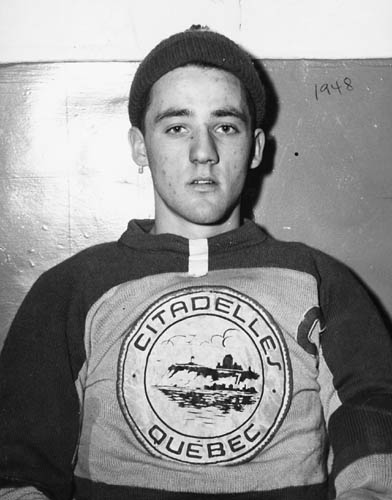
Jacques joined the Quebec Citadelles in 1947. While playing for Quebec, Plante started to play the puck outside his crease, a technique he developed when he recognized that the team's defense was performing poorly. Fans found Plante's unconventional playing style to be exciting, but it angered his managers, who believed that a goaltender should stay in the net and let his players recover the puck. Plante had concluded that as long as he was in control of the puck, the opponents could not shoot it at him – this is now standard practice for goaltenders. The same season, the Citadelles beat the Montreal Junior Canadiens in the league finals, with Plante being named the most valuable player on his team. The Montreal Canadiens' general manager, Frank J. Selke, became interested in acquiring Plante as a member of the team. In 1948, Plante received an invitation to the Canadiens' training camp. On August 17, 1949, Selke offered Plante a contract. Plante played for Montreal's affiliate Royal Montreal Hockey Club, earning $4,500 for the season, and an extra $500 for practicing with the Canadiens.
Hub AI
Jacques Plante AI simulator
(@Jacques Plante_simulator)
Jacques Plante
Joseph Jacques Omer Plante (French pronunciation: [ʒɑk plɑ̃t]; January 17, 1929 – February 27, 1986) was a Canadian professional ice hockey player. During a career as a goaltender lasting from 1947 to 1975, he was considered to be one of the most important innovators in hockey. He played for the Montreal Canadiens from 1953 to 1963; during his tenure, the team won the Stanley Cup six times, including five consecutive wins. In 2017 Plante was named one of the "100 Greatest NHL Players" in history.
Plante retired in 1965 but was persuaded to return to the National Hockey League to play for the expansion St. Louis Blues in 1968. He was later traded to the Toronto Maple Leafs in 1970 and to the Boston Bruins in 1973. He joined the World Hockey Association as a coach and general manager for the Quebec Nordiques in 1973–74. He then played goal for the Edmonton Oilers in 1974–75, ending his professional career with that team.
Plante was the first NHL goaltender to wear a goaltender mask in regulation play on a regular basis. He developed and tested many versions of the mask (including the forerunner of today's mask/helmet combination) with the assistance of other experts. Plante was the first NHL goaltender to regularly play the puck outside his crease in support of his team's defencemen, and he often instructed his teammates from behind the play. Plante was inducted into the Hockey Hall of Fame in 1978, was chosen as the goaltender of the Canadiens' "dream team" in 1985, and was inducted into the Quebec Sports Pantheon in 1994. The Montreal Canadiens retired Plante's jersey, #1, the following year. Plante ranks seventh among NHL goalies for all-time career wins with 437.
Plante was born on a farm near Notre-Dame-du-Mont-Carmel, in Mauricie, Quebec, the first of 11 children born to Palma and Xavier Plante. The family moved to Shawinigan Falls, where his father worked in one of the local factories. In 1932, Plante began to play hockey, skateless and with a tennis ball, using a goaltender's hockey stick his father had carved from a tree root. When he was five years old, Plante fell off a ladder and broke his hand. The fracture failed to heal properly and affected his playing style during his early hockey career; he underwent successful corrective surgery as an adult. Plante suffered from asthma starting in early childhood. This prevented him from skating for extended periods, so he gravitated to playing goaltender. As his playing progressed, Jacques received his first regulation goaltender's stick for Christmas of 1936. His father made Plante's first pads by stuffing potato sacks and reinforcing them with wooden panels. As a child, Plante played hockey outdoors in the bitterly cold Quebec winters. His mother taught him how to knit his own tuques to protect him from the cold. Plante continued knitting and embroidering throughout his life and wore his hand-knitted tuques while playing and practicing until entering the National Hockey League (NHL).
Plante's first foray into organized hockey came at age 12. He was watching his school's team practice when the coach ordered the goaltender off the ice after a heated argument over his play, and Plante asked to replace him. The coach permitted him to play since there was no other available goaltender; it was quickly apparent that Plante could hold his own, despite the other players being many years older than he was. He impressed the coach and stayed on as the team's number-one goaltender.
Two years later, Plante was playing for five different teams — the local factory team, and teams in the midget, juvenile, junior, and intermediate categories. Plante demanded a salary from the factory team's coach after his father told him that the other players were being paid because they were company employees. The coach paid Plante 50 cents per game to retain him and maintain the team's popularity. Afterwards, Plante began to receive various offers from other teams; he was offered $80 per week — a considerable sum in those days — to play for a team in England, and a similar offer to play for the Providence Reds of the American Hockey League. Plante passed them up because his parents wanted him to finish high school. He graduated with top honours in 1947. Upon graduation, he took a job as a clerk in a Shawinigan factory. A few weeks later, the Quebec Citadels offered Plante $85 per week to play for them; he accepted, marking the beginning of his professional career.
In 1949, he married Jacqueline Gagné; they had two sons, Michel and Richard.
Jacques joined the Quebec Citadelles in 1947. While playing for Quebec, Plante started to play the puck outside his crease, a technique he developed when he recognized that the team's defense was performing poorly. Fans found Plante's unconventional playing style to be exciting, but it angered his managers, who believed that a goaltender should stay in the net and let his players recover the puck. Plante had concluded that as long as he was in control of the puck, the opponents could not shoot it at him – this is now standard practice for goaltenders. The same season, the Citadelles beat the Montreal Junior Canadiens in the league finals, with Plante being named the most valuable player on his team. The Montreal Canadiens' general manager, Frank J. Selke, became interested in acquiring Plante as a member of the team. In 1948, Plante received an invitation to the Canadiens' training camp. On August 17, 1949, Selke offered Plante a contract. Plante played for Montreal's affiliate Royal Montreal Hockey Club, earning $4,500 for the season, and an extra $500 for practicing with the Canadiens.
Recent media