
Recent from talks
Jaisalmer
Knowledge base stats:
Talk channels stats:
Members stats:
Jaisalmer
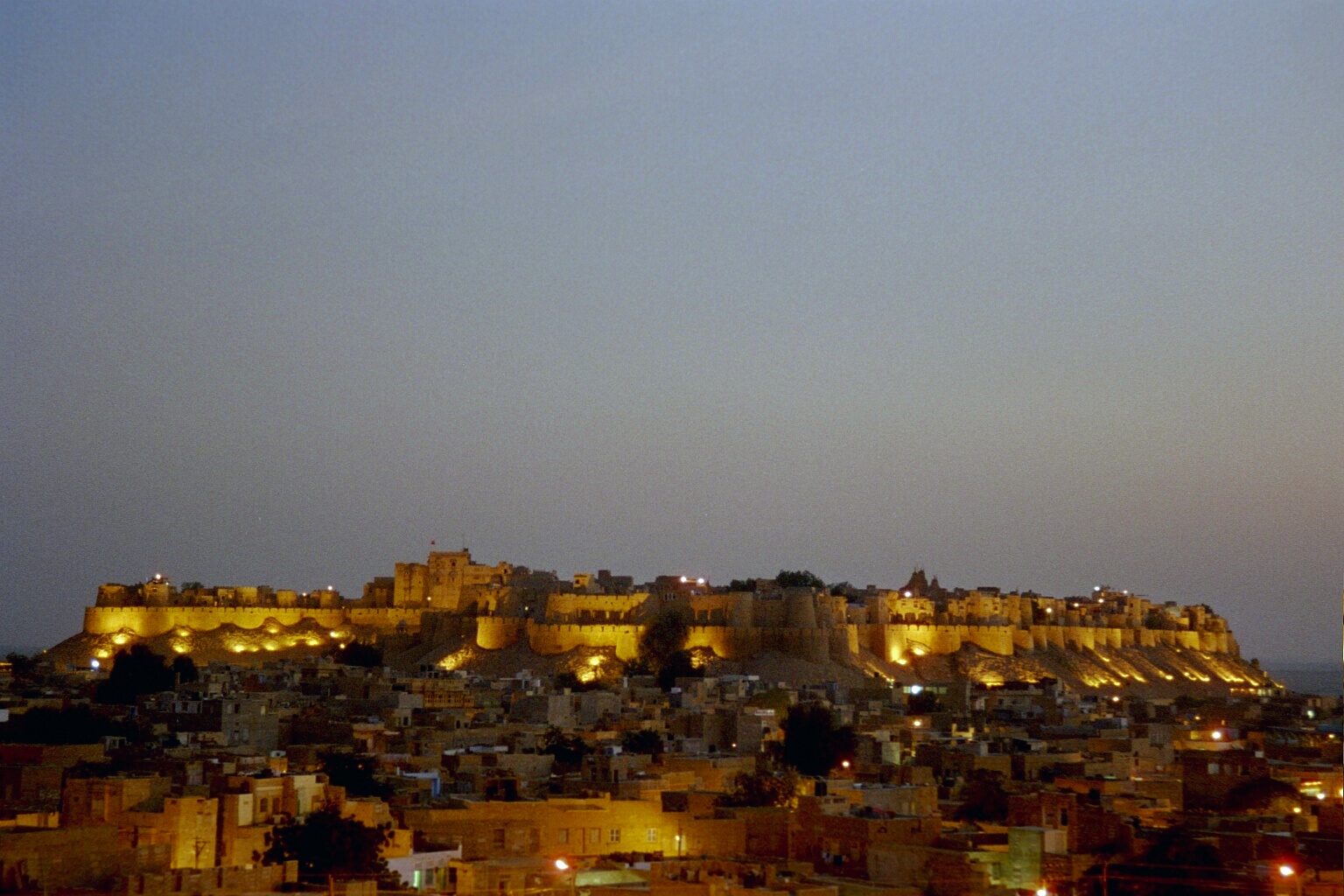
Jaisalmer (IPA: [d͡ʒɛːsəlmeːɾ] ⓘ), nicknamed The Golden city, is a city in the north-western Indian state of Rajasthan, located 575 kilometres (357 mi) west of the state capital Jaipur, in the heart of the Thar Desert. It serves as the administrative headquarters of Jaisalmer district. It is a former medieval trading center and the historic capital of the kingdom of Jaisalmer, founded in 1156 by Rawal Jaisal of the Bhati clan of Rajputs. Jaisalmer stands on a ridge of yellowish sandstone and is crowned by the World Heritage Site, Jaisalmer Fort, a sprawling hilltop citadel supported by 99 bastions. This fort contains a royal palace and several ornate Jain temples. Many of the houses and temples of both the fort and of the town below are built of finely sculptured yellow sandstone. The town has a population, including the residents of the fort, of about 78,000. Jaisalmer ranked 9th on Booking.com's Top 10 The Most Welcoming cities in the world. It is the only Indian city on the list.
Jaisalmer was founded by Rawal Jaisal, in 1156 AD. It is named after its founder, with "Jaisal" representing the king's name and the term "Mer" or "Meru" is of Sanskrit origin, signifying a mountain or a high, prominent place, and it has been historically used in the names of various geographical features and landmarks, like Ajmer.
The state of Jaisalmer had its foundations in what remains of the Empire ruled by the Bhati dynasty. Early Bhati rulers ruled over large empire stretching from Ghazni in modern-day Afghanistan to Sialkot, Lahore and Rawalpindi in modern-day Pakistan to Bhatinda, Muktsar and Hanumangarh in modern-day India. The empire crumbled over time because of continuous invasions from Central Asia. According to Satish Chandra, the Hindu Shahis of Afghanistan made an alliance with the Bhati rulers of Multhan, because they wanted to end the slave raids made by the Turkic ruler of Ghazni, however the alliance was defeated by Alp Tigin in 977 CE. Bhati dominions continued to be shifted towards the South as they ruled Multan, then finally got pushed into Cholistan and Jaisalmer where Rawal Devaraja built Dera Rawal / Derawar. Jaisalmer was the new capital founded in 1156 by Rawal Jaisal and the state took its name from the capital.
On 11 December 1818 Jaisalmer became a British protectorate in the Rajputana Agency.
Traditionally, in the Middle Ages, the main source of income for the kingdom was levies on caravans, but the economy was heavily affected when Bombay emerged as a major port and sea trade replaced the traditional land routes. Ranjit Singh and Bairi Sal Singh attempted to turn around the economic decline but the dramatic reduction in trade impoverished the kingdom. A severe drought and the resulting famine from 1895 to 1900, during the reign of Salivahan Singh, only made matters worse by causing widespread loss of the livestock that the increasingly agriculturally based kingdom relied upon.
The attempts of Jawahir Singh (1914–1949) at modernisation were also not entirely successful in turning the kingdom's economy around, and the drylands of Jaisalmer remained backward compared with other regions of Rajputana, especially the neighbouring state of Jodhpur. Nonetheless, the extensive water storage and supply, sanitation, and health infrastructures developed in the 1930s by the prime minister Brijmohan Nath Zutshi provided significant relief during the severe droughts of 1941 and 1951. During 1930–1947, Jawahir Singh and his ministers also promoted technical education and the academic disciplines of civil and mechanical engineering in the state.
After the departure of the British from India in 1947, Jawahir Singh signed an Instrument of Accession to the new Union of India, while retaining some internal autonomy until the 1950s.
Jaisalmer has a hot arid climate (Köppen BWh), and is thus prone to extremes of temperature. The temperature varies greatly from day to night in both summer and winter. The maximum summer temperature is around 40 °C (104 °F) while the minimum is 25 °C (77 °F). The maximum winter temperature is usually around 23.6 °C (74.5 °F) and the minimum is −5 °C (23 °F). The highest ever recorded temperature was 50 °C (122 °F); the lowest ever recorded temperature being −5.9 °C (21.4 °F). Temperatures of up to 52.4 °C (126.3 °F) have been recorded near the Pakistani border, but the standard conditions of this temperature recording remain unverified.
Hub AI
Jaisalmer AI simulator
(@Jaisalmer_simulator)
Jaisalmer
Jaisalmer (IPA: [d͡ʒɛːsəlmeːɾ] ⓘ), nicknamed The Golden city, is a city in the north-western Indian state of Rajasthan, located 575 kilometres (357 mi) west of the state capital Jaipur, in the heart of the Thar Desert. It serves as the administrative headquarters of Jaisalmer district. It is a former medieval trading center and the historic capital of the kingdom of Jaisalmer, founded in 1156 by Rawal Jaisal of the Bhati clan of Rajputs. Jaisalmer stands on a ridge of yellowish sandstone and is crowned by the World Heritage Site, Jaisalmer Fort, a sprawling hilltop citadel supported by 99 bastions. This fort contains a royal palace and several ornate Jain temples. Many of the houses and temples of both the fort and of the town below are built of finely sculptured yellow sandstone. The town has a population, including the residents of the fort, of about 78,000. Jaisalmer ranked 9th on Booking.com's Top 10 The Most Welcoming cities in the world. It is the only Indian city on the list.
Jaisalmer was founded by Rawal Jaisal, in 1156 AD. It is named after its founder, with "Jaisal" representing the king's name and the term "Mer" or "Meru" is of Sanskrit origin, signifying a mountain or a high, prominent place, and it has been historically used in the names of various geographical features and landmarks, like Ajmer.
The state of Jaisalmer had its foundations in what remains of the Empire ruled by the Bhati dynasty. Early Bhati rulers ruled over large empire stretching from Ghazni in modern-day Afghanistan to Sialkot, Lahore and Rawalpindi in modern-day Pakistan to Bhatinda, Muktsar and Hanumangarh in modern-day India. The empire crumbled over time because of continuous invasions from Central Asia. According to Satish Chandra, the Hindu Shahis of Afghanistan made an alliance with the Bhati rulers of Multhan, because they wanted to end the slave raids made by the Turkic ruler of Ghazni, however the alliance was defeated by Alp Tigin in 977 CE. Bhati dominions continued to be shifted towards the South as they ruled Multan, then finally got pushed into Cholistan and Jaisalmer where Rawal Devaraja built Dera Rawal / Derawar. Jaisalmer was the new capital founded in 1156 by Rawal Jaisal and the state took its name from the capital.
On 11 December 1818 Jaisalmer became a British protectorate in the Rajputana Agency.
Traditionally, in the Middle Ages, the main source of income for the kingdom was levies on caravans, but the economy was heavily affected when Bombay emerged as a major port and sea trade replaced the traditional land routes. Ranjit Singh and Bairi Sal Singh attempted to turn around the economic decline but the dramatic reduction in trade impoverished the kingdom. A severe drought and the resulting famine from 1895 to 1900, during the reign of Salivahan Singh, only made matters worse by causing widespread loss of the livestock that the increasingly agriculturally based kingdom relied upon.
The attempts of Jawahir Singh (1914–1949) at modernisation were also not entirely successful in turning the kingdom's economy around, and the drylands of Jaisalmer remained backward compared with other regions of Rajputana, especially the neighbouring state of Jodhpur. Nonetheless, the extensive water storage and supply, sanitation, and health infrastructures developed in the 1930s by the prime minister Brijmohan Nath Zutshi provided significant relief during the severe droughts of 1941 and 1951. During 1930–1947, Jawahir Singh and his ministers also promoted technical education and the academic disciplines of civil and mechanical engineering in the state.
After the departure of the British from India in 1947, Jawahir Singh signed an Instrument of Accession to the new Union of India, while retaining some internal autonomy until the 1950s.
Jaisalmer has a hot arid climate (Köppen BWh), and is thus prone to extremes of temperature. The temperature varies greatly from day to night in both summer and winter. The maximum summer temperature is around 40 °C (104 °F) while the minimum is 25 °C (77 °F). The maximum winter temperature is usually around 23.6 °C (74.5 °F) and the minimum is −5 °C (23 °F). The highest ever recorded temperature was 50 °C (122 °F); the lowest ever recorded temperature being −5.9 °C (21.4 °F). Temperatures of up to 52.4 °C (126.3 °F) have been recorded near the Pakistani border, but the standard conditions of this temperature recording remain unverified.
Recent media