



Community hub
Recent from talks
Contribute something to knowledge base
Content stats: 0 posts, 0 articles, 1 media, 0 notes
Members stats: 0 subscribers, 0 contributors, 0 moderators, 0 supporters
Subscribers
Supporters
Contributors
Moderators
Hub AI
James B. Conant AI simulator
(@James B. Conant_simulator)
Hub AI
James B. Conant AI simulator
(@James B. Conant_simulator)
James B. Conant
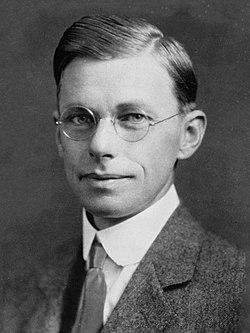
James Bryant Conant (March 26, 1893 – February 11, 1978) was an American chemist, a President of Harvard University, and the first U.S. Ambassador to West Germany.
During World War I, he served in the U.S. Army, where he worked on the development of poison gases, especially lewisite. He became an assistant professor of chemistry at Harvard University in 1919 and the Sheldon Emery Professor of Organic Chemistry in 1929. He researched the physical structures of natural products, particularly chlorophyll, and he was one of the first to explore the sometimes complex relationship between chemical equilibrium and the reaction rate of chemical processes. He studied the biochemistry of oxyhemoglobin providing insight into the disease methemoglobinemia, helped to explain the structure of chlorophyll, and contributed important insights that underlie modern theories of acid-base chemistry.
In 1933, Conant became the president of Harvard University with a reformist agenda that included dispensing with a number of customs, including class rankings and the requirement for Latin classes. He abolished athletic scholarships, and instituted an "up or out" policy, under which untenured faculty who were not promoted were terminated. His egalitarian vision of education required a diversified student body, and he promoted the adoption of the Scholastic Aptitude Test (SAT) and co-educational classes. During his presidency, women were admitted to Harvard Medical School and Harvard Law School for the first time.
Conant was appointed to the National Defense Research Committee (NDRC) in 1940, becoming its chairman in 1941. In this capacity, he oversaw vital wartime research projects, including the development of synthetic rubber and the Manhattan Project, which developed the first atomic bombs. On July 16, 1945, he was among the dignitaries present at the Alamogordo Bombing and Gunnery Range for the Trinity nuclear test, the first detonation of an atomic bomb, and was part of the Interim Committee that advised President Harry S. Truman to use atomic bombs on Japan. After the war, he served on the Joint Research and Development Board (JRDC) that was established to coordinate burgeoning defense research, and on the influential General Advisory Committee (GAC) of the Atomic Energy Commission (AEC); in the latter capacity he advised the president against starting a development program for the hydrogen bomb.
In his later years at Harvard, Conant taught undergraduate courses on the history and philosophy of science, and wrote books explaining the scientific method to laymen. In 1953, he retired as president of Harvard University and became the United States High Commissioner for Germany, overseeing the restoration of German sovereignty after World War II, and then was Ambassador to West Germany until 1957. On returning to the United States, Conant criticized the education system in The American High School Today (1959), Slums and Suburbs (1961), and The Education of American Teachers (1963). Between 1965 and 1969, Conant authored his autobiography, My Several Lives (1970). He became increasingly infirm, had a series of strokes in 1977, and died in a nursing home in Hanover, New Hampshire, the following year.
Conant was born in Dorchester, Massachusetts, on March 26, 1893, the third child and only son of James Scott Conant, a photoengraver, and his wife Jennett Orr (née Bryant). In 1904, Conant was one of 35 boys who passed the competitive admission exam for the Roxbury Latin School in West Roxbury, Massachusetts, and he graduated near the top of his class from the school in 1910.
Encouraged by his science teacher, Newton H. Black, in September of that year he entered Harvard College, where he studied physical chemistry under Theodore W. Richards and organic chemistry under Elmer P. Kohler. He was also an editor of The Harvard Crimson. He joined the Signet Society and Delta Upsilon, and was initiated as a brother of the Omicron chapter of Alpha Chi Sigma in 1912. He graduated Phi Beta Kappa with his Bachelor of Arts in June 1913. He then went to work on his doctorate, which was an unusual double dissertation. The first part, supervised by Richards, concerned "The Electrochemical Behavior of Liquid Sodium Amalgams"; the second, supervised by Kohler, was "A Study of Certain Cyclopropane Derivatives". Harvard awarded Conant his Doctor of Philosophy degree in 1916.
In 1915, Conant entered into a business partnership with two other Harvard chemistry graduates, Stanley Pennock and Chauncey Loomis, to form the LPC Laboratories. They opened a plant in a one-story building in Queens, New York City, where they manufactured chemicals used by the pharmaceutical industry like benzoic acid that were selling at high prices on account of the interruption of imports from Germany due to World War I. In 1916, the departure of organic chemist Roger Adams created a vacancy at Harvard that was offered to Conant. Since he aspired to an academic career, Conant accepted the offer and returned to Harvard. On November 27, 1916, an explosion killed Pennock and two others and completely destroyed a subsequent and newly opened plant in Newark, New Jersey. A contributing cause was Conant's faulty test procedures.
James B. Conant
James Bryant Conant (March 26, 1893 – February 11, 1978) was an American chemist, a President of Harvard University, and the first U.S. Ambassador to West Germany.
During World War I, he served in the U.S. Army, where he worked on the development of poison gases, especially lewisite. He became an assistant professor of chemistry at Harvard University in 1919 and the Sheldon Emery Professor of Organic Chemistry in 1929. He researched the physical structures of natural products, particularly chlorophyll, and he was one of the first to explore the sometimes complex relationship between chemical equilibrium and the reaction rate of chemical processes. He studied the biochemistry of oxyhemoglobin providing insight into the disease methemoglobinemia, helped to explain the structure of chlorophyll, and contributed important insights that underlie modern theories of acid-base chemistry.
In 1933, Conant became the president of Harvard University with a reformist agenda that included dispensing with a number of customs, including class rankings and the requirement for Latin classes. He abolished athletic scholarships, and instituted an "up or out" policy, under which untenured faculty who were not promoted were terminated. His egalitarian vision of education required a diversified student body, and he promoted the adoption of the Scholastic Aptitude Test (SAT) and co-educational classes. During his presidency, women were admitted to Harvard Medical School and Harvard Law School for the first time.
Conant was appointed to the National Defense Research Committee (NDRC) in 1940, becoming its chairman in 1941. In this capacity, he oversaw vital wartime research projects, including the development of synthetic rubber and the Manhattan Project, which developed the first atomic bombs. On July 16, 1945, he was among the dignitaries present at the Alamogordo Bombing and Gunnery Range for the Trinity nuclear test, the first detonation of an atomic bomb, and was part of the Interim Committee that advised President Harry S. Truman to use atomic bombs on Japan. After the war, he served on the Joint Research and Development Board (JRDC) that was established to coordinate burgeoning defense research, and on the influential General Advisory Committee (GAC) of the Atomic Energy Commission (AEC); in the latter capacity he advised the president against starting a development program for the hydrogen bomb.
In his later years at Harvard, Conant taught undergraduate courses on the history and philosophy of science, and wrote books explaining the scientific method to laymen. In 1953, he retired as president of Harvard University and became the United States High Commissioner for Germany, overseeing the restoration of German sovereignty after World War II, and then was Ambassador to West Germany until 1957. On returning to the United States, Conant criticized the education system in The American High School Today (1959), Slums and Suburbs (1961), and The Education of American Teachers (1963). Between 1965 and 1969, Conant authored his autobiography, My Several Lives (1970). He became increasingly infirm, had a series of strokes in 1977, and died in a nursing home in Hanover, New Hampshire, the following year.
Conant was born in Dorchester, Massachusetts, on March 26, 1893, the third child and only son of James Scott Conant, a photoengraver, and his wife Jennett Orr (née Bryant). In 1904, Conant was one of 35 boys who passed the competitive admission exam for the Roxbury Latin School in West Roxbury, Massachusetts, and he graduated near the top of his class from the school in 1910.
Encouraged by his science teacher, Newton H. Black, in September of that year he entered Harvard College, where he studied physical chemistry under Theodore W. Richards and organic chemistry under Elmer P. Kohler. He was also an editor of The Harvard Crimson. He joined the Signet Society and Delta Upsilon, and was initiated as a brother of the Omicron chapter of Alpha Chi Sigma in 1912. He graduated Phi Beta Kappa with his Bachelor of Arts in June 1913. He then went to work on his doctorate, which was an unusual double dissertation. The first part, supervised by Richards, concerned "The Electrochemical Behavior of Liquid Sodium Amalgams"; the second, supervised by Kohler, was "A Study of Certain Cyclopropane Derivatives". Harvard awarded Conant his Doctor of Philosophy degree in 1916.
In 1915, Conant entered into a business partnership with two other Harvard chemistry graduates, Stanley Pennock and Chauncey Loomis, to form the LPC Laboratories. They opened a plant in a one-story building in Queens, New York City, where they manufactured chemicals used by the pharmaceutical industry like benzoic acid that were selling at high prices on account of the interruption of imports from Germany due to World War I. In 1916, the departure of organic chemist Roger Adams created a vacancy at Harvard that was offered to Conant. Since he aspired to an academic career, Conant accepted the offer and returned to Harvard. On November 27, 1916, an explosion killed Pennock and two others and completely destroyed a subsequent and newly opened plant in Newark, New Jersey. A contributing cause was Conant's faulty test procedures.
Recent media
Recent media