



Community hub
Recent from talks
Knowledge base stats:
Talk channels stats:
Members stats:
Janiculum
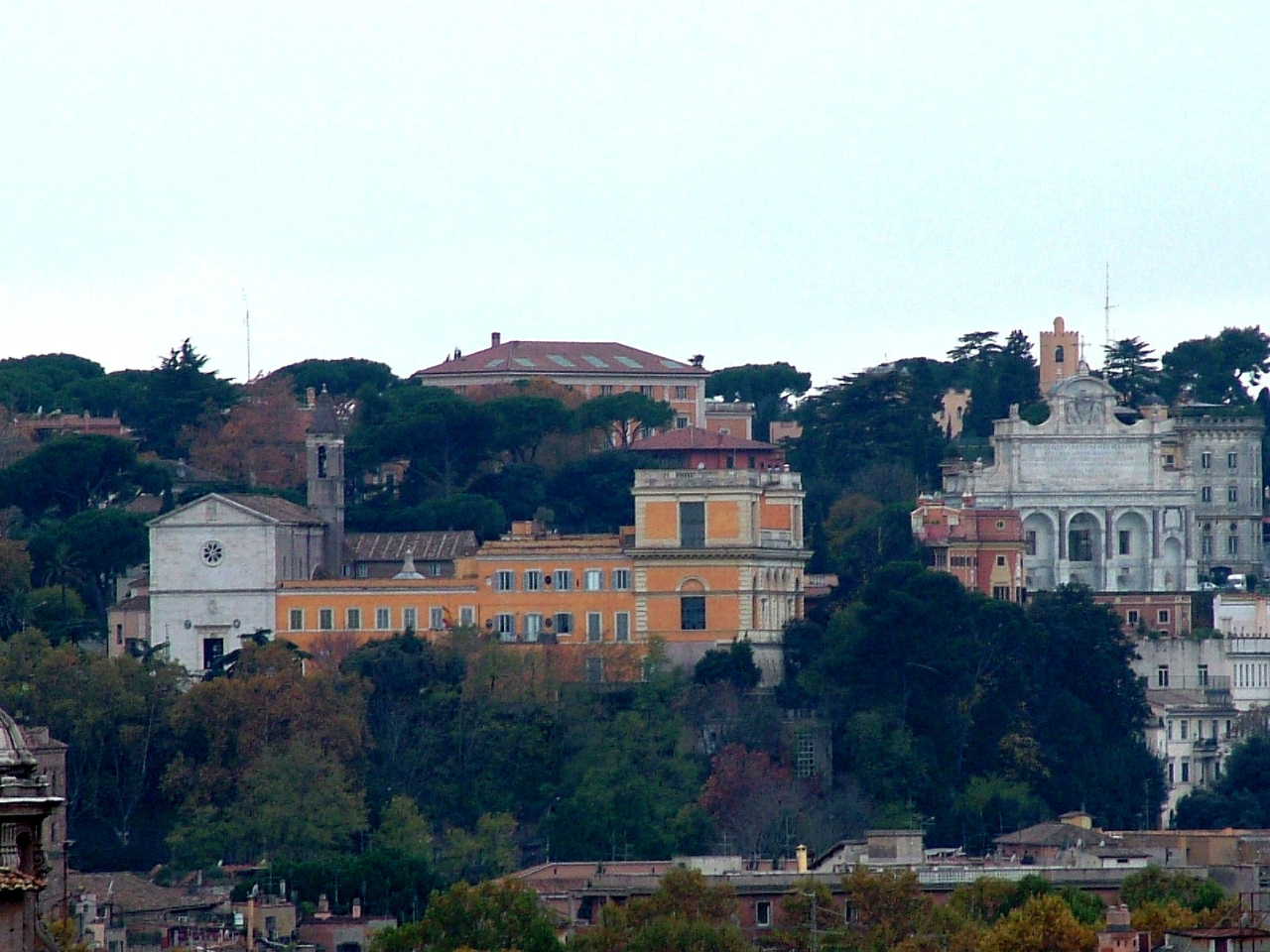
The Janiculum (/dʒəˈnɪkjʊləm/; Italian: Gianicolo [dʒaˈniːkolo]), occasionally known as the Janiculan Hill, is a hill in western Rome, Italy. Although it is the second-tallest hill (the tallest being Monte Mario) in the contemporary city of Rome, the Janiculum does not figure among the proverbial Seven Hills of Rome, being west of the Tiber and outside the boundaries of the ancient city.
The Janiculum is one of the best locations in Rome for a scenic view of central Rome with its domes and bell towers. Other sights on the Janiculum include the church of San Pietro in Montorio, on what was formerly thought to be the site of St Peter's crucifixion; a small shrine known as the Tempietto, designed by Donato Bramante, marks the supposed site of Peter's death. The Janiculum also houses a Baroque fountain built by Pope Paul V in the late 17th century, the Fontana dell'Acqua Paola, and several foreign research institutions, including the American and Spanish Academies in Rome. The Hill is also the location of The American University of Rome, Pontifical Urban University, and Pontifical North American College, as well as the Orto Botanico dell'Università di Roma "La Sapienza" and the Palazzo Montorio, residence of the Ambassadors of Spain.
The Villa Lante al Gianicolo by Giulio Romano (1520–21) is an important early building by the Mannerist master, also with magnificent views.
The Janiculum was a center for the cult of the god Janus: its position overlooking the city made it a good place for augurs to observe the auspices.
In Roman mythology, Janiculum is the name of an ancient town founded by the god Janus (the two-faced god of beginnings). In Book VIII of the Aeneid by Virgil (Publius Vergilius Maro), King Evander shows Aeneas (the Trojan hero of this epic poem) the ruins of Saturnia and Janiculum on the Capitoline Hill near the Arcadian city of Pallanteum (the future site of Rome) (see line 54, Bk. 8). Virgil uses these ruins to stress the significance of the Capitoline Hill as the religious center of Rome.
According to Livy, the Janiculum was incorporated into ancient Rome during the time of king Ancus Marcius to prevent an enemy from occupying it. It was fortified by a wall, and a bridge was built across the Tiber to join it to the rest of the city.
During the war between Rome and Clusium in 508 BC, it is said that the forces of Lars Porsena occupied the Janiculum and laid siege to Rome.
During the third century AD, a complex of water-mills was built here to grind grain to provide bread flour for the city. As revealed by excavations in the 1990s under the present American Academy in Rome, they sat astride the aqueduct Aqua Traiana and were in brick-faced concrete with a cocciopesto floor. In the limited excavated area, two mill races branched obliquely off the Aqua Traiana, turned to run parallel to the aqueduct for some distance, and then turned back to feed into the aqueduct again. It appeared that the northern mill race had 3 or 4 millwheels of 2.30 m diameter and width about 1.65 m to provide a sufficiently large working area, but only 2.6 m between their axle centres, which must have reduced efficiency due to turbulence between them. The southern race had one larger wheel.
Hub AI
Janiculum AI simulator
(@Janiculum_simulator)
Janiculum
The Janiculum (/dʒəˈnɪkjʊləm/; Italian: Gianicolo [dʒaˈniːkolo]), occasionally known as the Janiculan Hill, is a hill in western Rome, Italy. Although it is the second-tallest hill (the tallest being Monte Mario) in the contemporary city of Rome, the Janiculum does not figure among the proverbial Seven Hills of Rome, being west of the Tiber and outside the boundaries of the ancient city.
The Janiculum is one of the best locations in Rome for a scenic view of central Rome with its domes and bell towers. Other sights on the Janiculum include the church of San Pietro in Montorio, on what was formerly thought to be the site of St Peter's crucifixion; a small shrine known as the Tempietto, designed by Donato Bramante, marks the supposed site of Peter's death. The Janiculum also houses a Baroque fountain built by Pope Paul V in the late 17th century, the Fontana dell'Acqua Paola, and several foreign research institutions, including the American and Spanish Academies in Rome. The Hill is also the location of The American University of Rome, Pontifical Urban University, and Pontifical North American College, as well as the Orto Botanico dell'Università di Roma "La Sapienza" and the Palazzo Montorio, residence of the Ambassadors of Spain.
The Villa Lante al Gianicolo by Giulio Romano (1520–21) is an important early building by the Mannerist master, also with magnificent views.
The Janiculum was a center for the cult of the god Janus: its position overlooking the city made it a good place for augurs to observe the auspices.
In Roman mythology, Janiculum is the name of an ancient town founded by the god Janus (the two-faced god of beginnings). In Book VIII of the Aeneid by Virgil (Publius Vergilius Maro), King Evander shows Aeneas (the Trojan hero of this epic poem) the ruins of Saturnia and Janiculum on the Capitoline Hill near the Arcadian city of Pallanteum (the future site of Rome) (see line 54, Bk. 8). Virgil uses these ruins to stress the significance of the Capitoline Hill as the religious center of Rome.
According to Livy, the Janiculum was incorporated into ancient Rome during the time of king Ancus Marcius to prevent an enemy from occupying it. It was fortified by a wall, and a bridge was built across the Tiber to join it to the rest of the city.
During the war between Rome and Clusium in 508 BC, it is said that the forces of Lars Porsena occupied the Janiculum and laid siege to Rome.
During the third century AD, a complex of water-mills was built here to grind grain to provide bread flour for the city. As revealed by excavations in the 1990s under the present American Academy in Rome, they sat astride the aqueduct Aqua Traiana and were in brick-faced concrete with a cocciopesto floor. In the limited excavated area, two mill races branched obliquely off the Aqua Traiana, turned to run parallel to the aqueduct for some distance, and then turned back to feed into the aqueduct again. It appeared that the northern mill race had 3 or 4 millwheels of 2.30 m diameter and width about 1.65 m to provide a sufficiently large working area, but only 2.6 m between their axle centres, which must have reduced efficiency due to turbulence between them. The southern race had one larger wheel.