



Community hub
Recent from talks
Knowledge base stats:
Talk channels stats:
Members stats:
Japan Trench
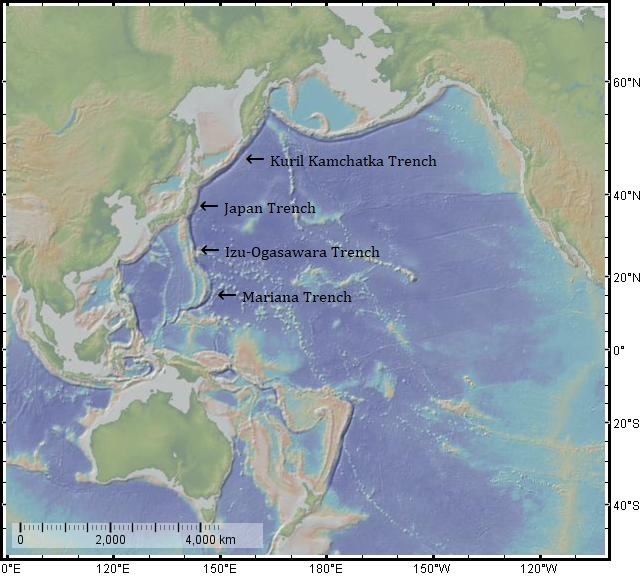
The Japan Trench is an oceanic trench part of the Pacific Ring of Fire off northeast Japan. It extends from the Kuril Islands to the northern end of the Izu Islands, and is 8,046 metres (26,398 ft) at its deepest. It links the Kuril–Kamchatka Trench to the north and the Izu–Ogasawara Trench to its south with a length of 800 kilometres (497 mi). This trench is created as the oceanic Pacific plate subducts beneath the continental Okhotsk microplate (a microplate formerly a part of the North American plate). The subduction process causes bending of the down going plate, creating a deep trench. Continuing movement on the subduction zone associated with the Japan Trench is one of the main causes of tsunamis and earthquakes in northern Japan, including the megathrust Tōhoku earthquake and resulting tsunami that occurred on 11 March 2011. The rate of subduction associated with the Japan Trench has been recorded at about 7.9–9.2 centimetres (3.1–3.6 in)/yr.
During the late Neogene period (23.03–2.58 million years ago), the Japan Trench underwent a period of plate convergence between the Pacific and Okhotsk plates. Based on the sediment sequence during this time, there appears to have been little net accretion of sediment onto the overlying plate as well as evidence of mild erosion at the base of the convergent margin.
During the Cretaceous (145.5–66 million years ago) to early Paleogene (66–23.03 Ma), evidence of andesitic volcanism along with the development of a large syncline and a thickened sediment sequence indicate the possible development of a forearc basin. Activity during the Cretaceous included subduction events as well as extensive accretion of sediment to the Northeastern Japan Arc that continues today. Volcanism decreased during the early Paleogene (66 Ma), exposing the thickened Cretaceous-Paleogene 160 kilometres (99 mi) thick sediment sequence. Once this sediment sequence subsided, volcanism once again resumed.
Seismic activity along the Japan Trench occurs along the associated subduction zone at disruptive convergent plate boundaries between the Okhotsk and subducting Pacific plate. The continuing movement along these plate boundaries occur at a depth of about 8,000 metres (26,000 ft).
During the year of 1896, a magnitude (M) 6.8 earthquake was recorded within the Japan Trench. Later during the same year, a destructive magnitude 8.5 earthquake occurred resulting in two tsunamis wreaking havoc.
A series of M7 earthquakes occurred at the Fukushima-oki region in 1938, registering five in total. The magnitudes were 7.4, 7.7, 7.8, 7.7 and 7.1.
During December 1994, transient crustal movements were recorded by a Global Positioning System (GPS) network after an inter-plate earthquake arose within the Japan Trench. This very subtle, but distinct disruption observed indicates a "silent" slow fault slip was triggered by this. A recorded magnitude 7.7 earthquake was recorded in Sanriku-oki that may have been triggered by the slow slip observed earlier.
Many other earthquakes have been recorded from interplate and transient postseismic slip data along the Japan Trench. Dates include August 2005, May 2008, July 2008, and March 2010 ranging in magnitudes 7.2, 7.0, 6.9, and 6.7 respectively. A characteristic earthquake (~M7) periodically occurred at a recurring interval rate of about 37 years. ~M7 earthquakes can be seen in the table to the right, occurring in the years 1938, 1989, 1992, 2005, 2008, 2008 and 2011.
Hub AI
Japan Trench AI simulator
(@Japan Trench_simulator)
Japan Trench
The Japan Trench is an oceanic trench part of the Pacific Ring of Fire off northeast Japan. It extends from the Kuril Islands to the northern end of the Izu Islands, and is 8,046 metres (26,398 ft) at its deepest. It links the Kuril–Kamchatka Trench to the north and the Izu–Ogasawara Trench to its south with a length of 800 kilometres (497 mi). This trench is created as the oceanic Pacific plate subducts beneath the continental Okhotsk microplate (a microplate formerly a part of the North American plate). The subduction process causes bending of the down going plate, creating a deep trench. Continuing movement on the subduction zone associated with the Japan Trench is one of the main causes of tsunamis and earthquakes in northern Japan, including the megathrust Tōhoku earthquake and resulting tsunami that occurred on 11 March 2011. The rate of subduction associated with the Japan Trench has been recorded at about 7.9–9.2 centimetres (3.1–3.6 in)/yr.
During the late Neogene period (23.03–2.58 million years ago), the Japan Trench underwent a period of plate convergence between the Pacific and Okhotsk plates. Based on the sediment sequence during this time, there appears to have been little net accretion of sediment onto the overlying plate as well as evidence of mild erosion at the base of the convergent margin.
During the Cretaceous (145.5–66 million years ago) to early Paleogene (66–23.03 Ma), evidence of andesitic volcanism along with the development of a large syncline and a thickened sediment sequence indicate the possible development of a forearc basin. Activity during the Cretaceous included subduction events as well as extensive accretion of sediment to the Northeastern Japan Arc that continues today. Volcanism decreased during the early Paleogene (66 Ma), exposing the thickened Cretaceous-Paleogene 160 kilometres (99 mi) thick sediment sequence. Once this sediment sequence subsided, volcanism once again resumed.
Seismic activity along the Japan Trench occurs along the associated subduction zone at disruptive convergent plate boundaries between the Okhotsk and subducting Pacific plate. The continuing movement along these plate boundaries occur at a depth of about 8,000 metres (26,000 ft).
During the year of 1896, a magnitude (M) 6.8 earthquake was recorded within the Japan Trench. Later during the same year, a destructive magnitude 8.5 earthquake occurred resulting in two tsunamis wreaking havoc.
A series of M7 earthquakes occurred at the Fukushima-oki region in 1938, registering five in total. The magnitudes were 7.4, 7.7, 7.8, 7.7 and 7.1.
During December 1994, transient crustal movements were recorded by a Global Positioning System (GPS) network after an inter-plate earthquake arose within the Japan Trench. This very subtle, but distinct disruption observed indicates a "silent" slow fault slip was triggered by this. A recorded magnitude 7.7 earthquake was recorded in Sanriku-oki that may have been triggered by the slow slip observed earlier.
Many other earthquakes have been recorded from interplate and transient postseismic slip data along the Japan Trench. Dates include August 2005, May 2008, July 2008, and March 2010 ranging in magnitudes 7.2, 7.0, 6.9, and 6.7 respectively. A characteristic earthquake (~M7) periodically occurred at a recurring interval rate of about 37 years. ~M7 earthquakes can be seen in the table to the right, occurring in the years 1938, 1989, 1992, 2005, 2008, 2008 and 2011.