Hubbry Logo
Jaques WagnerJaques WagnerMain
Open search
Jaques Wagner
Community hub
Jaques Wagner
logo
8 pages, 0 posts
0 subscribers
Be the first to start a discussion here.
Jaques Wagner
Jaques Wagner
from Wikipedia

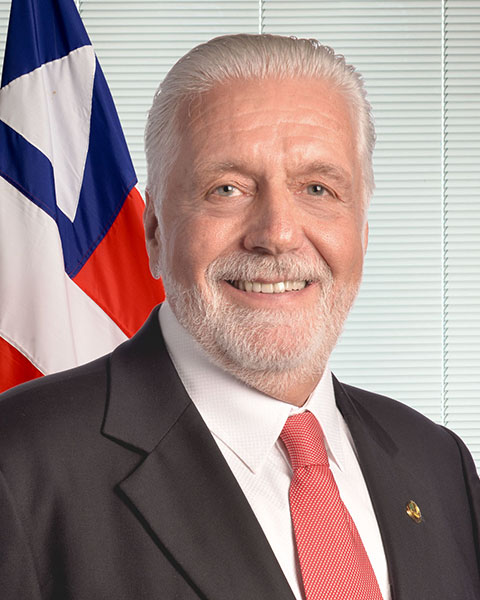
Jaques Wagner (Brazilian Portuguese: [ˈʒaks ˈvaɡneʁ]; born 16 March 1951) is a Brazilian politician who was Governor of Bahia from 2007 to 2015[1] and Minister of Defence[2] in 2015.

Key Information

Wagner, whose parents were Jewish immigrants from Poland, was born in Rio de Janeiro in 1951. In his youth, he was a member of the Labor Zionist youth organization Habonim Dror. He was a founding member of the Workers' Party (PT), as well as the Central Única dos Trabalhadores (CUT), a union which has organized more than seven million members. He won reelection in the 2010 Bahia gubernatorial election.[3][4]

Since 2019, he serves as a Senator for the state of Bahia.[5]

References

[edit]
[edit]
Revisions and contributorsEdit on WikipediaRead on Wikipedia
from Grokipedia
Jaques Wagner (born March 16, 1951, in Rio de Janeiro) is a Brazilian politician affiliated with the Workers' Party (PT). A former union leader and co-founder of the PT, he served as Governor of Bahia from 2007 to 2015, Minister of Defense in 2015, and has been a Senator representing Bahia since 2019. Wagner's career trajectory reflects a shift from labor activism to prominent executive and legislative roles, with emphases on regional development in Bahia and national defense policy.

Early life

Birth and upbringing

Jaques Wagner was born on 16 March 1951 in Rio de Janeiro, Brazil, to Jewish parents who had immigrated from Poland. His family's immigrant background provided early influences rooted in Jewish heritage and community life in the city. In his youth, Wagner became involved with the Labor Zionist youth movement Habonim Dror, reflecting formative exposure to Zionist ideals.

Early career and activism

Wagner relocated to Bahia in the early 1970s after facing persecution from the military dictatorship, which forced him to abandon his engineering studies in Rio de Janeiro. There, he entered the as a worker, before shifting focus to . He rose in the , becoming director and eventually president of the Sindicato dos Trabalhadores da Indústria Petroquímica (Sindiquímica-BA), where he advocated for amid Brazil's authoritarian regime. His leadership involved coordinating union efforts to challenge exploitative conditions and regime repression, contributing to broader labor resistance in the during the late 1970s and 1980s. Wagner's activism against the dictatorship included that highlighted worker grievances, positioning him as a key figure in Bahia's pre-democratic labor struggles without direct electoral involvement.

Political career

Workers' Party involvement

Jaques Wagner served as a co-founder of the Workers' Party (PT), which was established in 1980 amid Brazil's push for democratization and . Drawing from his union leadership experience, he helped shape the party's early structure as a platform for workers' representation and social justice. After relocating to Bahia, Wagner co-founded the 's local branch in 1980, focusing on grassroots organization to expand the party's influence in the Northeast. His efforts emphasized building alliances with local movements and promoting the PT's ideological stance toward democratic socialism, prioritizing worker empowerment and equitable development over traditional elite politics. These initial activities laid the groundwork for the party's sustained presence in Bahia through targeted campaigns that mobilized unions and community groups.

Federal deputy tenure

Jaques Wagner served as a federal deputy for Bahia from 1991 to 2003, representing the Workers' Party (PT). He was first elected in 1990, reelected in 1994, and again in 1998 for the 1999–2003 term. During his legislative tenure, Wagner focused on issues aligned with his background in , though specific bills sponsored are documented in congressional records. He took leave from his final term in January 2003 to assume the position of under President .

Governorship of Bahia

Jacques Wagner was elected governor of Bahia in the 2006 state election, marking the first victory for the Workers' Party (PT) in the state's executive branch after decades of dominance by other parties. He assumed office on January 1, 2007, and was reelected in 2010, serving until December 31, 2014, for a total of two consecutive terms. During his governorship, Wagner prioritized infrastructure development, including partnerships between public and private sectors to improve water access and rural connectivity in Bahia's semi-arid regions. In poverty reduction, his administration expanded programs like the construction of to provide durable water storage solutions for rural families, reducing reliance on emergency tanker deliveries and supporting semi-arid communities. These efforts aligned with federal initiatives under presidents Lula da Silva and Dilma Rousseff, facilitating resource transfers for state-level projects. Wagner's policies also focused on boosting productivity through state programs that enhanced competitiveness in rural economies, as evidenced by collaborations with international lenders. Under his leadership, Bahia experienced notable economic growth, driven by investments in social infrastructure and alignment with national development agendas like the Growth Acceleration Program (PAC).

Minister of Defence

Jaques Wagner was appointed Minister of Defence by President Dilma Rousseff on 1 January 2015, transitioning from his role as Governor of Bahia to oversee Brazil's armed forces amid ongoing national challenges. His tenure, lasting until 2 October 2015, emphasized discussions on modernizing the Armed Forces, including addressing government commitments to equipment and operational enhancements, though marked by ministerial instability with multiple leadership changes in quick succession. Wagner's departure came via a cabinet reshuffle that repositioned him as , a move aimed at retaining key allies during Rousseff's deepening political crisis, exacerbated by widespread corruption scandals and the impending .

Senatorial career

Jaques Wagner was elected to the Senate in the , representing Bahia with 35.63% of the valid votes, securing one of the state's two seats for an eight-year term beginning in February 2019. In December 2022, President-elect selected Wagner as the leader of the government in the Senate, a role he took up upon the administration's inauguration in January 2023. As leader, Wagner has employed pragmatic negotiation strategies to build consensus across parties, facilitating the passage of priority bills through procedural agreements and cross-aisle dialogues.

References

Add your contribution
Related Hubs
User Avatar
No comments yet.