Recent from talks
All channels
Be the first to start a discussion here.
Welcome to the community hub built to collect knowledge and have discussions related to Bahia.
Nothing was collected or created yet.
Bahia
View on Wikipediafrom Wikipedia
Not found
Bahia
View on Grokipediafrom Grokipedia
Bahia is a state in the Northeast Region of Brazil, the fifth largest by land area at 564,760 km², and home to a population of 14,870,907 as estimated for 2025. The inhabitants of the state are called baianos (feminine: baianas), a term referring to those born in Bahia.[1] Its capital, Salvador, founded in 1549 by the Portuguese, served as the first capital of colonial Brazil until 1763.[2] The state features diverse geography, including Atlantic coastline, the sertão interior, and the Chapada Diamantina highlands, supporting a demographic density of 25 inhabitants per km².[1] Bahia's cultural landscape is profoundly shaped by its role as a primary entry point for enslaved Africans during the transatlantic slave trade, fostering unique syncretic traditions such as capoeira—a martial art disguised as dance—and candomblé, an Afro-Brazilian religion blending Yoruba, Fon, and Catholic elements.[2] These influences are evident in Salvador's Historic Center, a UNESCO World Heritage site, and annual festivals like Carnival, which highlight musical genres including samba de roda originating in the region.[2] Economically, Bahia leads the Northeast as a major exporter, with industry concentrated in the Salvador metropolitan area, alongside robust agriculture in commodities like cocoa, soybeans, sugarcane, and fruits, as well as emerging petroleum production and tourism along its beaches and natural parks.[3] The state's GDP expanded by 6% in 2023, surpassing Brazil's national growth rate of 5%.[3] Despite these strengths, Bahia grapples with socioeconomic challenges, including regional disparities between coastal urban centers and rural interior areas marked by lower incomes and higher poverty rates.[1]
Geography
Location and Borders
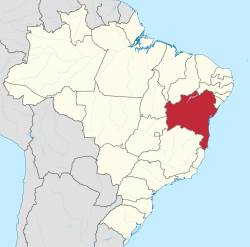
Bahia occupies the northeastern region of Brazil, forming part of the eastern protrusion of the South American continent into the Atlantic Ocean. It lies approximately between latitudes 3° S and 15° S and longitudes 38° W and 46° W, with its centroid at roughly 11.4° S, 41.3° W.[4] As the fifth-largest state in Brazil by land area, Bahia encompasses 564,693 square kilometers.[5] The state is bordered to the north by Piauí, Pernambuco, Alagoas, and Sergipe; to the east by the Atlantic Ocean, which forms an extensive coastline exceeding 1,000 kilometers; to the south by Minas Gerais and Espírito Santo; and to the west by Tocantins and Goiás.[5] This positioning places Bahia at the interface of Brazil's Northeast and Central-West regions, influencing its diverse physiographic features from coastal plains to inland plateaus.[5] The Bay of All Saints, the largest bay in Brazil, indents its eastern shoreline, providing a significant natural harbor.[5]Physical Geography and Regions
Bahia's physical geography encompasses an area of 567,295 km², dominated by low coastal plains rising inland to plateaus and highlands with elevations up to approximately 800 meters in many areas, though select peaks exceed 2,000 meters. The terrain features a narrow Atlantic coastal strip of beaches, dunes, and lagoons, transitioning to undulating hills and dissected tablelands known as tabuleiros. Central and southern sectors include rugged uplands like the Chapada Diamantina, a mountainous plateau with diversified topography serving as the source for 90% of the rivers in the Paraguaçu, Jacuípe, and Rio das Contas basins.[6][7][8] The hydrographic network is structured around major basins, with the São Francisco River forming much of the western boundary before curving eastward, supplemented by eastward-flowing coastal rivers such as the Paraguaçu and Contas. These systems support varied ecosystems across the state's biomes, including Caatinga in the arid interior, Atlantic Forest along the coast and south, and Cerrado savannas centrally, as mapped by official surveys.[9] Geographical regions reflect this topographic diversity: the coastal litoral zone with its 932 km Atlantic frontage; the fertile Recôncavo Baiano around the Bay of All Saints, featuring lowlands and hills; the southern Zona da Mata with denser forests and higher rainfall; the transitional agreste with mixed agriculture; the semi-arid sertão in the north and northwest, prone to drought; and the central Chapada Diamantina highlands, including the state's highest point at Pico do Barbado (2,033 m). These divisions align with IBGE's regional frameworks, influencing local economies from fishing and tourism on the coast to mining and cattle ranching inland.[6][10][11]Climate and Natural Hazards
Bahia's climate is predominantly tropical savanna (Aw) under the Köppen-Geiger classification, with average annual temperatures of 24–26 °C statewide, peaking at 27 °C in February and dipping to around 23 °C in July. Coastal areas like Salvador feature a tropical monsoon (Am) variant, characterized by high humidity, consistent warmth (annual mean 25.6 °C), and rainfall exceeding 1,800 mm annually, distributed more evenly but with peaks from March to July.[12][13][14] In contrast, the state's interior semi-arid regions, including the sertão, experience hotter conditions with scant precipitation of 400–500 mm per year, irregular rainy seasons from April to June, and prolonged dry periods that define the BSh (hot semi-arid) subtype. These zonal differences arise from Bahia's topography and position in Northeast Brazil, where Atlantic influences moderate coastal humidity while continental effects amplify interior aridity.[15][16] Natural hazards primarily consist of droughts and hydrometeorological events like floods and associated landslides. Droughts dominate in the semi-arid interior, accounting for over 80% of recorded disasters in Northeast Brazil from 1993–2013, causing severe water scarcity, crop failures, and livestock losses that recurrently threaten rural livelihoods.[17] Floods from intense seasonal downpours, often exceeding 200 mm in short bursts, inundate low-lying and urban areas, triggering landslides on slopes; the December 2021 event alone killed at least 21 people, injured 358, and displaced over 50,000 across southern Bahia amid record monthly rainfall. Such incidents, comprising about 12–15% of Brazil's disasters from 1991–2012, highlight vulnerabilities in deforested or informally settled zones, with historical precedents like multi-state flooding in the late 1970s underscoring persistent risks.[18][19][20]Biodiversity and Environmental Challenges
Bahia hosts diverse biomes, including remnants of the Atlantic Forest, vast Caatinga dry forests, and Cerrado savannas, supporting high levels of species richness and endemism. The Atlantic Forest portions in the state qualify as a biodiversity hotspot, where a single hectare can contain 450 tree species, with about half endemic to Brazil.[21] The Caatinga biome records 3,347 plant species across 962 genera and 153 families, exhibiting 15% endemism, with non-woody species comprising a significant portion of this diversity.[22] Reptilian fauna in the Caatinga includes 93 lizard species, 53% of which are endemic, reflecting adaptations to arid conditions.[23] Mammalian diversity features over 260 species in the Atlantic Forest, more than 70 endemic, including vulnerable primates and porcupines, while bird assemblages in the Caatinga encompass around 340 species, with notable regional endemics.[24] [25] Bahia's coastal forests further amplify endemism in vascular plants, birds, and primates, positioning the state as critical for regional conservation.[26] Protected areas, such as Chapada Diamantina National Park, preserve key ecosystems, but coverage in non-Amazonian biomes like those in Bahia falls below 10% of territorial extent, limiting overall safeguarding.[27] Deforestation poses acute threats, primarily from agricultural expansion into native habitats. Soy cultivation in western Bahia has driven conversion of Cerrado and Caatinga lands, mirroring national trends where soy-linked deforestation rose from 635,000 hectares in 2020 to 794,000 hectares by recent years.[28] In Atlantic Forest fragments, ongoing loss erodes biomass and biodiversity, with studies documenting reduced species abundance in isolated patches.[29] Caatinga dynamics from 1985 to 2019 reveal persistent conversion for pasture and crops, compounded by droughts that heighten fire vulnerability and water scarcity in semi-arid zones.[30] Coastal and mangrove degradation from urbanization and aquaculture further imperil endemic species, while climate variability intensifies erosion and habitat fragmentation.[31] Despite initiatives targeting 17% protection in Caatinga through sustainable units, enforcement gaps and agribusiness pressures hinder progress, underscoring causal links between land-use intensification and biodiversity decline.[32]History
Pre-Colonial Era and Indigenous Populations
The territory comprising modern Bahia evidenced human occupation dating back to the early Holocene, with archaeological sites including coastal shell mounds (sambaquis) indicating settled fishing and gathering communities from approximately 8,700 to 7,000 years before present.[33] These pre-Tupi populations relied on marine resources, as evidenced by layered accumulations of shells, fish bones, and tools, reflecting a lifestyle adapted to estuarine and lagoon environments. Inland areas show sparser evidence of hunter-gatherer activity, with rock shelters and lithic artifacts suggesting mobility across diverse biomes like caatinga and Atlantic forest precursors. By the late pre-colonial era (circa 1000–1500 CE), Tupi-Guarani-speaking groups dominated the coastal and Recôncavo regions through expansive migrations originating from the Amazon-Paraguay basin, displacing or assimilating earlier Macro-Jê inhabitants. The Tupinambá, a major Tupi subgroup, controlled northern and central Bahia, including the Bay of All Saints area, with villages structured around patrilineal kin groups and numbering hundreds to over a thousand individuals.[34] Southern coastal zones were held by the closely related Tupiniquim, who arrived around 800 CE as part of southward Tupi waves that intensified in the 14th–15th centuries.[35] Inland sertão territories hosted non-Tupi groups such as the Payayá, Sapuiá, and Aimoré (Macro-Jê speakers), who maintained more nomadic lifestyles focused on hunting and rudimentary horticulture.[36] These societies practiced shifting cultivation of manioc, maize, beans, and tobacco, integrated with protein sources from fishing, hunting tapirs and peccaries, and gathering forest products; ceramic pottery and polished stone tools facilitated food processing and storage. Social organization emphasized village autonomy, with frequent intertribal raids culminating in ritual executions and endocannibalism to absorb enemies' strength, as reconstructed from ethnoarchaeological patterns continuous into the contact period. Population densities varied, with coastal Tupi groups supporting higher numbers—estimated in the tens of thousands regionally—due to resource-rich environments, though exact pre-1500 figures remain speculative absent comprehensive surveys.[37] Linguistic and genetic continuity underscores a mosaic of interactions, including trade networks exchanging feathers, dyes, and salt, prior to European disruption.[38]Colonial Period and the Slave Economy
The Portuguese initiated colonization of the Bahia region following Pedro Álvares Cabral's sighting of the Brazilian coast on April 22, 1500, but systematic settlement lagged. In 1534, under the captaincy system, Francisco Pereira Coutinho received the captaincy of Bahia de Todos os Santos, yet his expedition failed amid strong indigenous resistance, leading to his death in 1540.[39] This prompted the Crown to centralize control, dispatching Tomé de Sousa in 1548; he founded Salvador da Bahia on February 29, 1549, establishing it as Brazil's first colonial capital and administrative hub for the Governorate-General.[40][41] Salvador's strategic port facilitated the export of goods and import of labor, anchoring an economy centered on sugar plantations in the Recôncavo Baiano, a fertile alluvial plain surrounding the Bay of All Saints. Sugar cultivation, introduced from Madeira around 1530, expanded rapidly with the construction of engenhos—large, self-sufficient estates integrating milling and refining. Initial reliance on coerced indigenous labor waned due to high mortality from European diseases, Jesuit advocacy for native protection, and flight to interior regions, prompting a shift to transatlantic African slavery by the 1550s.[42] The first documented African slaves arrived in Bahia circa 1550, with imports accelerating as sugar demand surged in Europe.[43] By the late 16th century, Bahia dominated Brazil's sugar output, producing over 10,000 tons annually by 1580 and accounting for much of the colony's exports, which propelled Brazil to become Europe's primary sugar supplier by 1600.[44] This boom relied on vast slave workforces; engenhos typically held 100-300 slaves each, enduring harsh conditions in field and mill labor that yielded high mortality rates offset by continuous imports. Bahia received approximately 1.8 million African slaves from the 16th to 19th centuries—over 37% of Brazil's total of about 4.8 million—disembarked primarily at Salvador's ports, sustaining the latifúndio system of monoculture estates owned by a small Portuguese elite.[45][46] The slave economy entrenched racial hierarchies, with Africans and their descendants comprising the majority of the population, while generating wealth that funded colonial infrastructure like forts and churches, though it also sparked resistance including maroon communities and revolts.[44] Tobacco cultivation emerged as a secondary slave-worked crop, but sugar remained paramount until competition from Caribbean producers eroded Bahia's primacy in the 17th century.[47]Independence and the Empire
The process of Brazilian independence unfolded unevenly across provinces, with Bahia exhibiting strong initial loyalty to Portugal despite the national declaration by Dom Pedro I on September 7, 1822.[48] In Bahia, pro-independence sentiment first crystallized in the interior town of Cachoeira on June 25, 1822, where local forces rallied against Portuguese control, but Salvador remained under Portuguese garrison command led by Inácio Luís Madeira de Melo.[49] This sparked a prolonged conflict, including the Siege of Salvador from March 2, 1822, to July 2, 1823, marked by Brazilian naval support and land skirmishes.[50] A pivotal engagement occurred at the Battle of Pirajá on November 8, 1822, where approximately 1,200 Brazilian troops, including mulatto and black soldiers, repelled a larger Portuguese force of over 2,000, inflicting heavy casualties and shifting momentum toward independence.[49] The war concluded with a major Brazilian offensive on June 3, 1823, under Colonel José Joaquim de Lima e Silva (later Viscount of Majé), prompting Portuguese evacuation from Salvador on July 2, 1823, an event commemorated annually as Bahia's Day of Independence.[49][51] Following integration into the Empire of Brazil, Bahia functioned as a province centered on export agriculture, particularly sugar production, which relied on enslaved African labor and faced modernization efforts like steam-powered mills introduced by figures such as Francisco Gonçalves Martins in 1859.[49] Infrastructure developments included the 1853 contract for the Bahia-São Francisco Railway to link interior production to ports, though economic stagnation hit hard by 1873 due to declining sugar prices amid global competition from beet sugar.[49] Politically, the province experienced unrest, including federalist agitations in 1832–1833 led by Captain Bernardo Miguel Guanais Mineiro seeking greater autonomy from Rio de Janeiro's central authority.[49] Social tensions erupted in the Malê Revolt on January 25, 1835, when around 600 African-born Muslim slaves and freedmen, armed with knives and machetes, attacked slaveholders in Salvador during Ramadan, aiming to establish an Islamic governance; the uprising was suppressed within hours, resulting in over 70 rebels killed and hundreds arrested or executed.[52][53] Further instability arose with the Sabinada, a separatist rebellion from November 7, 1837, to March 1838, proclaimed as the Republic of Bahia by radical liberals and republicans under physician Francisco Sabino Vieira Almeida, who briefly controlled Salvador with about 2,000 supporters before imperial forces, numbering over 6,000 under Francisco de Lima e Silva, reconquered the city.[54][55] These events reflected broader provincial grievances against imperial centralization and economic dependencies, yet Bahia's elites maintained influence in national politics, contributing to debates on abolition—culminating in slavery's end via the Golden Law of May 13, 1888—while the province's relative decline positioned it as a peripheral player by the Empire's close in 1889.[49] Despite such turbulence, the period solidified Bahia's transition from colonial outpost to imperial province, preserving its agrarian base amid mounting pressures for reform.[49]Republican Era and 20th-Century Turbulence
The proclamation of the Brazilian Republic on November 15, 1889, extended to Bahia the following day through the actions of Colonel Frederico Cristiano Buys, transforming the province into a state with its own constitution, elected governor, and legislative assembly.[49] Early governance featured appointed figures like José Luís de Almeida Couto and Manuel Vitorino Pereira, transitioning to direct elections with Joaquim Manuel Rodrigues Lima serving as the first elected governor from 1892 to 1896.[49] Political power consolidated under regional oligarchies practicing coronelismo, where local bosses (coronéis) wielded influence through patronage, vote manipulation, and control over rural populations, a system that perpetuated elite dominance amid widespread illiteracy and economic inequality.[56] Social turbulence erupted in the sertão with the War of Canudos (1896–1897), a millenarian uprising led by Antônio Conselheiro in the arid interior of Bahia, where a self-sustaining community of up to 25,000 followers rejected republican secular reforms, taxation, and land policies following slavery's abolition.[57] Federal forces, deploying over 8,000 troops in multiple expeditions, ultimately razed the settlement in October 1897, resulting in an estimated 15,000 to 30,000 deaths, mostly civilians, and exposing the fragility of central authority in marginalized regions plagued by drought, poverty, and cultural clashes between urban elites and rural traditionalism.[58] The conflict, initially framed by republican press as a monarchist plot, underscored deeper agrarian distress and resistance to modernization, straining the young republic's legitimacy in Bahia.[59] In the early 20th century, cocoa production surged in southern Bahia, accounting for 20% of Brazil's national budget by the 1900s and spurring 141 factories by 1904, yet rural unrest persisted amid recurring droughts and banditry.[49] José Joaquim Seabra emerged as a dominant figure, serving as governor from 1912 to 1916 and 1920 to 1924, promoting infrastructure and challenging federal interference, which culminated in a 1912 crisis where his state chamber's defiance prompted naval bombardment of Salvador on January 10.[60] [49] The 1930 Revolution toppled the Old Republic's oligarchic order nationwide, leading to federal military occupation in Bahia and the appointment of Lieutenant Juracy Magalhães as intervenor from 1931 to 1935, who advanced modernization in agriculture and industry before resigning amid Getúlio Vargas's 1937 Estado Novo coup.[49] These shifts marked a turbulent transition from localized coronelismo to centralized intervention, exacerbating tensions between coastal economic elites and the impoverished interior.Dictatorship, Redemocratization, and Contemporary Developments
Following the 1964 military coup d'état in Brazil, Bahia experienced direct intervention by the federal regime, with governors appointed rather than elected until the late 1970s. Luiz Viana Filho served as governor from March 15, 1967, to March 15, 1971, followed by Antônio Carlos Magalhães from March 15, 1971, to January 25, 1975, the latter explicitly appointed by military authorities to consolidate control in the Northeast. These administrations prioritized infrastructure expansion, including road networks and port upgrades in Salvador, to integrate Bahia into national development plans amid import-substitution industrialization, though such projects often benefited regime allies and exacerbated regional inequalities.[61][62] Repression in Bahia mirrored national patterns, targeting perceived subversives through arrests, torture, and censorship, particularly affecting student movements in Salvador universities and labor organizers. Petrobras facilities, such as the Mataripe refinery, faced intense crackdowns, with mass firings and detentions of unionized workers suspected of communist sympathies, contributing to Bahia's role as a site of regime resistance in the Northeast. Opposition coalesced among intellectuals, clergy, and underground leftist networks, though overt challenges were suppressed via Institutional Acts like AI-5 in 1968, which suspended habeas corpus and closed the state legislature temporarily. Juracy Magalhães governed from 1975 to 1978, followed by João Durval Carneiro from 1979 to 1983 under ARENA, the regime's sole legal party, maintaining stability through clientelistic patronage.[63] Redemocratization accelerated under President Ernesto Geisel's policy of gradual abertura from 1974, allowing multipartisan congressional elections in 1979 and direct gubernatorial votes in 1982. In Bahia, Carneiro secured re-election in 1982 as an ARENA successor, but the process eroded military dominance, culminating in the 1985 indirect presidential transition to civilian José Sarney and the 1988 constitution, which restored federalism and civil liberties while decentralizing fiscal powers to states like Bahia. Antônio Carlos Magalhães, leveraging his dictatorship-era networks, influenced the transition through the Liberal Front, though his carlista machine—rooted in ARENA—faced growing challenges from federalist reforms and urban mobilization.[64] Post-1988, Bahia's politics remained under carlista hegemony via the PFL (later DEM), with Magalhães serving as elected governor from 1991 to 1994 and wielding informal power until scandals in the early 2000s. Economic policies emphasized petrochemical expansion in Camaçari and agribusiness in the west, yielding GDP growth averaging 3-4% annually in the 1990s amid national stabilization under the Real Plan. The 2006 election marked a pivotal shift when Jaques Wagner of the Workers' Party (PT) defeated carlista incumbent Paulo Souto, ending 36 years of conservative dominance and aligning Bahia with Lula's federal social welfare expansions, including Bolsa Família, which reduced extreme poverty from 28% in 2003 to 12% by 2014 through targeted transfers.[65] Subsequent PT governors Rui Costa (2015–2022) and Jerônimo Rodrigues (2023–present) sustained this trajectory, prioritizing infrastructure like the West Bahia agro-industrial corridor and renewable energy, with soy production surging to over 10 million tons annually by 2020, diversifying from traditional cocoa and sugarcane. Rodrigues won the 2022 election with 54% of votes against União Brasil's Bruno Reis, reflecting PT's organizational strength in rural and urban poor demographics amid national polarization. Contemporary challenges include persistent inequality—Gini coefficient around 0.52 in 2022—corruption probes implicating prior administrations, and fiscal strains from pandemic recovery, though Bahia's economy grew 2.5% in 2023, buoyed by oil royalties and tourism rebound.[66]Demographics
Population Size and Growth
As of the 2022 census conducted by the Instituto Brasileiro de Geografia e Estatística (IBGE), Bahia's population totaled 14,141,626 inhabitants, maintaining its position as the fourth most populous state in Brazil and accounting for approximately 7% of the national total.[67] [68] This marked a minimal increase of 119,346 people from the 2010 census figure of 14,022,280, corresponding to an average annual growth rate of roughly 0.06%, the third-lowest among Brazilian states and well below the national rate of 0.5%.[68] [69] IBGE estimates indicate continued subdued expansion, with the population reaching 14,850,513 as of July 1, 2024, a 5% rise from the revised 2023 estimate but reflecting adjustment from pre-census projections that had overstated prior figures.[70] [71] By mid-2025, the estimate climbed to approximately 14.9 million, with a year-over-year growth of 0.1%, ranking fifth-lowest nationally amid broader trends of declining fertility and net out-migration.[72] Over the longer term from 2012 to 2024, cumulative growth totaled 3.9%, adding about 555,000 residents, driven primarily by natural increase rather than internal migration.[73] This low growth manifests unevenly across the state, with population declines recorded in 44.1% of Bahia's 417 municipalities between 2024 and 2025, particularly in rural interior areas, while urban centers like Salvador and Feira de Santana absorb most gains.[72] [74] The resulting density remains sparse at 25.04 inhabitants per square kilometer, underscoring Bahia's vast territorial expanse relative to its human settlement patterns.[67]Ethnic and Racial Composition
According to the 2022 Brazilian Census conducted by the Instituto Brasileiro de Geografia e Estatística (IBGE), Bahia's population of approximately 14.1 million is composed of 56.9% pardo (multiracial), 23.9% preta (black), 18.0% branca (white), and 1.2% indígena (indigenous), with the Asian (amarela) category comprising less than 0.5%.[75] [76] This distribution reflects self-identification based on phenotypic appearance, a method used in Brazilian censuses since 1940, which emphasizes cultural and visual self-perception over strict genetic ancestry.[77] The predominance of pardo and preta categories stems from Bahia's historical role as a primary entry point for the transatlantic slave trade, where over 1.5 million enslaved Africans—primarily from West and Central Africa—arrived between the 16th and 19th centuries, outnumbering Portuguese settlers in many periods.[78] This led to extensive genetic admixture, with pardo individuals typically exhibiting European-African or African-Indigenous mixtures, as confirmed by autosomal DNA studies showing average African ancestry at 50-60% in Bahians, higher than the national average of 20-30%.[79] The white population largely traces to Portuguese colonists and minor 19th-20th century European immigrants, concentrated in urban areas like Salvador.[80] Bahia records the highest national proportion of self-identified black residents at 22.4-23.9%, surpassing the Brazilian average of 10.2%, with nine of the ten municipalities having the highest black percentages located in the state.[81] [76] From 2010 to 2022, the black category grew by about 15% relative to total population, attributed to increased ethnic awareness and reclassification from pardo, while white identification declined from 22.5% to 18%. Indigenous identification, at 1.2%, represents remnants of pre-colonial groups like the Tupinambá, now numbering around 170,000 across 15 ethnicities, mostly in rural interior regions.[79] [78] The Asian category remains marginal, under 0.2%, primarily Japanese and Lebanese descendants in coastal cities.[82] These figures highlight Bahia's demographic distinctiveness within Brazil, where national averages show 45.3% pardo, 43.5% white, and 10.2% black; the state's composition underscores the long-term demographic impact of slavery and limited post-colonial immigration compared to southern states.[76] IBGE data, derived from direct household surveys, provide the most reliable empirical basis, though self-reporting introduces variability influenced by social trends rather than fixed biological markers.[77]Urbanization and Major Cities
Bahia's urbanization rate stood at approximately 76.7% in 2022, with 10.8 million residents in urban areas out of a total population of 14.1 million, marking an increase from 74.1% in 2015 but remaining below the national average of 87.4%.[74][83][84] This slower urbanization pace relative to other Brazilian states stems from persistent rural economic activities, particularly agriculture in the sertão and cocoa regions, retaining 3.3 million people—Brazil's largest rural population—in non-urban districts.[74] Urban growth has concentrated in coastal and industrial poles, driven by migration from rural interiors seeking employment in services, manufacturing, and ports. Salvador, the state capital and largest city, housed 2,417,678 inhabitants in 2022, functioning as Bahia's economic, administrative, and cultural hub with a metropolitan area exceeding 3.9 million.[85][86] Feira de Santana, the second-largest municipality at 616,279 residents, serves as a key inland commercial center, facilitating trade and logistics between Salvador and the interior.[87] Vitória da Conquista, with around 370,000 people, anchors the southwest region's agribusiness and education sectors. Other significant urban centers include Camaçari (population 304,342), home to Brazil's largest petrochemical complex; Itabuna (219,114), a cacao production nexus; and Juazeiro (225,124), focused on irrigation-based fruit farming along the São Francisco River.[67] These cities highlight Bahia's urban diversity, blending historic coastal settlements with emerging industrial and agro-industrial nodes, though challenges like informal housing and infrastructure strain persist in rapidly growing peripheries.[84]| City | Population (2022 Census) |
|---|---|
| Salvador | 2,417,678 |
| Feira de Santana | 616,279 |
| Vitória da Conquista | ~370,000 (est. from trends) |
| Camaçari | 304,342 |
| Juazeiro | 225,124 |
| Itabuna | 219,114 |
Education and Literacy Rates
Bahia's illiteracy rate for persons aged 15 and over was 12.6% in 2022, according to the IBGE census, surpassing the national average of 7.0% and ranking ninth highest among Brazilian states, while representing the largest absolute number of illiterates nationwide at 1,420,947 individuals.[88] [89] This rate reflects a decline from 16.6% in 2010, equating to an 18% reduction in the illiterate population over the period, though progress remains uneven, with higher rates persisting among the elderly, black and brown populations, rural residents, and those in the state's interior compared to urban centers like Salvador.[90] [91] Basic education enrollment in Bahia aligns closely with national trends, approaching universal coverage at 99% for children aged 6 to 14, supported by compulsory schooling laws and public infrastructure expansion.[92] However, quality metrics reveal persistent deficiencies, as measured by the Basic Education Development Index (IDEB), which combines approval rates and standardized test performance. In 2023, Bahia met its IDEB target of 5.3 for early fundamental years (grades 1-5) but fell short in later fundamental years and high school, scoring 3.7 in the latter—below the national goal of 5.0 and indicative of high repetition rates, estimated at over 10% in public schools, driven by socioeconomic barriers, teacher shortages, and infrastructural gaps in rural and low-income areas.[93] [94] Regional disparities exacerbate these issues, with interior municipalities lagging behind coastal urban zones due to limited access and funding inefficiencies. Higher education access in Bahia is anchored by public institutions such as the Federal University of Bahia (UFBA), the state's oldest and largest university, and the State University of Bahia (UNEB), which enrolls approximately 50,000 students across multiple campuses.[95] Gross tertiary enrollment remains below the national rate of 60.4% recorded in 2022, constrained by lower secondary completion rates and economic hurdles in a state where poverty affects over 30% of the population, though affirmative action policies since 2012 have increased representation of public school and low-income students in federal universities.[96] Challenges include high dropout rates—around 25% in early bachelor's years, mirroring national patterns—and uneven quality, with public institutions facing budget constraints amid national fiscal pressures.[97]Health Indicators and Public Welfare
In 2023, life expectancy at birth in Bahia stood at 75.6 years, an increase from previous years but still below the national average of 76.4 years, reflecting persistent regional disparities in healthcare access and socioeconomic conditions.[98][99] Infant mortality rate was 14.5 deaths per 1,000 live births, higher than the Brazilian average of 12.5, with contributing factors including limited prenatal care in rural areas and higher prevalence of preventable diseases.[100][101] Vaccination coverage improved in 2023, with increases in seven of eight key childhood vaccines, supported by state health initiatives amid ongoing challenges like vaccine hesitancy in underserved communities.[102] Public welfare in Bahia is marked by high poverty levels, with 46.0% of the population below the poverty line in 2023—nearly double the national rate of 27.4%—and extreme poverty affecting 8.8%, the highest absolute number among states despite a 26% reduction from 2022 due to expanded cash transfer programs like Bolsa Família.[103][104] These programs covered millions, mitigating extreme deprivation but not fully offsetting structural issues such as unemployment and informal labor dominance. Access to basic sanitation remains inadequate, with 47.8% of households lacking sewage network connections as of 2022, exacerbating health risks like waterborne diseases, particularly in rural and low-income areas where piped water reaches only about 85% of dwellings.[105][106]| Indicator | Bahia (2023 or latest) | National (Brazil) | Source |
|---|---|---|---|
| Life Expectancy at Birth (years) | 75.6 | 76.4 | IBGE[98][99] |
| Infant Mortality (per 1,000 live births) | 14.5 | 12.5 | DATASUS/IBGE[100][107] |
| Poverty Rate (%) | 46.0 | 27.4 | IBGE[103][104] |
| Extreme Poverty Rate (%) | 8.8 | 4.4 | IBGE[108][104] |
| Sewage Network Access (%) | 52.2 (2022) | 62.5 (2022) | IBGE Censo[105][106] |
Religion and Social Dynamics
According to the 2022 Brazilian census conducted by the Instituto Brasileiro de Geografia e Estatística (IBGE), 57% of Bahia's population aged 10 and older identified as Catholic, representing approximately 7 million individuals, though this marks a decline from prior decades amid national trends of diminishing Catholic adherence.[109] Evangelicals constituted 23.3%, or about 2.8 million people, reflecting a 42.7% growth since 2010 and positioning Bahia with the fourth-largest evangelical population in Brazil.[110] No religious affiliation reached 12.86%, the third-highest rate nationally, indicating rising secularism particularly among younger demographics.[111] Explicit adherents to Afro-Brazilian religions like Candomblé and Umbanda numbered under 1% in self-reports, but undercounting persists due to syncretic practices where participants identify primarily as Catholic while incorporating African-derived rituals.[112] Bahia serves as the epicenter of Candomblé, an Afro-Brazilian religion rooted in Yoruba, Bantu, and Fon traditions brought by enslaved Africans during the colonial era, with Salvador hosting an estimated 2,800 terreiros (sacred temple compounds) as of 2025—outnumbering Catholic churches by a factor of five.[113] Historical syncretism arose as a survival mechanism under Portuguese colonial suppression, equating African orixás (deities) with Catholic saints—such as Oxum with Our Lady of Conception and Ogum with Saint George—to evade persecution, fostering a dual-faith practice that persists in festivals like the Lavagem do Bonfim, where Catholic processions blend with Afro-Brazilian offerings.[114] This blending has sustained cultural continuity but complicates census data, as many terreiros function as community anchors without formal proselytization. Religions profoundly shape Bahia's social fabric, with terreiros providing informal welfare networks—including mental health support through rituals addressing spiritual afflictions, economic solidarity via collective labor, and political mobilization for Afro-descendant rights—often filling gaps left by state services in underserved neighborhoods.[115] Studies indicate higher religious commitment correlates with increased prosocial behavior, such as generosity in cooperative games among Candomblé practitioners, reinforcing community ties amid persistent racial and economic disparities.[116] However, evangelical expansion has intensified tensions, with reports of intolerance—including vandalism of terreiros and verbal assaults on practitioners—frequently linked to Pentecostal rhetoric framing Afro-Brazilian faiths as demonic, contributing to over 1,000 documented incidents nationwide in 2023, disproportionately affecting Bahia.[117] Despite legal protections under Brazil's 1988 constitution, enforcement remains uneven, exacerbating social fragmentation along religious lines while Catholic institutions maintain influence through historic sites and syncretic events that promote broader cultural cohesion.[118]Government and Politics
Administrative Structure
Bahia operates as a federative state within Brazil's constitutional framework, featuring independent executive, legislative, and judicial branches as outlined in the 1988 Federal Constitution, which states mirror in their autonomy. The executive branch is headed by the governor, elected by direct popular vote for a four-year term, with the possibility of one consecutive re-election; the governor is supported by a vice-governor and appointed state secretaries overseeing policy areas such as health, education, and public security.[119] The legislative branch consists of the unicameral Assembleia Legislativa da Bahia (AL-BA), comprising 63 state deputies elected by proportional representation every four years to enact state laws, approve the budget, and oversee the executive. The assembly, seated in Salvador, is structured with a directing board including a president, four vice-presidents, and four secretaries, facilitating its operations through committees and plenary sessions.[120] Judicial power is exercised independently through the Tribunal de Justiça da Bahia (TJ-BA), the state's highest court, which adjudicates appeals and ensures compliance with state and federal law; lower courts handle civil, criminal, and labor matters across the jurisdiction. Administratively, Bahia is divided into 417 municipalities as of 2024, each functioning as a semi-autonomous unit with elected mayors and legislative chambers responsible for local governance, taxation, and services. These municipalities are coordinated under state oversight, with Salvador serving as both the capital and the most populous municipality.[121]Political Parties and Ideological Landscape
The Workers' Party (PT), a left-wing social-democratic party emphasizing wealth redistribution and social welfare programs, has dominated Bahia's executive branch since Jaques Wagner's election as governor in 2006, marking the end of the conservative Carlism era led by the Antas da Cunha Menezes (ACM) family and their Democratic Movement Brazil (MDB) and Democrats (DEM, now part of União Brasil) alliances.[122] This hegemony continued with Rui Costa's terms from 2015 to 2023 and Jerônimo Rodrigues' victory in the 2022 gubernatorial election, where Rodrigues secured 55.76% of the vote in the first round on October 2, 2022, and 70.98% in the runoff against ACM Neto of União Brasil on October 30, 2022, according to official Tribunal Superior Eleitoral (TSE) data.[123] The PT's sustained control reflects strong voter support in rural and low-income urban areas, bolstered by federal programs like Bolsa Família and state-level initiatives targeting poverty reduction, though critics attribute it partly to clientelist networks and limited ideological competition rather than pure policy merit.[124] Opposition parties, primarily center-right groups such as União Brasil (centrist-conservative, successor to DEM's pro-business Carlism), the Liberal Party (PL, right-liberal with national Bolsonaro alignment), and Progressistas (PP, centrist with agrarian interests), hold significant legislative representation but struggle in statewide executive races. In the 2022 state legislative assembly elections, the PT-led coalition secured the largest bloc with around 30 seats out of 63, while União Brasil and allies captured about 15, per TSE tabulations, enabling PT majorities through pragmatic pacts with MDB and PSD.[125] Ideologically, Bahia's landscape tilts leftward at the state level due to the PT's appeal to the Afro-Brazilian majority and agrarian reform advocates, yet features hybrid governance blending socialist rhetoric with market-oriented policies in agribusiness and energy, as evidenced by alliances with centrist parties for infrastructure projects. Right-wing challengers like PL gained traction post-2018 nationally but polled under 10% for governor in 2022, highlighting regional resistance to national conservative surges.[123] This dominance persists amid broader Brazilian multiparty fragmentation, where Bahia's 2024 municipal elections saw PSD (centrist, often PT-allied) win 309 of 417 mayoral races, underscoring fluid coalitions over rigid ideology, though PT retained key urban strongholds like Salvador.[126] Systemic challenges, including corruption probes involving PT figures and opposition claims of electoral machine politics, temper the ideological narrative, with empirical data showing Bahia's Human Development Index lagging national averages despite two decades of left governance.[127]Governance Challenges and Corruption Scandals
Bahia has faced persistent governance challenges, including entrenched patronage networks and inefficiencies in public administration, exacerbated by decades of single-party dominance under the Workers' Party (PT) since 2007. These issues have contributed to stalled socioeconomic progress, with the state exhibiting high levels of inequality and public service delivery shortfalls despite substantial natural resource revenues from oil and agriculture. Critics attribute this to clientelist practices that prioritize political loyalty over merit-based management, leading to recurrent fiscal mismanagement and vulnerability to corruption in procurement processes.[128] Corruption scandals have prominently involved former governors Jaques Wagner (2007–2015) and Rui Costa (2015–2023). Wagner was implicated in a scheme surrounding the reconstruction of the Fonte Nova stadium, where Federal Police investigations in 2018 alleged he received R$82 million in bribes and undeclared campaign funds (caixa dois) from Odebrecht and OAS contractors, amid superfaturamento estimated at over R$450 million in corrected values.[129][130] In 2022, the Bahia Public Prosecutor's Office charged him with passive corruption for allegedly accepting R$30 million from Odebrecht in 2014.[131] Although some inquiries, including a 2018 money laundering probe under Operation Cartão Vermelho, were archived by federal courts in February 2025 due to insufficient evidence, the cases highlight systemic risks in large-scale infrastructure contracts.[132][133] Rui Costa faced scrutiny over the 2020 purchase of 300 respirators for R$49 million through the Northeast Consortium (which he coordinated as governor), from a company lacking prior experience in medical equipment; none of the devices were delivered, with funds partially traced to non-delivery despite advance payments authorized by Costa.[134][135] The Attorney General's Office identified criminal indicia in August 2025, prompting resumption of the inquiry by the Superior Court of Justice, including delações premiadas implicating intermediaries who described the deal as unusually lucrative.[136][137] Costa has denied direct involvement, asserting the consortium self-reported irregularities.[136] Under current Governor Jerônimo Rodrigues (since 2023), operations have exposed ongoing vulnerabilities, such as Operação Overclean in December 2024, which uncovered a R$1.4 billion diversion scheme in federal waterworks contracts managed by DNOCS in Bahia, involving shell companies, laranjas, and money laundering across multiple municipalities.[138][139] Additional probes targeted PT-affiliated politicians for embezzlement of parliamentary amendments and municipal desvios in health and education exceeding R$12 million.[140][141][142] Rodrigues' administration has appointed figures accused in prior corruption cases, such as an ex-mayor charged with Fundeb fraud, raising concerns over accountability in appointments.[143] These scandals intersect with broader governance hurdles, including resistance to federal intervention in combating organized crime, which has fueled violence in Salvador and rural areas, and inadequate oversight of public spending amid Bahia's status as Brazil's most populous yet underdeveloped state.[144] Despite anti-corruption operations yielding arrests and asset seizures, the recurrence of fraud in health, infrastructure, and social programs underscores institutional weaknesses, with federal audits revealing persistent gaps in internal controls.[145][146]Security and Organized Crime
Bahia experiences severe public security challenges, with violent crime rates among the highest in Brazil, particularly homicides driven by organized crime disputes. In 2023, six of the ten Brazilian municipalities with the highest homicide rates were located in Bahia, reflecting intense localized violence in urban peripheries and smaller cities.[147] Each recorded conflict between criminal groups correlates with a 39% spike in homicides in the affected area the following month, underscoring the direct causal link between gang rivalries and lethal outcomes.[144] The state hosts 21 active criminal organizations, representing 23% of Brazil's total illicit networks, including expansions by national factions such as the Primeiro Comando da Capital (PCC) and Comando Vermelho (CV), alongside local groups like Bonde do Maluco (BDM).[144][148] These entities compete fiercely for control of drug trafficking routes, ports, and retail points, with over 3,500 documented conflicts involving criminal networks nationwide from May 2022 to April 2025, many spilling into Bahia's territory.[144] CV and BDM have been particularly active in escalating turf wars, transforming neighborhoods into no-go zones and displacing residents through intimidation and reprisals.[148][149] Drug trafficking remains the core revenue source for these groups, facilitating cocaine shipments from the Amazon and Andes regions via Bahia's extensive coastline and highways, though diversification into extortion and arms smuggling has bolstered their resilience.[148] Rivalries often erupt over maritime access points and inland distribution corridors, with violence peaking in Salvador's favelas and interior municipalities like those near Maranguape, identified as Brazil's most dangerous city in 2024 data.[150] Approximately 62% of such conflicts involve inter-group clashes or confrontations with state forces, while 38% target civilians, amplifying broader insecurity.[144] State responses, primarily through Bahia's Military and Civil Police, have involved large-scale operations, but these have yielded high lethality, with the state's forces recording the nation's highest police killing rates in 2022 and continuing aggressive tactics into 2023, resulting in dozens of deaths during raids.[151][152] Nationally, police killings doubled from 2019 levels to 1,464 annually by 2022, with Bahia contributing disproportionately due to its volatile hotspots.[144] Low conviction rates for homicides—around 8%—further erode deterrence, perpetuating cycles of retaliation unchecked by judicial follow-through.[153] Despite national homicide declines, Bahia's entrenched factional wars sustain elevated risks, particularly for youth in controlled territories.[154]Economy
Economic Overview and Indicators
Bahia's gross domestic product (GDP) accounted for 4.0% of Brazil's national total in 2022, reflecting its position as the leading economy in the Northeast region but trailing major southern and southeastern states.[155] The state's GDP per capita reached R$28,483 that year, approximately 57% of the national average of R$49,638, highlighting persistent regional disparities driven by uneven infrastructure development and reliance on extractive and low-value-added activities.[155] [156] In 2023, Bahia's economy expanded by 6.0%, surpassing Brazil's revised national growth of 3.2%, fueled by recoveries in agriculture and manufacturing amid favorable commodity prices and export demand.[3] [157] The composition of GDP emphasizes services (around 70%), followed by industry (20-25%, including petrochemicals) and agriculture (10-15%, with agribusiness expansion in soybeans, cotton, and cocoa), though these shares vary with annual harvests and global markets.[3] [158] Key indicators underscore structural challenges:| Indicator | Value | Period | Notes/Source |
|---|---|---|---|
| GDP Growth Rate | 6.0% | 2023 | Outpaced national average; driven by agriculture and industry.[3] |
| Unemployment Rate | 9.7% | Q3 2024 | Declined from 11.1% prior quarter; higher than national 6.4%.[159] [160] |
| Monthly Household Income per Capita | R$1,366 | 2024 | Below national median; reflects informal employment prevalence.[67] |
| Poverty Rate (est.) | ~46% | 2023 | Per capita income below R$667/month; second-highest absolute numbers nationally after São Paulo.[161] |