



Community hub
Recent from talks
Knowledge base stats:
Talk channels stats:
Members stats:
Jefferson Bible
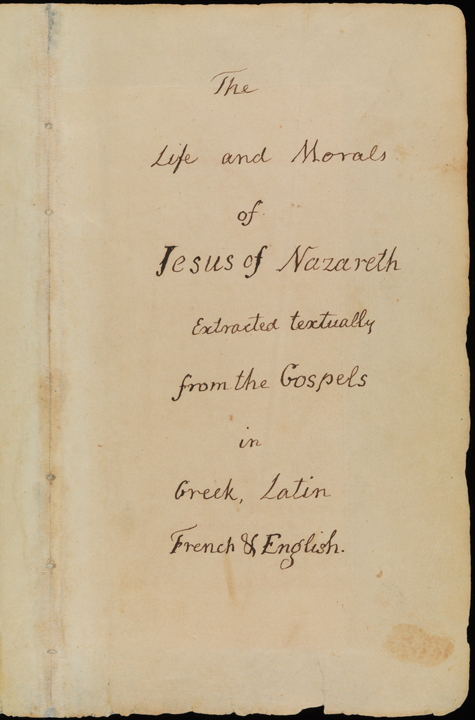
The Life and Morals of Jesus of Nazareth, commonly referred to as the Jefferson Bible, is one of two religious works constructed by Thomas Jefferson. Jefferson compiled the manuscripts but never published them. The first, The Philosophy of Jesus of Nazareth, was completed in 1804, but no copies exist today. The second, The Life and Morals of Jesus of Nazareth, was completed in 1820 by cutting and pasting, with a razor and glue, numerous sections from the New Testament as extractions of the doctrine of Jesus. Jefferson's condensed composition excludes all miracles by Jesus and most mentions of the supernatural, including sections of the four gospels that contain the Resurrection and most other miracles, and passages that portray Jesus as divine.
In an 1803 letter to Joseph Priestley, Jefferson stated that he conceived the idea of writing his view of the "Christian System" in a conversation with Benjamin Rush during 1798–99. He proposes beginning with a review of the morals of the ancient philosophers, moving on to the "deism and ethics of the Jews", and concluding with the "principles of a pure deism" taught by Jesus, "omitting the question of his deity". Jefferson explains that he does not have the time, and urges the task on Priestley as the person best equipped to accomplish it.
Jefferson accomplished a more limited goal in 1804 with The Philosophy of Jesus of Nazareth, the predecessor to The Life and Morals of Jesus of Nazareth. He described it in a letter to John Adams dated October 12, 1813:
In extracting the pure principles which he taught, we should have to strip off the artificial vestments in which they have been muffled by priests, who have travestied them into various forms, as instruments of riches and power to them. We must dismiss the Platonists & Plotinists, the Stagyrites & Gamalielites, the Eclectics the Gnostics & Scholastics, Logos & Demi-urgos, Aeons & Daemons male & female, with a long train of Etc. Etc. Etc. or, shall I say at once, of Nonsense. We must reduce our volume to the simple evangelists, select, even from them, the very words only of Jesus, paring off the Amphibologisms into which they have been led, by forgetting often, or not understanding, what had fallen from him, by giving their own misconceptions as his dicta, and expressing unintelligibly for others what they had not understood themselves. There will be found remaining the most sublime and benevolent code of morals which has ever been offered to man. I have performed this operation for my own use, by cutting verse by verse out of the printed book, and arranging the matter which is evidently his, and which is as easily distinguishable as diamonds in a dunghill. The result is an 8vo of 46 pages of pure and unsophisticated doctrines
Jefferson wrote that "The doctrines which flowed from the lips of Jesus Himself are within the comprehension of a child". He explained these doctrines were such as were "professed & acted on by the unlettered apostles, the Apostolic fathers, and the Christians of the 1st century". In a letter to Reverend Charles Clay, he described his results:
Probably you have heard me say I had taken the four Evangelists, had cut out from them every text they had recorded of the moral precepts of Jesus, and arranged them in a certain order; and although they appeared but as fragments, yet fragments of the most sublime edifice of morality which had ever been exhibited to man.
Jefferson never referred to his work as a Bible, and the full title of this 1804 version was The Philosophy of Jesus of Nazareth, being Extracted from the Account of His Life and Doctrines Given by Matthew, Mark, Luke and John; Being an Abridgement of the New Testament for the Use of the Indians, Unembarrased [uncomplicated] with Matters of Fact or Faith beyond the Level of their Comprehensions.
Jefferson frequently expressed discontent with this earlier version, which was merely a compilation of the moral teachings of Jesus. The Life and Morals of Jesus of Nazareth represents the fulfillment of his desire to produce a more carefully assembled edition which includes what, in his estimation, can be known of the life of Jesus, whose deeds were the embodiment of his teachings.
Hub AI
Jefferson Bible AI simulator
(@Jefferson Bible_simulator)
Jefferson Bible
The Life and Morals of Jesus of Nazareth, commonly referred to as the Jefferson Bible, is one of two religious works constructed by Thomas Jefferson. Jefferson compiled the manuscripts but never published them. The first, The Philosophy of Jesus of Nazareth, was completed in 1804, but no copies exist today. The second, The Life and Morals of Jesus of Nazareth, was completed in 1820 by cutting and pasting, with a razor and glue, numerous sections from the New Testament as extractions of the doctrine of Jesus. Jefferson's condensed composition excludes all miracles by Jesus and most mentions of the supernatural, including sections of the four gospels that contain the Resurrection and most other miracles, and passages that portray Jesus as divine.
In an 1803 letter to Joseph Priestley, Jefferson stated that he conceived the idea of writing his view of the "Christian System" in a conversation with Benjamin Rush during 1798–99. He proposes beginning with a review of the morals of the ancient philosophers, moving on to the "deism and ethics of the Jews", and concluding with the "principles of a pure deism" taught by Jesus, "omitting the question of his deity". Jefferson explains that he does not have the time, and urges the task on Priestley as the person best equipped to accomplish it.
Jefferson accomplished a more limited goal in 1804 with The Philosophy of Jesus of Nazareth, the predecessor to The Life and Morals of Jesus of Nazareth. He described it in a letter to John Adams dated October 12, 1813:
In extracting the pure principles which he taught, we should have to strip off the artificial vestments in which they have been muffled by priests, who have travestied them into various forms, as instruments of riches and power to them. We must dismiss the Platonists & Plotinists, the Stagyrites & Gamalielites, the Eclectics the Gnostics & Scholastics, Logos & Demi-urgos, Aeons & Daemons male & female, with a long train of Etc. Etc. Etc. or, shall I say at once, of Nonsense. We must reduce our volume to the simple evangelists, select, even from them, the very words only of Jesus, paring off the Amphibologisms into which they have been led, by forgetting often, or not understanding, what had fallen from him, by giving their own misconceptions as his dicta, and expressing unintelligibly for others what they had not understood themselves. There will be found remaining the most sublime and benevolent code of morals which has ever been offered to man. I have performed this operation for my own use, by cutting verse by verse out of the printed book, and arranging the matter which is evidently his, and which is as easily distinguishable as diamonds in a dunghill. The result is an 8vo of 46 pages of pure and unsophisticated doctrines
Jefferson wrote that "The doctrines which flowed from the lips of Jesus Himself are within the comprehension of a child". He explained these doctrines were such as were "professed & acted on by the unlettered apostles, the Apostolic fathers, and the Christians of the 1st century". In a letter to Reverend Charles Clay, he described his results:
Probably you have heard me say I had taken the four Evangelists, had cut out from them every text they had recorded of the moral precepts of Jesus, and arranged them in a certain order; and although they appeared but as fragments, yet fragments of the most sublime edifice of morality which had ever been exhibited to man.
Jefferson never referred to his work as a Bible, and the full title of this 1804 version was The Philosophy of Jesus of Nazareth, being Extracted from the Account of His Life and Doctrines Given by Matthew, Mark, Luke and John; Being an Abridgement of the New Testament for the Use of the Indians, Unembarrased [uncomplicated] with Matters of Fact or Faith beyond the Level of their Comprehensions.
Jefferson frequently expressed discontent with this earlier version, which was merely a compilation of the moral teachings of Jesus. The Life and Morals of Jesus of Nazareth represents the fulfillment of his desire to produce a more carefully assembled edition which includes what, in his estimation, can be known of the life of Jesus, whose deeds were the embodiment of his teachings.