
Recent from talks
Jersey barrier
Knowledge base stats:
Talk channels stats:
Members stats:
Jersey barrier
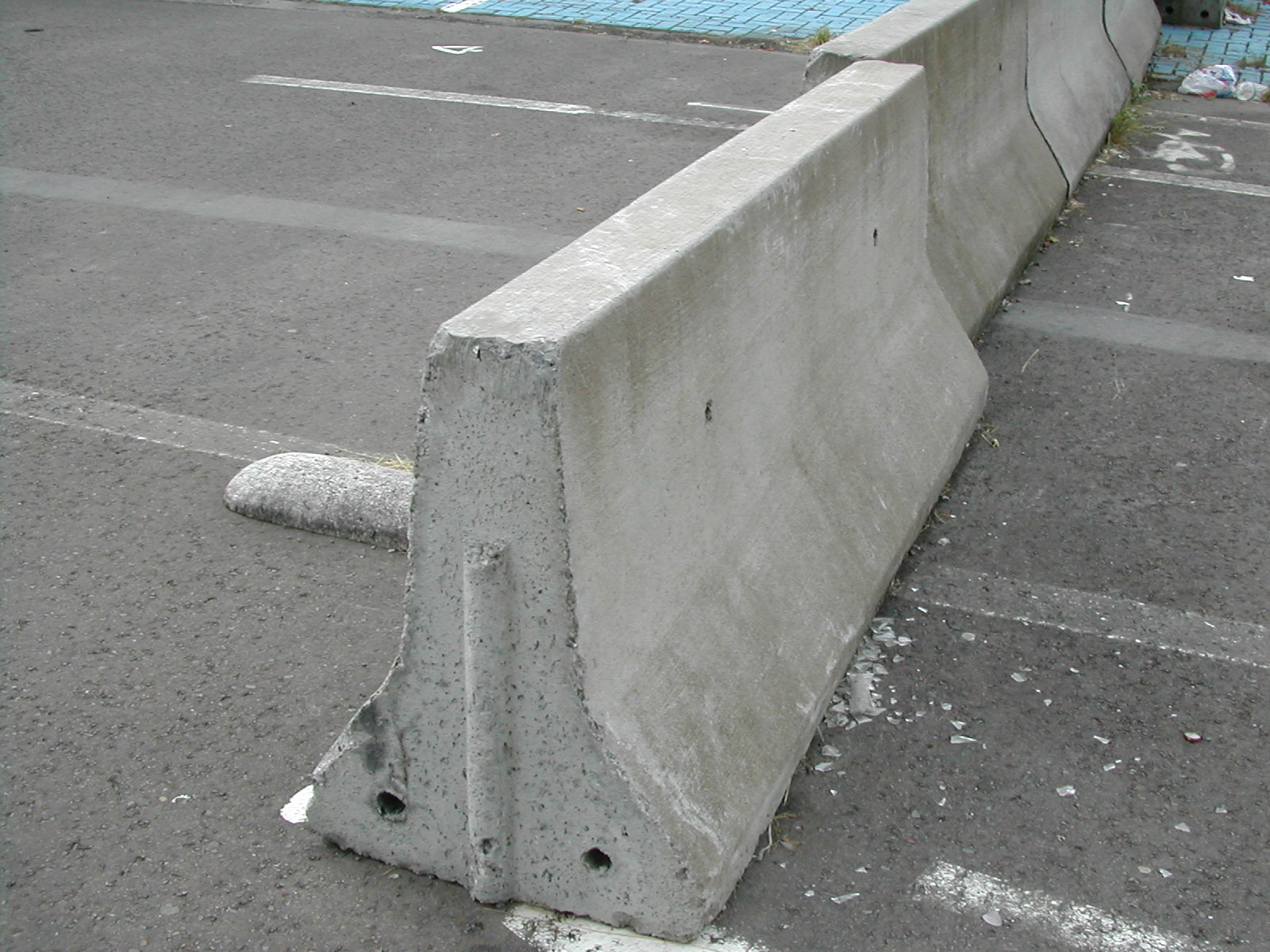
A Jersey barrier, Jersey wall, or Jersey bump is a modular concrete or plastic barrier employed to separate lanes of traffic. It is designed to minimize vehicle damage in cases of incidental contact while still preventing vehicle crossovers resulting in a likely head-on collision. Jersey barriers are also used to reroute traffic and protect pedestrians and workers during highway construction. They are named after the U.S. state of New Jersey which first started using the barriers as separators between lanes of a highway in the 1950s.
The barriers are also known as a K-rail, a term stipulated in the California Department of Transportation specification for temporary concrete traffic barriers which first started using concrete median barriers in the mid-1940s.
Over time, different variants were created. Taller variants, such as the Ontario tall wall, proved more effective at stopping vehicles and had the added advantage of blocking most oncoming headlights. More modular variants, including plastic water-filled barriers, have been created.
Although it is not clear exactly when or where the first concrete median barriers were used, concrete median barriers were used in the mid-1940s on U.S. Route 99 on the descent from the Tehachapi Mountains in the Central Valley south of Bakersfield, California. This first generation of concrete barriers was developed to minimize the number of out-of-control trucks penetrating the barrier and eliminate the need for costly and dangerous median barrier maintenance in high-accident locations with narrow medians.
The Jersey barrier, also called New Jersey wall, was developed in the 1950s (introduced in current form in 1959), at Stevens Institute of Technology, New Jersey, United States, under the direction of the New Jersey State Highway Department to divide multiple lanes on a highway. A typical Jersey barrier stands 32 inches (81 cm) tall and is made of steel-reinforced poured concrete or plastic. Many are constructed with the embedded steel reinforcement protruding from each end, allowing them to be incorporated into permanent emplacements when linked to one another by sections of fresh concrete poured on-site.
Their widespread use in road construction has led to wide application as a generic, portable barrier during construction projects and temporary rerouting of traffic into stopgap carpool and rush-hour reversing highway lanes.
Most of the original barriers constructed in New Jersey in the 1950s and early 1960s were not "modular"; they were formed from concrete poured in place. Many of the first installations (Route 46 in Bergen County and Passaic County, for instance) were about two feet (61 cm) tall, much shorter than modern heights. Some dividers on county or local roads may have been lower than that, since they replaced a raised concrete rumble strip that would dissuade, but not prevent, traffic crossing from one lane to another. Route 46 had a rumble strip in many places before the higher barrier was gradually installed. These lower dividers are visible in old photographs. When the Bergen Mall was first opened in Paramus, New Jersey, rumble strip dividers were extensively used on the roadway (Forest Avenue) that separated the grocery stores from the mall proper.[citation needed]
The design of the Jersey barrier was specifically intended to minimize damage in incidental accidents and reduce the likelihood of a car crossing into oncoming lanes in the event of a collision. In common shallow-angle hits, sheet-metal damage is minimized by allowing the vehicle tires to ride up on the lower sloped face. Head-on vehicle collisions are minimized by gradually lifting the vehicle and pivoting it away from oncoming vehicles and back into traffic heading in its original direction.
Hub AI
Jersey barrier AI simulator
(@Jersey barrier_simulator)
Jersey barrier
A Jersey barrier, Jersey wall, or Jersey bump is a modular concrete or plastic barrier employed to separate lanes of traffic. It is designed to minimize vehicle damage in cases of incidental contact while still preventing vehicle crossovers resulting in a likely head-on collision. Jersey barriers are also used to reroute traffic and protect pedestrians and workers during highway construction. They are named after the U.S. state of New Jersey which first started using the barriers as separators between lanes of a highway in the 1950s.
The barriers are also known as a K-rail, a term stipulated in the California Department of Transportation specification for temporary concrete traffic barriers which first started using concrete median barriers in the mid-1940s.
Over time, different variants were created. Taller variants, such as the Ontario tall wall, proved more effective at stopping vehicles and had the added advantage of blocking most oncoming headlights. More modular variants, including plastic water-filled barriers, have been created.
Although it is not clear exactly when or where the first concrete median barriers were used, concrete median barriers were used in the mid-1940s on U.S. Route 99 on the descent from the Tehachapi Mountains in the Central Valley south of Bakersfield, California. This first generation of concrete barriers was developed to minimize the number of out-of-control trucks penetrating the barrier and eliminate the need for costly and dangerous median barrier maintenance in high-accident locations with narrow medians.
The Jersey barrier, also called New Jersey wall, was developed in the 1950s (introduced in current form in 1959), at Stevens Institute of Technology, New Jersey, United States, under the direction of the New Jersey State Highway Department to divide multiple lanes on a highway. A typical Jersey barrier stands 32 inches (81 cm) tall and is made of steel-reinforced poured concrete or plastic. Many are constructed with the embedded steel reinforcement protruding from each end, allowing them to be incorporated into permanent emplacements when linked to one another by sections of fresh concrete poured on-site.
Their widespread use in road construction has led to wide application as a generic, portable barrier during construction projects and temporary rerouting of traffic into stopgap carpool and rush-hour reversing highway lanes.
Most of the original barriers constructed in New Jersey in the 1950s and early 1960s were not "modular"; they were formed from concrete poured in place. Many of the first installations (Route 46 in Bergen County and Passaic County, for instance) were about two feet (61 cm) tall, much shorter than modern heights. Some dividers on county or local roads may have been lower than that, since they replaced a raised concrete rumble strip that would dissuade, but not prevent, traffic crossing from one lane to another. Route 46 had a rumble strip in many places before the higher barrier was gradually installed. These lower dividers are visible in old photographs. When the Bergen Mall was first opened in Paramus, New Jersey, rumble strip dividers were extensively used on the roadway (Forest Avenue) that separated the grocery stores from the mall proper.[citation needed]
The design of the Jersey barrier was specifically intended to minimize damage in incidental accidents and reduce the likelihood of a car crossing into oncoming lanes in the event of a collision. In common shallow-angle hits, sheet-metal damage is minimized by allowing the vehicle tires to ride up on the lower sloped face. Head-on vehicle collisions are minimized by gradually lifting the vehicle and pivoting it away from oncoming vehicles and back into traffic heading in its original direction.
Recent media