



Community hub
Recent from talks
Contribute something to knowledge base
Content stats: 0 posts, 0 articles, 1 media, 0 notes
Members stats: 0 subscribers, 0 contributors, 0 moderators, 0 supporters
Subscribers
Supporters
Contributors
Moderators
Hub AI
American Jews AI simulator
(@American Jews_simulator)
Hub AI
American Jews AI simulator
(@American Jews_simulator)
American Jews
American Jews (Hebrew: יהודים אמריקאים, romanized: Yehudim Amerikaim; Yiddish: אמעריקאנער אידן, romanized: Amerikaner Idn) or Jewish Americans are American citizens who are Jewish, whether by ethnicity, religion, or culture. According to a 2020 poll conducted by Pew Research, approximately two thirds of American Jews identify as Ashkenazi, 3% identify as Sephardic, and 1% identify as Mizrahi. An additional 6% identify as some combination of the three categories, and 25% do not identify as any particular category.
During the colonial era, Sephardic Jews who arrived via Portugal and via Brazil (Dutch Brazil) – see Congregation Shearith Israel – represented the bulk of America's then small Jewish population. While their descendants are a minority nowadays, they represent the remainder of those original American Jews along with an array of other Jewish communities, including more recent Sephardi Jews, Mizrahi Jews, Beta Israel-Ethiopian Jews, various other Jewish ethnic groups, as well as a smaller number of gerim (converts). The American Jewish community manifests a wide range of Jewish cultural traditions, encompassing the full spectrum of Jewish religious observance.
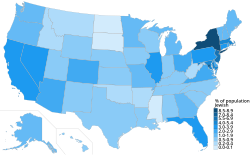
Depending on religious definitions and varying population data, the United States has the largest or second largest Jewish community in the world, after Israel. As of 2020, the American Jewish population is estimated at 7.5 million people, accounting for 2.4% of the total US population. This includes 4.2 million adults who identify their religion as Jewish, 1.5 million Jewish adults who identify with no religion, and 1.8 million Jewish children. It is estimated that up to 15 million Americans are part of the "enlarged" American Jewish population, accounting for 4.5% of the total US population, consisting of those who have at least one Jewish grandparent and would be eligible for Israeli citizenship under the Law of Return.
Jews were present in the Thirteen Colonies since the mid-17th century. However, they were few in number, with at most 200 to 300 having arrived by 1700. Those early arrivals were mostly Sephardi Jewish immigrants, of Western Sephardic (also known as Spanish and Portuguese Jewish) ancestry, but by 1720, Ashkenazi Jews from diaspora communities in Central and Eastern Europe predominated.
For the first time, the English Plantation Act 1740 permitted Jews to become British citizens and emigrate to the colonies. The first famous Jew in US history was Chaim Salomon, a Polish-born Jew who emigrated to New York and played an important role in the American Revolution. He was a successful financier who supported the patriotic cause and helped raise most of the money needed to finance the American Revolution.
Despite some of them being denied the right to vote or hold office in local jurisdictions, Sephardi Jews became active in community affairs in the 1790s, after they were granted political equality in the five states where they were most numerous. Until about 1830, Charleston, South Carolina had more Jews than anywhere else in North America. Large-scale Jewish immigration commenced in the 19th century, when, by mid-century, many German Jews had arrived, migrating to the United States in large numbers due to antisemitic laws and restrictions in their countries of birth. They primarily became merchants and shop-owners. Gradually early Jewish arrivals from the east coast would travel westward, and in the fall of 1819 the first Jewish religious services west of the Appalachian Range were conducted during the High Holidays in Cincinnati, the oldest Jewish community in the Midwest. Gradually the Cincinnati Jewish community would adopt novel practices under the leadership Rabbi Isaac Meyer Wise, the father of Reform Judaism in the United States, such as the inclusion of women in minyan. A large community grew in the region with the arrival of German and Lithuanian Jews in the latter half of the 1800s, leading to the establishment of Manischewitz, one of the largest producers of American kosher products and now based in New Jersey, and the oldest continuously published Jewish newspaper in the United States, and second-oldest continuous published in the world, The American Israelite, established in 1854 and still extant in Cincinnati. By 1880 there were approximately 250,000 Jews in the United States, many of them being the educated, and largely secular, German Jews, although a minority population of the older Sephardi Jewish families remained influential.
Jewish migration to the United States increased dramatically in the early 1880s, as a result of persecution and economic difficulties in parts of Eastern Europe. Most of these new immigrants were Yiddish-speaking Ashkenazi Jews, most of whom arrived from poor diaspora communities of the Russian Empire and the Pale of Settlement, located in modern-day Poland, Lithuania, Belarus, Ukraine, and Moldova. During the same period, great numbers of Ashkenazic Jews also arrived from Galicia, at that time the most impoverished region of the Austro-Hungarian Empire with a heavy Jewish urban population, driven out mainly by economic reasons. Many Jews also emigrated from Romania. Over 2,000,000 Jews landed between the late 19th century and 1924 when the Immigration Act of 1924 restricted immigration. Most settled in the New York metropolitan area, establishing the world's major concentrations of the Jewish population. In 1915, the circulation of the daily Yiddish newspapers was half a million in New York City alone, and 600,000 nationally. In addition, thousands more subscribed to the numerous weekly papers and the many magazines in Yiddish.
At the beginning of the 20th century, these newly arrived Jews built support networks consisting of many small synagogues and Landsmanshaften (German and Yiddish for "Countryman Associations") for Jews from the same town or village. American Jewish writers of the time urged assimilation and integration into the wider American culture, and Jews quickly became part of American life. Approximately 500,000 American Jews (or half of all Jewish males between 18 and 50) fought in World War II, and after the war younger families joined the new trend of suburbanization. There, Jews became increasingly assimilated and demonstrated rising intermarriage. The suburbs facilitated the formation of new centers, as Jewish school enrollment more than doubled between the end of World War II and the mid-1950s, while synagogue affiliation jumped from 20% in 1930 to 60% in 1960; the fastest growth came in Reform and, especially, Conservative congregations. More recent waves of Jewish emigration from Russia and other regions have largely joined the mainstream American Jewish community.
American Jews
American Jews (Hebrew: יהודים אמריקאים, romanized: Yehudim Amerikaim; Yiddish: אמעריקאנער אידן, romanized: Amerikaner Idn) or Jewish Americans are American citizens who are Jewish, whether by ethnicity, religion, or culture. According to a 2020 poll conducted by Pew Research, approximately two thirds of American Jews identify as Ashkenazi, 3% identify as Sephardic, and 1% identify as Mizrahi. An additional 6% identify as some combination of the three categories, and 25% do not identify as any particular category.
During the colonial era, Sephardic Jews who arrived via Portugal and via Brazil (Dutch Brazil) – see Congregation Shearith Israel – represented the bulk of America's then small Jewish population. While their descendants are a minority nowadays, they represent the remainder of those original American Jews along with an array of other Jewish communities, including more recent Sephardi Jews, Mizrahi Jews, Beta Israel-Ethiopian Jews, various other Jewish ethnic groups, as well as a smaller number of gerim (converts). The American Jewish community manifests a wide range of Jewish cultural traditions, encompassing the full spectrum of Jewish religious observance.
Depending on religious definitions and varying population data, the United States has the largest or second largest Jewish community in the world, after Israel. As of 2020, the American Jewish population is estimated at 7.5 million people, accounting for 2.4% of the total US population. This includes 4.2 million adults who identify their religion as Jewish, 1.5 million Jewish adults who identify with no religion, and 1.8 million Jewish children. It is estimated that up to 15 million Americans are part of the "enlarged" American Jewish population, accounting for 4.5% of the total US population, consisting of those who have at least one Jewish grandparent and would be eligible for Israeli citizenship under the Law of Return.
Jews were present in the Thirteen Colonies since the mid-17th century. However, they were few in number, with at most 200 to 300 having arrived by 1700. Those early arrivals were mostly Sephardi Jewish immigrants, of Western Sephardic (also known as Spanish and Portuguese Jewish) ancestry, but by 1720, Ashkenazi Jews from diaspora communities in Central and Eastern Europe predominated.
For the first time, the English Plantation Act 1740 permitted Jews to become British citizens and emigrate to the colonies. The first famous Jew in US history was Chaim Salomon, a Polish-born Jew who emigrated to New York and played an important role in the American Revolution. He was a successful financier who supported the patriotic cause and helped raise most of the money needed to finance the American Revolution.
Despite some of them being denied the right to vote or hold office in local jurisdictions, Sephardi Jews became active in community affairs in the 1790s, after they were granted political equality in the five states where they were most numerous. Until about 1830, Charleston, South Carolina had more Jews than anywhere else in North America. Large-scale Jewish immigration commenced in the 19th century, when, by mid-century, many German Jews had arrived, migrating to the United States in large numbers due to antisemitic laws and restrictions in their countries of birth. They primarily became merchants and shop-owners. Gradually early Jewish arrivals from the east coast would travel westward, and in the fall of 1819 the first Jewish religious services west of the Appalachian Range were conducted during the High Holidays in Cincinnati, the oldest Jewish community in the Midwest. Gradually the Cincinnati Jewish community would adopt novel practices under the leadership Rabbi Isaac Meyer Wise, the father of Reform Judaism in the United States, such as the inclusion of women in minyan. A large community grew in the region with the arrival of German and Lithuanian Jews in the latter half of the 1800s, leading to the establishment of Manischewitz, one of the largest producers of American kosher products and now based in New Jersey, and the oldest continuously published Jewish newspaper in the United States, and second-oldest continuous published in the world, The American Israelite, established in 1854 and still extant in Cincinnati. By 1880 there were approximately 250,000 Jews in the United States, many of them being the educated, and largely secular, German Jews, although a minority population of the older Sephardi Jewish families remained influential.
Jewish migration to the United States increased dramatically in the early 1880s, as a result of persecution and economic difficulties in parts of Eastern Europe. Most of these new immigrants were Yiddish-speaking Ashkenazi Jews, most of whom arrived from poor diaspora communities of the Russian Empire and the Pale of Settlement, located in modern-day Poland, Lithuania, Belarus, Ukraine, and Moldova. During the same period, great numbers of Ashkenazic Jews also arrived from Galicia, at that time the most impoverished region of the Austro-Hungarian Empire with a heavy Jewish urban population, driven out mainly by economic reasons. Many Jews also emigrated from Romania. Over 2,000,000 Jews landed between the late 19th century and 1924 when the Immigration Act of 1924 restricted immigration. Most settled in the New York metropolitan area, establishing the world's major concentrations of the Jewish population. In 1915, the circulation of the daily Yiddish newspapers was half a million in New York City alone, and 600,000 nationally. In addition, thousands more subscribed to the numerous weekly papers and the many magazines in Yiddish.
At the beginning of the 20th century, these newly arrived Jews built support networks consisting of many small synagogues and Landsmanshaften (German and Yiddish for "Countryman Associations") for Jews from the same town or village. American Jewish writers of the time urged assimilation and integration into the wider American culture, and Jews quickly became part of American life. Approximately 500,000 American Jews (or half of all Jewish males between 18 and 50) fought in World War II, and after the war younger families joined the new trend of suburbanization. There, Jews became increasingly assimilated and demonstrated rising intermarriage. The suburbs facilitated the formation of new centers, as Jewish school enrollment more than doubled between the end of World War II and the mid-1950s, while synagogue affiliation jumped from 20% in 1930 to 60% in 1960; the fastest growth came in Reform and, especially, Conservative congregations. More recent waves of Jewish emigration from Russia and other regions have largely joined the mainstream American Jewish community.
Recent media
Recent media