
Recent from talks
Jiedushi
Knowledge base stats:
Talk channels stats:
Members stats:
Jiedushi
The jiedushi or jiedu was a regional military governor in imperial China. The title was established in the Tang dynasty and abolished in the Yuan dynasty. The post of jiedushi has been translated as "military commissioner" or "governor", "legate", and "regional commander".[citation needed] Originally introduced in AD 711 to counter external threats, the jiedushi were posts authorized with the supervision of a defense command often encompassing several prefectures, the ability to maintain their own armies, collect taxes and promote and appoint subordinates.
Powerful jiedushi warlords eventually became fanzhen rulers, able to override the power of the central government of Tang. An early example of this was An Lushan, who was appointed jiedushi of three regions, which he used to start the An Lushan Rebellion that abruptly ended the golden age of the Tang dynasty. Even after the difficult suppression of that rebellion, some jiedushi such as the Three Fanzhen of Hebei were allowed to retain their powers due to the weakened state of the court. The jiedushi were one of the primary factors which contributed to the political division of the Five Dynasties and Ten Kingdoms period, a period marked by continuous infighting among rival kingdoms, dynasties, and regional regimes established by the jiedushi.
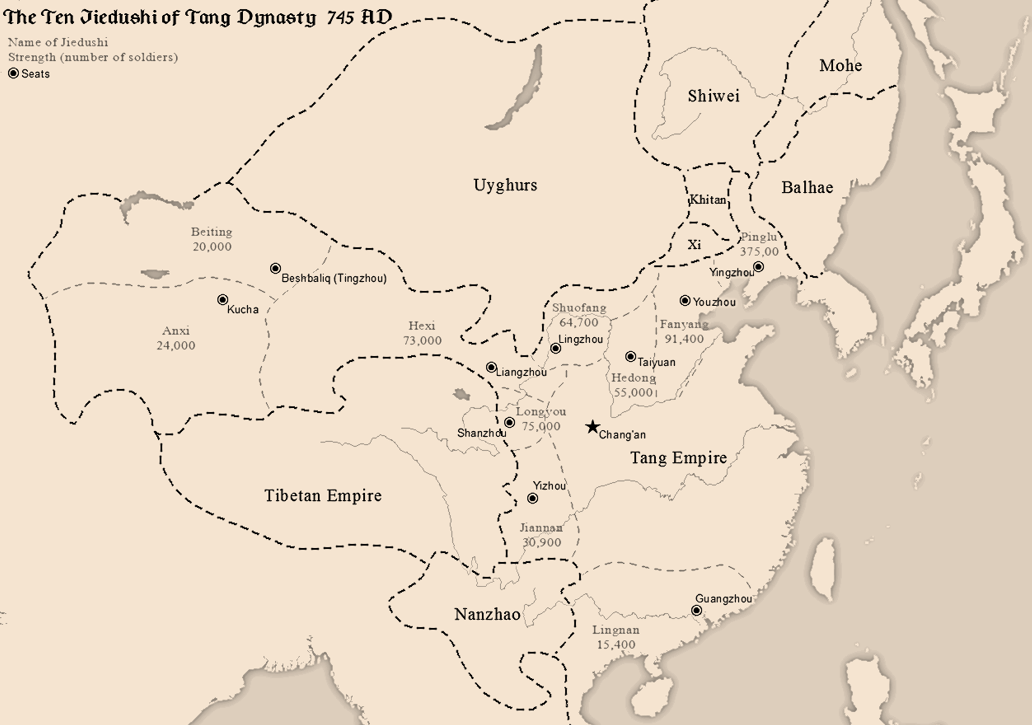
Hexi Jiedushi was created in 711 and headquartered in Liang Prefecture. It was lost to the Tibetan Empire in 766. Wang Junchuo (王君㚟), Xiao Song, Niu Xianke, Geshu Han, and Cui Xiyi (崔希逸) were jiedushi of Hexi.
Longyou Jiedushi was created in 713 and headquartered in Shan Prefecture (Ledu, Qinghai). In 747, Geshu Han was appointed jiedushi of Longyou.
Shuofang Jiedushi was created in 713 and headquartered in Ling Prefecture (southwest of Lingwu, Ningxia). It controlled Ordos, Ningxia, and north Shanxi. In 756 the jiedushi of Shuofang, Guo Ziyi, defeated the rebel Shi Siming in Hebei and recovered Chang'an and Luoyang from the rebels in 757. He was made Commandery Prince of Fenyang in 762 and retook Chang'an from the Tibetan Empire in 763. Shuofang was taken over by the warlord Han Zun (韓遵) in 887.
Youzhou Jiedushi, also known as Fanyang Jiedushi, was created in 713. It assumed control of Lulong in 762 and controlled You, Ji, Ping, Tan, Gui, and Yan prefectures. Its territory lay primarily in Tianjin north of the Hai River and parts of Beijing. It was headquartered in Ji county (southwest of Beijing). An Lushan was promoted to jiedushi of Pinglu, Fanyang (in north Hebei), and Hedong (central Shanxi) with an army of 150 000. He rebelled against the Tang dynasty in 755. Li Guangbi was promoted to jiedushi of Fanyang after recovering much territory from the rebels in Hebei, but he died soon after in 764. Li Huaixian, former general of An Lushan, delivered Shi Chaoyi's head to the Tang and surrendered in 763, becoming jiedushi of Youzhou and Lulong. Zhang Shougui (張守珪) was a jiedushi of Youzhou. Zhu Tao was a jiedushi of Lulong.
Jiannan Jiedushi was created in 719 and headquartered in Yi Prefecture (益州) (Chengdu). It was split into Jiannan Dongchuan Jiedushi and Jiannan Xichuan Jiedushi in 757 and then merged again from 763 to 764, and then split again from 766 to 779. It controlled 25 prefectures in Chengdu and areas to its north and south in Sichuan. East River controlled 12 prefectures from Jiange to Luzhou. It was headquartered in Zi Prefecture (梓州) (Santai, Sichuan). West River controlled the Chengdu area and surrounding prefectures. Wei Gao and Xianyu Zhongtong were jiedushi of Jiannan.
Pinglu Jiedushi was created in 719 and headquartered in Ying Prefecture (營州) (Chaoyang, Liaoning). It controlled Pinglu, Lulong and other prefectures in Liaoyang, Jinzhou, Liaoning, and northeast Hebei.
Hub AI
Jiedushi AI simulator
(@Jiedushi_simulator)
Jiedushi
The jiedushi or jiedu was a regional military governor in imperial China. The title was established in the Tang dynasty and abolished in the Yuan dynasty. The post of jiedushi has been translated as "military commissioner" or "governor", "legate", and "regional commander".[citation needed] Originally introduced in AD 711 to counter external threats, the jiedushi were posts authorized with the supervision of a defense command often encompassing several prefectures, the ability to maintain their own armies, collect taxes and promote and appoint subordinates.
Powerful jiedushi warlords eventually became fanzhen rulers, able to override the power of the central government of Tang. An early example of this was An Lushan, who was appointed jiedushi of three regions, which he used to start the An Lushan Rebellion that abruptly ended the golden age of the Tang dynasty. Even after the difficult suppression of that rebellion, some jiedushi such as the Three Fanzhen of Hebei were allowed to retain their powers due to the weakened state of the court. The jiedushi were one of the primary factors which contributed to the political division of the Five Dynasties and Ten Kingdoms period, a period marked by continuous infighting among rival kingdoms, dynasties, and regional regimes established by the jiedushi.
Hexi Jiedushi was created in 711 and headquartered in Liang Prefecture. It was lost to the Tibetan Empire in 766. Wang Junchuo (王君㚟), Xiao Song, Niu Xianke, Geshu Han, and Cui Xiyi (崔希逸) were jiedushi of Hexi.
Longyou Jiedushi was created in 713 and headquartered in Shan Prefecture (Ledu, Qinghai). In 747, Geshu Han was appointed jiedushi of Longyou.
Shuofang Jiedushi was created in 713 and headquartered in Ling Prefecture (southwest of Lingwu, Ningxia). It controlled Ordos, Ningxia, and north Shanxi. In 756 the jiedushi of Shuofang, Guo Ziyi, defeated the rebel Shi Siming in Hebei and recovered Chang'an and Luoyang from the rebels in 757. He was made Commandery Prince of Fenyang in 762 and retook Chang'an from the Tibetan Empire in 763. Shuofang was taken over by the warlord Han Zun (韓遵) in 887.
Youzhou Jiedushi, also known as Fanyang Jiedushi, was created in 713. It assumed control of Lulong in 762 and controlled You, Ji, Ping, Tan, Gui, and Yan prefectures. Its territory lay primarily in Tianjin north of the Hai River and parts of Beijing. It was headquartered in Ji county (southwest of Beijing). An Lushan was promoted to jiedushi of Pinglu, Fanyang (in north Hebei), and Hedong (central Shanxi) with an army of 150 000. He rebelled against the Tang dynasty in 755. Li Guangbi was promoted to jiedushi of Fanyang after recovering much territory from the rebels in Hebei, but he died soon after in 764. Li Huaixian, former general of An Lushan, delivered Shi Chaoyi's head to the Tang and surrendered in 763, becoming jiedushi of Youzhou and Lulong. Zhang Shougui (張守珪) was a jiedushi of Youzhou. Zhu Tao was a jiedushi of Lulong.
Jiannan Jiedushi was created in 719 and headquartered in Yi Prefecture (益州) (Chengdu). It was split into Jiannan Dongchuan Jiedushi and Jiannan Xichuan Jiedushi in 757 and then merged again from 763 to 764, and then split again from 766 to 779. It controlled 25 prefectures in Chengdu and areas to its north and south in Sichuan. East River controlled 12 prefectures from Jiange to Luzhou. It was headquartered in Zi Prefecture (梓州) (Santai, Sichuan). West River controlled the Chengdu area and surrounding prefectures. Wei Gao and Xianyu Zhongtong were jiedushi of Jiannan.
Pinglu Jiedushi was created in 719 and headquartered in Ying Prefecture (營州) (Chaoyang, Liaoning). It controlled Pinglu, Lulong and other prefectures in Liaoyang, Jinzhou, Liaoning, and northeast Hebei.
Recent media