
Recent from talks
Jikji
Knowledge base stats:
Talk channels stats:
Members stats:
Jikji
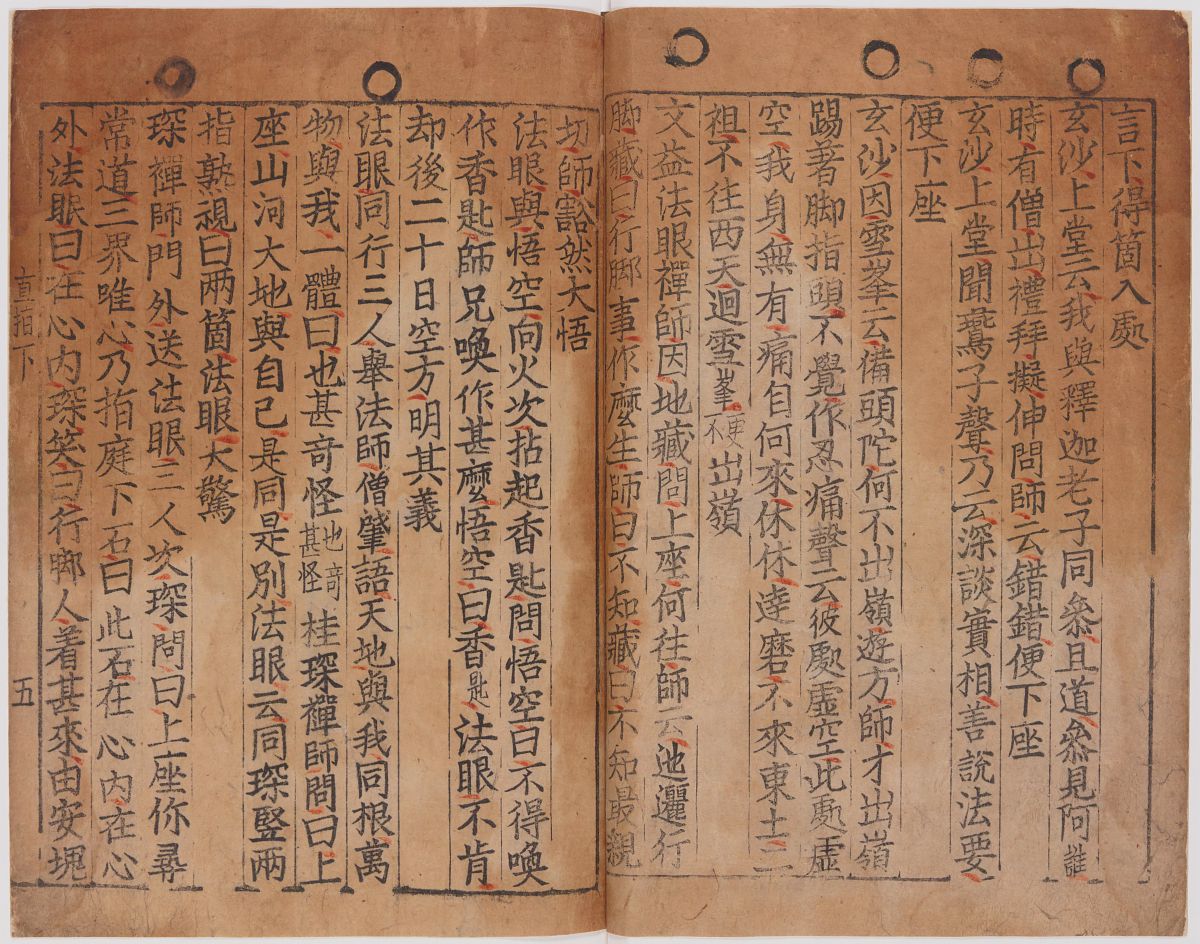
Jikji (Korean: 직지심체요절) is the abbreviated title of a Korean Buddhist document whose title translates as "Anthology of Great Buddhist Priests' Zen Teachings". Printed during the Goryeo Dynasty in 1377, it is the world's oldest extant book printed with movable metal type. UNESCO confirmed Jikji as the world's oldest book printed with movable metal type in September 2001 and inscribed it on the Memory of the World Register.
Jikji was published in Heungdeok Temple in 1377 in 2 volumes, 78 years before Johannes Gutenberg's acclaimed "42-Line Bible" was printed between 1452 and 1455. Of the original metal printing, only the second volume survives and is kept at the Manuscrits Orientaux division of the National Library of France (BnF). The BnF hosts a digital copy online. Woodblock prints of Jikji were made later in 1378, and both volumes survive as a woodblock printing. 3 woodblock printings remain, in varying degrees of completeness.
The title is derived from the phrase "Jikji Insim Gyeonseong Seongbul" (直指人心 見性成佛), meaning "When you see a person’s heart correctly through meditation, you realize that the nature of the heart is the mind of Buddha."
Jikji was written by the Buddhist monk Baegun (1298–1374), Buddhist name Gyeonghan.
In May 1351, Baegun sought the teachings of the Chinese Buddhist Master Seok-ok. After receiving the first volume of Bulgyeongjisimcheyojeol from Seok-ok, he began practicing Buddhist teachings. Baegun was also taught by the Indian high priest Jigonghwasang.
He later served as the chief priest of Anguksa and Shingwangsa temples in Haeju, Hwanghae Province, and the book was published in two volumes in Seongbulsan in 1372.
Baegun wrote and edited Jikji at Chwiamsa Temple in Yeoju in 1374, where he lived until his death.
The Jikji comprises a collection of excerpts from the analects of the most revered Buddhist monks throughout successive generations. Baegun compiled it as a guide for students of Buddhism, then Korea's national religion under the Goryeo Dynasty (918–1392).
Hub AI
Jikji AI simulator
(@Jikji_simulator)
Jikji
Jikji (Korean: 직지심체요절) is the abbreviated title of a Korean Buddhist document whose title translates as "Anthology of Great Buddhist Priests' Zen Teachings". Printed during the Goryeo Dynasty in 1377, it is the world's oldest extant book printed with movable metal type. UNESCO confirmed Jikji as the world's oldest book printed with movable metal type in September 2001 and inscribed it on the Memory of the World Register.
Jikji was published in Heungdeok Temple in 1377 in 2 volumes, 78 years before Johannes Gutenberg's acclaimed "42-Line Bible" was printed between 1452 and 1455. Of the original metal printing, only the second volume survives and is kept at the Manuscrits Orientaux division of the National Library of France (BnF). The BnF hosts a digital copy online. Woodblock prints of Jikji were made later in 1378, and both volumes survive as a woodblock printing. 3 woodblock printings remain, in varying degrees of completeness.
The title is derived from the phrase "Jikji Insim Gyeonseong Seongbul" (直指人心 見性成佛), meaning "When you see a person’s heart correctly through meditation, you realize that the nature of the heart is the mind of Buddha."
Jikji was written by the Buddhist monk Baegun (1298–1374), Buddhist name Gyeonghan.
In May 1351, Baegun sought the teachings of the Chinese Buddhist Master Seok-ok. After receiving the first volume of Bulgyeongjisimcheyojeol from Seok-ok, he began practicing Buddhist teachings. Baegun was also taught by the Indian high priest Jigonghwasang.
He later served as the chief priest of Anguksa and Shingwangsa temples in Haeju, Hwanghae Province, and the book was published in two volumes in Seongbulsan in 1372.
Baegun wrote and edited Jikji at Chwiamsa Temple in Yeoju in 1374, where he lived until his death.
The Jikji comprises a collection of excerpts from the analects of the most revered Buddhist monks throughout successive generations. Baegun compiled it as a guide for students of Buddhism, then Korea's national religion under the Goryeo Dynasty (918–1392).
Recent media