
Recent from talks
Jim Taylor (fullback)
Knowledge base stats:
Talk channels stats:
Members stats:
Jim Taylor (fullback)
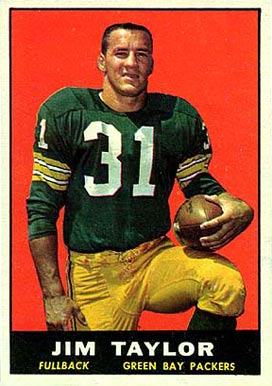
James Charles Taylor (September 20, 1935 – October 13, 2018) was an American professional football player who was a fullback in the National Football League (NFL) for ten seasons, with the Green Bay Packers from 1958 to 1966 and with the expansion New Orleans Saints in 1967. With the Packers, Taylor was invited to five straight Pro Bowls and won four NFL championships, as well as a victory in the first Super Bowl. He was recognized as the NFL Most Valuable Player (MVP) after winning the rushing title in 1962, beating out Jim Brown. An aggressive player and fluent trash talker, Taylor developed several personal rivalries throughout his career, most notably with New York Giants linebacker Sam Huff. This confrontational attitude, combined with his tenacious running style, a penchant for contact, and ability to both withstand and deliver blows, earned him a reputation as one of the league's toughest players.
Playing college football for the LSU Tigers, Taylor led the Southeastern Conference (SEC) in scoring in 1956 and 1957 and earned first-team All-America honors as a senior. He was selected by the Packers in the second round of the 1958 NFL draft and was used sparingly as a rookie, but with the arrival of coach Vince Lombardi in 1959 Taylor soon became the team's all-purpose back, especially when only a few yards were needed. In this role, his spirited performance against the Giants in the 1962 NFL Championship Game came to define his mental and physical toughness.
Taylor finished his career after carrying 1,941 times for 8,597 yards and 83 touchdowns. He was the first player to record five straight seasons of at least 1,000 rushing yards. His 81 rushing touchdowns for the Packers remains a franchise record by a wide margin, and his 8,207 rushing yards with the team has been surpassed only once. Taylor was inducted into the Pro Football Hall of Fame in 1976. He is a member of the Green Bay Packers Hall of Fame and his number 31 jersey is retired by the Saints.
Born in Baton Rouge, Louisiana, on September 20, 1935, James Charles Taylor had two paper routes to help his widowed mother make ends meet. He delivered the morning and afternoon routes by bicycle for three dollars a week, which helped to develop his leg muscles. Though he did not play football until his junior year, he was a star athlete in four sports at Baton Rouge High School, and graduated in 1954. He stayed in town and played college football at Louisiana State University for coach Paul Dietzel's LSU Tigers football team. Taylor played on LSU's freshman team in 1954, but due to struggles in the classroom, he transferred to Hinds Community College in Raymond, Mississippi, as a sophomore, where he met his future wife Dixie Grant. He then returned to LSU as a junior.
Taylor rushed for 1,314 yards and scored 20 rushing touchdowns over his LSU career, and led the Southeastern Conference (SEC) in scoring in 1956 and 1957. "With the ball under his arm, Jimmy Taylor was the best running back I've ever coached," said Dietzel. "He was just so versatile." After spending the first half of his junior season learning the offense, Taylor scored 51 points in the team's final five games of 1956. As a senior in 1957, he shared the backfield with future Heisman Trophy winner Billy Cannon, a combination that accounted for over 1,500 yards from scrimmage and 17 touchdowns that season. Against Texas Tech, due to the Red Raiders' focus on containing Taylor, Cannon had one of the most productive games of his career. The following week, Taylor scored three touchdowns in LSU's 20–13 upset of a No. 17 Georgia Tech team whose focus was on stopping Cannon. In his final college game, Taylor carried 17 times for 171 yards and two touchdowns in a 35–6 victory over in-state rival Tulane. He was selected as a first-team All-American by the Football Writers Association of America, and earned first-team All-SEC honors from the Associated Press (AP) and United Press (UPI). After the season, he played in the Senior Bowl and was named the game's most valuable player.
Taylor was selected by the Packers in the second round of the 1958 NFL draft, the 15th overall pick, taken in December 1957 while Lisle Blackbourn was still the head coach. His rookie contract was worth $9,500. That draft for the Packers included future stars Dan Currie (3rd), Ray Nitschke (36th), and Jerry Kramer (39th), but the 1958 team finished with the worst record in the league (and the franchise's worst ever, as of 2023), under first-year NFL head coach Ray "Scooter" McLean. Taylor was used sparingly as a rookie, but in the penultimate game at Kezar Stadium, he gained 137 yards on 22 carries in a 48–21 loss to the San Francisco 49ers, and his running style brought cheers from the San Francisco fans. With a one-year contract that was not to be renewed, McLean resigned days after the season and was replaced by Vince Lombardi in January 1959.
When Lombardi took over, Taylor became the feature back for the Packers, especially in short yardage situations. Taylor teamed with backfield mate, halfback Paul Hornung, to form a tandem that Green Bay fans affectionately called "Thunder and Lightning", due to Taylor's power and Hornung's agility. In 1960, Taylor rushed for 1,101 yards on a league-high 230 carries and scored 11 touchdowns. The Packers finished with an 8–4 record and met the Philadelphia Eagles in the 1960 NFL Championship Game. They were defeated 17–13, despite 24 carries for 105 yards and six catches for 46 yards from Taylor. Most notably, on the last play of the game, Taylor was tackled by Chuck Bednarik at the nine yard line. Following the season, Taylor was invited to his first Pro Bowl, where he tied a Pro Bowl record by scoring three touchdowns in the Western Conference's 35–31 victory over the East.
In the 1960s, Lombardi implemented the "Packers sweep" play in which guards Jerry Kramer and Fuzzy Thurston rapidly pulled out from their normal positions and led blocking for Hornung and Taylor. It became an integral part of the Packers' offense throughout the decade. In 1961, Taylor carried 243 times for 1,307 yards and led the league with 15 rushing touchdowns. For the second year in a row, his rushing yards total was second to Jim Brown of the Cleveland Browns. Taylor was selected as the second-team fullback behind Brown on the United Press International (UPI) All-Pro team, and finished second in voting behind Brown for the Associated Press (AP) team. The Packers again reached the NFL title game, this time defeating the New York Giants with a 37–0 shutout. Taylor had 69 yards on 14 attempts while playing despite badly damaged ribs, as Hornung carried most of the load for Green Bay.
Hub AI
Jim Taylor (fullback) AI simulator
(@Jim Taylor (fullback)_simulator)
Jim Taylor (fullback)
James Charles Taylor (September 20, 1935 – October 13, 2018) was an American professional football player who was a fullback in the National Football League (NFL) for ten seasons, with the Green Bay Packers from 1958 to 1966 and with the expansion New Orleans Saints in 1967. With the Packers, Taylor was invited to five straight Pro Bowls and won four NFL championships, as well as a victory in the first Super Bowl. He was recognized as the NFL Most Valuable Player (MVP) after winning the rushing title in 1962, beating out Jim Brown. An aggressive player and fluent trash talker, Taylor developed several personal rivalries throughout his career, most notably with New York Giants linebacker Sam Huff. This confrontational attitude, combined with his tenacious running style, a penchant for contact, and ability to both withstand and deliver blows, earned him a reputation as one of the league's toughest players.
Playing college football for the LSU Tigers, Taylor led the Southeastern Conference (SEC) in scoring in 1956 and 1957 and earned first-team All-America honors as a senior. He was selected by the Packers in the second round of the 1958 NFL draft and was used sparingly as a rookie, but with the arrival of coach Vince Lombardi in 1959 Taylor soon became the team's all-purpose back, especially when only a few yards were needed. In this role, his spirited performance against the Giants in the 1962 NFL Championship Game came to define his mental and physical toughness.
Taylor finished his career after carrying 1,941 times for 8,597 yards and 83 touchdowns. He was the first player to record five straight seasons of at least 1,000 rushing yards. His 81 rushing touchdowns for the Packers remains a franchise record by a wide margin, and his 8,207 rushing yards with the team has been surpassed only once. Taylor was inducted into the Pro Football Hall of Fame in 1976. He is a member of the Green Bay Packers Hall of Fame and his number 31 jersey is retired by the Saints.
Born in Baton Rouge, Louisiana, on September 20, 1935, James Charles Taylor had two paper routes to help his widowed mother make ends meet. He delivered the morning and afternoon routes by bicycle for three dollars a week, which helped to develop his leg muscles. Though he did not play football until his junior year, he was a star athlete in four sports at Baton Rouge High School, and graduated in 1954. He stayed in town and played college football at Louisiana State University for coach Paul Dietzel's LSU Tigers football team. Taylor played on LSU's freshman team in 1954, but due to struggles in the classroom, he transferred to Hinds Community College in Raymond, Mississippi, as a sophomore, where he met his future wife Dixie Grant. He then returned to LSU as a junior.
Taylor rushed for 1,314 yards and scored 20 rushing touchdowns over his LSU career, and led the Southeastern Conference (SEC) in scoring in 1956 and 1957. "With the ball under his arm, Jimmy Taylor was the best running back I've ever coached," said Dietzel. "He was just so versatile." After spending the first half of his junior season learning the offense, Taylor scored 51 points in the team's final five games of 1956. As a senior in 1957, he shared the backfield with future Heisman Trophy winner Billy Cannon, a combination that accounted for over 1,500 yards from scrimmage and 17 touchdowns that season. Against Texas Tech, due to the Red Raiders' focus on containing Taylor, Cannon had one of the most productive games of his career. The following week, Taylor scored three touchdowns in LSU's 20–13 upset of a No. 17 Georgia Tech team whose focus was on stopping Cannon. In his final college game, Taylor carried 17 times for 171 yards and two touchdowns in a 35–6 victory over in-state rival Tulane. He was selected as a first-team All-American by the Football Writers Association of America, and earned first-team All-SEC honors from the Associated Press (AP) and United Press (UPI). After the season, he played in the Senior Bowl and was named the game's most valuable player.
Taylor was selected by the Packers in the second round of the 1958 NFL draft, the 15th overall pick, taken in December 1957 while Lisle Blackbourn was still the head coach. His rookie contract was worth $9,500. That draft for the Packers included future stars Dan Currie (3rd), Ray Nitschke (36th), and Jerry Kramer (39th), but the 1958 team finished with the worst record in the league (and the franchise's worst ever, as of 2023), under first-year NFL head coach Ray "Scooter" McLean. Taylor was used sparingly as a rookie, but in the penultimate game at Kezar Stadium, he gained 137 yards on 22 carries in a 48–21 loss to the San Francisco 49ers, and his running style brought cheers from the San Francisco fans. With a one-year contract that was not to be renewed, McLean resigned days after the season and was replaced by Vince Lombardi in January 1959.
When Lombardi took over, Taylor became the feature back for the Packers, especially in short yardage situations. Taylor teamed with backfield mate, halfback Paul Hornung, to form a tandem that Green Bay fans affectionately called "Thunder and Lightning", due to Taylor's power and Hornung's agility. In 1960, Taylor rushed for 1,101 yards on a league-high 230 carries and scored 11 touchdowns. The Packers finished with an 8–4 record and met the Philadelphia Eagles in the 1960 NFL Championship Game. They were defeated 17–13, despite 24 carries for 105 yards and six catches for 46 yards from Taylor. Most notably, on the last play of the game, Taylor was tackled by Chuck Bednarik at the nine yard line. Following the season, Taylor was invited to his first Pro Bowl, where he tied a Pro Bowl record by scoring three touchdowns in the Western Conference's 35–31 victory over the East.
In the 1960s, Lombardi implemented the "Packers sweep" play in which guards Jerry Kramer and Fuzzy Thurston rapidly pulled out from their normal positions and led blocking for Hornung and Taylor. It became an integral part of the Packers' offense throughout the decade. In 1961, Taylor carried 243 times for 1,307 yards and led the league with 15 rushing touchdowns. For the second year in a row, his rushing yards total was second to Jim Brown of the Cleveland Browns. Taylor was selected as the second-team fullback behind Brown on the United Press International (UPI) All-Pro team, and finished second in voting behind Brown for the Associated Press (AP) team. The Packers again reached the NFL title game, this time defeating the New York Giants with a 37–0 shutout. Taylor had 69 yards on 14 attempts while playing despite badly damaged ribs, as Hornung carried most of the load for Green Bay.
Recent media