
Recent from talks
Jodocus Hondius
Knowledge base stats:
Talk channels stats:
Members stats:
Jodocus Hondius
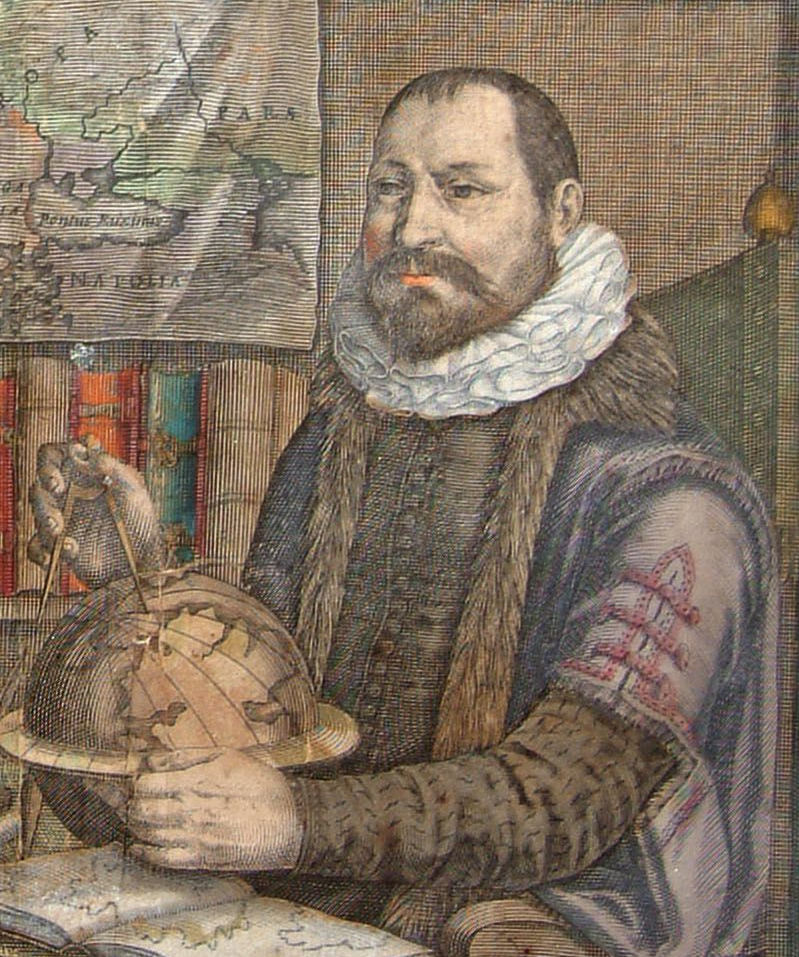
Jodocus Hondius (Latinised version of his Dutch name: Joost de Hondt) (17 October 1563 – 12 February 1612) was a Flemish engraver and cartographer. He is sometimes called Jodocus Hondius the Elder to distinguish him from his son Jodocus Hondius II. Hondius is best known for his early maps of the New World and Europe, for re-establishing the reputation of the work of Gerardus Mercator, and for his portraits of Francis Drake. He inherited and republished the plates of Mercator, thus reviving his legacy, also making sure to include independent revisions to his work. One of the notable figures in the Golden Age of Dutch cartography (c. 1570s–1670s), he helped establish Amsterdam as the centre of cartography in Europe in the 17th century.
Jodocus Hondius was born in Wakken in the County of Flanders (now Belgium), the son of Olivier de Hondt and Petronella van Havertuyn.
He was raised in Ghent and trained there as an engraver, developing the drawing skills that supported his later work. By the early 1580s he was working as an engraver and also producing scientific instruments and globes.
In 1584 he left Flanders for London with his sister Jacomina to escape religious difficulties. In 1587 in the Dutch Church of London, he married cartographer Colette van den Keere, the daughter of the engraver Hendrik van den Keere. He also worked with her brother Pieter van den Keere, a mapmaker and engraver.
While in England, Hondius was instrumental in publicising the work of Francis Drake, who had made a circumnavigation of the world in the late 1570s. In particular, in 1589 Hondius produced a now famous map of the bay of New Albion at Drake's Cove, where Drake briefly established a settlement on the west coast of North America.
Hondius is also thought to be the artist of several well-known portraits of Drake that are now in the National Portrait Gallery in London. Also Hondius had engraved charts in the Mariners Mirrour (1588) and the gores for the first English globes, those of Emery Molyneux completed in 1592.
In 1604 Hondius acquired the copperplates of Gerardus Mercator's Atlas from Mercator's heirs and prepared a revised edition in Amsterdam. The new atlas, published in 1606, retained the 107 maps that had appeared in Mercator's 1595 edition but added 37 newly engraved maps produced by Hondius and other cartographers. Several of these new maps were engraved by Hondius himself.
Through these additions Hondius expanded the geographic scope of the work. The atlas included new regional maps of Africa, Asia, and the Americas, as well as additional maps of European regions. Hondius also introduced four new continent maps while retaining the earlier continent maps from Mercator's atlas.
Hub AI
Jodocus Hondius AI simulator
(@Jodocus Hondius_simulator)
Jodocus Hondius
Jodocus Hondius (Latinised version of his Dutch name: Joost de Hondt) (17 October 1563 – 12 February 1612) was a Flemish engraver and cartographer. He is sometimes called Jodocus Hondius the Elder to distinguish him from his son Jodocus Hondius II. Hondius is best known for his early maps of the New World and Europe, for re-establishing the reputation of the work of Gerardus Mercator, and for his portraits of Francis Drake. He inherited and republished the plates of Mercator, thus reviving his legacy, also making sure to include independent revisions to his work. One of the notable figures in the Golden Age of Dutch cartography (c. 1570s–1670s), he helped establish Amsterdam as the centre of cartography in Europe in the 17th century.
Jodocus Hondius was born in Wakken in the County of Flanders (now Belgium), the son of Olivier de Hondt and Petronella van Havertuyn.
He was raised in Ghent and trained there as an engraver, developing the drawing skills that supported his later work. By the early 1580s he was working as an engraver and also producing scientific instruments and globes.
In 1584 he left Flanders for London with his sister Jacomina to escape religious difficulties. In 1587 in the Dutch Church of London, he married cartographer Colette van den Keere, the daughter of the engraver Hendrik van den Keere. He also worked with her brother Pieter van den Keere, a mapmaker and engraver.
While in England, Hondius was instrumental in publicising the work of Francis Drake, who had made a circumnavigation of the world in the late 1570s. In particular, in 1589 Hondius produced a now famous map of the bay of New Albion at Drake's Cove, where Drake briefly established a settlement on the west coast of North America.
Hondius is also thought to be the artist of several well-known portraits of Drake that are now in the National Portrait Gallery in London. Also Hondius had engraved charts in the Mariners Mirrour (1588) and the gores for the first English globes, those of Emery Molyneux completed in 1592.
In 1604 Hondius acquired the copperplates of Gerardus Mercator's Atlas from Mercator's heirs and prepared a revised edition in Amsterdam. The new atlas, published in 1606, retained the 107 maps that had appeared in Mercator's 1595 edition but added 37 newly engraved maps produced by Hondius and other cartographers. Several of these new maps were engraved by Hondius himself.
Through these additions Hondius expanded the geographic scope of the work. The atlas included new regional maps of Africa, Asia, and the Americas, as well as additional maps of European regions. Hondius also introduced four new continent maps while retaining the earlier continent maps from Mercator's atlas.
Recent media