Hubbry Logo
Joe PaternoJoe PaternoMain
Open search
Joe Paterno
Community hub
Joe Paterno
logo
8 pages, 0 posts
0 subscribers
Be the first to start a discussion here.
Joe Paterno
Joe Paterno
from Wikipedia

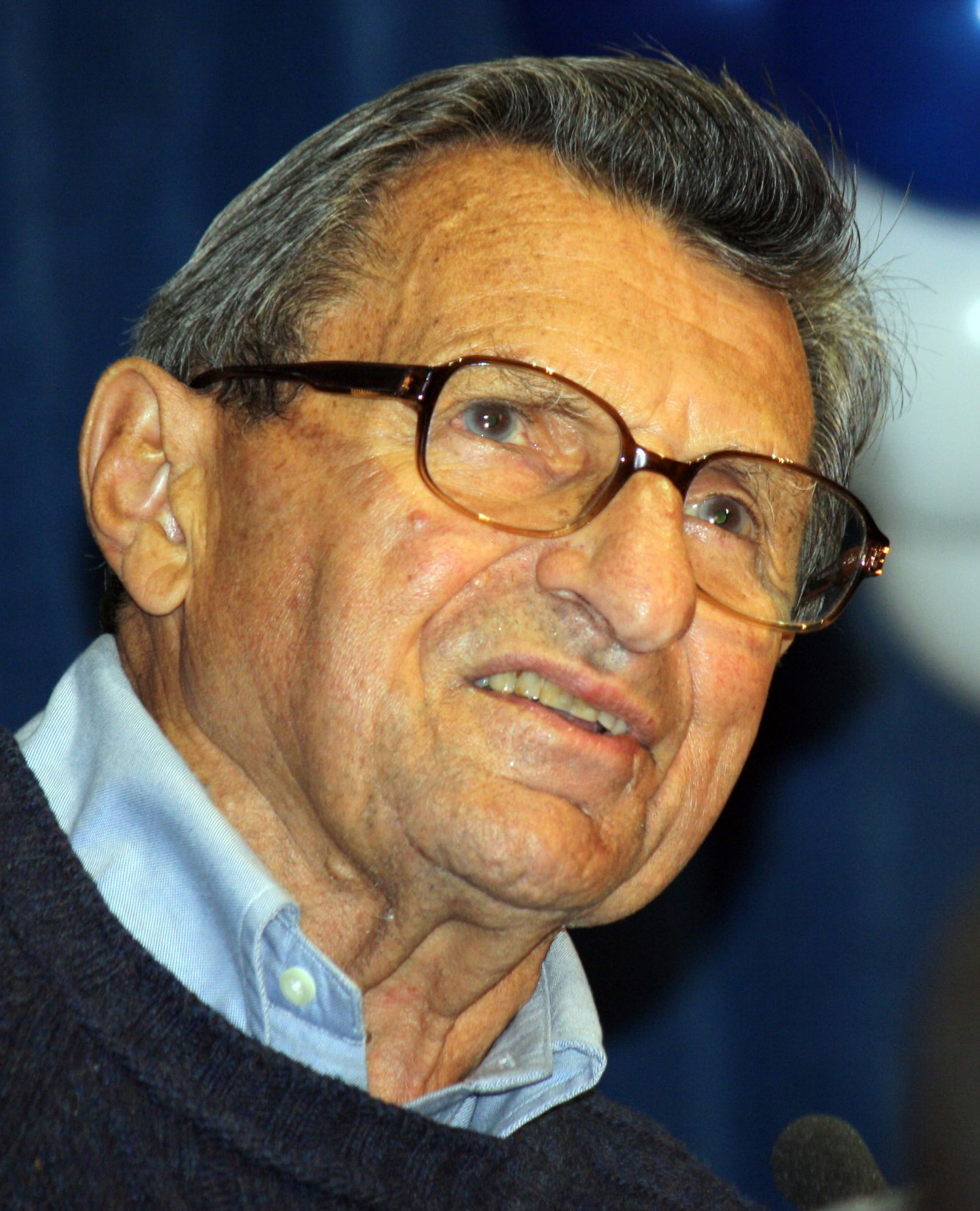
Joseph Vincent Paterno (/pəˈtɜːrn/; December 21, 1926 – January 22, 2012), sometimes referred to as JoePa, was an American college football player, athletic director, and coach. He was the head coach of the Penn State Nittany Lions from 1966 to 2011. With 409 wins, Paterno is the most victorious coach in NCAA FBS history. He recorded his 409th victory on October 29, 2011; his career ended with his dismissal from the team on November 9 (a week and a half after said victory), as a result of the Penn State child sex abuse scandal.[1][2][3] He died 74 days later, of complications from lung cancer.[4]

Key Information

Paterno was born in Brooklyn, New York. He attended Brown University, where he played football both ways as the quarterback and a cornerback. He had originally planned on going to law school, but he was instead hired in 1950 as an assistant football coach at Penn State. He was persuaded to do this by his college coach Rip Engle, who had taken over as Penn State's head coach. In 1966, Paterno was named as Engle's successor. He soon coached the team to two undefeated regular seasons in 1968 and 1969. The team won two national championships—in 1982 and 1986. Paterno coached five undefeated teams that won major bowl games, and in 2007 he was inducted into the College Football Hall of Fame as a coach. During his career, he led the Nittany Lions to 37 bowl appearances with 24 wins while turning down offers to coach National Football League (NFL) teams that included the Pittsburgh Steelers and the New England Patriots.

Paterno's coaching career ended abruptly in 2011, shortly before his death, when the Penn State Board of Trustees terminated his contract in response to a child sex abuse scandal involving Paterno's former defensive coordinator Jerry Sandusky.[5] An investigation conducted by former FBI director Louis Freeh reported that Paterno concealed information relating to Sandusky's abuse of a young boy.[6][7][8][9][10] A critique of the Freeh report, commissioned by the Paterno family, disputed Paterno's involvement in the alleged cover-up.[11]

In 2012, the NCAA vacated all of Penn State's wins from 1998 through 2011 as part of its punishment.[12] State Senator Jake Corman used the Freeh report as a basis to sue the NCAA, asserting that both Freeh and the NCAA had collaborated and failed to follow due process. Corman released emails showing "regular and substantive" contact between NCAA officials and Freeh's investigators, suggesting that Freeh's conclusions were orchestrated.[13] In a 2015 legal settlement with Penn State, the NCAA reversed its decision and restored all 111 wins to Paterno's record.[14][15]

Early life and education

[edit]

Paterno was born December 21, 1926, in Brooklyn, New York City, the son of Florence de LaSalle Cafiero, a homemaker, and Angelo Lafayette Paterno, a law clerk.[16] His family was of Italian ancestry. He spoke with a marked Brooklyn accent throughout his life. In 1944, Paterno graduated from Brooklyn Preparatory School. Six weeks later, he was drafted into the United States Army during World War II. Paterno spent a year in the Army before being discharged in time to start the 1946 school year at Brown University, where his tuition was paid by Busy Arnold.[17][18]

At Brown University, Paterno was a member of Delta Kappa Epsilon fraternity.[19] He played quarterback and cornerback for the Bears, and he shares the career record for interceptions (14) with Greg Parker.[20] Paterno graduated as an English literature major in 1950.[21]

Career

[edit]

Penn State Nittany Lions

[edit]

Paterno had been accepted to Boston University School of Law, and was planning to attend before changing his mind and deciding to coach at Penn State.[22] After hearing of his career choice, his father asked, "For God's sake, what did you go to college for?"[23] Paterno joined Rip Engle as an assistant coach at Penn State in 1950; Engle had coached five seasons, from 1944 to 1949, at Brown University.

In June 1964, Paterno was promoted to associate coach, the top assistant coaching position.[24] In 1966, when Engle announced his retirement,[25] Penn State University announced Paterno as his successor the following day.[26]

Paterno, c. 1976

Over his coaching career, Paterno had one Heisman Trophy winner, John Cappelletti, who earned the award in 1973.

Penn State football struggled from 2000 to 2004, with an overall 26–33 record in those years and Paterno became the target of criticism from some Penn State faithful. Many in the media attributed Penn State's struggles to Paterno's advancing age. He had no apparent plans to retire, and contingents of fans and alumni began calling for him to step down. Paterno rebuffed all of this and stated he would fulfill his contract until it expired in 2008.[27] Reflecting the growth in Penn State's stature, Beaver Stadium was expanded six times during his tenure, increasing in size from 46,284 in 1966 to 106,572 in 2001.

During a speech in Pittsburgh on May 12, 2005, Paterno announced that he would consider retirement if the 2005 football team had a disappointing season. "If we don't win some games, I've got to get my rear end out of here", Paterno said in a speech at the Duquesne Club. "Simple as that".[28] Penn State finished the season with a record of 11–1 and were champions of the Big Ten in 2005. They defeated Florida State 26–23 in triple overtime in the 2006 Orange Bowl.

The 2009 season was Paterno's 44th as head coach of the Nittany Lions, passing Amos Alonzo Stagg for the most years as head coach at a single institution in Division I.[29]

Paterno's abbreviated 2011 season was his 62nd on the Penn State coaching staff, which gave him the record for most seasons for any football coach at a single university.

From 2002 onward, Penn State faced a litany of players' off-the-field legal problems, which included 46 Penn State football players facing 163 criminal charges, of which 118 charges were dismissed or not proven, according to an ESPN analysis of Pennsylvania court records and reports.[30][31]

The Pennsylvania State Employees' Retirement System (SERS) revealed Paterno's salary in November 2007 as $512,664. He was paid $490,638 in 2006.[32] "I'm paid well, I'm not overpaid," Paterno said during an interview with reporters Wednesday before the salary disclosure. "I got all the money I need".[33]

Paterno was known for his gameday image — thick glasses, rolled-up dress slacks (by his admission, to save on cleaning bills), white socks and Brooklyn-tinged speech.[34]

Bowls and championships

[edit]
Paterno jogs out with his team before the start of a game in September 2007

Paterno holds an official NCAA total of 18 bowl victories. He holds the NCAA record for total bowl appearances with 37.[35] He had a bowl record of 24 wins, 12 losses, and 1 tie following a defeat in the 2011 Outback Bowl. Paterno was the first coach with the distinction of having won each of the four major bowls — Rose, Orange, Fiesta, and Sugar — as well as the Cotton Bowl Classic, at least once. Penn State won at least three bowl games in each of the four decades in which Paterno coached the entire decade, from 1970 thru 2009.

Paterno led Penn State to two national championships (1982 and 1986) and five undefeated, untied seasons (1968, 1969, 1973, 1986, and 1994). Four of his unbeaten teams (1968, 1969, 1973, and 1994) won major bowl games and were not awarded a national championship.

Under Paterno, Penn State won the Orange Bowl (1968, 1969, 1973 and 2005), the Cotton Bowl Classic (1972 and 1974), the Fiesta Bowl (1977, 1980, 1981, 1986, 1991, and 1996), the Liberty Bowl (1979), the Sugar Bowl (1982), the Aloha Bowl (1983), the Holiday Bowl (1989), the Citrus Bowl (1993 and 2010), the Rose Bowl Game (1994), the Outback Bowl (1995, 1998 and 2006), and the Alamo Bowl (1999 and 2007).

After Penn State joined the Big Ten Conference in 1993, the Nittany Lions under Paterno won the Big Ten championship three times (1994, 2005 and 2008). Paterno had 29 finishes in the Top 10 national rankings.

Awards and honors

[edit]

On May 16, 2006, Paterno was elected to the College Football Hall of Fame after the National Football Foundation decided to change its rules and allow any coach over the age of 75 to be eligible for the Hall of Fame instead of having to wait until retirement.[39] However, on November 4, 2006, he was injured during a sideline collision during a game against Wisconsin. As a result of his injuries, he was unable to travel to the induction ceremonies in New York City, and the National Football Foundation announced that he would instead be inducted as a part of the Hall of Fame class of 2007.[40] Paterno was inducted on December 4, 2007,[41] and officially enshrined in a ceremony held July 19, 2008.[42]

In 2009, Paterno was named to Sporting News' list of 50 greatest coaches of all time, including coaches from Major League Baseball, National Basketball Association, National Football League, National Hockey League, college basketball, and college football, ranked 13th overall.[43]

In 2010, the Maxwell Football Club of Philadelphia established the Joseph V. Paterno Award, to be awarded annually to the college football coach "who has made a positive impact on his university, his players and his community."[44] Following the breaking of the Penn State child sex abuse scandal the following year, the award was discontinued by the club.[45]

Also in 2010, the Big Ten Conference established the Stagg – Paterno Championship Trophy as the annual trophy to be awarded to the winner of the conference football championship.[46] However, on November 14, 2011, the trophy name was changed to the Stagg Championship Trophy in light of the Sandusky child abuse scandal.[47]

Paterno was also nominated for the Presidential Medal of Freedom. However, in light of the Sandusky child abuse scandal, U.S. Senators Pat Toomey and Bob Casey Jr., and Representative Glenn Thompson withdrew their support of Paterno receiving the honor.[48][49][50]

Child sex abuse scandal and dismissal

[edit]

My name, I have spent my whole life trying to make that name mean something. And now it's gone.
—Joe Paterno, following his termination[51]


I do not [believe Joe Paterno was involved in the alleged cover-up]. And I'm viewing this strictly on the evidence, not any kind of fealty to anybody. I did not find that evidence.
—Sandusky prosecutor Frank Fina, on 60 Minutes[52]

On November 5, 2011, former Penn State defensive coordinator Jerry Sandusky was arrested on 52 counts of child sexual abuse occurring between 1994 and 2009, including allegations of incidents on the Penn State campus.[53] A 2011 grand jury investigation reported that then-graduate assistant Mike McQueary told Paterno in 2002 (prosecutors later amended the date to 2001)[54] that he had seen Sandusky abusing a 10-year-old boy in Penn State football's shower facilities.[55][56] According to the report, Paterno notified Athletic Director Tim Curley about the incident and later notified Gary Schultz, vice president of finance and business,[57] to whom the University Police directly reported.[58] Paterno said McQueary informed him that "he had witnessed an incident in the shower... but he at no time related to me the very specific actions contained in the grand jury report."[59] In his grand jury testimony, Paterno stated that McQueary had described Sandusky "fondling" a young boy in an act he described as of a "sexual nature," but stopped short of the rape to which McQueary would later testify.[60][61][62] Despite the nature of the 2001 incident and that it later became clear that Curley and other university officials had not reported the allegations to police, Paterno did not then notify police either.[63][64] Instead, two weeks later, Curley reported that Sandusky's keys to the locker room had been taken away and that the incident was reported to The Second Mile charity. Sandusky was also banned from bringing children onto the Penn State campus.[65] While the prosecutors did not accuse Paterno of any wrongdoing, he was questioned over his apparent failure to follow up on his report to his boss about McQueary's statements.[66] Pennsylvania Attorney General Linda Kelly said that Paterno was cooperative with prosecutors and that he met his statutory responsibility to report the 2001 incident to school administrators.[67]

Under Pennsylvania state law at the time, any state employee who learned about suspected child abuse was required to report the incident to their immediate supervisor.[68] In the case of the 2001 incident, McQueary reported the incident to his immediate supervisor, Paterno. In turn, Paterno reported the incident to his immediate supervisor, Curley, who then reported it to Gary Schultz, former senior vice president for business and finance, a position to which the University Police Department directly reported. (Schultz failed to notify his subordinate, the director of university police.) For these reasons, Paterno did not come under criminal suspicion.[68][69][70] Pennsylvania State Police Commissioner Frank Noonan, however, criticized Paterno for not doing enough to stop Sandusky's crimes. Noonan stated that while Paterno may have done what he was legally required to do, anyone with knowledge of possible sexual abuse against minors had "moral requirements" to notify police.[64]

On the night of November 8, hundreds of students gathered in front of Paterno's home in support of Paterno. Paterno thanked the crowd and said, "The kids who were victims or whatever they want to say, I think we all ought to say a prayer for them. It's a tough life when people do certain things to you."[71][72] As Paterno began walking back into his home with the crowd chanting "Let Joe Stay," he turned around to instead lead the crowd in "We are Penn State" cheers,[73] which unnamed members of the Penn State Board of Trustees viewed as insensitive.[2] Within days of the scandal breaking in full, speculation was rife that Paterno would not be allowed to return as head coach. On November 9, Paterno announced that he would retire at the end of the season, stating:

. . . I have decided to announce my retirement effective at the end of this season. At this moment the Board of Trustees should not spend a single minute discussing my status. They have far more important matters to address. I want to make this as easy for them as I possibly can.[74][75]

Later that evening, however, the board of trustees voted to terminate Paterno's contract, effective immediately.[2][76] They considered but ultimately rejected the idea of letting Paterno finish out the season, saying that growing outrage at the situation would have made it impossible for him to be effective as coach.[2][77][78] Unable to reach Paterno personally due to the crowd around his house and not wanting Paterno to find out through the media, the board notified him of their decision over the telephone.[79][80] Tom Bradley, Sandusky's successor as defensive coordinator, was named interim head coach for the remainder of the 2011 season. At the same meeting, university president Graham Spanier resigned rather than face being fired as well.[81][82][83][84] That night, several thousand Penn State students chanting Paterno's name rioted in the streets, hurling rocks, tearing down street signs, and overturning a news van.[85]

Paterno supporters and family members continued to harshly criticize the board's actions in the months following his death, prompting the board in March 2012 to release an additional statement explaining their decision. In it, the board said that it opted to remove Paterno after finding that "his decision to do his minimum legal duty and not to do more to follow up constituted a failure of leadership."[79][80] The board had earlier said there were three key reasons for his firing: his failure to do more when told about a suspected sexual assault by Jerry Sandusky; what the board of trustees regarded as his questioning of the board's authority in the days after Sandusky's arrest; and what the board determined to be his inability to effectively continue coaching in the face of continuing questions surrounding the program.[2] However, in late 2014 and early 2015, court depositions by trustees Kenneth Frazier and Keith Masser conflicted with the "failure of leadership" story. Masser stated, "The decision to remove Coach Paterno had nothing to do with what he had known, what he hadn't done. It was based upon the distraction of having him on the sidelines would have caused the university and the current football team harm. It had nothing to do with what Coach Paterno had done, or hadn't done."[86][87]

Posthumous findings

[edit]

Former FBI director Louis Freeh and his firm, including a team of former federal prosecutors and FBI agents, were hired by the Penn State Board of Trustees to conduct an independent investigation into the scandal.[88] In the opinion of writer Michael Sokolove, the mission Freeh was given seemed to speculate that Sandusky's crimes were not his alone and that people who had reason to suspect him had looked away.[89] After interviewing over 400 people and reviewing voluminous documents, the investigation team reported that Paterno, Spanier, Curley, and Schultz (none of whom was interviewed) concealed Sandusky's actions in order to protect the publicity surrounding Penn State's celebrated football program.[6][7][90] Freeh's firm's investigation concluded that by their actions, the four men "failed to protect against a child sexual predator harming children for over a decade." The report asserted that Paterno, Schultz, Spanier, and Curley "concealed Sandusky's activities from the Board of Trustees, the University community and authorities."[91]

Freeh's investigators discovered an email between Curley and Schultz regarding a previous incident between Sandusky and another child in 1998 that the district attorney declined to prosecute after an investigation by State College police and an evaluation by the Department of Public Welfare. On May 13, 1998, in an email with the subject "Jerry," Curley asked Schultz, "Anything new in this department? Coach is anxious to know where it stands." Curley testified more than nineteen years later in the 2017 criminal trial against Spanier that the "coach" who wanted to know where it stands was Paterno.[92][93][94] Before a grand jury in 2011, when Paterno was asked, other than the 2001 incident that Mike McQueary reported to him, whether he knew of any other inappropriate sexual conduct by Sandusky with young boys, Paterno testified, "I do not know of anything else that Jerry would be involved in of that nature, no. I do not know of it. You did mention — I think you said something about a rumor. It may have been discussed in my presence, something else about somebody. I don't know. I don't remember, and I could not honestly say I heard a rumor."[95][96]

Freeh's team also discovered a 2001 email from Curley about the subsequent 2001 incident in which McQueary witnessed Sandusky with a boy in the Penn State showers. On February 25, Curley, Schultz, and Spanier decided to have Curley report McQueary's information to the state Department of Public Welfare. On February 26, Curley had a conversation with Paterno. (Curley testified in 2017, "I don't recall the specific conversation or what his [Paterno's] reaction was.") On February 27, Curley emailed Spanier and Schultz that he was "having trouble with going to everyone, but the person involved". (In 2017 he testified that was his opinion. "I wanted the first step to be a meeting with Jerry Sandusky.") Curley, Schultz and Spanier then agreed to report the incident to both the Department of Public Welfare and the Second Mile if Sandusky did not cooperate and get professional help (i.e., rather than not reporting the incident to authorities outside the university, reporting to the Department of Public Welfare was still part of the plan).[91]: Exh 2F  In his press release, Freeh wrote to the contrary that "the only known, intervening factor between the decision made on February 25, 2001 by Messrs. Spanier, Curley and Schulz to report the incident to the Department of Public Welfare, and then [as alleged by Freeh] agreeing not to do so on February 27th, was Mr. Paterno's February 26th conversation with Mr. Curley." Freeh's mischaracterization of the February 27 email was widely inferred by the press to mean that Paterno had persuaded Curley (and Schultz and Spanier) not to report the incident to authorities outside the university.[8][9][10]

In addition, the Freeh report said that even after Sandusky's retirement in 1999, Paterno, Schultz, Spanier, and Curley "empowered Sandusky to attract potential victims to the campus and football events by allowing him to have continued, unrestricted and unsupervised access to the University's facilities and affiliation with the University's prominent football program."[91]: 14–15  Sandusky's access was part of the retirement agreement between the university and Sandusky: "The university will permit you to use, at no charge, a locker, weight rooms, fitness facilities and training room in the East Area locker room complex. This benefit will continue for the balance of your lifetime," and "For a period of ten years commencing July 1, 1999 and subject to renewal upon concurrence of both parties you will be given an office and a phone in the East Area Locker room complex ..." The agreement was signed by Curley and Schultz along with Sandusky on June 29, 1999.[91]: Exh 3H 

Following the release of the Freeh report, Nike, Inc. removed Paterno's name from the Joe Paterno Child Development Center, a child care facility at the company's headquarters in Beaverton, Oregon.[97][98] Brown University, Paterno's alma mater, announced that it would remove Paterno's name from its annual award honoring outstanding male freshman athletes and stated his status in the Brown Athletic Hall of Fame would be placed under review.[99]

Joe Paterno statue before it was removed from the front of Penn State's Beaver Stadium. The statue was removed on July 22, 2012, six months after Paterno's death, and placed in secure storage inside the stadium.

On July 14, 2012, The New York Times reported that in January 2011, Paterno opened "surprise" negotiations to prematurely end his contract with an additional $3 million early retirement payout, prior to public knowledge of the scandal. Although his contract was not up for negotiation until the end of 2011, Paterno initiated negotiations with his superiors to amend his contract in January 2011, the same month he was notified of the police investigation. By August 2011, Paterno and his attorneys had reached a deal with the PSU Board for a total package worth $5.5 million, including a $3 million cash payout, forgiveness of a $350,000 interest-free loan issued by the university, and the use of a private box at Beaver Stadium and a private jet for 25 years, if he agreed the 2011 season would be his last. Ultimately, the board rejected Paterno's offer to resign at the end of the 2011 season. But following Paterno's firing, faced with hate mail and a threat of a defamation lawsuit by Paterno's family, the board agreed to give Paterno and his family the $5.5 million package, which included additional perks for the family. A lawyer for the family said that Penn State proposed the retirement package.[100]

After the Freeh report's release, critics called for the removal of the Joe Paterno statue outside Beaver Stadium. A small plane towed a banner over campus, reading Take the Statue Down or We Will.[101] After some days of mixed messages,[102][103][104] the school removed the statue on Sunday, July 22, in front of a crowd of student onlookers.[105] The statue was reportedly put in storage.[106] Spanier's successor as president, Rodney Erickson, said the statue had become "a source of division and an obstacle to healing" but made a distinction between it and the Paterno Library, also on campus.[107]

On July 23, two weeks after the release of the Freeh report, the NCAA punished Penn State with some of the most severe sanctions ever handed down in the history of collegiate athletics.[108] Penn State was fined $60 million, stripped of 40 total scholarships from 2013 to 2017, banned from postseason play until 2016, and vacated all 112 of its wins dating back to 1998. This included the removal of Paterno's last 111 wins at Penn State, dropping him from first to 12th on the all-time wins list. (In early 2015 the wins were restored.)[109] The NCAA reported that "Penn State's leadership failed to value and uphold institutional integrity, breaching both the NCAA Constitution and Division I rules", and that the NCAA "intended to remediate the 'sports is king' culture that led to failures in leadership".[110] The NCAA report harshly criticized Paterno for his role in an alleged cover-up of Sandusky's crimes, saying that Paterno, Spanier, Schultz, and Curley had demonstrated "a failure of institutional and individual integrity". Although this action was outside the normal process for investigating major violations, the NCAA said this action was merited because the alleged cover-up violated basic principles of intercollegiate athletics that were over and above specific policies.[111][112][113]

In a September 2013 interview with the CBS show 60 Minutes, Sandusky prosecutor Frank Fina was asked if he believed Joe Paterno was involved in the alleged cover-up. Fina stated, "I do not. And I'm viewing this strictly on the evidence, not any kind of fealty to anybody. I did not find that evidence."[52]

Response to the Freeh Report

[edit]

On September 13, 2012, a group of alumni and supporters called Penn Staters for Responsible Stewardship released a review of the Freeh Report that was critical of the Freeh Group's investigation and conclusions.[114] In February 2013, Paterno's family released a report written by Dick Thornburgh, a former U.S. attorney general and Pennsylvania governor, disputing Freeh's investigative methods and the portrayal of Paterno in his findings, calling the Freeh report a "rush to injustice".[115] Thornburgh concluded that the Freeh report was "seriously flawed, both with respect to the process of [its] investigation and its findings related to Mr. Paterno".[116] In response, Freeh called the Paterno family's report "self-serving" and said that it did not change the facts and findings of his initial investigation.[117]

NBC sportscaster Bob Costas said, "What Freeh did was not only gather facts but he reached a conclusion which is at least debatable from those facts and then he assigned a motivation, not only to Curley and Schultz and Spanier, but he specifically assigned a very dark motivation to Joe Paterno, which seems like it might be quite a leap. ... A reasonable person will conclude that there is some doubt here and that the other side of the story deserves to be heard."[118] Similarly Todd Blackledge, ESPN college football analyst and former Penn State quarterback, noted on the media coverage, "it felt like the media felt at liberty to just connect [] all those dots, whether they had facts. Based on whatever information they had, they were going to connect the dots and tell a story. And it had tremendous momentum. Because of the serious and horrendous nature of the allegations against Jerry, that narrative went pretty much unopposed."[119]

In 2014 NCAA internal emails revealed that the NCAA worked closely with Louis Freeh in his investigation of the Sandusky scandal.[120] In addition, emails revealed that many in the NCAA questioned whether they had the authority to sanction Penn State and that some officials wanted to "bluff" Penn State's leadership into accepting a severe punishment, because they believed that they did not have the authority to punish Penn State.[121] On the day the Freeh Report was released, Oregon State president Ed Ray, chairman of the NCAA's executive committee, sent an e-mail to NCAA president Mark Emmert, his deputy, and the former enforcement head of the NCAA that directed them to come up with a way to sanction Penn State.[122][123]

Freeh had maintained publicly that his investigation was entirely independent and would include "no favoritism". This was criticized by Pennsylvania state Senator Jake Corman, who claimed, "There clearly is a significant amount of communication between Freeh and the NCAA that goes way beyond merely providing information. I'd call it coordination ... Clearly, Freeh went way past his mandate. He was the enforcement person for the NCAA. That's what it looks like. I don't know how you can look at it any other way. It's almost like the NCAA hired him to do their enforcement investigation on Penn State. At a minimum, it is inappropriate. At a maximum, these were two parties working together to get an outcome that was predetermined."[124] NCAA Vice President of Academic and Membership Affairs Kevin Lennon wrote in another email from July 14 that the NCAA was "banking on the fact the school is so embarrassed they will do anything" before interim Penn State president Rodney Erickson signed the consent decree.[15]

In January 2013, Senator Corman and state treasurer Rob McCord used the Freeh report as a basis to sue the NCAA, arguing that the $60 million fine should be kept to assist victims of child sexual abuse in Pennsylvania, instead of allowing it to be spread to programs beyond the state's boundaries.[13]

On May 30, 2013, the Paterno family and members of the Penn State community (though not the university itself) filed a lawsuit in the Centre County Court of Common Pleas in an attempt to overturn sanctions against the school. The lawsuit asserted that the NCAA and the other defendants breached their contractual obligations, violated their duties of good faith and fair dealing, intentionally interfered with contractual relations, and defamed and/or commercially disparaged the individuals filing the lawsuit.[125]

On January 16, 2015, the NCAA agreed to a settlement, removing the probationary period imposed on Penn State and restoring Paterno's 111 wins between 1998 and 2011. Corman proclaimed, "Today is a victory for due process which was not afforded in this case. Today is a victory for the people of Pennsylvania. Today is a victory for Penn State nation."[126]

A year after the report was issued, the chairman of the Penn State Board of Trustees, which had originally commissioned the report, said that Freeh's conclusions amounted to "speculation."[127] In a January 2015 interview with the Associated Press, Penn State President Eric Barron said, "I have to say, I'm not a fan of the report. There's no doubt in my mind, Freeh steered everything as if he were a prosecutor trying to convince a court to take the case."[128]

On July 12, 2016, The New York Times reported that, in a document created in 2014, an anonymous man alleged that Sandusky had touched him inappropriately in 1976 and that he had told Paterno the next day.[129]

Views on college football issues

[edit]
Paterno in 2003

Paterno was a long-time advocate for some type of college football playoff system. The question was posed to him frequently over the years, as only one of his five undefeated teams was voted national champion.[130][131][132] The college football playoff system would become a reality three years after Paterno's exit from the game.

Paterno believed that scholarship college athletes should receive a modest stipend so that they have some spending money. As justification, Paterno pointed out that many scholarship athletes came from poor families and that other students had time to hold down a part-time job, whereas busy practice and conditioning schedules prevented college athletes from working during the school year.[133]

Paterno initially preferred not to play true freshmen, but later in his career he did play redshirts in order to refrain from being at a competitive disadvantage. Some Penn State recruits, like recruits at many other schools, now graduate from high school a semester early so that they can enroll in college during the spring semester and participate in spring practice. Several team members from the recruiting class of 2005, including Justin King, Anthony Scirrotto, and Derrick Williams, received considerable playing time as true freshmen during the 2005–2006 season.[134]

In 2010, Paterno and former Chicago Bears head coach Mike Ditka suggested that concussions and other injuries in the NFL and college football might be reduced if face masks were eliminated.[135]

Penn State's football players were twice recognized for outstanding academic performance by the New America Foundation's Academic Bowl Championship Series while under the leadership of Paterno.[136] The team was ranked number one out of the top 25 ranked BCS teams in 2009 and 2011. The criteria in the rankings include the graduation rate of the team as compared to the rest of university, the difference between the graduation rate of African-American players and the rest of the squad as well as the same statistics for the rest of the students at Penn State, and the graduation rate differences between the African American players and students.[136]

Officiating and instant replay

[edit]

In 2002, 76-year-old Paterno chased down referee Dick Honig in a dead sprint following a 42–35 overtime home loss to Iowa. Paterno saw Tony Johnson catch a pass for a first down with both feet in bounds on the stadium's video replay board, but the play was ruled an incompletion. This being after Penn State had rallied from a 35–13 deficit with 9 minutes left in the game to tie the score at 35, and were driving on their first possession in overtime (a touchdown would have tied the game at 42). Penn State failed on fourth down and Iowa held on for the win.[137]

Just weeks later, in the final minute of the Michigan game, the same wide receiver, Johnson, made a catch that would have given Penn State a first down and put them in range for a game-winning field goal. Although Johnson was ruled out of bounds, replays clearly showed that Johnson had both feet in bounds and the catch should have been ruled complete.[138]

In 2004, the Big Ten Conference became the first college football conference to adopt a form of instant replay. The previous two incidents, along with Paterno's public objections, and the Big Ten's Clockgate controversy, are often cited as catalysts for its adoption.[139] Within the next year, almost all of the Division I-A conferences adopted a form of instant replay based on the Big Ten model.[140]

Outside of football

[edit]

Philanthropy and education

[edit]
The East wing of the Pattee Library (center) is connected to the Paterno Library (to right, not seen) at Penn State University.

After the announcement of his appointment as head coach in 1966, Paterno set out to conduct what he called a "Grand Experiment" in melding athletics and academics in the collegiate environment, an idea that he had learned during his years at Brown.[141] As a result, Penn State's players have consistently demonstrated above-average academic success compared to Division I-A schools nationwide. According to the NCAA's 2008 Graduation Rates Report, Penn State's four-year Graduation Success Rate of 78% easily exceeds the 67% Division I average, second to only Northwestern among Big Ten institutions.[142] In 2011, Penn State football players had an 80% graduation rate and showed no achievement gap between its black and white players, which is extremely rare for Division I football teams.[143] The New American Foundation ranked Penn State No. 1 in its 2011 Academic Bowl Championship Series.[144]

Paterno was also renowned for his charitable contributions to academics at Penn State. He and his wife Sue have contributed over $4 million towards various departments and colleges, including support for the Penn State All-Sports Museum, which opened in 2002, and the Pasquerilla Spiritual Center, which opened in 2003.[145] After helping raise over $13.5 million in funds for the 1997 expansion of Pattee Library, the university named the expansion Paterno Library in their honor.[146]

In 2007, former player Franco Harris and his company R Super Foods honored Paterno for his contributions to Penn State by featuring his story and picture on boxes of Super Donuts and Super Buns in Central PA. A portion of the sales will be donated to an endowment fund for the university library that bears his name.[147]

Paterno also attended the annual Penn State Dance Marathon, a popular weekend-long charity event and the largest student-run philanthropy in the world (it raised over $10 million in 2012), every year to raise money for kids with cancer.

Political interests

[edit]
Paterno shakes hands with FIU Coach Mario Cristobal in September 2007.

Paterno was a political conservative and a personal friend of President George H. W. Bush.[141] He campaigned for Bush door-to-door in the 1988 New Hampshire primary, and seconded his nomination at the Republican National Convention.[148] Paterno was also a close friend of President Gerald R. Ford,[149] and introduced President George W. Bush at a campaign rally before the 2004 presidential election.[150] Before the 1974 Pennsylvania gubernatorial election, a group of Pennsylvania Republican Party leaders briefly considered Paterno for Andrew Lewis' ticket as the candidate for lieutenant governor.[151]

In 2004, his son Scott Paterno, an attorney, won the Republican primary for Pennsylvania's 17th congressional district but lost in the November general election to Democratic incumbent Tim Holden.[152] "I brought my kids up to think for themselves since day one," Joe Paterno said in 2008. "I got a son who's a Republican, who ran for Congress, Scott. I'm a Republican. I've got a son, Jay, who's for Obama. I've got a daughter, who I'm pretty sure she's going to be for Hillary [Clinton]. So God bless America."[153]

Personal life

[edit]

While serving as an assistant coach, Paterno met freshman coed Suzanne Pohland at the campus library;[154] she was a Latrobe native 13 years his junior and an English literature honors student. They married in 1962, the year she graduated. They had five children: Diana, Joseph Jr. "Jay", Mary Kay, David, and Scott. All of their children are Penn State graduates, and Jay Paterno was the quarterbacks coach at Penn State until his departure following the hiring of new head coach Bill O'Brien on January 7, 2012. The Paternos had 17 grandchildren.

Paterno was a longtime summer resident of Avalon, New Jersey.[155]

Paterno and Suzanne co-authored the children's book We Are Penn State!,[156] which takes place during a typical Penn State homecoming weekend.

Deteriorating health and death

[edit]
Thousands of Penn State students and faculty attend a candlelight vigil for Paterno at Old Main on his day of death, January 22, 2012.

In November 2006, Paterno was involved in a sideline collision during a game against Wisconsin. He was unable to avoid the play and was struck in the knee by Badgers linebacker DeAndre Levy's helmet. Paterno, then 79 years old, suffered a fractured shin bone and damage to knee ligaments.[157] He coached the 2007 Outback Bowl from the press box before making a full recovery.[158][159]

In November 2008, Paterno had successful hip replacement surgery after spraining his leg while trying to demonstrate onside kicks during a practice session.[160] While recovering, he coached the remainder of the season and the 2009 Rose Bowl from the press box.[161] After sustaining these injuries, he made use of a golf cart to move around the field during practices.

Paterno was injured again in August 2011, after colliding with a player during practice. He sustained hairline fractures to his hip and shoulder. No surgery was required, but Paterno began the 2011 regular season schedule in a wheelchair.

On November 18, 2011, just nine days after his dismissal from Penn State, Paterno's son Scott reported that his father had a treatable form of lung cancer.[162] On January 13, 2012, Paterno was hospitalized in State College for complications relating to his cancer treatment, and he remained there until his death nine days later on January 22, 2012; his death came 74 days after his dismissal from Penn State.[163][164] His death resulted in tributes from prominent leaders in the U.S., including former President George H. W. Bush, who called Paterno "an outstanding American who was respected not only on the field of play but in life generally—and he was, without a doubt, a true icon in the world of sports."[165] Pennsylvania Governor Tom Corbett said of Paterno, "His legacy as the winningest coach in major college football and his generosity to Penn State as an institution and to his players, stand as monuments to his life. ... His place in our state's history is secure."[165] On January 23, Corbett ordered all state flags to be lowered to half staff in Paterno's honor.[166] At the time of his death, Penn State was still finalizing Paterno's retirement package.[77]

Paterno's funeral was held in State College on January 25, 2012.[167] About 750 mourners attended the private ceremony, after which thousands of mourners lined the route of the funeral procession.[168] Paterno was buried in Spring Creek Presbyterian Cemetery just outside the town.[169] Approximately 12,000 people attended a public memorial service that was held at the Bryce Jordan Center on January 26, 2012.[170][171]

Head coaching record

[edit]

At the time of his death, Paterno had accumulated a record of 409 wins, 136 losses, and 3 ties. However, on July 23, 2012, the NCAA officially vacated 111 of Paterno's wins based on the findings of the Freeh report regarding his involvement in the Penn State sex abuse scandal. All wins dating back to 1998 were vacated, the year Paterno was first informed of Sandusky's suspected child abuse.[172][173] Based on the criteria used by the NCAA, Paterno no longer held the record for most victories by an NCAA Division I football coach. Former Florida State coach Bobby Bowden held the NCAA major college record for wins at 377, while for NCAA Division I schools, Grambling State University coach Eddie Robinson's 408 victories stood as the official record.[174] The 111 wins were restored on January 16, 2015, as a part of a settlement between the NCAA and Penn State, once again making him the most victorious coach in FBS NCAA football history.[175][176]

Year Team Overall Conference Standing Bowl/playoffs Coaches# AP°
Penn State Nittany Lions (NCAA University Division / Division I / Division I-A independent) (1966–1992)
1966 Penn State 5–5
1967 Penn State 8–2–1 T Gator 11 10
1968 Penn State 11–0 W Orange 3 2
1969 Penn State 11–0 W Orange 2 2
1970 Penn State 7–3 19 18
1971 Penn State 11–1 W Cotton 11 5
1972 Penn State 10–2 L Sugar 8 10
1973 Penn State 12–0 W Orange 5 5
1974 Penn State 10–2 W Cotton 7 7
1975 Penn State 9–3 L Sugar 10 10
1976 Penn State 7–5 L Gator
1977 Penn State 11–1 W Fiesta 4 5
1978 Penn State 11–1 L Sugar 4 4
1979 Penn State 8–4 W Liberty 18 20
1980 Penn State 10–2 W Fiesta 8 8
1981 Penn State 10–2 W Fiesta 3 3
1982 Penn State 11–1 W Sugar 1 1
1983 Penn State 8–4–1 W Aloha Bowl 17
1984 Penn State 6–5
1985 Penn State 11–1 L Orange 3 3
1986 Penn State 12–0 W Fiesta 1 1
1987 Penn State 8–4 L Florida Citrus
1988 Penn State 5–6
1989 Penn State 8–3–1 W Holiday 14 15
1990 Penn State 9–3 L Blockbuster 10 11
1991 Penn State 11–2 W Fiesta 3 3
1992 Penn State 7–5 L Blockbuster 24
Penn State Nittany Lions (Big Ten Conference) (1993–2011)
1993 Penn State 10–2 6–2 3rd W Florida Citrus 7 8
1994 Penn State 12–0 8–0 1st W Rose 2 2
1995 Penn State 9–3 5–3 T–3rd W Outback 12 13
1996 Penn State 11–2 6–2 T–3rd W Fiesta 7 7
1997 Penn State 9–3 6–2 T–2nd L Florida Citrus 17 16
1998 Penn State 9–3 5–3 5th W Outback 15 17
1999 Penn State 10–3 5–3 T–4th W Alamo 11 11
2000 Penn State 5–7 4–4 T–6th
2001 Penn State 5–6 4–4 T–4th
2002 Penn State 9–4 5–3 4th L Capital One 15 16
2003 Penn State 3–9 1–7 T–8th
2004 Penn State 4–7 2–6 9th
2005 Penn State 11–1 7–1 T–1st W Orange 3 3
2006 Penn State 9–4 5–3 T–4th W Outback 25 24
2007 Penn State 9–4 4–4 T–5th W Alamo 25
2008 Penn State 11–2 7–1 T–1st L Rose 8 8
2009 Penn State 11–2 6–2 T–2nd W Capital One 8 9
2010 Penn State 7–6 4–4 T–4th L Outback
2011 Penn State 8–1[n 1] 5–0[n 1] (Leaders)[n 1]
Penn State: 409–136–3 95–54
Total: 409–136–3
      National championship         Conference title         Conference division title or championship game berth

Coaching tree

[edit]

Assistant coaches under Paterno that became NFL or NCAA head coaches:

Players under Paterno that became NFL or NCAA head coaches:

Players under Paterno that became general managers or executives in the NFL:

See also

[edit]

Notes

[edit]

References

[edit]
[edit]
Revisions and contributorsEdit on WikipediaRead on Wikipedia
from Grokipedia
Joseph Vincent Paterno (December 21, 1926 – January 22, 2012) was an American coach who served as head coach of the from 1966 to 2011. Over his 46-year tenure, Paterno compiled a record of 409 wins, 136 losses, and 3 ties, establishing the benchmark for most victories by a coach in NCAA Football Bowl Subdivision history at the time. His teams secured national championships in 1982 and 1986, along with five undefeated seasons and numerous bowl victories, while maintaining a strong emphasis on academic achievement among players. Paterno's career concluded abruptly in November 2011 when Penn State trustees fired him amid fallout from a investigation into allegations against his longtime , who was later convicted on 45 counts; Paterno reported the key 2001 eyewitness account to university administrators but was criticized for not notifying law enforcement directly, though he faced no criminal charges and investigations into his knowledge have yielded disputed findings. Paterno died from complications of two months later, prompting polarized reflections on his legacy of on-field success and institutional ethics.

Early Life and Education

Childhood and Family Influences

Joseph Vincent Paterno was born on December 21, 1926, in , New York, the eldest of four children to and Paterno. His father, Lafayette Paterno, immigrated from as a child or was the son of recent immigrants, worked as a to finance for a , and later held the position of Clerk of the of the First Judicial District in New York; he was recognized for his idealism, love of , and leadership in interfaith initiatives. Paterno managed the household as a homemaker in the family's working-class environment amid Brooklyn's dense, energetic urban streets. The Paternos emphasized education and personal achievement, with taking an extra job to cover tuition costs, directing Joe toward as preparation for a legal career akin to his own. This parental focus on intellectual rigor and ethical standards influenced Paterno's lifelong prioritization of academic success alongside athletics, as evidenced by his later insistence on high graduation rates for his players. 's values of integrity and societal contribution extended to advising Joe, upon his pivot from to , to "make an impact," a directive that Paterno credited with guiding his professional ethos. Paterno's sibling dynamics further reinforced competitive and familial bonds, particularly with George, who shared his early football experiences at Brooklyn Preparatory School—a Jesuit attended by both—and later at , where they played together. George, who pursued and analysis roles at Penn State, exemplified the family's orientation toward sports and , though the two sisters received less public documentation in Paterno's biographical accounts. The household's Italian-American heritage, marked by resilience amid immigrant challenges, fostered a pragmatic that Paterno later channeled into disciplined team-building.

Athletic and Academic Development at Brown University

Paterno enrolled at after completing military training at the preparatory school, majoring in English literature and earning his bachelor's degree in 1950. His academic pursuits reflected a pre-existing interest in , influenced by his father's profession, though he balanced coursework with demanding athletic commitments in the Ivy League environment, where eligibility rules emphasized scholarly performance alongside sports. Athletically, Paterno joined the team from 1946 to 1949, starting as a for his first two seasons before shifting to and special teams roles in his junior and senior years under Charles "Rip" Engle. As starting , he posted a 15-3 record, anchoring the 1949 team's 8-1 mark that established it as an Eastern powerhouse. His defensive prowess yielded 14 career interceptions, a Brown program record, while on special teams he averaged 8.8 yards per punt return (with 350 career yards ranking third all-time) and 20.1 yards per kickoff return, highlighted by a 69-yard punt return against Holy Cross in 1949. In a signature 1949 comeback against Colgate, Paterno intercepted a pass, broke a 40-yard run, and threw a pass during a 34-point rally, showcasing his versatility and quick decision-making. This period honed Paterno's cerebral approach to the game, blending offensive orchestration with defensive instincts and return skills, which impressed Engle and foreshadowed his emphasis on intelligent, multi-faceted players. Post-senior year, he assisted part-time with Brown's quarterbacks under Engle, gaining early exposure while maintaining academic eligibility standards that prioritized intellectual development—principles he later credited for shaping his views on student-athletes. His contributions earned induction into the Athletic Hall of Fame in 1977 and selection to the program's 125th Anniversary All-Time Team as a .

Entry into Coaching

Assistant Roles at Penn State

Joseph Vincent Paterno joined the Penn State football staff in 1950 as an assistant coach under head coach , his former mentor from , initially intending to serve for one year before pursuing . He primarily handled responsibilities as backfield coach, focusing on the development of running backs, quarterbacks, and offensive strategies during his 16-year tenure as assistant from 1950 to 1965. Paterno's contributions under Engle included recruiting talent and implementing disciplined training regimens that elevated the program's competitiveness, contributing to notable successes such as the 1960 undefeated regular season (9-0) and Lambert Trophy award as the top Eastern independent team. His loyalty was evident in his rare absences; during his assistant years, he missed only select games, including the 1955 matchup at due to personal commitments. By 1965, Engle elevated him to assistant , signaling Paterno's grooming as successor amid the program's growing national profile. This period solidified Paterno's foundational influence on Penn State's "Grand Experiment" philosophy, emphasizing alongside athletic achievement, as he helped build a staff and roster that transitioned seamlessly upon Engle's . Paterno's tenure as assistant spanned 16 seasons, during which the Nittany Lions compiled a 104-48-4 record under Engle, including multiple bowl appearances like the 1960 victory over Oregon State.

Transition to Head Coach

Paterno served as an assistant coach under Rip Engle at Penn State from 1950 to 1965, initially focusing on quarterback coaching and later expanding responsibilities. Engle, Paterno's former coach at Brown University, had recruited him to the staff, dissuading him from pursuing law school. In 1965, Engle elevated Paterno to assistant head coach, positioning him as the presumptive successor amid the program's growing success in the Atlantic Coast Conference independents era. Engle announced his retirement on February 18, 1966, after 16 seasons at Penn State, citing health concerns and a desire to step aside while the program was strong. The following day, February 19, 1966, university president Eric A. Walker appointed Paterno as , bypassing external candidates in favor of internal continuity. Paterno agreed to a three-year contract with an annual salary of $20,000, reflecting the university's confidence in his preparation after 16 years on staff. Paterno's first game as occurred on September 17, 1966, against , marking the start of his 46-season tenure. The Nittany Lions finished that inaugural season with a 5–5 record, a transitional outcome as Paterno implemented his emphasis on player development and while building on Engle's foundations.

Head Coaching Tenure at Penn State

Program Building and Philosophy

Upon assuming the head coaching position at Penn State in 1966 following a 5-5 debut season, Joe Paterno pursued a vision of constructing an elite football program grounded in academic excellence and personal integrity, dubbing it the "Grand Experiment." This approach prioritized recruiting athletes capable of succeeding scholastically, resulting in Penn State players consistently achieving above-average graduation rates compared to national averages. Paterno emphasized developing well-rounded individuals over mere athletic prowess, insisting that football serve higher education's mission rather than overshadow it. Central to Paterno's philosophy was the motto "Success with Honor," which encapsulated a commitment to ethical conduct, , and within the program. He fostered team privacy and internal cohesion, shielding players from external distractions to maintain focus on preparation and performance. Recruiting efforts targeted the Northeast region, appealing to prospects and their families by highlighting the program's alignment with educational values and long-term personal growth, rather than professional prospects alone. This strategy enabled gradual program elevation, transforming Penn State from an independent with modest success into a national contender through sustained high standards. Paterno's methods included rigorous preparation and a conservative tactical style that rewarded fundamentals and player development over flashy innovation. He viewed as an extension of , aiming to instill life lessons on responsibility and resilience, which he believed causal drivers of both on-field victories and off-field achievements. By resisting pressures to compromise academic rigor for athletic gains—unlike many contemporaries—Paterno's framework sustained program integrity amid evolving dynamics.

Key Seasons and National Championships

Under Joe Paterno's guidance, Penn State secured two national championships, in 1982 and 1986, both affirmed by major selectors including the Associated Press and coaches' polls. These triumphs highlighted Paterno's emphasis on disciplined execution and defensive resilience, with the 1986 team achieving a perfect 12–0 record for consensus recognition. The program also produced four other undefeated seasons (1968, 1969, 1973, and 1994), though none yielded a title due to poll splits or postseason outcomes. The 1982 season marked Paterno's first national title, as the Nittany Lions finished 11–1, suffering their only defeat in a 21-point loss to on September 11. Key contributors included quarterback , who threw for over 2,700 yards, and running back , who rushed for 1,400 yards and 18 touchdowns. Penn State earned the AP championship after a 27–23 upset victory over top-ranked Georgia in the on January 1, 1983, overcoming a deficit with a staunch defense that limited the Bulldogs to 133 rushing yards. This win elevated Paterno's teams from consistent contenders to champions, despite preseason skepticism following the early stumble. In , Paterno's squad went undefeated at 12–0, outscoring opponents 326–127 while ranking first nationally in scoring defense (10.6 points allowed per game). The season featured dominant performances, such as a 21–7 road win at on September 6, where linebacker Shane Conlan's interceptions anchored a of the Crimson Tide's offense after . Paterno was named FWAA Coach of the Year. The campaign culminated in a 14–10 defensive struggle against in the on January 2, 1987, with kicker Pete Gift's field goal and a goal-line stand sealing the consensus title against a Hurricanes team led by . Earlier key seasons laid the foundation for these peaks. In 1968, Penn State posted an 11–0 record, capping it with a 15–0 rout of , as fullback Steve Garban rushed for 136 yards. The 1969 team followed with a 10–0 mark, extending an undefeated streak to 22 games before a 1970 loss. The 1973 Lions achieved a 10–0–1 regular season, tying only Syracuse, and won the Cotton Bowl 16–6 over , though poll divisions denied a title claim. These campaigns showcased Paterno's grand illusion offense and grand slam defense, fostering a culture of precision that propelled later successes.

Bowl Game Successes

Under Joe Paterno's leadership from 1966 to 2011, Penn State amassed a 24–12–1 record across 37 bowl appearances, setting NCAA records for the most postseason games and victories by any . This sustained excellence in postseason play underscored the program's consistency, with wins in every major bowl at the time, including the , Orange, , Fiesta, and Bowls. Paterno's most prominent bowl triumphs came in the , where Penn State secured five victories, including the two that clinched s. On January 1, 1983, the Nittany Lions defeated Georgia 27–23 in the , capping an 11–1 regular season and earning the national title for 1982, with standout performances from quarterback and running back . Four years later, on January 2, 1987, Penn State upset top-ranked 14–10 in another , completing a 12–0 undefeated campaign and securing Paterno's second consensus for the 1986 season, highlighted by a crucial goal-line stand in the final moments. Beyond the title games, notable successes included a 38–20 victory over in the , marking Penn State's only appearance in that historic matchup under Paterno and showcasing quarterback ' prolific passing. The win against Florida State, 26–23 in overtime, added to a 3–1 record in that bowl, while the 2010 Bowl triumph over , 19–16, extended Paterno's late-career bowl prowess at age 83. These achievements, spanning five decades, reflected disciplined execution and resilience against ranked opponents, contributing to 16 top-10 final rankings during Paterno's era.

Awards, Honors, and Statistical Milestones

Paterno compiled a career record of 409 wins, 136 losses, and 3 ties over 46 seasons as Penn State's from 1966 to 2011, achieving a .749 and ranking as the winningest coach in FBS history upon his firing. These totals include 112 victories from 1998 to 2011 that were initially vacated by the NCAA in 2012 amid the but fully restored in January 2015 following successful appeals and procedural reviews. He averaged 8.9 wins per season, directed five undefeated campaigns (1968, 1969, 1973, 1986, and 1994), and secured two consensus national championships—in 1982 via a 27–23 Sugar Bowl victory over Georgia and in 1986 after finishing atop both major polls. In postseason play, Paterno set NCAA records with 37 bowl appearances and 24 victories (24–12–1 overall), including triumphs in the Fiesta, , Orange, , , and Bowls among others. His teams achieved 17 finishes in the top 10 of the poll and produced 33 first-team All-Americans. Paterno received the Award from the in 2002 for distinguished service to the sport. He was named Coach of the Year in 1981 and 2005, and earned additional national coaching honors in 2008. Posthumously, he was awarded the Award for lifetime achievement in sports broadcasting and journalism in 2012. Paterno was inducted into the in 2007 and the Pennsylvania Sports Hall of Fame in 2015.

The Jerry Sandusky Scandal

Background on Sandusky's Activities

Jerry Sandusky founded The Second Mile charity in 1977, ostensibly to support at-risk youth from disadvantaged backgrounds through mentoring, camps, and scholarships, but the organization later provided him access to vulnerable boys whom he groomed and abused. Over a 15-year period from approximately 1994 to 2009, Sandusky sexually assaulted at least 10 identified victims, most of whom were preteens or young teens encountered via the charity, targeting those from unstable family environments to exploit their need for adult guidance. Sandusky's modus operandi involved initial grooming through acts of apparent benevolence, such as inviting boys to Penn State football games, providing gifts and meals, and positioning himself as a father figure, before escalating to physical isolation and abuse. Abuses frequently occurred in the Lasch Football Building showers on campus, where he would engage in "bear hugging" victims from behind while both were naked, followed by forced oral sex, fondling, and attempts at anal penetration; similar incidents took place in hotels during charity trips, his home, and vehicles. Victims reported patterns of manipulation, including threats of withheld future support and normalization of boundary violations under the guise of "playful" wrestling or hygiene lessons. In 2012, Sandusky was convicted by a jury on 45 of 48 counts, including multiple charges of involuntary deviate sexual intercourse and , based primarily on victim testimonies corroborated by like phone records and eyewitness accounts of suspicious behavior. He received a sentence of 30 to 60 years imprisonment, with appeals denied, affirming the pattern of predatory serial offenses enabled by his charitable facade and institutional access. The charity's board dissolved in 2012 amid revelations that it had received millions in Penn State funds, raising questions about oversight failures in donor-vetted programs for minors.

2001 Eyewitness Incident and Initial Reporting

On the evening of February 10, 2001, Penn State University football coach entered the Lasch Football Building locker room facility around 9:35 p.m. to retrieve personal items and heard sounds of rhythmic slapping and a young boy's voice from the shower area. Upon looking into the showers, McQueary observed , a retired Penn State assistant football coach, positioned nude behind a nude prepubescent boy appearing 10 to 12 years old, with Sandusky's hands gripping the boy's waist while thrusting his midsection against the boy's rear in a manner McQueary interpreted as anal rape. McQueary did not physically intervene but slammed a metal locker door to signal his presence before leaving the scene; he later consulted his father and a family friend that night. The next morning, February 11, McQueary reported the incident to head football coach Joe Paterno at Paterno's home, conveying that he had witnessed Sandusky engaged in sexual activity with a young boy in the showers, though accounts of the conversation's explicitness differ: McQueary testified he described "some kind of intercourse" or an "extreme sexual " act, while Paterno's 2011 grand jury testimony recalled McQueary as saying only that he saw "Jerry doing something to a boy" that "wasn't right" or involved "inappropriate" contact without further details on penetration. Paterno, who had no direct involvement with charity founded by Sandusky, advised McQueary to report it to university administrators and, after discussing with his wife Sue, contacted athletic director Tim Curley and vice president Gary Schultz by phone the following day, February 12, relaying McQueary's observations as involving "of a sexual " with a young boy but deferring to them for next steps. Curley and Schultz met with McQueary on , 2001, where McQueary reiterated details, prompting them to inform university president and decide against immediate police involvement, instead planning an internal discussion with Sandusky to restrict his campus child access while notifying charity. No or were contacted in 2001, with the matter confined to university personnel; emails from Curley and later described the incident euphemistically as "horsing around in the shower" potentially not criminal, though McQueary disputed this characterization. This initial handling reflected deference to internal protocols over mandatory reporter obligations under law, which required educators to report suspected to authorities.

Paterno's Knowledge and Decision-Making

On February 10, 2001, graduate assistant coach informed Joe Paterno that he had witnessed in the Lasch Football Building showers the previous evening engaged in apparent sexual activity with a estimated to be 10-12 years old, including sounds of skin slapping and rhythmic movements suggestive of intercourse. Paterno later testified before a that McQueary appeared highly agitated and described seeing Sandusky "fondling or something of a sexual nature" with the , though Paterno stated he did not seek additional specifics to avoid discomfort and trusted McQueary's judgment. The following day, February 11, 2001, Paterno telephoned Tim Curley to report the matter, emphasizing that McQueary had observed "inappropriate and sexual in nature" conduct between Sandusky and a young boy in the facility after normal business hours; Paterno also relayed the details to Curley and senior vice president Gary Schultz during an in-person meeting. Paterno's decision to report internally rather than directly to aligned with Penn State's administrative hierarchy and his understanding of protocol, as he lacked firsthand knowledge and deferred to university officials for further action, including any police involvement. No records indicate Paterno followed up on the matter in subsequent weeks or months, and Sandusky retained access to university facilities. The 2012 Freeh Report, commissioned by Penn State's board of trustees, asserted that Paterno possessed sufficient knowledge of the assault's severity—based on emails among administrators and McQueary's account—and chose concealment to safeguard the football program's reputation, prioritizing institutional interests over child welfare. However, a independent review led by former U.S. Dick , commissioned by Paterno's family, critiqued the Freeh investigation for relying on circumstantial inferences, omitting exculpatory context such as Paterno's consistent reporting up the chain, and failing to Paterno (who was battling cancer) or other principals before his death in January 2012, rendering its conclusions on intent speculative and procedurally deficient. Claims of Paterno's prior awareness of Sandusky's misconduct, such as a 1976 victim's 2014 alleging he informed Paterno of an or a 1998 incident involving a different boy, remain uncorroborated by contemporary records or Paterno's accounts and were not substantiated in criminal proceedings against officials. In a November 6, 2011, public statement amid escalating scrutiny, Paterno expressed profound regret, stating, "This is a ... I wish I had done more," while maintaining he had fulfilled his duty by alerting superiors.

University Administration's Response

Following Joseph Paterno's report to athletic director Tim Curley and senior vice president Gary Schultz on February 11, 2001, regarding assistant coach 's eyewitness account of in a shower with a young boy, Curley and Schultz consulted with university general counsel Cynthia Baldwin and decided against reporting the incident to . Instead, they planned to inform Sandusky that he could no longer bring children to campus facilities through human resources channels and to notify Sandusky's charity, , of the concerns. Schultz later testified that the group interpreted McQueary's description as potential "horsing around" rather than clear , though emails indicated awareness of a more serious allegation. Curley and Schultz briefed president Graham Spanier on the matter, who approved the internal handling approach, later emailing that they had chosen a "humane" option over more severe measures like police involvement or firing Sandusky, citing risks of public exposure. Spanier maintained he was not informed of the full details of potential , describing the issue only as "sex with a minor" in communications, and claimed reliance on subordinates' judgment. No police report was filed, despite Pennsylvania's mandatory reporting laws for suspected by officials in positions of authority, and Sandusky retained access to campus facilities intermittently until his 2011 arrest. In subsequent years, the administration took no further investigative steps regarding Sandusky's activities, even as received vague notifications and external abuse allegations surfaced in 2008. Curley and expressed regret in 2017 testimony, with Curley stating, "I wish I would have done more to follow up," acknowledging the failure to alert or police. Spanier similarly denied intent to conceal but was held accountable in court for the oversight. This internal containment prioritized institutional reputation over external reporting, as evidenced by preserved emails showing concerns about media fallout.

Investigations, Arrests, and Paterno's Firing

The Office of impaneled a statewide investigating in 2010 to examine allegations of by , former Penn State defensive coordinator and founder of charity, following a victim's report to Clinton County police in late 2010. The probe uncovered testimony from multiple accusers detailing assaults dating back to the , including incidents on Penn State property, and highlighted failures in reporting by university officials after a 2001 eyewitness account by assistant coach of Sandusky showering with and possibly abusing a young boy in the Lasch Football Building. On November 5, 2011, the grand jury issued a presentment leading to Sandusky's arrest at his home in College Township, Pennsylvania; he was charged with 40 counts, including involuntary deviate sexual intercourse, corruption of minors, and endangering the welfare of children, related to eight alleged victims aged 10 to 15 at the time of the abuses. The charges stemmed from empirical evidence including victim interviews, physical descriptions matching Sandusky, and corroborative details from program records. On November 7, 2011, athletic director Tim Curley and senior vice president for finance and business Gary Schultz surrendered to authorities on charges of and failure to report suspected abuse under Pennsylvania's laws, accused of lying to the grand jury about their handling of McQueary's 2001 report and not alerting . University president was not charged at that time but faced internal scrutiny for his role in the administrative response. The unfolding investigation prompted the Penn State Board of Trustees to convene an emergency meeting on , 2011, resulting in the immediate termination of Paterno's employment as head football coach, despite his announcement two days earlier of intending to retire at the season's end. The board cited Paterno's "failure of " in merely fulfilling his legal to McQueary's account to Curley rather than pursuing further action, such as contacting or police directly, as detailed in later trustee statements. Spanier was simultaneously removed from office. Paterno, aged 84 and in his 62nd year at Penn State, learned of the decision via a phone call from board vice chair John Surma and did not coach the November 12 game against , which Penn State won 10-7; he issued a statement expressing regret, stating, "This is a tragedy. It is one of the great sorrows of my life," while maintaining he had followed university protocol by escalating the 2001 information to administrators. The firing ignited student protests, including overturning a television news van near campus, reflecting polarized views on Paterno's accountability amid the scandal's revelations.

The Freeh Report: Findings and Methodological Critiques

The Freeh Report, formally titled the Report of the Special Investigative Counsel Regarding the Actions of the Related to the Committed by A. Sandusky, was commissioned by the Penn State University Board of Trustees on November 21, 2011, and led by former FBI Director . Released on July 12, 2012, after reviewing over 3.5 million documents and conducting 430 interviews, the 267-page document concluded that a group of senior leaders—including head football coach Joe Paterno, President , Athletic Director Tim Curley, and Vice President —exhibited a "total and consistent disregard" for the safety of children over a period spanning at least 1998 to 2011. Specifically, it alleged that Paterno was aware of a 1998 incident involving Sandusky and a young boy in a shower, based on university police records and administrative discussions, yet failed to ensure full reporting to ; for the 2001 incident witnessed by assistant coach , Paterno was said to have informed Curley and Schultz but prioritized the football program's reputation by not escalating to police or child welfare authorities, thereby enabling Sandusky's continued access to children via charity. The report characterized this as a deliberate concealment driven by a "culture of reverence for the football program" that suppressed empathy for victims, recommending reforms in governance and ethics training. Critiques of the report's methodology emerged promptly, highlighting its reliance on incomplete evidence and procedural shortcomings that undermined its conclusions, particularly those implicating Paterno. A February 2013 review commissioned by Paterno's family, conducted by former U.S. and forensic experts, argued that the Freeh team failed to interview key figures like Paterno (who died on January 22, 2012, before the investigation began), Curley and (who were indicted and thus unavailable), and inadequately confronted McQueary, resorting instead to speculative inferences from emails and documents without adversarial testing. This analysis, spanning over 100 pages, identified factual errors—such as misrepresenting the 1998 incident as definitively known to Paterno without direct evidence—and methodological flaws like , where the report amplified from biased sources while ignoring exculpatory context, such as administrative consultations with counsel that led to notifications to the Department of Public Welfare and 's office in 2001. Similarly, a law firm assessment described the report as "deeply flawed" in investigative processes, noting its use of unverified secondary accounts and failure to apply standard FBI protocols for corroboration, resulting in unsubstantiated claims of a "conspiracy of silence" unsupported by empirical proof of intent or knowledge. Further scrutiny from Penn State stakeholders reinforced these issues. A 2018 report to the Board of Trustees by independent counsel, leaked in 2019, deemed the Freeh Report rife with "investigative and reporting flaws," including unreliable analytic methods like selective quoting of emails that distorted decision-making timelines and overlooked legal advice given to administrators, which indicated compliance with reporting obligations rather than cover-up. Empirical inconsistencies were evident: subsequent disclosures, including grand jury testimony and state investigations, found no criminal conspiracy among university leaders, and the report's reliance on McQueary's evolving accounts—without cross-examination—lacked causal rigor, as no documents directly linked Paterno to suppressing police involvement. These critiques gained traction when, in January 2015, the NCAA vacated its sanctions (including vacating 111 Paterno-era wins) and restored them, citing newly released emails that contradicted Freeh's narrative of inaction; Penn State President Eric Barron later stated in 2012 that the university had "lost confidence" in the report's accuracy for guiding reforms. Overall, while the Freeh Report influenced initial penalties and public perception, its findings on Paterno have been challenged as inferential overreach rather than evidence-based, prompting calls for re-examination amid source credibility concerns in a media environment prone to rapid condemnation.

Alternative Analyses and Evidence of Procedural Failures

Independent analyses have challenged the Freeh Report's conclusions that Joe Paterno actively concealed knowledge of Jerry Sandusky's 2001 incident with a , , arguing instead that Paterno fulfilled his reporting obligations by notifying university administrators Tim Curley and Gary Schultz the day after learning of the allegation, on or about February 12, 2001. A 2013 review commissioned by Paterno's , conducted by former U.S. Attorney General and other experts, found no evidence that Paterno withheld information or participated in a , emphasizing that the report's methodology lacked by failing to interview Paterno—who was terminally ill—or provide the an opportunity to rebut findings prior to the , 2012, public release. These critiques highlight procedural shortcomings, including reliance on fewer than 30 ambiguous documents—primarily emails not authored by Paterno—out of 3.5 million reviewed, without subpoena power or cross-examination of testimony. The Freeh investigation has been faulted for interpretive errors, such as assuming a 1998 email reference to "Coach" denoted Paterno without corroboration and mischaracterizing a February 27, 2001, email as evidence of Paterno's decision to limit reporting, when it pertained to Curley's actions. Critics, including a leaked 2019 internal report by seven Penn State trustees, accused the Freeh team of cherry-picking evidence to fit a preconceived narrative of a "football culture" prioritizing athletics over child safety, selectively quoting from interviews (e.g., one of eight janitors' accounts) while omitting exculpatory context and using unrecorded FBI-style "302" summaries that lacked transcripts. The trustees' analysis noted that key witnesses like Sandusky, McQueary, Curley, and Schultz were not interviewed, and revisions to drafts hardened conclusions without supporting data, potentially influenced by external pressures from the NCAA and former Governor Tom Corbett. Procedural failures extended to Paterno's November 9, 2011, firing by Penn State's Board of Trustees, which cited a "failure of " based on preliminary information without awaiting full investigation outcomes or charging documents against Paterno himself. Legal scholars have argued that the presentment unfairly named Paterno despite no , violating norms against publicizing uncharged individuals and contributing to a amplified by media and institutional biases. In 2015, Penn State President Eric Barron publicly deemed the Freeh Report "not useful," describing its prosecutorial stance as creating an "absurd" narrative that overlooked systemic reporting ambiguities and Paterno's lack of direct authority over police notifications. The NCAA's subsequent vacating of 111 wins—restored in January 2015—implicitly acknowledged these investigative lapses, as no independent verification supported claims of Paterno's complicity beyond chain-of-command reporting. Alternative views posit that McQueary's vague of the incident may have led to underestimation of its severity, with no contemporaneous records indicating Paterno understood it as penetrative assault at the time, and retroactively imputing greater knowledge. Following Jerry Sandusky's arrest on November 5, 2011, and conviction on 45 counts of on December 14, 2011, authorities charged former Penn State administrators , Gary Schultz, and with perjury, endangering the welfare of ren, and related offenses for allegedly failing to report the 2001 incident involving Sandusky. Curley and Schultz were convicted in March 2017 on endangerment charges, while Spanier was convicted in 2017 on a single count, with sentences including and fines; appeals partially succeeded, leading to some charges being dropped or reduced by 2020. Sandusky's appeals, including claims of ineffective counsel, were denied by courts, upholding his sentence of 30 to 60 years . Penn State University reached civil settlements with Sandusky's victims totaling approximately $93 million across 33 claimants by 2017, including a $59.7 million agreement announced on October 28, 2013, with 26 victims covering alleged abuses dating back to 1971. These payouts, funded partly by insurance and university reserves, addressed claims of institutional negligence without admitting liability. In response to NCAA sanctions imposed in July 2012, which vacated 112 Penn State wins from 1998 to 2011 including 111 attributed to Paterno, the Paterno family filed a lawsuit on May 30, 2013, against the NCAA, alleging improper reliance on the Freeh report without due process and violations of antitrust laws. Pennsylvania state officials, including Treasurer Rob McCord and Senator Jake Corman, filed a separate federal suit in January 2013, arguing the sanctions exceeded NCAA authority. The Paterno suit was voluntarily dismissed on June 30, 2017, without payment or admission. On January 16, 2015, the NCAA settled with Penn State, restoring the 111 vacated wins to Paterno's record, elevating his total to 409 and reinstating him as the winningest coach in major history, while lifting remaining sanctions like scholarship reductions; the decision cited emerging evidence questioning the Freeh report's conclusions and Penn State's post-scandal compliance. In February 2020, Penn State and the Paterno family announced a financial settlement resolving lingering disputes over legacy and records, without disclosing terms.

Broader Views on College Football

Emphasis on Academic Integrity and Player Eligibility

Paterno's coaching philosophy, often termed the "Grand Experiment," sought to demonstrate that elite athletic competition could coexist with rigorous academic standards, prioritizing player development beyond the field. This approach was embodied in his mantra of "Success with Honor," which extended to ensuring football players met academic requirements to maintain eligibility and graduate. Under his tenure, Penn State football implemented structured academic support, including mandatory study halls and close monitoring of coursework, to uphold eligibility standards set by the NCAA and the . Empirical outcomes reflected this emphasis: Penn State football teams under Paterno consistently achieved among the highest Graduation Success Rates (GSR) in Division I, with an 88% GSR in 2011 tying for the best among (BCS) top-25 teams, surpassing the national average of 80%. An independent analysis ranked Penn State first in player graduation rates among major programs, with 80% of players earning degrees within six years and no racial achievement gap between Black and white athletes. By 1983, 90% of former Penn State players in the held college degrees, a figure Paterno cited as validation of his focus on academically prepared prospects. These metrics contrasted with broader trends in , where lower graduation rates often prevailed amid commercialization pressures. Paterno enforced eligibility through direct intervention, benching or dismissing players who failed to meet grade-point-average thresholds or class attendance expectations, reinforcing that athletic participation hinged on academic compliance. While this yielded verifiable success in retention and degrees—such as an 89% graduation rate topping poll teams—tensions arose with administrators over broader disciplinary processes, where Paterno advocated for football-specific handling of violations that could impact eligibility, arguing players warranted tailored accountability to preserve program integrity. Such practices, though criticized for potentially shielding s from standard sanctions, aligned with his first-principles view that sustained eligibility demanded holistic personal standards, evidenced by the program's academic performance amid national scrutiny of exploitation. Paterno long criticized elements of college football's commercialization, particularly the (BCS), which he viewed as prioritizing revenue from television deals and bowl affiliations over fair competition. In May 2008, he endorsed a multi-team playoff to determine the national champion, dismissing anti-playoff arguments about player fatigue or academic disruption as "bogus" and urging conference commissioners to prioritize merit-based outcomes. His advocacy, dating back decades, sought to reduce the sway of subjective polls and tie-ins that funneled profits to select conferences while sidelining programs like Penn State from title contention despite strong regular-season records. On athlete compensation, Paterno supported limited financial aid to uphold amateurism without veering into . As early as , he proposed modest stipends of around $65 per month to cover personal expenses, arguing this preserved the student-athlete balance amid rising costs. By June 2011, responding to calls for coaches to personally pay players, he quipped he would "happily give players a each game," underscoring that full scholarships—covering tuition, room, board, and training—delivered value exceeding $200,000 per athlete over four years, far beyond wages. This position reflected his broader resistance to treating as a profit-driven enterprise, emphasizing education and character development instead. Paterno's philosophy manifested in Penn State football's academic success, with graduation rates reaching 89% under his —among the highest nationally and without an achievement gap relative to non-athletes—contrasting with scandals at commercialized programs involving improper benefits. These outcomes embodied his "success with honor" mantra, prioritizing integrity against pressures to recruit and retain talent via financial incentives. While Paterno died in January 2012 before the 2021 NCAA adoption of name, image, and likeness (NIL) rights—allowing athletes to earn from endorsements—his critiques of pay-for-play trends anticipated concerns that NIL exacerbates by shifting focus from academics to , potentially undermining the ethos he defended.

Positions on Officiating, Replay, and Rule Changes

Paterno voiced strong criticisms of Big Ten Conference officiating in the early 2000s, attributing several Penn State losses to erroneous calls by referees. Following a 2002 overtime defeat to Iowa, he physically confronted referee Dick Honig on the field, though he faced no punishment from the conference. In subsequent press conferences, Paterno argued that poor officiating had influenced three of Penn State's last four losses at the time, urging the Big Ten to conduct a comprehensive review of its assignment and training processes for officials. He emphasized that while officials faced a challenging role, systemic issues warranted scrutiny, including a lack of regional representation among crews, such as fewer officials from Pennsylvania and New Jersey. To address inconsistencies, Paterno advocated for standardized officiating across conferences, proposing a national pool of officials in 2006 to ensure uniformity in rule interpretation and enforcement. His concerns aligned with broader Big Ten coach sentiments, prompting the conference to discipline specific crews after high-profile errors and explore enhancements like expanded training. Regarding instant replay, Paterno initially resisted its adoption in but reversed course amid repeated officiating controversies, becoming a leading proponent for its implementation in the Big Ten by 2002. He argued that replay would correct undeniable errors, stating, "If the call is incorrect, instant replay will be the fairest way for us to make sure the better team wins that day." Under his influence, Big Ten coaches unanimously voted 11-0 in favor of pursuing replay in 2003, with conference officials also endorsing it; this led to pilot programs and eventual standardized adoption across major conferences to review plays like boundary calls and goal-line breaks without altering penalties. On broader rule changes, Paterno critiqued the NCAA's proliferation of regulations, asserting in 2011 that excessive rules created unnecessary complexity and scapegoated coaches, though he acknowledged his own inadvertent violations, such as observing pre-practice workouts. He supported structural reforms like a system and pressed the Big Ten to pioneer replay integration, but opposed varsity eligibility, proposing in 2011 a gradual phase-out to prioritize academic adjustment, allowing only eight freshmen per game initially before full elimination. These positions reflected his emphasis on preserving competitive integrity amid evolving game dynamics.

Extracurricular Contributions

Philanthropy in Education and Youth Development

Paterno and his wife, Sue, maintained longstanding involvement with , facilitating the annual Summer Games on the campus to support youth and adults with intellectual disabilities through athletic training and competition. Their efforts included direct participation in events dating back to at least the mid-1980s, with the games providing developmental opportunities for approximately 20,000 participants statewide. In recognition of these contributions, the couple received the Robert P. McNerney Founders Award from Mount Nittany Medical Center in 2008 for broader community . Posthumously, donations honoring Paterno to surpassed $80,000 by early 2012, reflecting the perceived alignment of his legacy with youth empowerment initiatives. The Paternos directed substantial philanthropic resources toward educational access, endowing scholarships at Penn State to aid Pennsylvania residents pursuing higher education, particularly in fields like liberal arts and . Their cumulative donations to the university exceeded $4 million by 2011, prioritizing need-based aid to enable underrepresented students' enrollment and retention. These funds supported student enrichment programs, including and extracurricular development activities, even amid personal challenges such as Paterno's 2011 dismissal, when the couple donated $100,000 in December of that year split between library enhancements and student support initiatives. Paterno also backed youth-focused health philanthropy through Penn State's THON, the largest student-run fundraiser for pediatric cancer via the Four Diamonds Fund at Hershey Medical Center, addressing treatment and support for affected children. He delivered motivational addresses at THON events, including in 2009, emphasizing resilience and community service, while the family designated THON as a preferred recipient for memorial contributions following his January 22, 2012, death. This support complemented broader commitments to youth welfare, though specific donation amounts to THON remain undisclosed in public records.

Library and Academic Facility Endowments

Joe Paterno and his wife Sue co-chaired a campaign in the 1990s to expand the Pattee Library at Penn State University, contributing personally $250,000 as part of the $14 million raised for the project. The expansion, completed in 2000, added the Paterno Library wing, named in recognition of their leadership and support for academic resources. This facility now serves as a central hub for collections, including maps, special collections, and digital technologies. Over their lifetimes, the Paternos donated more than $4 million to Penn State University Libraries, funding acquisitions, enhancements, and operations. Specific endowments include the Sue and Joe Paterno Libraries Support Endowment, established to address the libraries' greatest needs, such as collections and services. Another, the Paterno Libraries Endowment, honors Paterno's advocacy for academics by supporting library materials and resources. Even after Paterno's firing in November 2011 amid the university , the couple donated $100,000 in December 2011, split between the libraries and undergraduate fellowships, continuing their commitment to academic infrastructure. The Pattee and Paterno Libraries retained their name in 2012, reflecting the enduring impact of these contributions despite institutional controversies. These efforts aligned with Paterno's emphasis on integrating athletics with scholarly pursuits, prioritizing library development as a of university excellence.

Political and Personal Beliefs

Conservative Principles and Moral Stance

Paterno identified as a Republican with conservative leanings, supporting figures such as during political campaigns where he was highlighted for instilling character in athletes. His advocacy extended to policies promoting academic rigor in college athletics, including endorsement of NCAA Proposition 48, which imposed stricter eligibility standards starting in 1986 to prioritize scholarly achievement over athletic recruitment. These positions reflected a broader commitment to traditional values, resisting trends toward and lax standards in sports. Rooted in his Catholic , Paterno's moral framework emphasized family devotion, , and ethical integrity as foundational to personal and communal success. Bishops and contemporaries described him as a "good Catholic" whose life exemplified fidelity to religious principles, including regular attendance and viewing as integral to leadership. He promoted "Success with Honor" as a guiding for his program, insisting that athletic triumphs must align with moral conduct and character development rather than mere victory. In personal conduct, Paterno modeled conservative through a 62-year marriage and active involvement in raising five children, often crediting these ties for grounding his decisions amid professional pressures. He rejected tactics in favor of building resilience and judging individuals by character, opposing while upholding and . This stance extended to his coaching philosophy, where he favored proven, principled strategies like a strong defense and running game over flashy risks, mirroring a preference for reliability and tradition.

Political Endorsements and Civic Engagement

Paterno actively participated in Republican politics by delivering a seconding speech for George H.W. Bush's presidential nomination at the in New Orleans on August 17. In his address, flanked by "Joe-Pa for Bush" signs, he praised Bush as a leader of character who exemplified discipline, integrity, and service to the nation, drawing parallels to his own coaching philosophy of building success through moral foundations. This appearance underscored Paterno's alignment with core Republican values, including personal responsibility and national pride, though no records indicate formal campaign donations or further high-profile endorsements during his tenure. Beyond partisan support, Paterno engaged in broader civic discourse by advocating for active participation in public life. In a 1973 Penn State commencement address amid the , he urged graduates to resist cynicism toward government and civic institutions, emphasizing the importance of ethical involvement in to foster rather than withdrawal. His public persona as a extended to in , where he promoted accountability and character development as prerequisites for societal contributions, often framing athletics as a model for responsible . Paterno's influence manifested in local esteem as a figure who bridged sports and civic duty, though his later years were overshadowed by institutional controversies that limited further overt political activity.

Family Life and Personal Relationships

Joe Paterno married Suzanne Pohland, known as Sue, on May 12, 1962, following their meeting in the late 1950s at Penn State's Pattee Library, where she was a and he was an assistant coach. The couple remained together for 49 years until Paterno's death in 2011, during which Sue served as his primary confidante on coaching matters despite her limited interest in football strategy. In July 2011, Paterno transferred ownership of their State College home to Sue for $1, a move documented in Centre County property records amid his declining health. The Paternos had five children: Diana, Joseph Jr. (Jay), , David, and Scott. , the eldest son, followed his father into coaching as a longtime Penn State assistant, specializing in quarterbacks, before leaving the program after the 2011 season; he later authored a 2014 book defending his father's legacy and was elected to Penn State's board of trustees in 2017. Paterno-Hort, another child, has spoken publicly about her father's emphasis on family and players as central to his legacy. The family grew to include 17 grandchildren by the early 2010s, with maintaining close ties to them post-Joe's death. Paterno's family life emphasized stability and mutual support, with Sue actively involved in early household decisions, such as suggesting he roll up his pants cuffs in the to avoid mud during practices—a style that became his signature. The couple prioritized education and community over extravagance, raising their children in a modest home near campus despite Paterno's rising prominence. Following the 2011 events surrounding the university, family members, including Sue and , publicly affirmed their unity and ignorance of prior allegations against associate , framing their response as rooted in limited personal knowledge rather than institutional complicity.

Final Years, Health, and Death

Onset of Cancer and Medical Battle

In November 2011, Joe Paterno, then 84 years old, experienced a bronchial illness that prompted a medical evaluation. During a follow-up visit over the weekend of November 12–13, physicians diagnosed him with . On November 18, 2011, Paterno's son Scott publicly announced the diagnosis, describing it as a treatable form of for which his father was already receiving treatment. Scott Paterno stated that doctors anticipated a full recovery, emphasizing the early detection during the bronchial evaluation. This disclosure came nine days after Paterno's dismissal from Penn State amid the scandal. Paterno's medical battle involved , but complications arose, leading to hospitalization by mid-January 2012. His physicians reported on January 21, 2012, that the cancer had spread, rendering his condition serious. Despite the initial optimism for treatability in stages I through III, the progression underscored the challenges of in an elderly patient.

Death and Immediate Aftermath

Joe Paterno died on January 22, 2012, at 9:25 a.m. at Medical Center in , from complications of metastatic small cell . He was 85 years old and had been diagnosed with the aggressive cancer in mid-November 2011, shortly after his firing from Penn State amid the child abuse scandal. In the days following his death, thousands gathered in State College for vigils and tributes honoring Paterno's contributions to Penn State and . A public memorial service, titled "A Memorial for Joe," was held on January 26, 2012, at the Penn State , drawing approximately 12,000 attendees including former players, coaches, and university officials. Speakers, such as Nike executive chairman and former player , praised Paterno as a teacher, winner, and moral figure, with Knight asserting that any villainy in the Sandusky scandal lay in the investigation rather than Paterno's actions. Paterno's son Jay recounted whispering to his father on his deathbed, "Dad, you won. You did all you could do," reflecting family sentiments of vindication amid ongoing . Public reactions mixed with division over Paterno's legacy tied to the ; while supporters lined streets for his , expressing gratitude via and personal accounts, critics maintained that his handling of abuse reports warranted scrutiny. The university lowered flags to half-staff, and Penn State president Rodney Erickson issued a statement acknowledging Paterno's impact on generations of students and athletes. These events underscored the polarized views, with immediate tributes emphasizing his achievements while the 's shadow persisted in broader discourse.

Legacy and Enduring Impact

Coaching Tree and Influence on Successors

Paterno's was comparatively limited despite his 46 seasons as , a phenomenon frequently linked to the exceptional tenure and loyalty of his assistants, who often prioritized long-term roles at Penn State over pursuing positions at other programs. Over his career, only a handful of staff members advanced to major roles elsewhere, reflecting Paterno's success in fostering a stable, family-like environment that retained talent. Among the most prominent branches was George Welsh, an early assistant under Paterno who later served as head coach at the U.S. Naval Academy from 1973 to 1981, achieving a 55–46–1 record, and at the from 1982 to 2000, where he compiled a 134–99–3 mark and secured five bowl victories. Galen Hall, who worked as offensive coordinator for Paterno from 1979 to 1982, went on to lead the from 1984 to 1989, posting a 40–23 record before departing amid NCAA violations. Jim Caldwell, an assistant from 1986 to 1992 who coached wide receivers and quarterbacks during the 1986 season, became at Wake Forest from 1993 to 2000 (53–43 record) and later guided the to in 2009. Al Golden, who joined as linebackers coach and recruiting coordinator in 2000, subsequently headed from 2006 to 2010 (30–29 record) and the from 2011 to 2015 (29–30 record). These coaches often credited Paterno's emphasis on disciplined preparation, player accountability, and integrating academics with athletics as foundational to their approaches. Paterno's influence persisted in Penn State's succession, particularly through Tom Bradley, his defensive coordinator from 1980 to 2010, who assumed interim head coaching duties in 2011 and finished 5–5 amid institutional turmoil. Bradley's schemes mirrored Paterno's conservative, fundamentals-driven defenses, which prioritized physicality and coverage integrity over aggressive risks. Later hires like Bill O'Brien (2012–2013) and James Franklin (2014–present), while not direct assistants, inherited a program steeped in Paterno's "Grand Experiment" model of prioritizing graduation rates—Penn State maintained a 10-year Football Bowl Subdivision graduation rate above 85% under his tenure—and holistic development, elements Franklin has invoked in sustaining competitive rosters post-sanctions. This legacy underscores Paterno's indirect shaping of successors via ingrained cultural norms rather than prolific direct lineage.

Restored Achievements and Statistical Record

In January 2015, the (NCAA) agreed to restore 111 victories to Penn State's football program that had been vacated in 2012 amid the , with 111 of those credited to Paterno, elevating his career total to 409 wins and reinstating him as the winningest coach in Football Bowl Subdivision (FBS) history at the time. The restoration stemmed from a settlement vacating the NCAA's prior sanctions, which had erased records from the 1998 through 2011 seasons, following a review that found insufficient evidence linking the vacated wins directly to institutional failures in the . Paterno's restored career record stands at 409 wins, 136 losses, and 3 ties over 46 seasons (1966–2011), yielding a .749 . This includes two consensus national championships in 1982 and 1986, achieved via victories in the and , respectively, and five undefeated seasons (1968, 1969, 1973, 1986, 1994). His record is 24–12–1 across 37 appearances, the most in , with notable triumphs including the 1983 Cotton Bowl (where Penn State defeated Georgia 27–23 for the national title) and the (Penn State 42, 24).
CategoryStatistic
Career Wins409
Career Losses136
Career Ties3
Winning Percentage.749
National Championships2 (1982, 1986)
Undefeated Seasons5 (1968, 1969, 1973, 1986, 1994)
Bowl Appearances37 (NCAA record)
Bowl Record24–12–1
The restoration did not alter other vacated elements, such as postseason bans or scholarships, but it affirmed Paterno's statistical preeminence among major college coaches until surpassed by others post-2011.

Ongoing Debates on Character and Institutional Lessons

The central debate surrounding Joe Paterno's character centers on his response to a 2001 eyewitness account from assistant coach , who reported observing in a shower with a young boy in a manner McQueary described as potentially sexual in nature. Paterno testified before a in 2011 that he relayed the information the next day to athletic director Tim Curley and senior vice president Gary Schultz, after which he deferred to their handling, assuming they would investigate further; he did not contact police directly, citing uncertainty about the details and reliance on the university's chain of command. Critics, drawing from the 2012 Freeh Report commissioned by Penn State's board, argue this inaction constituted active concealment to safeguard the football program's reputation, with the report asserting Paterno participated in a "conspiracy of silence" by failing to inquire aggressively or escalate beyond administrators. Supporters, including a 2013 independent commissioned by Paterno's and conducted by former U.S. Dick and forensic experts, counter that the Freeh Report was methodologically flawed—lacking interviews with key figures like Paterno (who was ill) and relying on speculative inferences without of prior knowledge or intent to —concluding instead that Paterno fulfilled his legal reporting obligations under law at the time by notifying superiors. Allegations of Paterno's earlier awareness, such as a 2016 unsealed filing claiming he was informed of potential as far back as and a 2017 police report suggesting knowledge of a 1998 incident, have fueled ongoing contention but remain contested, with Paterno's denying specific details of and no corroborating evidence from contemporaneous records or witnesses leading to charges against him. Proponents of Paterno's character emphasize his lack of legal culpability—unlike Curley, , and president , who faced convictions for endangering children and perjury—and portray him as a product of institutional where coaches avoided administrative overreach, while detractors highlight moral lapses, arguing his unparalleled influence at Penn State (over 400 wins and campus icon status) imposed a higher duty to protect vulnerable children beyond mere procedural compliance. This divide persists in public opinion, with some former players like decrying the Freeh Report as biased and incomplete, and others viewing Paterno's legacy as irreparably tainted by prioritizing program preservation over child welfare. Institutionally, the scandal exposed failures in Penn State's governance, where senior leaders prioritized internal resolution over mandatory reporting to , as evidenced by emails showing Curley and opting against police involvement after consulting counsel in 2001 despite state requiring suspicion of to be reported. The Freeh attributed this to a "culture of reverence for the football program" that discouraged scrutiny of its figures, leading to Sandusky's unchecked access to facilities and children via his charity even after retirement in 1999. Lessons drawn include the necessity for flattened hierarchies in reporting—bypassing internal chains to ensure direct external notification—and independent oversight mechanisms, as post-scandal reforms at Penn State mandated ethics training and hotlines but have been criticized for inadequate enforcement, with a 2023 investigation revealing persistent retaliation against whistleblowers on misconduct complaints. Broader causal insights underscore how athletic departments' insularity can erode accountability, prompting NCAA policy shifts toward emphasizing institutional integrity over competitive sanctions, though critics note that vacating Paterno's 111 wins in 2012 (partially restored by court order in 2015) served more as symbolic punishment than preventive reform.

References

Add your contribution
Related Hubs
User Avatar
No comments yet.