Hubbry Logo
Johann MostJohann MostMain
Open search
Johann Most
Community hub
Johann Most
logo
8 pages, 0 posts
0 subscribers
Be the first to start a discussion here.
Johann Most
Johann Most
from Wikipedia

Johann Joseph "Hans" Most (February 5, 1846 – March 17, 1906) was a German-American Social Democratic and then anarchist politician, newspaper editor, and orator. He is credited with popularizing the concept of "propaganda of the deed" in the United States. Most became a widely noted controversial figure when he published literature on how to make and use bombs, and was imprisoned several times for advocacy of violent anarchism.

Key Information

Early years

[edit]

According to biographer Frederic Trautmann, Johann Joseph Most was born out of wedlock to a governess and a clerk in Augsburg, Bavaria.[1] Most's mother died of cholera when he was very young. Most was subjected to physical abuse by his stepmother and a schoolteacher;[2] his aversion to religion earned him more beatings at school.[3] To the end of his life Most was "a militant atheist with the zeal of a religious fanatic" who "knew more Scripture than many clergymen knew".[4]

Most developed frostbite on the left side of his face as a young child. For several years thereafter, flesh rotted and infection spread, with the primitive medicine of the day unable to treat the condition.[1] His condition worsened and Most was diagnosed with terminal cancer.[1] As a last-gasp measure a surgeon was called in. A two-inch section of his jawbone was removed, resulting in permanent disfigurement.[5]

At the age of twelve, Most organized a strike of students against a particularly hated teacher, resulting in his expulsion from school.[5] This ended Most's brief period of formal education, forcing him into the workforce as a youth. Most was apprenticed to a bookbinder, for whom he had to bind books from dawn until sunset, a condition which Most later likened to slavery.[6] At the age of 17 he became a journeyman bookbinder and plied his trade from town to town and job to job, working in 50 cities in 6 countries from 1863 to 1868.[7] In Vienna he was fired and placed on a blacklist for having staged a strike. Unemployable in his trade, he learned to make wooden boxes for hats, cigars, and matches, which he sold on the street until police brought an end to his trade for lacking a license.[8]

Political career

[edit]
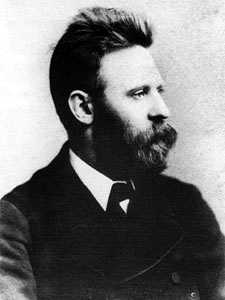
Most aged 33, 1879

As the 1860s drew to a close, Most was won over to the ideas of international socialism, an emerging political movement in Germany and Austria. Most saw in the doctrines of Karl Marx and Ferdinand Lassalle a blueprint for a new egalitarian society and became a fervid supporter of Social Democracy, as the Marxist movement was known in the day.[9]

Most engaged himself as editor of socialist newspapers in Chemnitz and Vienna, both were suppressed by the authorities, he also worked as editor of the Berliner Freie Presse (Berlin Free Press). Most was a dedicated advocate of revolutionary socialism, sharing the views expressed by Wilhelm Liebknecht in an 1869 speech where he had said; "Socialism cannot be realized within the present state. Socialism must overturn the present state."[10] In 1873, Most wrote a summary of Marx's Das Kapital.[11] At Liebknecht's request, Marx and Friedrich Engels made some corrections to Most's text for a second edition published in 1876, despite the fact that the pair did not believe the pamphlet represented a satisfactory summary of Marx's work.[11]

In the 1874 German federal election, Most was elected to represent the Chemnitz constituency as a Social Democratic Workers' Party of Germany deputy in the Reichstag, in which he served until 1878.[12] Most was repeatedly arrested for his verbal attacks on patriotism, religion, ethics and for his gospel of terrorism, preached in prose and in many songs such as those in his Proletarier-Liederbuch (Proletarian Songbook). Some of his experiences in prison were recounted in the 1876 work, Die Bastille am Plötzensee: Blätter aus meinem Gefängniss-Tagebuch (The Bastille on Plötzensee: Pages from my Prison Diary).[13]

After advocating violent action, including the use of explosives, as a mechanism to bring about revolutionary change, Most was forced into exile by the government. He first traveled to France but was forced to leave at the end of 1878, settling in London instead. There he founded his own newspaper, Freiheit (Freedom), with the first issue coming off the press on January 4, 1879.[14] Convinced by his own experiences of the futility of parliamentary action, Most began to espouse the doctrine of anarchism, which led to his expulsion from the German Social Democratic Party in 1880.[15] In March 1881, Most expressed his delight in the pages of the Freiheit over the assassination of Tsar Alexander II of Russia and advocated its emulation; for this Most was imprisoned by British authorities for a year and a half.[13][16]

Life in the United States

[edit]

Anything that can tear up the side of a mountain should definitely be effective against a high society party attended by royalty or capitalist exploiters (monopolists).

—Johann Most, Science of Revolutionary Warfare[17]
Cover of Freiheit (German for "freedom")
Most in his later years

Encouraged by news of labor struggles and industrial disputes in the United States, Most emigrated to the US upon his release from prison in 1882. He promptly began agitating in his adopted land among other German émigrés. Among his associates was August Spies, one of the anarchists hanged for conspiracy in the Haymarket Square bombing, in whose desk police found an 1884 letter from Most promising a shipment of "medicine," his code word for dynamite.[18]

Most resumed the publication of the Freiheit in New York. He was imprisoned in 1886, again in 1887, and in 1902, the last time for two months for publishing after the assassination of President McKinley an editorial in which he argued that it was no crime to kill a ruler.[13] He said: "Whoever looks at America will see: the ship is powered by stupidity, corruption, or prejudice."[19][20] Most initially advocated traditional collectivist anarchism,[21] but later embraced anarchist communism.[22] Most was famous for stating the concept of the "propaganda of the deed" (Attentat): "The existing system will be quickest and most radically overthrown by the annihilation of its exponents. Therefore, massacres of the enemies of the people must be set in motion."[23]

Most is best known for a pamphlet published in 1885: The Science of Revolutionary Warfare, a how-to manual on the subject of bomb-making which earned the author the moniker "Dynamost". A gifted orator, Most propagated these ideas throughout Marxist and anarchist circles in the United States and attracted many adherents, most notably Emma Goldman and Alexander Berkman. Inspired by Most's theories of attentat, Goldman and Berkman, enraged by the deaths of workers during the Homestead strike, put words into action with Berkman's attempted assassination of Homestead factory manager Henry Clay Frick in 1892. Berkman and Goldman were soon disillusioned as Most became one of Berkman's most outspoken critics. In Freiheit, Most attacked both Goldman and Berkman, implying Berkman's act was designed to arouse sympathy for Frick.[24]

Goldman's biographer Alice Wexler suggests that Most's criticisms may have been inspired by jealousy of Berkman.[25] Goldman was enraged, and demanded that Most prove his insinuations. When he refused to respond, she confronted him at next lecture.[24] After he refused to speak to her, she lashed him across the face with a horsewhip, broke the whip over her knee, then threw the pieces at him.[24] She later regretted her assault, confiding to a friend, "At the age of twenty-three, one does not reason."

Most was in Cincinnati, Ohio, to give a speech when he fell ill. He was diagnosed with erysipelas. The doctors could do little for him, and he died a few days later.

Personal life

[edit]

His grandson was Boston Celtics radio play-by-play man Johnny Most.[26]

Works

[edit]

Note: This list includes only titles published in German or English. Some of Most's writings were translated into Italian, Spanish, Russian, Yiddish, French, Polish, and other languages.

  • Neuestes Proletarier-Liederbuch von Verschiedenen Arbeiterdichtern (Latest Proletarian Songbook by Various Worker-Poets). Chemnitz: Druck und Verlag der Genossenschafts-Buchdruckerei, 1873.
  • Kapital und Arbeit: Ein Populärer Auszug aus "Das Kapital" von Karl Marx (Capital and Labor: A Popular Excerpt from "Capital" by Karl Marx). Chemnitz: G. Rübner, n.d. [1873]. Revised 2nd edition, 1876.
  • Die Pariser Commune vor den Berliner Gerichten: Eine Studie über Deutschpreussische Rechtszustände. (The Paris Commune in Front of Berlin Courts: A Study of German-Prussian Legal Conditions). Brunswick, Germany: Bracke Jr., 1875.
  • Die Bastille am Plötzensee: Blätter aus meinem Gefängniss-Tagebuch (The Bastille on Plötzensee: Pages from my Prison Diary). Brunswick, Germany: W. Bracke, 1876.
  • Der Kleinbürger und die Socialdemokratie: Ein Mahnwort an die Kleingewerbtreibenden (The Petty-Bourgeois and Social-Democracy: A Warning to Small Businessmen). Augsburg: Verlag der Volksbuchhandlung, 1876.
  • Gewerbe-Ordnung für das Deutsche Reich: Mit Erläuterung der für den Arbeiter wichtigsten Bestimmungen (The Industrial Code of the German Empire: With Commentary on the Most Important Provisions for the Worker). Leipzig: Verlag der Genossenschaftsbuchdruckerei, 1876.
  • Freizügigkeits-Gesetz, Impf-Gesetz, Lohnbeschlagnahme-Gesetz, Haftpflicht-Gesetz: Mit Erläuterung der für den Arbeiter wichtigsten Bestimmungen (The Law on Freedom of Movement, the Law on Vaccination, the Law on Wage Attachment, the Law on Liability: With Commentary on the Most Important Provisions for the Worker). Leipzig: Verlag der Genossenschaftsbuchdruckerei, 1876.
  • "Taktika" contra "Freiheit": Ein Wort zum Angriff und zur Abwehr ("Tactics" versus "Freedom": A Word on Attack and Defence). London: Freiheit, n.d. [c. 1881].
  • Revolutionäre Kriegswissenschaft: Eine Handbüchlein zur Anleitung Betreffend Gebrauches und Herstellung von Nitro-Glycerin, Dynamit, Schiessbaumwolle, Knallquecksilber, Bomben, Brandsätzen, Giften usw., usw. (The Science of Revolutionary Warfare: A Little Handbook of Instruction in the Use and Preparation of Nitroglycerine, Dynamite, Gun-Cotton, Fulminating Mercury, Bombs, Fuses, Poisons, Etc., Etc.). New York: Internationaler Zeitung-Verein, c. 1883.
  • Die Freie Gesellschaft: Eine Abhandlung über Principien und Taktik der Kommunistischen Anarchisten: Nebst Einem Polemischen Anhang (The Free Society: An Essay on the Principles and Tactics of the Communist Anarchists: With a Polemical Appendix). New York: self-published, 1884.
  • August Reinsdorf und die Propaganda der That (August Reinsdorf and Propaganda of the Deed). New York: self-published, 1885.
  • Acht Jahre hinter Schloss und Riegel. Skizzen aus dem Leben Johann Most's. (Eight years Under Lock and Key: Sketches from the Life of Johann Most). New York: self-published, 1886.
  • Die Hoelle von Blackwells Island (The Hell of Blackwells Island). New York: self-published, 1887.
  • An das Proletariat (To the Proletariat). New York: J. Müller, 1887.
  • Die Eigenthumsbestie (The Property Beast). New York: J. Müller, 1887. English: The Beast of Property: Total Annihilation Proposed as the Only Infallible Remedy: The Curse of the World which Defeats the People's Emancipation. New Haven, CT: International Workingmen's Ass'n, Group New Haven, n.d. [c. 1890].
  • Die Gottespest (The God Pestilence), New York: J. Müller, 1887. English: The Deistic Pestilence and Religious Plague of Man, n.d. [1880s]. Reissued as The God Pestilence.
  • The Accusation! A Speech Delivered by John Most, at Kramer's Hall, New York, on November 13, 1887, in Denunciation of the Judicial Butchery of the Chicago Anarchists: For Delivering Which, He Has Been Sentenced to Twelve Month's Imprisonment by Judge Cowing. London: International Publishing Co., n.d. [c. 1887].
  • Vive la Commune. New York: J. Müller, 1888.
  • Der Stimmkasten (The Ballot Box). New York: J. Müller, 1888.
  • The Social Monster: A Paper on Communism and Anarchism. New York: Bernhard and Schenck, 1890.
  • The Free Society: Tract on Communism and Anarchy. New York: J. Müller, 1891.
  • Zwischen Galgen und Zuchthaus (Between Gallows and Penitentiary). New York: J. Müller, 1892.
  • Anarchy Defended by Anarchists. With Emma Goldman. New York: Blakely Hall, 1896.
  • Down with the Anarchists! This is the War-Cry Raised by President Roosevelt and Echoed by the Congress of the United States. Now, Then, Hear the Other Side! The Anarchists will Take the Floor. Listen!. New York: John Most, n.d. [c. 1905].
  • Memoiren, Erlebtes, Erforschtes und Erdachtes (Memoirs: Experiences, Explorations, and Thoughts). In 4 volumes. New York: Selbstverlag des Verfassers, 1903–1907.

Primary sources

[edit]

Anarchist press

[edit]

References

[edit]

Bibliography

[edit]

Further reading

[edit]
[edit]
Revisions and contributorsEdit on WikipediaRead on Wikipedia
from Grokipedia

Johann Most (1846–1906) was a German-American anarchist editor, orator, and theorist renowned for editing the radical newspaper Freiheit and championing "" as a means to incite revolution through targeted violence against symbols of state and capital oppression. Born into poverty in , , Most endured a traumatic childhood including familial and severe illness that disfigured his face, fostering a lifelong antagonism toward authority and religion. Initially aligned with , he edited socialist publications, won election to the German Reichstag in 1874, and faced repeated imprisonment and expulsion under , prompting a radical shift toward influenced by during his London exile in the late 1870s.
Emigrating to the in 1882 after further persecution in , Most revitalized the German-American anarchist milieu by relocating Freiheit to New York, where it became a fervent organ for anti-authoritarian agitation, circulating widely among immigrant workers. His most notorious contribution was the 1885 pamphlet Science of Revolutionary Warfare, a practical manual detailing the manufacture and deployment of explosives like for and uprisings, which he defended as essential tools for the oppressed to counter systemic violence. Most publicly celebrated regicidal acts, such as the 1881 of II, and electrified audiences with speeches urging over reformist gradualism, profoundly influencing figures like while drawing sharp rebukes for endorsing . Over time, his views evolved toward emphasizing collective worker resistance following events like the , though he remained unyielding in his rejection of compromise, enduring U.S. arrests and vilification until his death in from .

Early Life

Childhood and Family Background

Johann Joseph Most was born on February 5, 1846, in , , then part of the Kingdom of Bavaria in the . He was the illegitimate child of a low-level —described variably as a petty official or copyist—and a , whose impoverished circumstances delayed their until Most was approximately two years old. Most's mother died of when he was a young child, leaving him without primary at an early age. Following her death, he was placed with an and , who subjected him to harsh treatment, exacerbating his sense of isolation. His father remarried, but the stepmother reportedly continued the pattern of ill-treatment toward Most, contributing to a childhood marked by and within the family dynamic. Additionally, Most suffered a prolonged illness during his early years that resulted in a lifelong speech impediment, further compounding his physical and social challenges. These experiences fostered in him a profound of and societal structures from a formative age.

Entry into Politics and Early Activism

Most's political awakening occurred during his travels as a bookbinder in the mid-1860s, when exposure to workers' conditions and radical literature drew him toward . By 1867, at age 21, he affiliated with the Zurich section of the First (International Workingmen's Association), an organization advocating and class struggle, thereby initiating his organized activism. In 1868, Most relocated to , immersing himself in Austria's burgeoning socialist scene amid economic unrest and demands for political reform. He emerged as a charismatic street orator, blending humor, sarcasm, and fiery rhetoric to rally workers, and contributed to founding the , which expanded to approximately 5,500 members by promoting self-education and labor solidarity. His provocative speeches advocating workers' led to repeated legal repercussions, including a one-month imprisonment in 1869 for during a public address. Undeterred, Most helped organize mass actions, such as the December 1869 demonstration involving around 20,000 workers marching on to demand universal male suffrage. He faced two additional arrests in for similar agitation before authorities deported him in 1871 amid heightened suppression of radicals following the Commune's influence.

European Period

Social Democratic Involvement

Most's entry into organized socialism occurred in the mid-1860s while working as a typesetter in , where he aligned with emerging workers' movements advocating for labor reforms and . By 1868, he relocated to , , immersing himself in the local branch of the Sozialdemokratische Arbeiterpartei (Social Democratic Workers' Party), which emphasized , workers' cooperatives, and opposition to monarchical absolutism. There, Most rapidly emerged as a charismatic orator, delivering speeches that mobilized factory workers and artisans; his inflammatory addresses contributed to his arrest and trial in the 1870 Vienna high treason case, where he defended radical agitation as essential for proletarian emancipation, though the charges centered on alleged plots against the Habsburg regime. Following his release and brief expulsions from Austrian territories, Most returned to Germany in 1871, formally affiliating with the Sozialdemokratische Arbeiterpartei Deutschlands (SDAP), the precursor to the modern SPD, which had unified various socialist factions under Marxist influence at the 1869 Eisenach Congress. He assumed editorial control of the Chemnitzer Freie Presse, a party-aligned newspaper suppressed under the 1871 Chemnitz press trial for anti-government content, using it to propagate demands for an eight-hour workday, , and repeal of . Circulation reached thousands, amplifying SDAP messaging amid Bismarck's and emerging Anti-Socialist Laws. Most's parliamentary ambitions culminated in his 1874 election to the Reichstag from the district, securing one of 11 SDAP seats with exceeding 50% in working-class precincts; he served until 1878, using debates to critique industrial exploitation and while adhering to on electoral tactics over immediate . Re-elected in 1877 amid suppressed party activities, Most's tenure highlighted tensions between reformist parliamentarism and grassroots militancy, as he prioritized agitating for legal protections against factory hazards—evidenced by 1876 SDAP resolutions he supported—over abstract doctrinal purity. His moderation during this phase contrasted later , focusing on building SDAP membership, which grew from 35,000 in 1874 to over by 1877 despite state repression.

Radicalization Toward Anarchism and Exile

Following the enactment of Germany's on October 21, 1878, which criminalized socialist agitation and publications, Most fled the country to evade prosecution, briefly residing in before arriving in by December of that year. In , amid a community of German exiles harboring radical sentiments, Most founded the newspaper Freiheit in early 1879, using it as a platform to critique state authority and parliamentary while smuggling copies into despite legal risks. Most's contributions to Freiheit grew increasingly confrontational, denouncing the Social Democratic Party's (SDP) gradualist tactics and emphasizing direct worker action, which culminated in his formal expulsion from the SDP at its Wyden from August 21 to 23, 1880, on charges of fostering indiscipline and anti-organizational tendencies. This ousting severed his ties to and intensified his shift away from state-oriented , as he began incorporating anti-authoritarian and critiques of centralized party structures influenced by encounters with Bakuninist exiles. The assassination of Tsar Alexander II on March 13, 1881, provided a pivotal catalyst; in the March 19 issue of Freiheit, Most celebrated the act as a model of revolutionary efficacy, explicitly advocating "propaganda by the deed"—violent exemplars to inspire mass uprising—thereby completing his transition to by rejecting electoralism and in favor of spontaneous, decentralized revolt. This stance, drawing on published excerpts from Mikhail Bakunin's works and Sergei Nechaev's , positioned Most as a proponent of immediate insurrection over , though his anarchism retained a self-developed socialist core rather than strict adherence to any school. Most's unyielding militancy provoked British authorities, resulting in multiple arrests, including one in 1881 for following Freiheit's red-bordered issue praising , and the paper's temporary relocation to amid seizures. Released from in October 1882 after serving time for high charges tied to his writings, Most deemed untenable for sustained agitation and emigrated to the later that year, seeking freer terrain for anarchist organizing among immigrant workers.

Arrival and Activities in the United States

Immigration and Initial Settlement

Following his release from prison in on October 25, 1882, Johann Most emigrated to the , arriving in on December 14, 1882, aboard the steamer Donau amid an early morning collision that damaged the vessel but caused no serious injuries. The journey was prompted by ongoing persecution in and reports of labor unrest in America, which Most viewed as fertile ground for anarchist agitation. Most received an enthusiastic welcome from New York's German-speaking radical community, who organized a large reception at shortly after his arrival, establishing him immediately as a leading figure in the nascent American anarchist movement. He settled in Manhattan's , amid dense immigrant neighborhoods teeming with German workers, where he quickly integrated into existing socialist and anarchist circles centered around taverns and labor halls. In his initial months, Most focused on reestablishing Die Freiheit, relocating its printing operations from to New York by early 1883, and launching a lecture tour across the Northeast that drew crowds of up to 5,000 in cities like and . This period marked his adaptation to American conditions, emphasizing propaganda among proletarian immigrants while critiquing the U.S. as a facade for capitalist exploitation. His settlement solidified New York as the hub of German anarchism, fostering networks that would influence events like the .

Founding and Editing Anarchist Publications

Upon arriving in New York City on December 14, 1882, Johann Most promptly resumed editing and publishing Freiheit (Freedom), the German-language anarchist weekly he had originally launched in London on January 4, 1879, prior to his imprisonment and exile. The relocation of Freiheit to the United States marked a continuation of Most's efforts to propagate revolutionary anarchism among German immigrant workers, with the newspaper operating from New York as its central hub for distribution and content creation. Freiheit under Most's editorship emphasized militant tactics, including advocacy for ""—direct actions such as assassinations and bombings to incite broader revolt against capitalist and state authority. Most personally oversaw its production, contributing fiery editorials and serialized writings that critiqued and promoted , while smuggling copies back to to evade suppression. The publication became a cornerstone of the American anarchist press, fostering networks among laborers disillusioned with reformist . Most maintained editorial control of Freiheit until his death on March 17, 1906, despite repeated legal challenges that temporarily halted operations, such as his 1886 imprisonment following the commentary. No other major anarchist periodicals were founded by Most in the United States; Freiheit remained his primary platform, evolving from its social-democratic origins into an explicitly anarchist organ by the early .

Promotion of Revolutionary Violence

Development of Propaganda of the Deed Doctrine

Johann Most's advocacy for propaganda of the deed emerged during his London exile following expulsion from Germany under the Anti-Socialist Laws on October 19, 1878. Initially opposing violence as a social democrat in the 1870s—condemning assassination attempts on Kaiser Wilhelm I by Max Hödel and Karl Nobiling as foolish—Most shifted toward revolutionary action amid isolation from electoral politics. Launching the newspaper Freiheit in 1879, he increasingly glorified direct action as a means to awaken the masses, arguing that exemplary violent deeds against tyrants would demonstrate anarchist resolve and erode state authority more effectively than mere agitation. A pivotal moment came in March 1881 with Most's article "At Last!" in Freiheit, celebrating the assassination of Tsar Alexander II by Russian revolutionaries as a triumphant blow against that would inspire global emulation. This piece, which led to his arrest and a prison sentence, marked Most's full embrace of —the notion that targeted violence, publicized to reveal its motives, serves as ideological propagation by instilling terror in oppressors and hope in the exploited. Most contended that such acts proclaim "this man or that man must die for this and this reason," countering state narratives and amplifying anarchist principles through the deed itself. By 1884, Most formalized the doctrine in writings emphasizing individual tyrannicide and technological innovation, publishing Revolutionäre Kriegswissenschaft (The Science of Revolutionary Warfare) in , which detailed bomb-making with as an equalizer for the powerless against entrenched power. In his July 25, , Freiheit article "Action as Propaganda," he clarified that deeds alone suffice only if paired with explicit publicity—via posters, press, or manifestos—to educate and mobilize, distinguishing purposeful anarchist vengeance from random crime. This synthesis positioned not as impulsive terror but as strategic, communicative revolt, drawing on earlier French and Italian precedents while adapting them to German-speaking radicals through accessible manuals and editorials. Most's framework prioritized acts against symbols of capital and state, such as factory owners or officials, to catalyze spontaneous uprisings by proving the vulnerability of hierarchy.

Instructions for Dynamite and Bomb-Making

In 1883, Johann Most authored and published Revolutionäre Kriegswissenschaft (The Science of Revolutionary Warfare), a 48-page German-language manual that compiled practical instructions for producing explosives and incendiary devices, drawing from publicly available chemical knowledge and military sources such as Austrian ordnance manuals. The detailed methods for manufacturing by mixing nitric and sulfuric acids with glycerin under controlled temperatures to avoid detonation, stabilizing it into by absorption into (diatomaceous earth), and preparing gun-cotton through of waste. It emphasized the accessibility of these materials, noting that could be sourced from mining suppliers or improvised from household chemicals, with detonation achieved via blasting caps made from fulminating mercury or simple fuses. The manual extended beyond explosives to bomb construction, recommending pipe bombs filled with dynamite and capped with wooden plugs pierced for fuses, or more advanced designs like hollowed cannonballs packed with gunpowder and shrapnel for fragmentation effects. Most included guidance on arson using phosphorus-based combustibles ignited by air exposure and poisons derived from strychnine or arsenic for sabotage, framing these as tools for proletarian self-defense against capitalist tyranny. He argued that such knowledge democratized warfare, enabling isolated acts of destruction against symbols of authority like factories, barracks, or prisons, without requiring organized armies. An English translation appeared by 1885, circulated among American anarchists via Most's newspaper Freiheit, which serialized excerpts and recipes in issues from 1883 onward to amplify their reach. Most positioned these instructions within his advocacy for "propaganda of the deed," asserting that empirical success in small-scale attacks would inspire mass uprisings by demonstrating the vulnerability of state power to asymmetric tactics. While the manual's recipes were not original inventions—relying on established like Alfred Nobel's formulation patented in 1867—their explicit adaptation for use marked a shift toward open dissemination, contrasting with earlier esoteric or state-restricted knowledge. Critics, including rival socialists, contended that such publications glorified haphazard violence over strategic organizing, potentially alienating workers, though Most countered that theoretical agitation alone had proven futile in and America. The work's influence was evident in subsequent anarchist actions, such as the 1886 , where prosecutors cited it as a blueprint, though forensic evidence showed the bombers employed cruder black powder devices rather than Most's recommended variants.

Arrests in Europe and Early U.S. Trials

Most faced repeated arrests in during the 1860s and 1870s for his socialist agitation and speeches deemed inciting or treasonous. In 1869, he received a one-month sentence in for satirical remarks at workers' gatherings that offended authorities. On March 2, 1870, authorities in arrested him for high during a workers' demonstration, leading to a five-year sentence from which he was released early in 1871 under a general amnesty. He endured multiple imprisonments between 1867 and 1871 in as a member of the International Working Men's Association, culminating in his deportation from in 1871. In late April 1874, arrested him for a speech commemorating the third anniversary of the , resulting in a sentence that kept him incarcerated until 1876. These and other detentions totaled nearly seven years in European prisons prior to his emigration. Following the German of 1878, which prompted his expulsion from , Most relocated to where he continued publishing radical content. In 1881, British authorities arrested him for an article in Freiheit that celebrated the of Alexander II, charging him with ; he was convicted and sentenced to 18 months of hard labor, from which he was released in October 1882. This imprisonment directly preceded his departure for the later that month. Upon arriving in New York in 1882, Most initially avoided immediate prosecution but faced legal scrutiny for his advocacy of revolutionary tactics. His first U.S. occurred in April 1886, stemming from a speech at Germania Garden in which he urged violence against oppressors; charged with , he was convicted and sentenced to one year in Blackwell's Island Penitentiary. A subsequent in May 1886 arose from similar inflammatory in anarchist gatherings, though outcomes varied and reflected broader efforts to curb his influence amid rising tensions over labor unrest. These early cases highlighted U.S. authorities' application of and laws against immigrant radicals, though Most's acquittals in some instances demonstrated limits in suppressing printed and spoken without direct evidence of criminal acts.

Post-Haymarket Consequences and Appeals

Following the Haymarket bombing on May 4, 1886, and the ensuing trial and executions of anarchist leaders in Chicago, authorities in New York intensified efforts to suppress radical publications and speeches associated with Johann Most. Most's Freiheit had published articles endorsing the bombing as an exemplary act of propaganda by the deed shortly after the event, which prosecutors cited as evidence of ongoing incitement amid national anti-anarchist fervor. In 1886, Most was arrested on charges related to inciting riot at public meetings and disseminating his 1885 pamphlet Revolutionäre Kriegswissenschaft (The Science of Revolutionary Warfare), which detailed bomb-making techniques as tools for class struggle. Convicted in a New York court, Most was sentenced to one year of hard labor on Blackwell's Island penitentiary (now ), a facility notorious for harsh conditions that exacerbated his lifelong health issues from earlier European imprisonments. The prosecution argued that his writings, viewed through the lens of Haymarket violence, posed an imminent threat to public order, overriding defenses that emphasized theoretical advocacy over direct calls to immediate action. Most demonstrated that specific meetings in question had remained peaceful, but the upheld the , reflecting broader post-Haymarket judicial intolerance for anarchist rhetoric. During his incarceration, Freiheit's circulation temporarily declined under associate editors, though Most's supporters maintained the paper's operations. Upon release in 1887, coinciding with the Haymarket executions on , Most publicly critiqued the verdicts as judicial murder while distancing himself from indiscriminate bombings, advocating instead for organized worker militias. This period marked a pivot in his tactics, influenced by the affair's fallout, though legal harassment persisted, culminating in further arrests in subsequent years. No successful appeals overturned the 1886 sentence, underscoring the era's prioritization of security over free expression for radicals.

Controversies and Internal Anarchist Disputes

Celebration of Assassinations and Haymarket Affair

Most's advocacy for revolutionary violence extended to explicit endorsements of targeted assassinations, viewing them as exemplary acts of propaganda of the deed. Following the assassination of Tsar Alexander II on March 13, 1881, by members of the Russian revolutionary group Narodnaya Volya, Most published a celebratory article in his newspaper Freiheit on March 19, 1881, exclaiming "Endlich krepierte er" ("At last he croaked"), framing the killing as a triumphant blow against tyranny. This piece, along with similar endorsements of assassins as heroes, prompted his arrest in London on April 1, 1881, and a sentence of 16 months' imprisonment for inciting violence. Most reiterated such support in works like August Reinsdorf und die Propaganda der Tat (1885), praising German anarchist August Reinsdorf's failed 1883 plot to bomb German imperial sites as a model for dismantling state power through exemplary destruction. The of May 4, 1886, in —where an unknown individual detonated a during a labor rally protesting police violence against strikers, killing seven police officers and injuring dozens—intensified scrutiny of Most's doctrines. His 1885 manual Revolutionäre Kriegswissenschaft (Revolutionary Science of War), which detailed -making and urged as "the equalizer of class war," was entered as evidence in the trials of eight anarchists accused of conspiracy, including and , four of whom were hanged on November 11, 1887. Although Most had not directly organized the event and lacked personal ties to the defendants, his earlier shipments of "medicine" (code for ) to anarchists in 1884 and promotion of violent insurrection were cited by prosecutors as inspirational factors. In the affair's aftermath, Most experienced a tactical reversal, publicly condemning the bombing's indiscriminate nature in Freiheit as early as May 11, 1886, arguing it alienated potential allies and invited repression without advancing . This shift, motivated partly by personal safety concerns amid U.S. anti-anarchist crackdowns, sparked disputes within radical circles; critics like later accused him of cowardice for abandoning propaganda by deed in favor of organized labor agitation, while defenders saw it as pragmatic adaptation to empirical failures of isolated acts. The episode underscored tensions between Most's prior exaltation of and the unintended consequences of emulating it in mass settings, contributing to his declining influence among younger militants.

Conflicts with Other Anarchists and Socialists

Most's advocacy for immediate revolutionary action and rejection of parliamentary tactics led to his expulsion from the German Social Democratic Party (SPD) at its Wyden Congress on August 21–23, 1880, alongside Wilhelm Hasselmann, on charges of promoting , anti-organizational tendencies, and inciting violence contrary to the party's reformist strategy. The SPD leadership, favoring legalistic gradualism amid the , viewed Most's Freiheit newspaper—launched in 1879—as excessively provocative, with figures like decrying its tone, while and had earlier dismissed Most's rhetoric as empty "revolutionary phrases" in correspondence. This rift stemmed from Most's insistence that workers were ready for upheaval, countering SPD claims of societal unreadiness, which he lambasted as excuses perpetuating exploitation under worsening conditions of physical and moral decay. In the United States, Most's arrival in intensified divides within radical circles, as his intransigence clashed with the more doctrinaire elements of the Socialist Labor (SLP) and social democrats who tolerated electoral participation, exacerbating tensions over anti-parliamentarism. Within , Most's adherence to Bakuninist collectivism—emphasizing labor-based remuneration via notes—drew criticism from emerging communist-anarchists influenced by , who prioritized distribution according to need and viewed Most's framework as insufficiently advanced beyond post-Bakunin developments. Most also feuded with individualist anarchists, notably Benjamin R. Tucker, through public exchanges in their journals Freiheit and Liberty, where Tucker assailed Most's collectivist stance as enabling labor exploitation, while Most defended communal production against egoist market individualism, highlighting a schism over property, wages, and post-revolutionary economics that fragmented late-19th-century American anarchism. Personal and tactical disputes further eroded alliances, including a 1880s–1890s rivalry with Joseph Peukert over editorial control and ideological purity—Peukert, backed by Kropotkin, challenged Most's authoritarian tendencies in anarchist organization and accused him of complicity in the 1887 arrest of Johann Neve—culminating in mutual betrayals that splintered European émigré networks. A notable rupture occurred in 1892 with Emma Goldman and Alexander Berkman, whom Most initially mentored but publicly denounced Berkman's July 1892 attempt to assassinate steel magnate as potentially the act of a mere "crank" rather than principled , prompting Goldman's physical on Most with a horsewhip and accelerating the disintegration of unified anarchist agitation in New York. These intra-movement clashes, often blending tactical divergences on violence with personal animosities, underscored Most's isolation as his uncompromising militancy alienated both reformist socialists and evolving anarchist factions seeking broader syntheses.

Intellectual Output and Key Ideas

Major Publications and Essays

Johann Most's primary platform for disseminating anarchist ideas was the newspaper Freiheit ("Freedom"), which he founded and edited starting with its first issue on January 4, 1879, in . Initially reflecting social democratic influences, the publication shifted toward explicit anarchist advocacy, characterized by energetic prose promoting revolutionary upheaval, , and critiques of state and capital. After Most's arrival in New York in 1882, Freiheit continued as a weekly, copies into and serving as a central organ for German-speaking radicals, with circulation reaching thousands despite frequent legal suppressions. Its content often celebrated acts of attentat and outlined strategies for proletarian insurrection, influencing immigrant anarchist networks . Beyond periodical journalism, Most authored several pamphlets that encapsulated his revolutionary theories. The Science of Revolutionary Warfare, released in 1885, offered practical guidance on constructing bombs and explosives from everyday materials, framing such knowledge as essential for overthrowing oppressive structures. This work, translated into multiple languages, exemplified Most's commitment to empowering workers through accessible weaponry, though it drew immediate authorities' scrutiny. In 1890, Most published The Social Monster: A Paper on Communism and Anarchism through Bernhard & Schenck in New York, a tract dissecting as a new form of tyranny while asserting 's superiority in fostering voluntary cooperation. Complementing this, The Beast of Property lambasted private ownership as the root impediment to human , urging its violent abolition to unleash communal . These essays, often reprinted together, reinforced Most's rejection of in favor of immediate, destructive confrontation with capitalist institutions. Most also penned Die Gottespest ("The God Pestilence"), a vehement antireligious denouncing organized faith as a tool of class domination, aligning with his broader materialist critique of ideological props sustaining authority. His , Memoiren, detailed personal experiences shaping his radicalism, from proletarian hardships to imprisonments, providing a foundation for his calls to action. Collectively, these writings prioritized empirical of force over abstract theorizing, prioritizing causal disruption of power hierarchies through and deed.

Core Philosophical Positions

Johann Most espoused anarchism as the total eradication of coercive authority, defining it as a condition free from state, government, laws, or any form of compulsion imposed by one person over another. He argued that such structures inherently perpetuated exploitation and inequality, rendering true human freedom impossible under their dominance. In his view, anarchy represented not chaos but a harmonious, self-regulated society based on voluntary cooperation and mutual aid, contrasting sharply with the hierarchical order of capitalist states. Central to Most's thought was , which he presented as the economic foundation of a , where the would be held in common and goods distributed according to need, eliminating wage slavery and . He contended that true aligned inherently with , as both aimed to dismantle class divisions and achieve collective emancipation without authoritarian intermediaries like a transitional state. Most criticized reformist for compromising with existing power structures, asserting that only expropriation could realize communal and abolish the "beast of property" that enslaved workers. Most rejected pacifism and electoral politics as illusions that sustained oppression, advocating instead for class war through direct action, including targeted violence against symbols of authority to awaken revolutionary consciousness. He viewed such acts not as mere destruction but as necessary propaganda to demonstrate the vulnerability of tyrannical systems and inspire mass uprising. While emphasizing strategic rather than indiscriminate violence, Most maintained that physical force was a legitimate response to the state's inherent brutality, rooted in the principle that the oppressed must wield power to end their subjugation. His atheism further underscored this, portraying religion as a tool of elite control that diverted the masses from material struggles.

Later Career and Decline

Fading Influence and Organizational Splits

By the late 1880s, Most began moderating his earlier advocacy for "propaganda by the deed," deeming individual terrorist acts futile following the Haymarket executions of November 11, 1887, and shifting toward collective worker action and intellectual propaganda. This evolution alienated younger anarchists who continued to favor , contributing to his waning personal influence within radical circles. Membership in the International Working People's Association, which Most had helped organize, peaked at 7,000–8,000 in 1885 but declined sharply thereafter amid broader disillusionment with revolutionary tactics. Organizational fractures intensified in the early 1890s, particularly after Alexander Berkman's July 23, 1892, assassination attempt on industrialist . Most publicly condemned the act in Freiheit as premature and counterproductive, prompting a bitter rift with Berkman and his associate , whom Most had mentored since 1889. Goldman, enraged, publicly horsewhipped Most during a lecture in 1892, symbolizing the generational and tactical divide between Most's revised emphasis on organized and the militants' commitment to immediate violence. Rivalries with figures like Joseph Peukert over editorial control and strategy further fragmented German-American anarchist groups, including splits within New York's Social-Revolutionary Club. The influx of less radical German immigrants after 1890 and the rising appeal of Peter Kropotkin's mutual aid theories over Most's combative style accelerated the erosion of his leadership. By 1901, Most's reprinting of an article praising assassination following President William McKinley's September 6 murder led to his imprisonment, underscoring persistent legal pressures but also highlighting his marginalization as anarchism shifted toward syndicalist models like the Industrial Workers of the World founded in 1905. Freiheit faced severe financial strain by 1905, forcing Most into exhaustive speaking tours that reflected the organization's diminished support base. These developments marked the transition of U.S. anarchism away from Most's orbit toward more pragmatic or ideologically divergent factions.

Health Deterioration and Death

In early 1906, Johann Most, then aged 60, embarked on a lecture tour across the , appearing in robust health despite his advancing years and history of facial scarring from childhood complications. While en route, he arrived in , , on March 12 as a guest of local supporter Adolph Kraus to deliver speeches. Shortly thereafter, Most contracted , a bacterial typically caused by streptococci, which rapidly progressed to systemic involvement. The illness proved acute and unrelenting; Most experienced for much of his final days, confining him to bed without effective medical intervention available at the time. He succumbed to the infection on March 17, 1906, in , preventing his planned continuation to for a commemorative event. No prior chronic health decline is documented in the immediate years leading to this event, marking his death as a sudden termination of an otherwise active propagandist phase.

Assessments and Legacy

Positive Influences on Radical Movements

Johann Most's emigration to the in October 1882 introduced militant anarchist ideas to a burgeoning labor radicalism, particularly among German immigrants, through his editorship of Die Freiheit, which by 1883 had a circulation exceeding 6,000 copies weekly and served as a primary conduit for . His advocacy for ""—exemplified by endorsements of assassinations like that of Tsar Alexander II in 1881—energized disparate radical groups, framing violence as a catalyst for mass uprising and inspiring tactical militancy in worker organizations. Most profoundly shaped individual radicals, including , who arrived in New York in 1889 and described his oratory and writings as pivotal in her conversion to , crediting him as her initial mentor in the movement's principles of and . Similarly, , arriving in 1888, absorbed Most's emphasis on revolutionary , which informed Berkman's later attempts at exemplary acts against capitalist figures. These influences extended to broader networks, as Most's lectures and publications recruited activists into autonomous worker groups that prioritized armed and expropriation over electoral . In the American labor context, Most's rhetoric injected anarchist dominance into struggles, such as the push for the eight-hour day, by promoting autonomous federations over craft unions and envisioning strikes as preludes to general insurrection, thereby radicalizing segments of of Labor and International Working People's Association toward class-war preparedness. His synthesis of with appeals to arm the —outlined in pamphlets like Revolutionäre Kriegswissenschaft (1884)—provided ideological ammunition for militants, fostering a culture of defiance that persisted in syndicalist offshoots despite subsequent repressions.

Criticisms of Tactics and Empirical Failures

Most's endorsement of propaganda by the deed—violent acts such as assassinations intended to ignite mass revolt—was critiqued by contemporaries for promoting isolated, symbolic gestures over organized , rendering them tactically ineffective in mobilizing the . Even Most himself, reflecting after the 1886 , rejected "lone wolf" attacks as futile and counterproductive, arguing they failed to propagate revolutionary ideas without broader support and instead invited backlash. Anarchist historian Tom Goyens notes that Most's associates' plots between 1883 and 1886 often backfired, inadvertently killing bystanders and eroding sympathy among potential allies, as these deeds prioritized spectacle over strategic impact. Empirically, Most's tactics yielded no successful revolutions; the 1881 assassination of Tsar Alexander II, which Most celebrated in Freiheit as a model attentat, prompted intensified state repression across rather than widespread uprising, including the deployment of 148 German agents for abroad under the 1878 . Similarly, the 1892 failed attempt by on industrialist —echoing Most's rhetoric—drew Most's own condemnation for lacking contextual propaganda value in the U.S., where anarchist networks were too sparse to capitalize, resulting only in Berkman's 14-year imprisonment and further alienation of labor movements. The 1901 of President by , influenced by anarchist circles including Most's writings, led to Most's year-long imprisonment and a wave of anti-anarchist , such as U.S. restrictions, which discredited the movement without advancing its goals. Broader historical evaluations highlight how propaganda by the deed entrenched a damaging association between and indiscriminate , deterring mass adherence and enabling governments to justify crackdowns. Academic Constance Bantman argues that while the shaped early anarchist theory, its persistent failures—evident in public revulsion to acts like the 1883 Richetsky bombing in , which caused minimal disruption—ultimately marginalized the movement by prioritizing elite provocation over proletarian education. Historian Robert Pinkerton observed in 1901 that such harmed anarchism more than aided it, as it failed to convert outrage into solidarity, instead reinforcing state narratives of radicals as threats. These outcomes underscore a causal disconnect: isolated amplified repression without dismantling capitalist structures, as evidenced by the absence of any systemic overthrow in regions exposed to Most's influence from 1880 to 1906.

Historical Evaluations in Modern Scholarship

Modern scholarship portrays Johann Most as a transitional figure in the evolution from European to , crediting him with adapting socialist agitation techniques to American immigrant contexts while critiquing his uncompromising militancy for alienating broader labor movements. Historians such as Tom Goyens emphasize Most's effectiveness as a propagandist, noting his 1882 arrival in New York initiated the city's first sustained anarchist network among German workers, which disseminated ideas through newspapers like Die Freiheit and public lectures. Goyens argues that Most's ideological flexibility—from Marxist roots to advocacy of armed —enabled him to bridge transatlantic radical traditions, influencing Yiddish-speaking anarchists by the 1890s through translated works and shared organizational spaces. Evaluations highlight Most's advocacy of "propaganda by the deed" as both innovative and flawed, with scholars observing an evolution in his tactics: initial endorsement of exemplary violence in publications like Revolutionary War Science (1885) gave way to calls for collective worker armament after the Haymarket executions, rejecting acts that harmed innocents. Goyens contends this shift demonstrated pragmatic adaptation amid repression, yet Most's persistent radicalism distanced him from American realities, fostering a rhetorical intensity that inspired disciples like but failed to build enduring coalitions. Critics in , drawing on archival evidence of his imprisonments and exiles, attribute anarchism's marginalization in the U.S. to such tactics' empirical shortcomings, as state responses like the 1886 anti-anarchist laws curtailed growth without sparking mass revolt. Contemporary analyses, informed by declassified records and immigrant press archives, reject simplistic caricatures of Most as a mere "dynamite fanatic," instead viewing him as a product of 19th-century authoritarian contexts whose ideas prefigured modern debates on . While acknowledging biases in period sources—such as sensationalist media portraying him as a terrorist—scholars prioritize primary texts to affirm his role in radicalizing urban laborers, though they concur his voluntarist emphasis on spontaneous uprising underestimated structural barriers like industrial capitalism's resilience. This nuanced reassessment underscores Most's legacy as a catalyst for anarchist pluralism in America, albeit one whose violent prescriptions yielded more schisms than successes.

References

Add your contribution
Related Hubs
User Avatar
No comments yet.