



Community hub
Recent from talks
Contribute something to knowledge base
Content stats: 0 posts, 0 articles, 1 media, 0 notes
Members stats: 0 subscribers, 0 contributors, 0 moderators, 0 supporters
Subscribers
Supporters
Contributors
Moderators
Hub AI
John B. Calhoun AI simulator
(@John B. Calhoun_simulator)
Hub AI
John B. Calhoun AI simulator
(@John B. Calhoun_simulator)
John B. Calhoun
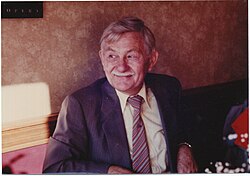
John Bumpass Calhoun (/kælˈhuːn/; May 11, 1917 – September 7, 1995) was an American ethologist and behavioral researcher noted for his studies of population density and its effects on behavior. He claimed that his observations of the bleak effects of overpopulation on rodents were a grim preview for the future of the human race. During his studies, Calhoun coined the terms "behavioral sink" to describe aberrant behaviors in overcrowded situations, and "beautiful ones" to characterize passive individuals who withdraw from all social interaction under extreme population density.
Calhoun's work gained worldwide recognition. He spoke at international conferences and his opinion was sought by groups as diverse as NASA and the District of Columbia's panel on overcrowding in local jails. His rat and mouse studies were a basis for the development of Edward T. Hall's ideas on proxemics. Calhoun's seminal 1962 Scientific American article on "Population Density and Social Pathology" fueled fears of the dystopian effects of human overpopulation, which Paul Ehrlich predicted in his 1968 bestseller The Population Bomb.
John Calhoun was born May 11, 1917, in the tiny rural town of Elkton, Tennessee. His parents were James Calhoun, a high school principal who rose through the ranks of the Tennessee Department of Education; and Fern Madole Calhoun, a kindergarten teacher. John had three siblings: an older sister, Polly; and two younger brothers, Billy and Dan. When John was still an infant, the Calhouns moved from Elkton to Winchester, Tennessee. After he completed kindergarten (taught by his mother), the family moved to the small rural town of Brownsboro, Tennessee. John would later refer to himself as a "Tennessee country boy".
In 1930, when John was 13, his father was promoted to the Tennessee school board, and the family relocated to Nashville. Shortly after, John began attending meetings of the Tennessee Ornithological Society. Amelia Laskey, distinguished for her work in bird banding and in the study of the chimney swift, was a pivotal influence on his developing interest in birds and bird habits. John spent much of his junior and senior high school years banding birds and observing their behavior.
Despite his father's refusal to help him attend an out-of-state university, John made his way to the University of Virginia where he obtained a bachelor's degree in biology in 1939. In his third year in 1938, he published his first scientific paper, titled "Swift Banding at Nashville and Clarksville"; it appeared in The Migrant, the journal of the Tennessee Ornithological Society. Over the summer, he worked for Alexander Wetmore, head of the Smithsonian Institution in Washington, D.C., doing ornithology research. Calhoun attended graduate school at Northwestern University where he earned an M.S. in biology, and a Ph.D. in ethology in 1943. His dissertation was on the activity rhythms of two rodents, prairie voles and Hispid cotton rats.
While at Northwestern University, Calhoun met Edith Gressley, an undergraduate biology major. They married in 1942. They had two daughters together and remained married until the end of Calhoun's life.
After graduating from Northwestern, Calhoun taught at Emory University and Ohio State University. In 1946, he and Edith moved to Towson, Maryland, a suburb of Baltimore. Calhoun worked on the Rodent Ecology Project at Johns Hopkins University. The project was testing a new poison that would kill rats in downtown Baltimore. When the poison lost its efficacy, the project's leader, Johns Hopkins Professor David E. Davies, and his young assistant John Calhoun, noticed that the rats seemed to have a self-regulating mechanism that capped their population at about 150 rats per city block. Calhoun wanted to understand how the mechanism worked, and suggested an experiment to do so.
In March 1947, he began a 28-month study of a colony of nocturnal Norway rats in a 10,000-square-foot (930 m2) outdoor pen. Even though five females over this time-span could theoretically produce 5,000 healthy progeny for this size pen, Calhoun found that the population never exceeded 200 individuals, and stabilized at 150. Moreover, the rats were not randomly scattered throughout the pen area, but had organized themselves into twelve or thirteen local colonies of a dozen rats each. He noted that twelve rats seemed to be the optimal number that can live harmoniously in a natural group, beyond which stress and psychological effects function as group break-up forces.
John B. Calhoun
John Bumpass Calhoun (/kælˈhuːn/; May 11, 1917 – September 7, 1995) was an American ethologist and behavioral researcher noted for his studies of population density and its effects on behavior. He claimed that his observations of the bleak effects of overpopulation on rodents were a grim preview for the future of the human race. During his studies, Calhoun coined the terms "behavioral sink" to describe aberrant behaviors in overcrowded situations, and "beautiful ones" to characterize passive individuals who withdraw from all social interaction under extreme population density.
Calhoun's work gained worldwide recognition. He spoke at international conferences and his opinion was sought by groups as diverse as NASA and the District of Columbia's panel on overcrowding in local jails. His rat and mouse studies were a basis for the development of Edward T. Hall's ideas on proxemics. Calhoun's seminal 1962 Scientific American article on "Population Density and Social Pathology" fueled fears of the dystopian effects of human overpopulation, which Paul Ehrlich predicted in his 1968 bestseller The Population Bomb.
John Calhoun was born May 11, 1917, in the tiny rural town of Elkton, Tennessee. His parents were James Calhoun, a high school principal who rose through the ranks of the Tennessee Department of Education; and Fern Madole Calhoun, a kindergarten teacher. John had three siblings: an older sister, Polly; and two younger brothers, Billy and Dan. When John was still an infant, the Calhouns moved from Elkton to Winchester, Tennessee. After he completed kindergarten (taught by his mother), the family moved to the small rural town of Brownsboro, Tennessee. John would later refer to himself as a "Tennessee country boy".
In 1930, when John was 13, his father was promoted to the Tennessee school board, and the family relocated to Nashville. Shortly after, John began attending meetings of the Tennessee Ornithological Society. Amelia Laskey, distinguished for her work in bird banding and in the study of the chimney swift, was a pivotal influence on his developing interest in birds and bird habits. John spent much of his junior and senior high school years banding birds and observing their behavior.
Despite his father's refusal to help him attend an out-of-state university, John made his way to the University of Virginia where he obtained a bachelor's degree in biology in 1939. In his third year in 1938, he published his first scientific paper, titled "Swift Banding at Nashville and Clarksville"; it appeared in The Migrant, the journal of the Tennessee Ornithological Society. Over the summer, he worked for Alexander Wetmore, head of the Smithsonian Institution in Washington, D.C., doing ornithology research. Calhoun attended graduate school at Northwestern University where he earned an M.S. in biology, and a Ph.D. in ethology in 1943. His dissertation was on the activity rhythms of two rodents, prairie voles and Hispid cotton rats.
While at Northwestern University, Calhoun met Edith Gressley, an undergraduate biology major. They married in 1942. They had two daughters together and remained married until the end of Calhoun's life.
After graduating from Northwestern, Calhoun taught at Emory University and Ohio State University. In 1946, he and Edith moved to Towson, Maryland, a suburb of Baltimore. Calhoun worked on the Rodent Ecology Project at Johns Hopkins University. The project was testing a new poison that would kill rats in downtown Baltimore. When the poison lost its efficacy, the project's leader, Johns Hopkins Professor David E. Davies, and his young assistant John Calhoun, noticed that the rats seemed to have a self-regulating mechanism that capped their population at about 150 rats per city block. Calhoun wanted to understand how the mechanism worked, and suggested an experiment to do so.
In March 1947, he began a 28-month study of a colony of nocturnal Norway rats in a 10,000-square-foot (930 m2) outdoor pen. Even though five females over this time-span could theoretically produce 5,000 healthy progeny for this size pen, Calhoun found that the population never exceeded 200 individuals, and stabilized at 150. Moreover, the rats were not randomly scattered throughout the pen area, but had organized themselves into twelve or thirteen local colonies of a dozen rats each. He noted that twelve rats seemed to be the optimal number that can live harmoniously in a natural group, beyond which stress and psychological effects function as group break-up forces.
Recent media
Recent media