



Community hub
Recent from talks
Knowledge base stats:
Talk channels stats:
Members stats:
Joint Light Tactical Vehicle
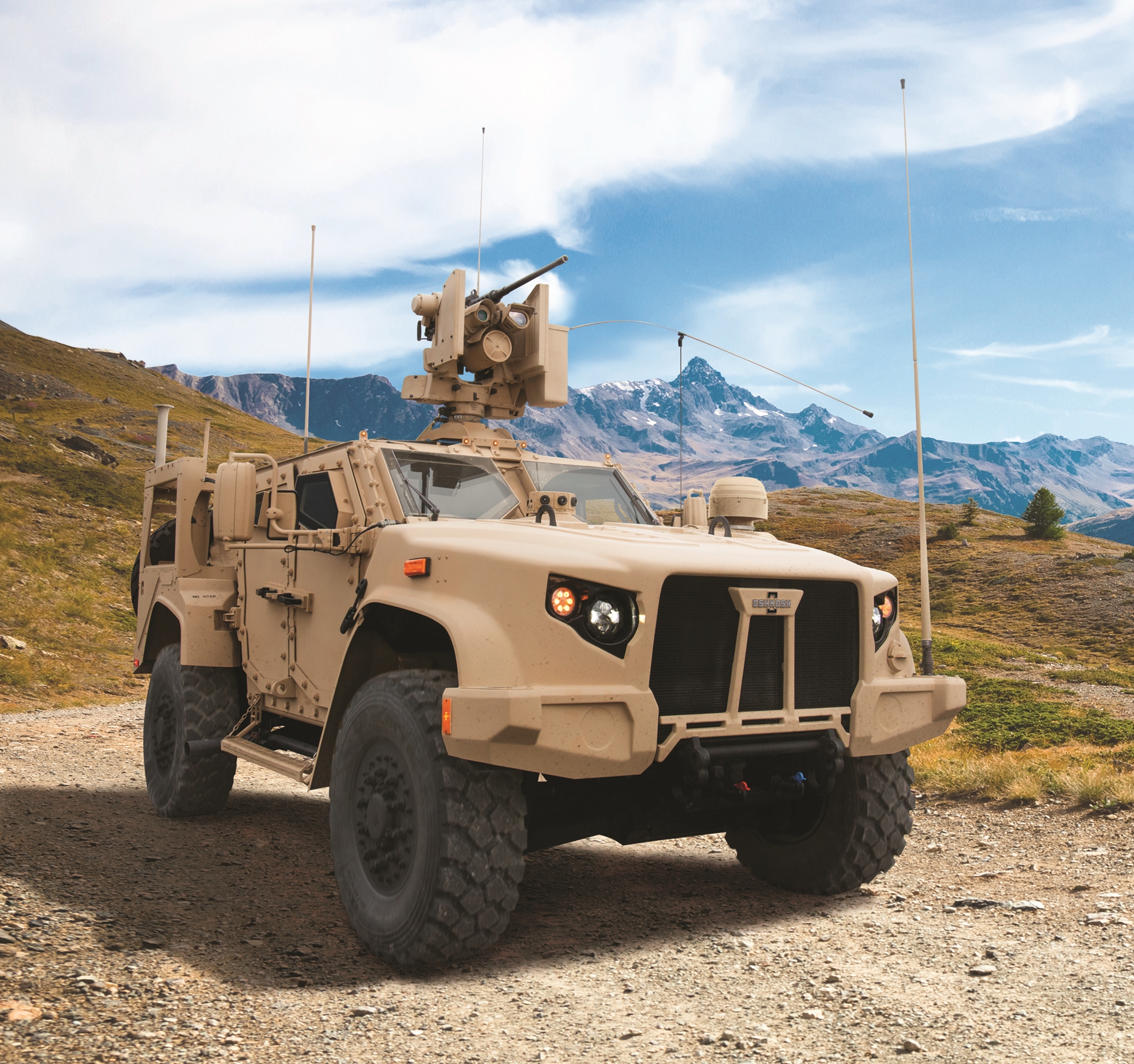
The Joint Light Tactical Vehicle (JLTV), known and marketed under Oshkosh development as the L-ATV (Light Combat Tactical All-Terrain Vehicle), is a light utility/combat multi-role vehicle. The Oshkosh-developed JLTV was selected for acquisition under the US military's Army-led Joint Light Tactical Vehicle program. In the very early stages of the program it was suggested that JLTV would replace the AM General High Mobility Multi-purpose Wheeled Vehicle (HMMWV) on a one-for-one basis. It is now suggested that the JLTV will partially replace the HMMWV.
The L-ATV was designed to deliver a level of protection comparable to that of heavier and less maneuverable Mine Resistant Ambush Protected (MRAP) class designs, these having more protection from blast than up-armored HMMWVs which they were delivered to replace on deployed operations.
In August 2015, the L-ATV was selected as the winner of the JLTV program. The first JLTV delivery order was placed in March 2016 with the U.S. Army ordering 657 examples. Overall requirements have fluctuated, but as of January 2022[update] were stated by Michael Sprang, JLTV Project Director to be 49,099 for the Army; approximately 12,500 for the Marine Corps; 2,000 for the Air Force (dependent on funding); and approximately 400 for the Navy.
The JLTV achieved initial operating capability in the U.S. Marine Corps in 2019. The Army recompeted the right to manufacture the JLTV beginning with the A2 variant. In 2023, the Army selected AM General. Oshkosh expects to produce JLTVs into early 2025 and retains the right to produce JLTVs for direct commercial sale.
The idea for the Joint Light Tactical Vehicle (JLTV) first emerged in 2006 from threats experienced during the Iraq War. The primary tactical wheeled vehicle used by the U.S. military at the start of the war was the Humvee. However, most were unarmored and the type (including armored examples) incurred heavy losses when improvised explosive devices (IEDs) began being employed by insurgents. The initial response was to add armor, or more armor to armored models, and primarily on the sides. This improved side protection against direct fire and associated threats, but since the chassis was not designed to handle any further additional weight, there was little room for underbody protection. The added armor weight greatly reduced remaining useful payload capacity (within max gross weight), negatively impacted off-road mobility, compromised vehicle reliability, and greatly increased their maintenance needs (frequency, labor and parts costs).
To combat increasing numbers of IED attacks, the U.S. rapidly procured some 29,000 Mine Resistant Ambush Protected (MRAP) vehicles, including the Oshkosh M-ATV for use in Iraq and Afghanistan. While MRAPs offered superior protection from IEDs, especially underbody blasts, they were significantly larger and heavier and had relatively poor off-road mobility. The military incorporated MRAPs in response to operational needs, but never intended them to become a permanent part of their tactical wheeled vehicle fleets. At the conclusion of operations, many thousands were either scrapped, adapted for other roles, or offered for sale/transfer to allies. Ultimately U.S. armed forces would retain over 11,100 MRAPS, just over 6,350 of these Oshkosh M-ATVs.
Since up-armoring Humvees and buying MRAPs addressed specific issues but created gaps in vehicle capabilities, the JLTV program was started to incorporate lessons learned and balance payload, mobility, and protection into a new vehicle. Its purpose was to restore the mobility commanders had with the original Humvee, while having the side and underbody protection of a basic MRAP. It would be around two-thirds the weight of an MRAP, possible to be carried under a CH-47 Chinook and CH-53E Super Stallion and by amphibious vessels, things impossible for an MRAP. It would also be 70 percent faster off-road, adding to survivability by enabling it to egress a combat situation faster. Compared to the Humvee, the JLTV was to have the mobility of early unarmored versions with greater protection than up-armored versions, along with greater reliability, payload capacity, and ease of repair. The JLTV is the first vehicle purpose-built for network connectivity into the Warfighter Information Network-Tactical.
The Joint Chief of Staff's Joint Requirements Oversight Council approved the JLTV program in November 2006; this began a 13-month Concept Refinement phase which is a pre-systems acquisition process designed to further develop the initial concepts resident in the Initial Capabilities Document. The Concept Refinement phase also includes an Analysis of Alternatives. At the conclusion of the Concept Refinement phase in December 2007, the Joint Program Office JLTV project manager intended to transition the program directly into the engineering, manufacturing, and development phase.
Hub AI
Joint Light Tactical Vehicle AI simulator
(@Joint Light Tactical Vehicle_simulator)
Joint Light Tactical Vehicle
The Joint Light Tactical Vehicle (JLTV), known and marketed under Oshkosh development as the L-ATV (Light Combat Tactical All-Terrain Vehicle), is a light utility/combat multi-role vehicle. The Oshkosh-developed JLTV was selected for acquisition under the US military's Army-led Joint Light Tactical Vehicle program. In the very early stages of the program it was suggested that JLTV would replace the AM General High Mobility Multi-purpose Wheeled Vehicle (HMMWV) on a one-for-one basis. It is now suggested that the JLTV will partially replace the HMMWV.
The L-ATV was designed to deliver a level of protection comparable to that of heavier and less maneuverable Mine Resistant Ambush Protected (MRAP) class designs, these having more protection from blast than up-armored HMMWVs which they were delivered to replace on deployed operations.
In August 2015, the L-ATV was selected as the winner of the JLTV program. The first JLTV delivery order was placed in March 2016 with the U.S. Army ordering 657 examples. Overall requirements have fluctuated, but as of January 2022[update] were stated by Michael Sprang, JLTV Project Director to be 49,099 for the Army; approximately 12,500 for the Marine Corps; 2,000 for the Air Force (dependent on funding); and approximately 400 for the Navy.
The JLTV achieved initial operating capability in the U.S. Marine Corps in 2019. The Army recompeted the right to manufacture the JLTV beginning with the A2 variant. In 2023, the Army selected AM General. Oshkosh expects to produce JLTVs into early 2025 and retains the right to produce JLTVs for direct commercial sale.
The idea for the Joint Light Tactical Vehicle (JLTV) first emerged in 2006 from threats experienced during the Iraq War. The primary tactical wheeled vehicle used by the U.S. military at the start of the war was the Humvee. However, most were unarmored and the type (including armored examples) incurred heavy losses when improvised explosive devices (IEDs) began being employed by insurgents. The initial response was to add armor, or more armor to armored models, and primarily on the sides. This improved side protection against direct fire and associated threats, but since the chassis was not designed to handle any further additional weight, there was little room for underbody protection. The added armor weight greatly reduced remaining useful payload capacity (within max gross weight), negatively impacted off-road mobility, compromised vehicle reliability, and greatly increased their maintenance needs (frequency, labor and parts costs).
To combat increasing numbers of IED attacks, the U.S. rapidly procured some 29,000 Mine Resistant Ambush Protected (MRAP) vehicles, including the Oshkosh M-ATV for use in Iraq and Afghanistan. While MRAPs offered superior protection from IEDs, especially underbody blasts, they were significantly larger and heavier and had relatively poor off-road mobility. The military incorporated MRAPs in response to operational needs, but never intended them to become a permanent part of their tactical wheeled vehicle fleets. At the conclusion of operations, many thousands were either scrapped, adapted for other roles, or offered for sale/transfer to allies. Ultimately U.S. armed forces would retain over 11,100 MRAPS, just over 6,350 of these Oshkosh M-ATVs.
Since up-armoring Humvees and buying MRAPs addressed specific issues but created gaps in vehicle capabilities, the JLTV program was started to incorporate lessons learned and balance payload, mobility, and protection into a new vehicle. Its purpose was to restore the mobility commanders had with the original Humvee, while having the side and underbody protection of a basic MRAP. It would be around two-thirds the weight of an MRAP, possible to be carried under a CH-47 Chinook and CH-53E Super Stallion and by amphibious vessels, things impossible for an MRAP. It would also be 70 percent faster off-road, adding to survivability by enabling it to egress a combat situation faster. Compared to the Humvee, the JLTV was to have the mobility of early unarmored versions with greater protection than up-armored versions, along with greater reliability, payload capacity, and ease of repair. The JLTV is the first vehicle purpose-built for network connectivity into the Warfighter Information Network-Tactical.
The Joint Chief of Staff's Joint Requirements Oversight Council approved the JLTV program in November 2006; this began a 13-month Concept Refinement phase which is a pre-systems acquisition process designed to further develop the initial concepts resident in the Initial Capabilities Document. The Concept Refinement phase also includes an Analysis of Alternatives. At the conclusion of the Concept Refinement phase in December 2007, the Joint Program Office JLTV project manager intended to transition the program directly into the engineering, manufacturing, and development phase.