
Recent from talks
Joint Terrorism Task Force
Knowledge base stats:
Talk channels stats:
Members stats:
Joint Terrorism Task Force
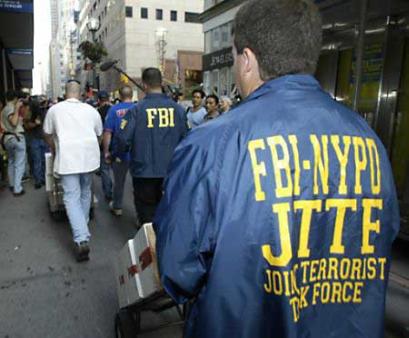
A Joint Terrorism Task Force (JTTF) is an American locally-based multi-agency partnership between various federal, state, and local law enforcement agencies tasked with investigating terrorism and terrorism-related crimes, led by the Federal Bureau of Investigation and U.S. Department of Justice. The first JTTFs were established in the 1980s and 1990s, with their numbers increasing dramatically after the September 11 attacks.
The first JTTF was established in 1980 in New York City, with ten FBI special agents and ten New York City Police Department (NYPD) detectives. In 1999, the United States had 26 JTTFs; shortly after the attacks, FBI director Robert Mueller instructed all FBI field offices to establish formal terrorism task forces. By December 2011, there were more than 100 Joint Terrorism Task Forces nationwide, the vast majority established after the September 11 attacks. There were 113 JTTFs as of 2013, and approximately 200 JTTFs as of 2022.
JTTFs are led by the Federal Bureau of Investigation, which is part of the U.S. Department of Justice. The various investigators, analysts, and specialists who participate in JTTFs (including linguists and SWAT personnel) are drawn from more than 600 state and local agencies and 50 federal agencies (including both federal law enforcement and intelligence agencies). The FBI's 2011 Domestic Investigations and Operations Guide, cited in a 2013 Congressional Research Service report, stated that more than 4,400 federal, state, and local law enforcement officers and agents work in JTTFs.
The regional JTTFs coordinate their efforts through the interagency National Joint Terrorism Task Force (NJTTF), based at FBI Headquarters in Washington, D.C. As of 2003, NJTTF was composed of representatives from 35 federal agencies and fell under the Operational Support Branch of the FBI Counterterrorism Division.
A 2013 report from the Brennan Center for Justice at the NYU School of Law noted that "JTTFs tend to focus on investigative work while fusion centers are geared towards information collection and analysis, but their missions are intimately related and often overlapping"; JTTFs and fusion centers are sometimes "co-located" in the same physical working space.
Joint Terrorism Task Forces have participated in high-profile investigations, including investigations into the 2007 Fort Dix attack plot, 2007 John F. Kennedy International Airport attack plot, 2009 plot by Najibullah Zazi targeting the New York City subway, Tarek Mehanna case, 2012 Jose Pimentel case, 2015 Usaama Rahim plot, Ahmad Khan Rahami's 2016 New York and New Jersey bombings, Mark Steven Domingo's failed 2019 plot to bomb a rally in Long Beach, California, and January 6 United States Capitol attack.
Before U.S. Army psychiatrist Nidal Hasan murdered 14 people in a mass shooting at Fort Hood, the JTTF in San Diego had acquired two messages from Hasen to radical Islamic ideologue Anwar al-Aulaqi. Concerned by the content of the messages, the San Diego JTTF contacted FBI Headquarters and the JTTF based in the FBI's Washington Field Office. The Washington Field Office did a limited assessment and concluded that Hasan was not "involved in terrorist activities." In the meantime, agents in San Diego acquired 14 additional emails and messages (12 from Hasan to al-Aulaqi and two from al-Aulaqi to Hasen), but San Diego did not forward these communications to the D.C. JTTF, and neither JTTF took any action. Hasan committed the terrorist attack at Fort Hood several months later. A commission led by William H. Webster investigated the FBI's counterterrorism intelligence in the lead-up to the Fort Hood shooting, and released its final report in 2012. The Webster Commission found that the assessment of Hasan conducted by the FBI and JTTFs was "belated, incomplete, and rushed, primarily because of their workload" and an "exponential growth in the amount of electronically stored information." The report did, however, conclude that all the FBI and task force personnel "acted with good intent" and that their mistakes did not result "from intentional misconduct."
In 2005, Portland, Oregon, became the first city in the nation to withdraw from a JTTF after the City Council voted 4–1 to leave. The city rejoined the task force in 2015, with the City Council voting 3–2 to approve the assignment of two of its city's police officers to join the JTTF staff. In 2019, Portland again voted to leave the JTTF by a 3–2 vote.
Hub AI
Joint Terrorism Task Force AI simulator
(@Joint Terrorism Task Force_simulator)
Joint Terrorism Task Force
A Joint Terrorism Task Force (JTTF) is an American locally-based multi-agency partnership between various federal, state, and local law enforcement agencies tasked with investigating terrorism and terrorism-related crimes, led by the Federal Bureau of Investigation and U.S. Department of Justice. The first JTTFs were established in the 1980s and 1990s, with their numbers increasing dramatically after the September 11 attacks.
The first JTTF was established in 1980 in New York City, with ten FBI special agents and ten New York City Police Department (NYPD) detectives. In 1999, the United States had 26 JTTFs; shortly after the attacks, FBI director Robert Mueller instructed all FBI field offices to establish formal terrorism task forces. By December 2011, there were more than 100 Joint Terrorism Task Forces nationwide, the vast majority established after the September 11 attacks. There were 113 JTTFs as of 2013, and approximately 200 JTTFs as of 2022.
JTTFs are led by the Federal Bureau of Investigation, which is part of the U.S. Department of Justice. The various investigators, analysts, and specialists who participate in JTTFs (including linguists and SWAT personnel) are drawn from more than 600 state and local agencies and 50 federal agencies (including both federal law enforcement and intelligence agencies). The FBI's 2011 Domestic Investigations and Operations Guide, cited in a 2013 Congressional Research Service report, stated that more than 4,400 federal, state, and local law enforcement officers and agents work in JTTFs.
The regional JTTFs coordinate their efforts through the interagency National Joint Terrorism Task Force (NJTTF), based at FBI Headquarters in Washington, D.C. As of 2003, NJTTF was composed of representatives from 35 federal agencies and fell under the Operational Support Branch of the FBI Counterterrorism Division.
A 2013 report from the Brennan Center for Justice at the NYU School of Law noted that "JTTFs tend to focus on investigative work while fusion centers are geared towards information collection and analysis, but their missions are intimately related and often overlapping"; JTTFs and fusion centers are sometimes "co-located" in the same physical working space.
Joint Terrorism Task Forces have participated in high-profile investigations, including investigations into the 2007 Fort Dix attack plot, 2007 John F. Kennedy International Airport attack plot, 2009 plot by Najibullah Zazi targeting the New York City subway, Tarek Mehanna case, 2012 Jose Pimentel case, 2015 Usaama Rahim plot, Ahmad Khan Rahami's 2016 New York and New Jersey bombings, Mark Steven Domingo's failed 2019 plot to bomb a rally in Long Beach, California, and January 6 United States Capitol attack.
Before U.S. Army psychiatrist Nidal Hasan murdered 14 people in a mass shooting at Fort Hood, the JTTF in San Diego had acquired two messages from Hasen to radical Islamic ideologue Anwar al-Aulaqi. Concerned by the content of the messages, the San Diego JTTF contacted FBI Headquarters and the JTTF based in the FBI's Washington Field Office. The Washington Field Office did a limited assessment and concluded that Hasan was not "involved in terrorist activities." In the meantime, agents in San Diego acquired 14 additional emails and messages (12 from Hasan to al-Aulaqi and two from al-Aulaqi to Hasen), but San Diego did not forward these communications to the D.C. JTTF, and neither JTTF took any action. Hasan committed the terrorist attack at Fort Hood several months later. A commission led by William H. Webster investigated the FBI's counterterrorism intelligence in the lead-up to the Fort Hood shooting, and released its final report in 2012. The Webster Commission found that the assessment of Hasan conducted by the FBI and JTTFs was "belated, incomplete, and rushed, primarily because of their workload" and an "exponential growth in the amount of electronically stored information." The report did, however, conclude that all the FBI and task force personnel "acted with good intent" and that their mistakes did not result "from intentional misconduct."
In 2005, Portland, Oregon, became the first city in the nation to withdraw from a JTTF after the City Council voted 4–1 to leave. The city rejoined the task force in 2015, with the City Council voting 3–2 to approve the assignment of two of its city's police officers to join the JTTF staff. In 2019, Portland again voted to leave the JTTF by a 3–2 vote.
Recent media