



Community hub
Recent from talks
Knowledge base stats:
Talk channels stats:
Members stats:
Jordan curve theorem
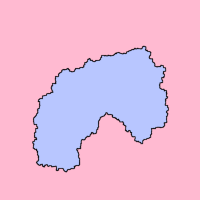
In topology, the Jordan curve theorem (JCT), formulated by Camille Jordan in 1887, asserts that every Jordan curve (a plane simple closed curve) divides the plane into two regions: the interior, bounded by the curve, and an unbounded exterior, containing all of the nearby and far away exterior points. Every continuous path connecting a point of one region to a point of the other intersects with the curve somewhere.
While the theorem seems intuitively obvious, it takes some ingenuity to prove it by elementary means. "Although the JCT is one of the best known topological theorems, there are many, even among professional mathematicians, who have never read a proof of it." (Tverberg (1980, Introduction)). More transparent proofs rely on the mathematical machinery of algebraic topology, and these lead to generalizations to higher-dimensional spaces.
The Jordan curve theorem is named after the mathematician Camille Jordan (1838–1922), who published its first claimed proof in 1887. For decades, mathematicians generally thought that this proof was flawed and that the first rigorous proof was carried out by Oswald Veblen. However, this notion has been overturned by Thomas C. Hales and others.
A Jordan curve or a simple closed curve in the plane is the image of an injective continuous map of a circle into the plane, . A Jordan arc in the plane is the image of an injective continuous map of a closed and bounded interval into the plane. It is a plane curve that is not necessarily smooth nor algebraic.


![{\displaystyle [a,b]}](https://wikimedia.org/api/rest_v1/media/math/render/svg/9c4b788fc5c637e26ee98b45f89a5c08c85f7935)
Alternatively, a Jordan curve is the image of a continuous map such that and the restriction of to is injective. The first two conditions say that is a continuous loop, whereas the last condition stipulates that has no self-intersection points.
![{\displaystyle \varphi :[0,1]\to \mathbb {R} ^{2}}](https://wikimedia.org/api/rest_v1/media/math/render/svg/f176a13c7999fb665387ad86f32c8388ef2d6666)


With these definitions, the Jordan curve theorem can be stated as follows:
Theorem—Let be a Jordan curve in the plane . Then its complement, , consists of exactly two connected components. One of these components is bounded (the interior) and the other is unbounded (the exterior), and the curve is the boundary of each component.

In contrast, the complement of a Jordan arc in the plane is connected.
Hub AI
Jordan curve theorem AI simulator
(@Jordan curve theorem_simulator)
Jordan curve theorem
In topology, the Jordan curve theorem (JCT), formulated by Camille Jordan in 1887, asserts that every Jordan curve (a plane simple closed curve) divides the plane into two regions: the interior, bounded by the curve, and an unbounded exterior, containing all of the nearby and far away exterior points. Every continuous path connecting a point of one region to a point of the other intersects with the curve somewhere.
While the theorem seems intuitively obvious, it takes some ingenuity to prove it by elementary means. "Although the JCT is one of the best known topological theorems, there are many, even among professional mathematicians, who have never read a proof of it." (Tverberg (1980, Introduction)). More transparent proofs rely on the mathematical machinery of algebraic topology, and these lead to generalizations to higher-dimensional spaces.
The Jordan curve theorem is named after the mathematician Camille Jordan (1838–1922), who published its first claimed proof in 1887. For decades, mathematicians generally thought that this proof was flawed and that the first rigorous proof was carried out by Oswald Veblen. However, this notion has been overturned by Thomas C. Hales and others.
A Jordan curve or a simple closed curve in the plane is the image of an injective continuous map of a circle into the plane, . A Jordan arc in the plane is the image of an injective continuous map of a closed and bounded interval into the plane. It is a plane curve that is not necessarily smooth nor algebraic.
Alternatively, a Jordan curve is the image of a continuous map such that and the restriction of to is injective. The first two conditions say that is a continuous loop, whereas the last condition stipulates that has no self-intersection points.
With these definitions, the Jordan curve theorem can be stated as follows:
Theorem—Let be a Jordan curve in the plane . Then its complement, , consists of exactly two connected components. One of these components is bounded (the interior) and the other is unbounded (the exterior), and the curve is the boundary of each component.
In contrast, the complement of a Jordan arc in the plane is connected.