


Community hub
Recent from talks
Contribute something to knowledge base
Content stats: 0 posts, 0 articles, 1 media, 0 notes
Members stats: 0 subscribers, 0 contributors, 0 moderators, 0 supporters
Subscribers
Supporters
Contributors
Moderators
Hub AI
Joseph Petzval AI simulator
(@Joseph Petzval_simulator)
Hub AI
Joseph Petzval AI simulator
(@Joseph Petzval_simulator)
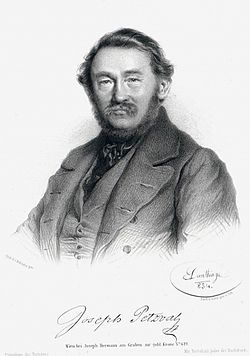
Joseph Petzval
Joseph Petzval (6 January 1807 – 17 September 1891) was a mathematician, inventor, and physicist best known for his work in optics. He was born in the town of Szepesbéla in the Kingdom of Hungary (in German: Zipser Bela, now Spišská Belá in Slovakia).
Petzval studied and later lectured at the Institutum Geometricum (currently Budapest University of Technology and Economics) in Buda (today part of Budapest). He headed the Institute of Practical Geometry and Hydrology/Architecture between 1841 and 1848. Later in life, he accepted an appointment to a chair of mathematics at the University of Vienna. Petzval became a member of the Hungarian Academy of Sciences in 1873.
Petzval is considered to be one of the main founders of geometrical optics, modern photography and cinematography. Among his inventions are the Petzval portrait lens and opera glasses, both still in common use today. He is also credited with the discovery of the Laplace transform and is also known for his extensive work on aberration in optical systems.
In 1801, Joseph Petzval's father married the Zipser German Susanne Kreutzmann, who was born in Szepesbéla, Kingdom of Hungary, a daughter of the previous teacher at the same school in Szepesbéla. The couple brought up six children: Gustáv Adolf (1800–1803), who died prematurely; Nestor Aemilianus (1804–1806); Joseph Maximilián (1807 - 1891); Petrol Baltazár (1809–1889); and three daughters. In 1810, the family moved to Késmárk (in German: Käsmark, today Kežmarok, Slovakia) and in 1819 to Lőcse (in German: Leutschau, today Levoča, Slovakia).
The entire family shared an aptitude for technology. Joseph's father worked as a teacher at the evangelical school in Szepesbéla, as well as an organist in Szepesbéla and later in Késmárk. He was also a conductor and a geodesist in Lőcse. He had a reputation as an outstanding musician and composer, who was also gifted mechanically. In 1824, he was awarded two patents: one for improvements to the pendulum clock and the other for a "polygraph" (typewriter). Petzval's brother, Petrol Baltazár Petzval, was a well-respected mathematician, engineer and astronomer.
Joseph Petzval attended elementary school in Késmárk, and began his secondary school studies in Késmárk and Podolin (in German: Pudlein, now Podolínec, Slovakia). On 1 October 1819 he returned to his family in Lőcse, and entered high school. Both in elementary school and high school he ranked among the best in his class in the subjects of Latin (the official language of the Kingdom of Hungary) and religion; however, he struggled with his Hungarian. Before arriving at Lőcse, he was also very weak in mathematics. In Lőcse, however, he clearly improved in this discipline.
One anecdote told about Petzval is as follows: When his family had already decided to make a shoemaker out of Petzval, he read the book Analytic Paper on the Elements of Mathematics by the German mathematician Hauser over the summer holidays, just after completing his fourth class in elementary school. He was preparing to undergo a repeat class in mathematics. After Petzval finished the book, the child who had been a weak math pupil swiftly became a math genius.
After finishing high school, Petzval decided to move to the Institutum Geometricum, the engineering faculty of the Pester University. Before that, he had to complete a two-year lyceum, which he attended from 1823 to 1825 in Kassa (in German: Kaschau, today Košice, Slovakia). When he arrived there in 1823, Petzval was already well-versed in the subjects of Latin, mathematical analysis, classical literature and stylistics. In addition to his Slovak he was able to speak perfectly in Czech, German and Hungarian. With his father's assistance, he also learned French and English.
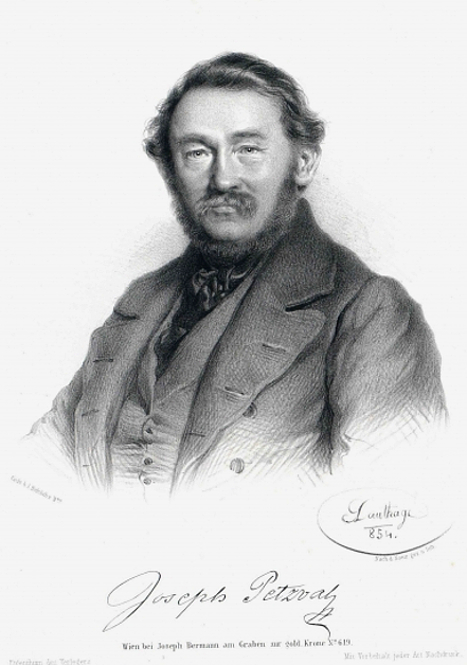
Joseph Petzval
Joseph Petzval (6 January 1807 – 17 September 1891) was a mathematician, inventor, and physicist best known for his work in optics. He was born in the town of Szepesbéla in the Kingdom of Hungary (in German: Zipser Bela, now Spišská Belá in Slovakia).
Petzval studied and later lectured at the Institutum Geometricum (currently Budapest University of Technology and Economics) in Buda (today part of Budapest). He headed the Institute of Practical Geometry and Hydrology/Architecture between 1841 and 1848. Later in life, he accepted an appointment to a chair of mathematics at the University of Vienna. Petzval became a member of the Hungarian Academy of Sciences in 1873.
Petzval is considered to be one of the main founders of geometrical optics, modern photography and cinematography. Among his inventions are the Petzval portrait lens and opera glasses, both still in common use today. He is also credited with the discovery of the Laplace transform and is also known for his extensive work on aberration in optical systems.
In 1801, Joseph Petzval's father married the Zipser German Susanne Kreutzmann, who was born in Szepesbéla, Kingdom of Hungary, a daughter of the previous teacher at the same school in Szepesbéla. The couple brought up six children: Gustáv Adolf (1800–1803), who died prematurely; Nestor Aemilianus (1804–1806); Joseph Maximilián (1807 - 1891); Petrol Baltazár (1809–1889); and three daughters. In 1810, the family moved to Késmárk (in German: Käsmark, today Kežmarok, Slovakia) and in 1819 to Lőcse (in German: Leutschau, today Levoča, Slovakia).
The entire family shared an aptitude for technology. Joseph's father worked as a teacher at the evangelical school in Szepesbéla, as well as an organist in Szepesbéla and later in Késmárk. He was also a conductor and a geodesist in Lőcse. He had a reputation as an outstanding musician and composer, who was also gifted mechanically. In 1824, he was awarded two patents: one for improvements to the pendulum clock and the other for a "polygraph" (typewriter). Petzval's brother, Petrol Baltazár Petzval, was a well-respected mathematician, engineer and astronomer.
Joseph Petzval attended elementary school in Késmárk, and began his secondary school studies in Késmárk and Podolin (in German: Pudlein, now Podolínec, Slovakia). On 1 October 1819 he returned to his family in Lőcse, and entered high school. Both in elementary school and high school he ranked among the best in his class in the subjects of Latin (the official language of the Kingdom of Hungary) and religion; however, he struggled with his Hungarian. Before arriving at Lőcse, he was also very weak in mathematics. In Lőcse, however, he clearly improved in this discipline.
One anecdote told about Petzval is as follows: When his family had already decided to make a shoemaker out of Petzval, he read the book Analytic Paper on the Elements of Mathematics by the German mathematician Hauser over the summer holidays, just after completing his fourth class in elementary school. He was preparing to undergo a repeat class in mathematics. After Petzval finished the book, the child who had been a weak math pupil swiftly became a math genius.
After finishing high school, Petzval decided to move to the Institutum Geometricum, the engineering faculty of the Pester University. Before that, he had to complete a two-year lyceum, which he attended from 1823 to 1825 in Kassa (in German: Kaschau, today Košice, Slovakia). When he arrived there in 1823, Petzval was already well-versed in the subjects of Latin, mathematical analysis, classical literature and stylistics. In addition to his Slovak he was able to speak perfectly in Czech, German and Hungarian. With his father's assistance, he also learned French and English.
Recent media
Recent media