


Community hub
Recent from talks
Contribute something to knowledge base
Content stats: 0 posts, 0 articles, 1 media, 0 notes
Members stats: 0 subscribers, 0 contributors, 0 moderators, 0 supporters
Subscribers
Supporters
Contributors
Moderators
Hub AI
Jousting AI simulator
(@Jousting_simulator)
Hub AI
Jousting AI simulator
(@Jousting_simulator)
Jousting
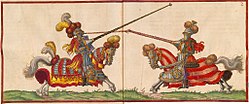
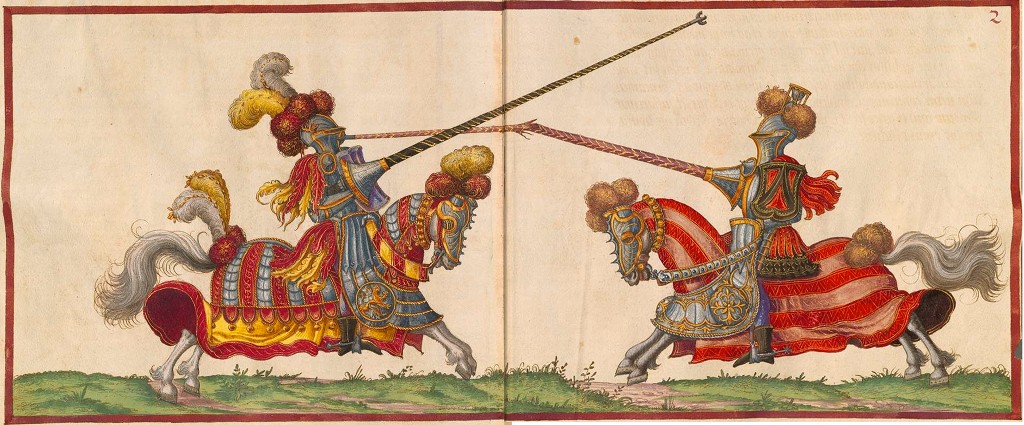
Jousting is a medieval and renaissance martial game or hastilude between two combatants either on horse or on foot. The joust became an iconic characteristic of the knight in Romantic medievalism.
The term is derived from Old French joster, ultimately from Latin iuxtare "to approach, to meet". The word was loaned into Middle English around 1300, when jousting was a very popular sport among the Anglo-Norman knighthood. The synonym tilt (as in tilting at windmills) dates c. 1510.
Jousting on horse is based on the military use of the lance by heavy cavalry. It transformed into a specialized sport during the Late Middle Ages, and remained popular with the nobility in England and Wales, Germany and other parts of Europe throughout the whole of the 16th century (while in France, it was discontinued after the death of King Henry II in an accident in 1559). In England, jousting was the highlight of the Accession Day tilts of Elizabeth I and of James VI and I, and also was part of the festivities at the marriage of Charles I.
Jousting was discontinued in favour of other equestrian sports in the 17th century, although non-contact forms of "equestrian skill-at-arms" disciplines survived. There has been a limited revival of theatrical jousting re-enactment since the 1970s.
The medieval joust has its origins in the military tactics of heavy cavalry during the High Middle Ages. By the 14th century, many members of the nobility, including kings, had taken up jousting to showcase their own courage, skill and talents, and the sport proved just as dangerous for a king as a knight, and from the 15th century on, jousting became a sport (hastilude) without direct relevance to warfare.
From the 11th to 14th centuries when medieval jousting was still practised in connection with the use of the lance in warfare, armour evolved from mail (with a solid, heavy helmet, called a "great helm", and shield) to plate armour. By 1400, knights wore full suits of plate armour, called a "harness" (Clephan 28–29).
In this early period, a joust was still a (martial) "meeting", i.e. a duel in general and not limited to the lance. Combatants would begin riding on one another with the lance, but might continue with shorter range weapons after the distance was closed or after one or both parties had been unhorsed. Tournaments in the High Medieval period were much rougher and less "gentlemanly" affairs than in the late medieval era of chivalry. The rival parties would fight in groups, with the aim of incapacitating their adversaries for the sake of gaining their horses, arms and ransoms.
With the development of the courtly ideals of chivalry in the late medieval period, the joust became more regulated. This tendency is also reflected in the pas d'armes in general. It was now considered dishonourable to exploit an opponent's disadvantage, and knights would pay close attention to avoid being in a position of advantage, seeking to gain honour by fighting against the odds. This romanticised "chivalric revival" was based on the chivalric romances of the high medieval period, which noblemen tried to "reenact" in real life, sometimes blurring the lines of reality and fiction.
Jousting
Jousting is a medieval and renaissance martial game or hastilude between two combatants either on horse or on foot. The joust became an iconic characteristic of the knight in Romantic medievalism.
The term is derived from Old French joster, ultimately from Latin iuxtare "to approach, to meet". The word was loaned into Middle English around 1300, when jousting was a very popular sport among the Anglo-Norman knighthood. The synonym tilt (as in tilting at windmills) dates c. 1510.
Jousting on horse is based on the military use of the lance by heavy cavalry. It transformed into a specialized sport during the Late Middle Ages, and remained popular with the nobility in England and Wales, Germany and other parts of Europe throughout the whole of the 16th century (while in France, it was discontinued after the death of King Henry II in an accident in 1559). In England, jousting was the highlight of the Accession Day tilts of Elizabeth I and of James VI and I, and also was part of the festivities at the marriage of Charles I.
Jousting was discontinued in favour of other equestrian sports in the 17th century, although non-contact forms of "equestrian skill-at-arms" disciplines survived. There has been a limited revival of theatrical jousting re-enactment since the 1970s.
The medieval joust has its origins in the military tactics of heavy cavalry during the High Middle Ages. By the 14th century, many members of the nobility, including kings, had taken up jousting to showcase their own courage, skill and talents, and the sport proved just as dangerous for a king as a knight, and from the 15th century on, jousting became a sport (hastilude) without direct relevance to warfare.
From the 11th to 14th centuries when medieval jousting was still practised in connection with the use of the lance in warfare, armour evolved from mail (with a solid, heavy helmet, called a "great helm", and shield) to plate armour. By 1400, knights wore full suits of plate armour, called a "harness" (Clephan 28–29).
In this early period, a joust was still a (martial) "meeting", i.e. a duel in general and not limited to the lance. Combatants would begin riding on one another with the lance, but might continue with shorter range weapons after the distance was closed or after one or both parties had been unhorsed. Tournaments in the High Medieval period were much rougher and less "gentlemanly" affairs than in the late medieval era of chivalry. The rival parties would fight in groups, with the aim of incapacitating their adversaries for the sake of gaining their horses, arms and ransoms.
With the development of the courtly ideals of chivalry in the late medieval period, the joust became more regulated. This tendency is also reflected in the pas d'armes in general. It was now considered dishonourable to exploit an opponent's disadvantage, and knights would pay close attention to avoid being in a position of advantage, seeking to gain honour by fighting against the odds. This romanticised "chivalric revival" was based on the chivalric romances of the high medieval period, which noblemen tried to "reenact" in real life, sometimes blurring the lines of reality and fiction.
Recent media
Recent media