Hubbry Logo
Julia KristevaJulia KristevaMain
Open search
Julia Kristeva
Community hub
Julia Kristeva
logo
8 pages, 0 posts
0 subscribers
Be the first to start a discussion here.
Julia Kristeva
Julia Kristeva
from Wikipedia

Key Information

Julia Kristeva (/ˈkrɪstəvə/; French: [kʁisteva]; born Yuliya Stoyanova Krasteva, Bulgarian: Юлия Стоянова Кръстева [ˈkrɤstɛvɐ]; on 24 June 1941) is a Bulgarian-French philosopher, literary critic, semiotician, psychoanalyst, feminist, and novelist who has lived in France since the mid-1960s. She has taught at Columbia University, and is now a professor emerita at Université Paris Cité. The author of more than 30 books, including Powers of Horror, Tales of Love, Black Sun: Depression and Melancholia, Proust and the Sense of Time, and the trilogy Female Genius, she has been awarded Commander of the Legion of Honor, Commander of the Order of Merit, the Holberg International Memorial Prize, the Hannah Arendt Prize, and the Vision 97 Foundation Prize, awarded by the Havel Foundation.

Kristeva became influential in international critical analysis, cultural studies and feminism after publishing her first book, Semeiotikè, in 1969. Her sizeable body of work includes books and essays that address intertextuality, the semiotic, and abjection, in the fields of linguistics, literary theory and criticism, psychoanalysis, biography and autobiography, political and cultural analysis, art and art history. She is prominent in structuralist and poststructuralist thought.

Kristeva is also the founder of the Simone de Beauvoir Prize committee.[2]

Life

[edit]

Born in Sliven, Bulgaria to Christian parents, Kristeva is the daughter of a church accountant. On her mother's side, she has distant Jewish ancestry.[3] Kristeva and her sister attended a Francophone school run by Dominican nuns. Kristeva became acquainted with the work of Mikhail Bakhtin at this time in Bulgaria. Kristeva went on to study at the University of Sofia, and while a postgraduate there obtained a research fellowship that enabled her to move to France in December 1965, when she was 24.[4] She continued her education at several French universities, studying under Lucien Goldmann and Roland Barthes, among other scholars.[5][6] On August 2, 1967, Kristeva married the novelist Philippe Sollers,[7] born Philippe Joyaux.

Kristeva taught at Columbia University in the early 1970s, and remains a visiting professor.[8] She has also published under the married name Julia Joyaux.[9][10][11]

Work

[edit]

After joining the 'Tel Quel group' founded by Sollers, Kristeva focused on the politics of language and became an active member of the group. She trained in psychoanalysis, and earned her degree in 1979. In some ways, her work can be seen as trying to adapt a psychoanalytic approach to the poststructuralist criticism. For example, her view of the subject, and its construction, shares similarities with Sigmund Freud and Jacques Lacan. However, Kristeva rejects any understanding of the subject in a structuralist sense; instead, she favors a subject always "in process" or "on trial".[12] In this way, she contributes to the poststructuralist critique of essentialized structures, whilst preserving the teachings of psychoanalysis. She travelled to China in the 1970s and later wrote About Chinese Women (1977).[13][14][15][16][17][18]

The "semiotic" and the "symbolic"

[edit]

One of Kristeva's most important contributions is that signification is composed of two elements, the symbolic and the semiotic, the latter being distinct from the discipline of semiotics founded by Ferdinand de Saussure. As explained by Augustine Perumalil, Kristeva's "semiotic is closely related to the infantile pre-Oedipal referred to in the works of Freud, Otto Rank, Melanie Klein, British Object Relation psychoanalysis, and Lacan's pre-mirror stage. It is an emotional field, tied to the instincts, which dwells in the fissures and prosody of language rather than in the denotative meanings of words."[19] Furthermore, according to Birgit Schippers, the semiotic is a realm associated with the musical, the poetic, the rhythmic, and that which lacks structure and meaning. It is closely tied to the "feminine", and represents the undifferentiated state of the pre-Mirror Stage infant.[20]

Upon entering the Mirror Stage, the child learns to distinguish between self and other, and enters the realm of shared cultural meaning, known as the symbolic. In Desire in Language (1980), Kristeva describes the symbolic as the space in which the development of language allows the child to become a "speaking subject," and to develop a sense of identity separate from the mother. This process of separation is known as abjection, whereby the child must reject and move away from the mother in order to enter into the world of language, culture, meaning, and the social. This realm of language is called the symbolic and is contrasted with the semiotic in that it is associated with the masculine, the law, and structure. Kristeva departs from Lacan in the idea that even after entering the symbolic, the subject continues to oscillate between the semiotic and the symbolic. Therefore, rather than arriving at a fixed identity, the subject is permanently "in process". Because female children continue to identify to some degree with the mother figure, they are especially likely to retain a close connection to the semiotic. This continued identification with the mother may result in what Kristeva refers to in Black Sun (1989) as melancholia (depression), given that female children simultaneously reject and identify with the mother figure.

It has also been suggested (e.g., Creed, 1993) that the degradation of women and women's bodies in popular culture (and particularly, for example, in slasher films) emerges because of the threat to identity that the mother's body poses: it is a reminder of time spent in the undifferentiated state of the semiotic, where one has no concept of self or identity. After abjecting the mother, subjects retain an unconscious fascination with the semiotic, desiring to reunite with the mother, while at the same time fearing the loss of identity that accompanies it. Slasher films thus provide a way for audience members to safely reenact the process of abjection by vicariously expelling and destroying the mother figure.

Kristeva is also known for her adoption of Plato’s idea of the chora, meaning "a nourishing maternal space" (Schippers, 2011). Kristeva's idea of the chora has been interpreted in several ways: as a reference to the uterus, as a metaphor for the relationship between the mother and child, and as the temporal period preceding the Mirror Stage. In her essay Motherhood According to Giovanni Bellini from Desire in Language (1980), Kristeva refers to the chora as a "non-expressive totality formed by drives and their stases in a motility that is as full of movement as it is regulated." She goes on to suggest that it is the mother's body that mediates between the chora and the symbolic realm: the mother has access to culture and meaning, yet also forms a totalizing bond with the child.

Kristeva is also noted for her work on the concept of intertextuality.

Anthropology and psychology

[edit]

Kristeva argues that anthropology and psychology, or the connection between the social and the subject, do not represent each other, but rather follow the same logic: the survival of the group and the subject. Furthermore, in her analysis of Oedipus, she claims that the speaking subject cannot exist on his/her own, but that he/she "stands on the fragile threshold as if stranded on account of an impossible demarcation" (Powers of Horror, p. 85).

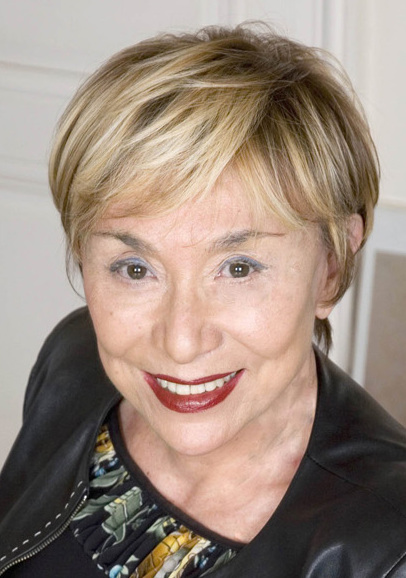
Julia Kristeva in 2005

In her comparison between the two disciplines, Kristeva claims that the way in which an individual excludes the abject mother as a means of forming an identity, is the same way in which societies are constructed. On a broader scale, cultures exclude the maternal and the feminine, and by this come into being.[clarification needed]

Feminism

[edit]

Kristeva has been regarded as a key proponent of French feminism together with Simone de Beauvoir, Hélène Cixous, and Luce Irigaray.[21][22] Kristeva has had a remarkable influence on feminism and feminist literary studies[23][24] in the US and the UK, as well as on readings into contemporary art[25][26] although her relation to feminist circles and movements in France has been quite controversial. Kristeva made a famous disambiguation of three types of feminism in "Women's Time" in New Maladies of the Soul (1993); while rejecting the first two types, including that of Beauvoir, her stands are sometimes considered as rejecting feminism altogether. Kristeva proposed the idea of multiple sexual identities against the joined code [clarification needed] of "unified feminine language".

Denunciation of identity politics

[edit]

Kristeva argues that her writings have been misunderstood by American feminist academics in the identity politics tradition. In Kristeva's view, it was not enough simply to dissect the structure of language in order to find its hidden meaning. Language should also be viewed through the prisms of history and of individual psychic and sexual experiences. This post-structuralist approach enabled specific social groups to trace the source of their oppression to the very language they used. However, Kristeva believes that it is harmful to posit collective identity above individual identity, and that this political assertion of sexual, ethnic, and religious identities is ultimately totalitarian.[27]

Novelist

[edit]

Kristeva has written a number of novels that resemble detective stories. While the books maintain narrative suspense and develop a stylized surface, her readers also encounter ideas intrinsic to her theoretical projects. Her characters reveal themselves mainly through psychological devices, making her type of fiction mostly resemble the later work of Dostoevsky. Her fictional oeuvre, which includes The Old Man and the Wolves, Murder in Byzantium, and Possessions, while often allegorical, also approaches the autobiographical in some passages, especially with one of the protagonists of Possessions, Stephanie Delacour—a French journalist—who can be seen as Kristeva's alter ego. Murder in Byzantium deals with themes from orthodox Christianity and politics; she referred to it as "a kind of anti-Da Vinci Code".[28]

Honors

[edit]

For her "innovative explorations of questions on the intersection of language, culture and literature", Kristeva was awarded the Holberg International Memorial Prize in 2004. She won the 2006 Hannah Arendt Prize for Political Thought. She has also been awarded Commander of the Legion of Honor, Commander of the Order of Merit, and the Vaclav Havel Prize.[29] On October 10, 2019, she received an honoris causa doctorate from Universidade Católica Portuguesa.

Scholarly reception

[edit]

Roman Jakobson said that "Both readers and listeners, whether agreeing or in stubborn disagreement with Julia Kristeva, feel indeed attracted to her contagious voice and to her genuine gift of questioning generally adopted 'axioms,' and her contrary gift of releasing various 'damned questions' from their traditional question marks."[30]

Roland Barthes comments that "Julia Kristeva changes the place of things: she always destroys the last prejudice, the one you thought you could be reassured by, could be take [sic] pride in; what she displaces is the already-said, the déja-dit, i.e., the instance of the signified, i.e., stupidity; what she subverts is authority -the authority of monologic science, of filiation."[31]

Ian Almond criticizes Kristeva's ethnocentrism. He cites Gayatri Spivak's conclusion that Kristeva's book About Chinese Women "belongs to that very eighteenth century [that] Kristeva scorns" after pinpointing "the brief, expansive, often completely ungrounded way in which she writes about two thousand years of a culture she is unfamiliar with".[32] Almond notes the absence of sophistication in Kristeva's remarks concerning the Muslim world and the dismissive terminology she uses to describe its culture and believers.[33] He criticizes Kristeva's opposition which juxtaposes "Islamic societies" against "democracies where life is still fairly pleasant" by pointing out that Kristeva displays no awareness of the complex and nuanced debate ongoing among women theorists in the Muslim world, and that she does not refer to anything other than the Rushdie fatwa in dismissing the entire Muslim faith as "reactionary and persecutory".[34]

In Impostures intellectuelles (1997), physics professors Alan Sokal and Jean Bricmont devote a chapter to Kristeva's use of mathematics in her early writings. They argue that Kristeva fails to show the relevance of the mathematical concepts she discusses to linguistics and the other fields she studies, and that no such relevance exists.[35]

Alleged collaboration with the Communist Regime in Bulgaria

[edit]

In 2018, Bulgaria's state Dossier Commission announced that Kristeva had been an agent for the Committee for State Security under the code name "Sabina". She was supposedly recruited in June 1971, five years earlier she left Bulgaria to study in France.[36][37] Under the People's Republic of Bulgaria, any Bulgarian who wanted to travel abroad had to apply for an exit visa and get an approval from the Ministry of Interior. The process was long and difficult because anyone who made it to the west could declare political asylum.[38] Kristeva has called the allegations "grotesque and false".[39] On 30 March, the state Dossier Commission began publishing online the entire set of documents reflecting Kristeva's activity as an informant of the former Committee for State Security.[40][41][42][43][44][45] She vigorously denies the charges.[46]

Neal Ascherson wrote: "...the recent fuss about Julia Kristeva boils down to nothing much, although it has suited some to inflate it into a fearful scandal... But the reality shown in her files is trivial. After settling in Paris in 1965, she was cornered by Bulgarian spooks who pointed out to her that she still had a vulnerable family in the home country. So she agreed to regular meetings over many years, in the course of which she seems to have told her handlers nothing more than gossip about Aragon, Bataille & Co. from the Left Bank cafés – stuff they could have read in Le Canard enchaîné... the combined intelligence value of its product and her reports was almost zero. The Bulgarian security men seem to have known they were being played. But never mind: they could impress their boss by showing him a real international celeb on their books..."[47]

Selected writings

[edit]

Linguistic and literature

[edit]
  • Séméiôtiké: recherches pour une sémanalyse, Paris, Seuil, 1969 (trans. in Desire in Language: A Semiotic Approach to Literature and Art, New York, Columbia University Press, Blackwell, London, 1980)
  • Le langage, cet inconnu: Une initiation à la linguistique, S.G.P.P., 1969; new ed., coll. Points, Seuil, 1981 (trans. in 1981 as Language. The Unknown: an Initiation into Linguistics, Columbia University Press, Harvester Wheatsheaf, London, 1989)
  • La révolution du langage poétique: L'avant-garde à la fin du 19e siècle: Lautréamont et Mallarmé, Seuil, Paris, 1974 (abridged trans. containing only the first third of the original French edition, Revolution in Poetic Language, Columbia University Press, New York, 1984)
  • Polylogue, Seuil, Paris, 1977 (trans. in Desire in Language: A Semiotic Approach to Literature and Art, New York, Columbia University Press, Blackwell, London, 1980)
  • Histoires d’amour, Denoël, Paris, 1983 (trans. Tales of Love, Columbia University Press, New York, 1987)
  • Le temps sensible. Proust et l’expérience littéraire, Gallimard, Paris, 1994 (trans. Time and Sense: Proust and the experience of literature, Columbia University Press, New York, 1996)
  • Dostoïevski, Buchet-Chastel, Paris, 2020

Psychoanalysis and philosophy

[edit]
  • Pouvoirs de l’horreur. Essai sur l’abjection (trans. Powers of Horror: An Essay on Abjection, Columbia University Press, New York, 1982)
  • Au commencement était l’amour. Psychanalyse et foi, Hachette, Paris, 1985 (trans. In the Beginning Was Love. Psychoanalysis and Faith, Columbia University Press, New York, 1987)
  • Soleil Noir. Dépression et mélancolie, Gallimard, Paris, 1987 (trans. The Black Sun: Depression and Melancholia, Columbia University Press, New York, 1989)
  • Etrangers à nous-mêmes, Fayard, Paris, 1988 (Strangers to Ourselves, Columbia University Press, New York, 1991)
  • Lettre ouverte à Harlem Désir, Rivages, Paris, 1990, (trans. Nations without Nationalism. Columbia University Press, New York, 1993
  • Les Nouvelles maladies de l’âme, Fayard, Paris, 1993 (trans. New Maladies of the Soul. Columbia University Press, New York, 1995)
  • Sens et non sens de la révolte, Fayard, Paris, 1996 (trans. The Sense of Revolt, Columbia University Press, 2000)
  • La Révolte intime, Fayard, 1997 (trans. Intimate Revolt, Columbia University Press, 2002)
  • Le Génie féminin: la vie, la folie, les mots, Fayard, Paris, 1999–2002 (trans. Female Genius: Life, Madness, Words, Columbia University Press, New York, 2001–2004):
    • 1. Hannah Arendt ou l’action comme naissance et comme étrangeté, vol. 1, Fayard, Paris, 1999
    • 2. Melanie Klein ou le matricide comme douleur et comme créativité: la folie, vol. 2, Fayard, Paris, 2000
    • 3. Colette ou la chair du monde, vol. 3, Fayard, Paris, 2002
  • Vision capitales, Réunion des musées nationaux, 1998 (trans. The Severed Head: capital visions, Columbia University Press, New York, 2012)

Autobiographical essays

[edit]
  • Des Chinoises, édition des Femmes, Paris, 1974 (About Chinese Women, Marion Boyars, London, 1977
  • Du mariage considéré comme un des Beaux-Arts, Fayard, Paris, 2015 (Marriage as a Fine Art (with Philippe Sollers) Columbia University Press, New York 2016
  • Je me voyage. Mémoires. Entretien avec Samuel Dock, Fayard, Paris, 2016 (A Journey Across Borders and Through Identities. Conversations with Samuel Dock, in The Philosophy of Julia Kristeva, ed. Sara Beardsworth, The Library of Living Philosophers, vo. 36, Open Cort, Chicago, 2020)

Collection of essays

[edit]
  • The Kristeva Reader, ed. Toril Moi, Columbia University Press, New York, 1986
  • The Portable Kristeva, ed. Kelly Oliver, Columbia University Press, New York, 1997
  • Crisis of the European Subject, Other Press, New York, 2000
  • La Haine et le pardon, ed. with a foreword by Pierre-Louis Fort, Fayard, Paris, 2005 (trans. Hatred and forgiveness, Columbia University Press, New York, 2010)
  • Pulsions du temps, foreword, edition and notes by David Uhrig, Fayard, Paris, 2013 (trans. Passions of Our Time, ed. with a foreword by Lawrence D. Kritzman, Columbia University Press, New York, 2019)

Novels

[edit]
  • Les Samouraïs, Fayard, Paris, 1990 (trans. The Samurai: A Novel, Columbia University Press, New York, 1992)
  • Le Vieil homme et les loups, Fayard, Paris, 1991(trans. The Old Man and the Wolves, Columbia University Press, New York, 1994)
  • Possessions, Fayard, Paris, 1996 (trans. Possessions: A Novel, Columbia University Press, New York, 1998)
  • Meurtre à Byzance, Fayard, Paris, 2004 (trans. Murder in Byzantium, Columbia University Press, New York, 2006)
  • Thérèse mon amour : récit. Sainte Thérèse d’Avila, Fayard, 2008 (trans. Teresa, my love. An Imagined Life of the Saint of Avila, Columbia University Press, New York, 2015)
  • L’Horloge enchantée, Fayard, Paris, 2015 (trans. The Enchanted Clock, Columbia University Press, 2017)

See also

[edit]

References

[edit]

Further reading

[edit]
[edit]
Revisions and contributorsEdit on WikipediaRead on Wikipedia
from Grokipedia
Julia Kristeva (born Yuliya Stoyanova Krasteva, 24 June 1941) is a Bulgarian-born French academic, philosopher, , and semiotician whose interdisciplinary work spans , , and , most notably through her theorization of the semiotic (pre-linguistic drives) and (structured ) elements of signification. Born in , , Kristeva studied at before emigrating to in 1966, where she joined the intellectual circles of , earned a , and became a professor of at the University (Paris VII), while also practicing as a . Her major publications, such as Revolution in Poetic Language (1974) and (1980), introduced concepts like the chora (a rhythmic, maternal space preceding symbolization), (the process of separating self from threatening otherness), and (texts as mosaics of references), influencing fields from to . Kristeva's career has included engagements with Freudian and Lacanian , explorations of melancholy and love in works like Black Sun (1987) and Tales of Love (1983), and awards such as the Holberg International Memorial Prize in 2004 for her contributions to and philosophy. In 2018, a Bulgarian state commission declassified documents alleging she collaborated with the communist as agent "Sabina" in the 1970s, providing reports on French intellectuals; Kristeva has rejected these claims as fabricated and defamatory, attributing them to post-communist political motives.

Early Life and Background

Childhood and Family in Bulgaria

Julia Kristeva was born on June 24, 1941, in , a small city in central-eastern , two days after the German invasion of the initiated World War II's eastern front in the region. Her family maintained an Orthodox Christian background amid 's wartime alliance with the , during which her father actively resisted efforts to deport the country's Jewish population. Kristeva's father, whose surname derived from the Bulgarian word for "cross," was an orphaned theologian who became an Orthodox priest and later worked as a church accountant before transitioning to the Soviet Ministry of Religion under communist rule; he was fervently religious, loved literature and music, and faced regime opposition due to his non-communist stance, including accounts of torture he relayed to his children. Her mother, from a bourgeois family with historical ties to Jewish, Muslim, and Christian traditions, studied biology at , embraced secular Darwinian views, and prioritized her daughters' education, encouraging study abroad despite political constraints. As the elder daughter, Kristeva had a younger sister, Ivanka, born in 1945, who inherited their father's musical talents; the family relocated from to shortly after Ivanka's birth, seeking better opportunities amid postwar instability. Her early childhood unfolded against the backdrop of Soviet occupation in 1944 and the establishment of a Stalinist regime by 1946 under , which imposed restrictions on non-communist families like hers, barring pursuits such as her desired astronomy studies in due to her father's status. Kristeva recalled hiding in a basement to listen to Radio broadcasts during the Nazi occupation and witnessing postwar executions, such as that of an agricultural , which underscored the era's and ideological shifts. Her initial education began at a French-language religious nursery run by the Oblates of the Assumption until age two, fostering early familiarity with French and , before transitioning to schools; following the 1947 expulsion of the nuns under communist policies, she continued French studies at the . Despite these pressures, her parents' emphasis on intellectual development and family affection shaped a formative environment blending Orthodox heritage with exposure to Western influences.

Education in Linguistics and Philosophy

Kristeva pursued her higher education at Sofia University (now Sofia University "St. Kliment Ohridski"), where she studied French philology, a field encompassing linguistic analysis of Romance languages. In 1963, she received a diploma in Romance Philology from the institution. This training emphasized structural linguistics and textual interpretation, laying groundwork for her later semiotic theories, though conducted within the constraints of Bulgaria's communist academic environment, which prioritized Marxist interpretations alongside Western influences. Concurrently, Kristeva engaged with during her university years, focusing on Hegel's and aspects of Husserl's phenomenology. These studies involved critical examination of Hegelian negation and its critiques of , as well as introductory phenomenological concepts, fostering her interest in subjectivity and language's disruptive potentials. Such exposure, amid limited access to primary texts under state , shaped her early synthesis of linguistic precision with philosophical inquiry into meaning and revolt. Following her diploma, Kristeva continued postgraduate research at , securing a competitive fellowship in 1966 for advanced linguistic studies abroad, which facilitated her transition to France. This period honed her analytical skills in , , and poetic , while philosophical readings informed her emerging views on processes in .

Emigration and Early Career in France

Arrival in Paris and Integration into Intellectual Circles

Julia Kristeva departed in 1965, arriving in around Christmas of that year on a from the , shortly after completing her degree at the of . With limited resources—equivalent to about five dollars—she faced initial financial hardships but leveraged prior academic connections and her linguistic expertise to establish herself in . In , Kristeva rapidly integrated into the city's post-war intellectual milieu, which was marked by debates in , , and amid the cultural upheavals leading to May 1968. Introduced by , the writer and founder of the avant-garde journal , she attended seminars by psychoanalyst , whose influence shaped her early theoretical engagements. , whom she married in 1969, facilitated her entry into 's editorial circle, a group centered on literary experimentation, political radicalism, and critiques of bourgeois culture. Kristeva's involvement with , founded in 1960, positioned her at the intersection of and ; she contributed articles on and poetic language, challenging Saussurean with dynamic models of signification. This period saw her pursue advanced studies at institutions like the , where she worked under and , absorbing influences from and Prague School that she had encountered in . Her outsider perspective as a Bulgarian added a layer of estrangement to her critiques, fostering alliances with figures like Barthes while navigating the group's shifts toward in the late .

Association with Tel Quel Group and Structuralism

Kristeva arrived in Paris in late 1965 on a French government scholarship to pursue advanced studies in linguistics. She quickly integrated into French intellectual circles, meeting Philippe Sollers, the founder and editor of the avant-garde literary journal Tel Quel, in May 1966. The couple married on August 2, 1967, and Sollers encouraged her involvement with the group, which had been publishing since 1960 and served as a platform for innovative literary and theoretical discourse. As an active member of , Kristeva joined the and began contributing essays that explored the of language and , drawing on her Bulgarian training in and French structuralist influences. The journal, during its phase, engaged deeply with , publishing works aligned with figures like and , whom Kristeva studied under, emphasizing the analysis of linguistic signs and textual structures as systems of meaning. Her contributions, starting in the late , introduced concepts of signifying processes that challenged rigid structuralist models by incorporating pre-linguistic drives and historical dynamism, laying groundwork for her 1969 book Semeiotikè. This association positioned Kristeva at the intersection of structuralism's focus on langue (language as system) and emerging critiques thereof, with fostering debates on how texts disrupt established sign systems through poetic and revolutionary practices. While the group initially aligned with structuralist methods to decode as a signifying practice, Kristeva's emphasis on the subject's role in anticipated shifts toward post-structuralist concerns, though her early writings remained rooted in empirical linguistic analysis rather than pure formalism. By the early 1970s, her involvement helped evolve the journal's theoretical orientation amid broader intellectual upheavals, including engagements with and .

Theoretical Contributions

Semiotic and Symbolic Distinction

Julia Kristeva introduced the distinction between the semiotic and the symbolic in her 1974 book Revolution in Poetic Language, positing them as two inseparable modalities within the signifying process that underpin subject formation and linguistic practice. The semiotic refers to pre-linguistic articulations of drives and rhythms originating from the infant's bodily interactions with the maternal body, organized around what Kristeva terms the chora—a non-expressive, mobile receptacle of pulsions modeled on Plato's cosmological space but reinterpreted through Freudian psychoanalysis as a psychosomatic modality prior to the mirror stage. This semiotic rhythmicity manifests in phenomena like intonation, gestures, and poetic disruptions, challenging rigid structures without constituting a separate language. In contrast, the symbolic emerges during the thetic phase, marking the child's positional entry into and social law through and judgment, akin to Lacan's order but emphasizing a dialectical tension rather than mere repression. Kristeva argues that the does not eradicate the semiotic but incorporates it circuitously, as the repression of semiotic drives enables symbolic positioning while their irruptions—evident in poetry or psychotic discourse—reveal the fragility of symbolic mastery. This interplay, rooted in her synthesis of (Saussure, Jakobson) and , posits the subject as a oscillating between bodily disruption and linguistic order, with poetic language exemplifying revolutionary potential through semiotic ruptures in symbolic coherence. Critics have noted that Kristeva's framework privileges empirical observations of infant semiosis—drawing from her clinical psychoanalytic experience—over purely structuralist abstraction, yet it assumes a universal trajectory that overlooks cultural variations in maternal practices. Empirical support for the distinction appears in analyses of linguistic acquisition , where pre-verbal vocalizations align with semiotic pulsions before syntactic mastery solidifies competence around age 18-24 months. Nonetheless, the model's reliance on Lacanian revisions invites scrutiny for its causal emphasis on maternal semiotic as generative of subjectivity, potentially undervaluing paternal or environmental factors in acquisition documented in developmental studies.

Intertextuality and Revolution in Poetic Language

Julia Kristeva introduced the concept of intertextuality in her 1966 essays "Word, Dialogue and Novel" and "The Bounded Text," drawing on Mikhail Bakhtin's theories of dialogism and polyphony to argue that every text exists as a "mosaic of quotations," absorbing and transforming prior texts rather than originating in isolation. This framework posits texts along two axes: a horizontal one linking the text to its reader and a vertical one connecting it to other texts, thereby emphasizing dynamic permutation over static authorship or formalist closure. Kristeva's formulation challenges traditional notions of originality by viewing textual production as an interweaving of structural and ideological elements from existing discourses, influencing subsequent literary theory while underscoring the text's productivity within socio-cultural contexts. In her 1974 book La Révolution du langage poétique (translated as Revolution in Poetic Language in 1984), Kristeva extended these ideas to analyze how poetic enacts a "revolution" in signifying practices by disrupting the established order. The work distinguishes between the semiotic—pre-linguistic drives, s, and pulsions rooted in the infant's relation to the maternal body—and the symbolic, the structured linguistic order governed by , , and social positioning. These modalities, inseparable in the signifying process, converge in poetic discourse, where semiotic irruptions (manifest as , intonation, or prosody) challenge symbolic coherence, fostering a "subject-in-process" that resists totalization and enables transformative subjectivity. Kristeva applies this dialectic to historical avant-gardes like Lautréamont and Mallarmé, illustrating how their works mobilize to subvert ideological fixity, linking linguistic innovation to broader socio-political without reducing to mere representation. here functions as a mechanism for poetic , as texts permute and absorb others to generate genotextual over phenotextual stasis, prioritizing empirical semiotic over abstract linguistic models. This approach, grounded in Freudian and Hegelian influences, posits poetic language as a site of ongoing and renewal, verifiable through close readings of modernist texts that evidence rhythmic disruptions of syntactic norms.

Applications to Anthropology and Psychology

Kristeva's psychoanalytic theories apply to via the dialectic between the semiotic and , where the semiotic denotes pre-linguistic drives, rhythms, and maternal bodily connections in infancy, preceding Oedipal structuration. This framework, outlined in Revolution in Poetic Language (1974), posits subject formation as a dynamic process of semiotic disruption within order, influencing understandings of unconscious drives, , and mental disruption in writing and expression. Such dynamics reveal psychological tension between repressed impulses and structured cognition, extending to analyses of subjectivity crises and emotional processes beyond purely cognitive models. In anthropological contexts, Kristeva's concept from (1980) addresses cultural mechanisms for identity preservation through repulsion of boundary-threatening elements like decay or impurity, echoing Mary Douglas's purity-pollution distinctions. Anthropologists have utilized to interpret rituals expelling the abject—such as purification ceremonies or enforcements—that sustain social coherence by confronting and marginalizing threats to symbolic unity. This approach highlights causal links between individual psychical reactions and collective cultural practices, revealing how horror and revulsion underpin societal boundaries without relying on overt ideological narratives.

Psychoanalytic and Philosophical Work

Transition to Psychoanalysis

In the early 1970s, following her structuralist engagements with the group, Kristeva increasingly integrated into her semiotic analyses of language and subjectivity, marking a pivotal shift from pure toward a psychodynamic framework. This evolution was catalyzed by her immersion in Freudian and Lacanian ideas, which she encountered through attendance at Jacques Lacan's seminars in . Her seminal 1974 work, La Révolution du langage poétique, exemplifies this synthesis, positing the subject as emerging from pre-linguistic drives akin to Freud's primary processes, thereby bridging with the unconscious. A personal turning point occurred in when Kristeva began her own psychoanalytic treatment, an experience that profoundly reshaped her conception of and the speaking subject as rooted in intimate psychic processes rather than abstract structures alone. This therapeutic engagement underscored her view of as indispensable for refounding humanistic inquiry amid linguistic decentering. By the late 1970s, after years of theoretical application and clinical exposure via Lacan's circle, she qualified as a practicing psychoanalyst in 1979, formalizing her transition from theorist to clinician. Kristeva's affiliation with the Société Psychanalytique de Paris further institutionalized this phase, positioning her within France's orthodox Freudian tradition while allowing critical distance from Lacan's structuralist excesses, such as his overemphasis on the symbolic order at the expense of bodily rhythms. Subsequent publications, like Pouvoirs de l'horreur (1980), applied these insights to concepts such as abjection, deriving from maternal semiotic disruptions analyzed through a psychoanalytic lens. This period solidified psychoanalysis as the core method for her explorations of identity, religion, and cultural pathology, diverging from her earlier Marxist-inflected semiology.

Key Concepts in Subjectivity and Abjection

Kristeva's theory of subjectivity posits the subject not as a stable entity but as a process constituted through the signifying practice, particularly in her 1974 book Revolution in Poetic Language. Central to this is the distinction between the semiotic—a pre-symbolic modality of drives, rhythms, and pulsions linked to the maternal , which precedes and disrupts linguistic structure—and , the ordered realm of , , and social law derived from Lacanian influences. Subjectivity arises from the thetic phase, where semiotic energies rupture , enabling poetic to challenge totalizing structures and fostering a heterogeneous, genotextual subject in tension with the phenotext of conventional . This dynamic rejects static humanist notions of the self, emphasizing instead the subject's perpetual negotiation of bodily drives against linguistic imposition. Abjection, detailed in Kristeva's 1980 Powers of Horror: An Essay on Abjection, serves as a foundational mechanism for subjectivity's emergence, marking the primal repulsion that delineates the self from the maternal undifferentiated. The abject encompasses phenomena like the corpse, blood, or excrement—borderline entities that provoke horror by dissolving distinctions between subject and object, threatening symbolic coherence without fully entering repression like the unconscious. Unlike Freudian , abjection operates pre-Oedipally, as the infant's violent separation from the mother's body establishes the clean/unclean binary essential for ego formation; failure to abject leads to borderline states or . Kristeva draws on Mary Douglas's anthropological work on pollution taboos and Lacan's real to frame as a liminal force that both endangers and constitutes identity, interiorized subjectively to sustain cultural and religious rituals of purification. The interplay between subjectivity and underscores Kristeva's view of the subject as forever haunted by semiotic undercurrents, where preempts symbolic entry by expelling the maternal semiotic, yet and can rearticulate the abject for renewal. In religious contexts, such as , manifests in confronting filth to achieve sublimation, preventing societal collapse into archaic fusion. This framework critiques modern secularism's denial of , attributing phenomena like to unprocessed borders, while affirming art's role in the abject to disrupt rigid subjectivities. Empirical literary analyses, such as Kristeva's readings of , illustrate how textual genotexts mimic 's rhythms to evoke subjective crisis and catharsis.

Literary Productions

Non-Fiction Essays and Autobiographical Writings

Kristeva's non-fiction essays often blend semiotic analysis with psychoanalytic insights, exploring , , and cultural phenomena through a lens of linguistic disruption and subjective experience. In Desire in Language: A Semiotic Approach to Literature and Art (1980), a collection of essays originally published in French as part of broader works like Polylogue (1977), she dissects how texts by authors such as Mallarmé and Joyce embody the tension between semiotic rhythms and symbolic structures, arguing that artistic expression disrupts conventional signification. These pieces, spanning the and , emphasize the revolutionary potential of poetic in challenging ideological norms. Later essay collections extend this approach to broader cultural and psychoanalytic critiques. Powers of Horror: An Essay on Abjection (1980), while structured as a , functions as an extended essay probing the psychological boundaries of repulsion and identity through literary examples like Céline's works, positing as a precondition for subjectivity. Similarly, Passions of Our Time (2019 English edition), compiling essays from the 2000s and 2010s, addresses themes of freedom, mysticism, and contemporary , including reflections on Freud, Lacan, and figures like , underscoring the enduring relevance of analytic thought amid modern crises. These writings maintain Kristeva's commitment to interdisciplinary rigor, integrating , , and without deference to prevailing academic orthodoxies. Kristeva's autobiographical writings are sparse and integrated into essays or dialogues rather than standalone memoirs, offering glimpses into her personal trajectory amid intellectual pursuits. In the essay "My Memory's Hyperbole," she recounts her formative years in under communist rule, detailing the cultural isolation and linguistic fervor that propelled her to in 1965 and integration into structuralist circles. This piece, evoking hyperbolic distortions of memory as a semiotic process, frames her early encounters with and exile as catalysts for her theories on revolt and foreignness. Autobiographical elements also surface in dialogic formats, such as her extended interview with Samuel Dock, where she reflects on motherhood, , and political disillusionments, positioning personal experience as a site of theoretical innovation. These writings prioritize causal links between and thought, eschewing excess for analytical depth.

Fiction and Novels

Kristeva's fiction, commencing in the 1990s, blends detective narrative structures with philosophical and psychoanalytic explorations, often featuring recurring investigator Stephanie Delacour and settings that probe boundaries between rationality and the irrational. These works maintain suspense through stylized plotting while interrogating themes of foreignness, , and cultural decay, reflecting her theoretical interests without didactic imposition. Her debut novel, Les Samouraïs (1990, translated as The Samurai in 1992), semi-autobiographically depicts Parisian intellectuals of the through the perspective of Olga, a Bulgarian pursuing literary studies. Spanning 25 years across three continents, it follows a circle of ""—passionate writers and thinkers engaged in ideological and romantic conflicts amid love, depression, maternity, and illness. The narrative critiques leftist intellectual elites while evoking post-structuralist milieus akin to Kristeva's own associations. In Le Vieil homme et les loups (1991, translated as The Old Man and the Wolves in 1994), Kristeva constructs a fable-like detective tale set in the mythical coastal town of Santa Barbara, invaded by wolves that slaughter inhabitants and distort human features. The plot centers on hatred's destructive force, foreign invasion, and societal barbarism, blurring East-West divides and civilization's fragility through an elderly protagonist's futile resistance. This work allegorizes ethnic tensions and psychoanalytic notions of the archaic, positioning narrative as a site for revolt against cultural stagnation. Possessions (1996, translated in 1998), a sequel to The Old Man and the Wolves, unfolds as a murder mystery in the same decaying resort, initiated by a decapitated corpse signaling deeper communal insanity. Detective Stephanie Delacour investigates amid tropical corruption and artistic undercurrents, revealing multiple perpetrators and themes of possession, erasure of meaning, and mythic violence. The novel integrates psychoanalytic diagnostics with suspense, portraying detection as a metaphor for confronting abjection in postcolonial settings. Meurtre à Byzantium (2004, translated as Murder in Byzantium in 2006) employs Delacour to unravel killings by a figure dubbed "the Purifier" in contemporary Santa Varvara, interweaving eleventh-century Crusade with modern identity crises. Drawing on a historian's unpublished Crusade , it satirizes European cultural , , and through doubles, secrets, and random violence, fusing , , and medieval . Kristeva uses this framework to diagnose contemporary , emphasizing fiction's role in remapping ethical memory against nationalist fragmentation.

Political and Feminist Positions

Engagement with Feminism

Julia Kristeva's theoretical contributions, including the distinction between the semiotic and symbolic orders, have significantly influenced feminist thought by emphasizing the pre-linguistic, rhythmic disruptions associated with maternal bodily experiences and their role in challenging phallocentric structures. Her concept of abjection, introduced in Powers of Horror (1980), further explores the expulsion of the maternal body in the formation of subjectivity, providing tools for analyzing gendered exclusions and the horror of bodily boundaries, which feminist scholars have applied to critiques of patriarchal norms. Despite these impacts, Kristeva has consistently distanced herself from militant or dogmatic feminism, stating in a 1985 interview that she is "not a feminist militant" and expressing hope only that her work embodies a non-clichéd attention to feminine sexual and bodily experiences. In her 1974 essay "Woman Can Never Be Defined," derived from an interview with the feminist group Psych et Po, Kristeva argued that any attempt to fix a positive identity for "" risks , as it imposes a monolithic essence that suppresses individual differences and the inherent otherness within subjectivity. This position critiques essentialist strands in , including those seeking equality within order, which she viewed as insufficiently disruptive of underlying structures. Similarly, her 1974 book About Chinese Women engaged with cross-cultural analyses of femininity but drew criticism for orientalist undertones, underscoring her uneasy alliance with Western feminist movements that prioritize victimhood or group solidarity over personal revolt and singularity. Kristeva has lambasted modern for constructing an idealized notion of female power that excludes diverse experiences of women, particularly those not fitting progressive narratives, and for fostering that prioritize collective resentment over individual psychic transformation. She advocated instead for embracing the "foreigner" within oneself—as articulated in (1991)—to foster tolerance through self-analysis rather than externally imposed group affiliations, a stance that anticipates critiques of exclusionary feminist orthodoxies. This ambivalence reflects her broader psychoanalytic commitment to singularity and revolt against rigid categorizations, rendering her work generative for while resisting co-optation into its institutional forms.

Critiques of Identity Politics and Nationalism

Kristeva has denounced , particularly its manifestation in American feminist scholarship, as a misinterpretation of her work that fosters totalitarian dynamics by subordinating individual subjectivity to rigid group affiliations. She contends that such politics, by elevating collective identities—whether feminist, ethnic, or sexual—over personal singularity, undermines democratic pluralism and echoes authoritarian structures. In a 2001 discussion, Kristeva described these group-based revendications as outdated and undemocratic, arguing they stifle the introspective freedom essential to ethical and political agency. This critique aligns with her broader psychoanalytic emphasis on the subject's instability and revolt against fixed categories, viewing as a defensive "anti-depressant" that, when over-relied upon, represses the semiotic disruptions necessary for renewal. Kristeva attributes the appeal of to a compensatory response against modern alienation but warns it risks homogenizing differences into oppressive norms, contrary to her for intimate, singular bonds over communal abstractions. On , Kristeva's 1993 collection Nations Without Nationalism delineates a distinction between nationhood as a contractual space for tolerating otherness and as an exclusionary rooted in mythic, homogeneous imaginings. She critiques the latter for reviving , spectral attachments to origins—such as ethnic purity or Volksgeist—that fuel and totalitarian impulses, drawing on historical precedents like French Republicanism and American constitutionalism as antidotes. Kristeva proposes a cosmopolitan grounded in and Enlightenment , where diverse values coexist without subsuming the foreigner or the abject other, rejecting blood-and-soil in favor of political love and mutual recognition. This stance, informed by her Bulgarian and French assimilation, posits nations as arenas for agonic pluralism rather than fusion, cautioning against nationalism's potential to devolve into sacrificial violence.

Recent Political Commentary and Views on Contemporary Issues

In a September 2025 interview with , Kristeva characterized as "the complete absence of ," portraying it as a Freudian of , efficiency, and brutality that supplants reciprocal societal bonds with transactional deals. She attributed elements of the contemporary to the ambitions of American and Russian leaders, while decrying "extremist 'wokeism'" for reducing the critical legacy of French Theory—rooted in thinkers like herself—to a "unilateral of Western ." Kristeva positioned as a fragile "promise" against , imperiled by from both internal far-right surges—framed as a "national depression" manifesting in manic defenses—and external pressures from the Global South. She advocated French laïcité () as an essential counter to identity-driven fragmentation, aligning with her longstanding cosmopolitan rejection of as a regressive response to existential voids. In a March 2020 Corriere della Sera interview during the early crisis, she affirmed her European identity—"Bulgarian by origin, French by adoption"—but condemned the bloc's "frightening healthcare incapacity," citing shortages of medical equipment in and as evidence of overlooked human limits, mortality, and the isolating effects of hyperconnectivity amid viral threats.

Controversies

Allegations of Collaboration with Bulgarian Secret Services

In March 2018, Bulgaria's Commission on File Access and Historical Clarification, tasked with reviewing Communist-era State Security (DS) archives, publicly alleged that Julia Kristeva had collaborated with the Bulgarian secret services as an agent under the codename "Sabina" starting in 1971. The commission claimed her file documented recruitment by DS Department VI (foreign intelligence, akin to the KGB's operations abroad) and subsequent provision of reports on French intellectual and cultural circles, including figures like and , during her residence in since 1965. These allegations emerged amid Bulgaria's ongoing process, which has declassified thousands of DS files since 2006 to expose former collaborators, though critics have noted inconsistencies in archival authenticity due to the regime's history of fabricating dossiers for . Kristeva categorically denied the claims, asserting in a March 29, 2018, statement that she "never belonged to any " and that the "Sabina" designation reflected DS attempts to monitor and pressure her as a émigré rather than genuine collaboration. She argued the 270-page file, released in full by the commission, primarily contained surveillance notes on her activities, intercepted correspondence, and failed recruitment overtures—evidenced by DS officers' repeated contacts with her family in to coerce compliance, which she resisted by maintaining anti-regime stances in her writings. In a detailed November 2018 response published in the , Kristeva described the file as a "fabricated " typical of totalitarian policing, where non-cooperative targets were retroactively labeled agents to justify ongoing scrutiny, and emphasized her defection as an act of ideological rupture from . Independent analyses of the dossier have yielded mixed interpretations, with some Bulgarian investigative outlets concluding that while DS pursued Kristeva for intelligence on Western and circles—fields she pioneered—no verifiable operational tasks or payments were documented, suggesting the "agent" status was aspirational rather than actual. Others, including French intellectuals who signed petitions in her support, viewed the disclosures as politically motivated smears amid Bulgaria's EU-era reckonings with its , potentially exaggerated by the commission's mandate to publicize names without judicial verification. No legal proceedings or further official validations have substantiated active , and Kristeva has continued her academic career unabated, framing the episode as emblematic of post-totalitarian Europe's struggles with archival truth versus inherited fabrication.

Theoretical and Ideological Criticisms

Kristeva's theoretical contributions, particularly in and , have faced accusations of , with critics arguing that her dense, jargon-heavy prose obscures rather than illuminates ideas, rendering her work impenetrable to non-specialists. In a , detractors described her as a "prime exponent of impenetrable and unnecessary critical complexities," while one colleague labeled her theories "bonkers," highlighting perceptions of subjective excess over rigorous analysis. , critiquing postmodern French intellectuals including Kristeva, dismissed her early affiliations and writings as emblematic of "flaming " and incomprehensible pseudointellectualism, prioritizing stylistic flair over empirical substance. Her psychoanalytic speculations, such as infants forming detailed imaginings of parental intercourse, have been faulted for irresponsibility, relying on ungrounded propped up by "dense " rather than pediatric or , though some neurological findings have retrospectively lent partial credence. In semanalysis, Kristeva's positing of a pre-symbolic chora—a rhythmic, bodily disruption of linguistic order—draws critique for insufficiently bridging material drives and symbolic structures, potentially conflating biological pulsions with cultural signification without falsifiable mechanisms. Ideologically, Kristeva's abjection theory, which frames horror as a boundary-maintaining response to bodily fluids and maternal origins, has been challenged by feminists for inadvertently reinforcing patriarchal toward the body, risking reproduction of historical violence against maternal figures rather than subverting it. and Ann Rosalind Jones contend that her elevation of the semiotic maternal as ahistorical sidelines feminist political agency, confining disruption to individual psyche over collective praxis. Her broader emphasis on artistic transgression—poetry, —as a substitute for direct political action invites ideological reproach for depoliticizing critique, privileging elite aestheticism amid systemic inequities. Kristeva's ambivalent , rejecting essentialist "feminine language" as illusory while critiquing identity-based exclusions, draws fire for undermining ; her insistence that idealizing female power alienates "whole masses of women" is seen by some as elitist , echoing her own marginal yet privileged position. In religious analysis, her psychoanalytic reduction of faith phenomena—like —to uniform psycho-symbolic binaries imposes friend-enemy logics, contradicting her anti-totalitarian aims and flattening diverse into subjective pathology. These critiques, often from within leftist academia, underscore tensions between her and demands for pragmatic , though her defenders argue such charges overlook her causal focus on unconscious drives preceding ideological formation.

Reception and Legacy

Scholarly Influence and Debates

Kristeva's conceptualization of intertextuality, drawing from Mikhail Bakhtin, posits texts as mosaics of quotations absorbed from prior discourses, fundamentally reshaping literary analysis by emphasizing relationality over isolated authorship. This idea, articulated in her 1969 essay "Word, Dialogue and Novel," has permeated postmodern literary theory, influencing scholars in reading canonical works through layers of cultural and historical echoes rather than original genius. In psychoanalysis, Kristeva extended Lacanian frameworks by introducing the semiotic—pre-symbolic drives tied to the maternal body, manifesting in rhythms, tones, and disruptions within the symbolic order of language—challenging Freudian emphasis on the phallic stage with a maternal regulation preceding paternal law. Her 1974 work Revolution in Poetic Language argued this semiotic irruption enables revolutionary subjectivity, impacting feminist psychoanalysis by reframing maternity not as biological determinism but as a site of ethical renewal and abjection's negotiation. Psychoanalytic theorists have since applied her abjection concept from Powers of Horror (1980) to explore borders of self and other, influencing clinical understandings of trauma and identity formation. Debates surrounding Kristeva's work often center on her psychoanalytic , with critics like arguing it privileges universal ethical over group-based , potentially diluting struggles against systemic inequalities by subsuming them into individual psychic processes. Some feminist scholars contend her elevation of the maternal semiotic essentializes women's bodies, reinforcing traditional gender associations despite her intent to disrupt them, as seen in reinterpretations of Simone de Beauvoir's maternal rejection. These critiques, prevalent in academic discourse since the , highlight tensions between Kristeva's anti-essentialist aims and perceived biological undertones, though proponents counter that her model avoids reductive binarism by integrating bodily drives with symbolic critique. Her semiotic-symbolic dialectic has also sparked contention in semiotics and linguistics, where detractors view it as overly speculative, prioritizing psychoanalytic metaphor over empirical linguistic data, yet it endures in interdisciplinary fields like cultural studies for analyzing how signifying practices sustain or subvert power structures. Kristeva's influence persists in contemporary theory, evidenced by citations in post-structuralist extensions by thinkers like Deleuze and Guattari, underscoring her role in bridging European structuralism with Anglo-American cultural critique.

Honors, Awards, and Recognitions

Kristeva was appointed Chevalier des Arts et des Lettres in 1987. She received the Chevalier de l'Ordre National du Mérite in 1991. In 1997, she was named Chevalier de la Légion d'Honneur. Her rank in the Légion d'Honneur was elevated to Officier on May 28, 2008. In 2011, President awarded her the Grand Croix de l'Ordre National du Mérite during a ceremony at the on September 28. She was promoted to Commandeur de la Légion d'Honneur in February 2015. Internationally, Kristeva received the Holberg International Memorial Prize in 2004 for her contributions to the , particularly in , , and . In 2006, she was awarded the for Political Thought by the city of . The VIZE 97 Prize, established by the Dagmar and Václav Havel Foundation, was conferred upon her on October 5, 2008, recognizing her work in and . Kristeva holds numerous honorary doctorates, including from , in 2011; the in 2014; IULM University in in 2018; Universidade Católica Portuguesa in 2019; and Södertörn University in 2021. She was elected an Honorary Member of the in 1986. In 2008, she founded the Prize for women's freedom, serving as its head.

References

Add your contribution
Related Hubs
User Avatar
No comments yet.