


Community hub
Recent from talks
Contribute something
Nothing was collected or created yet.
Sliven
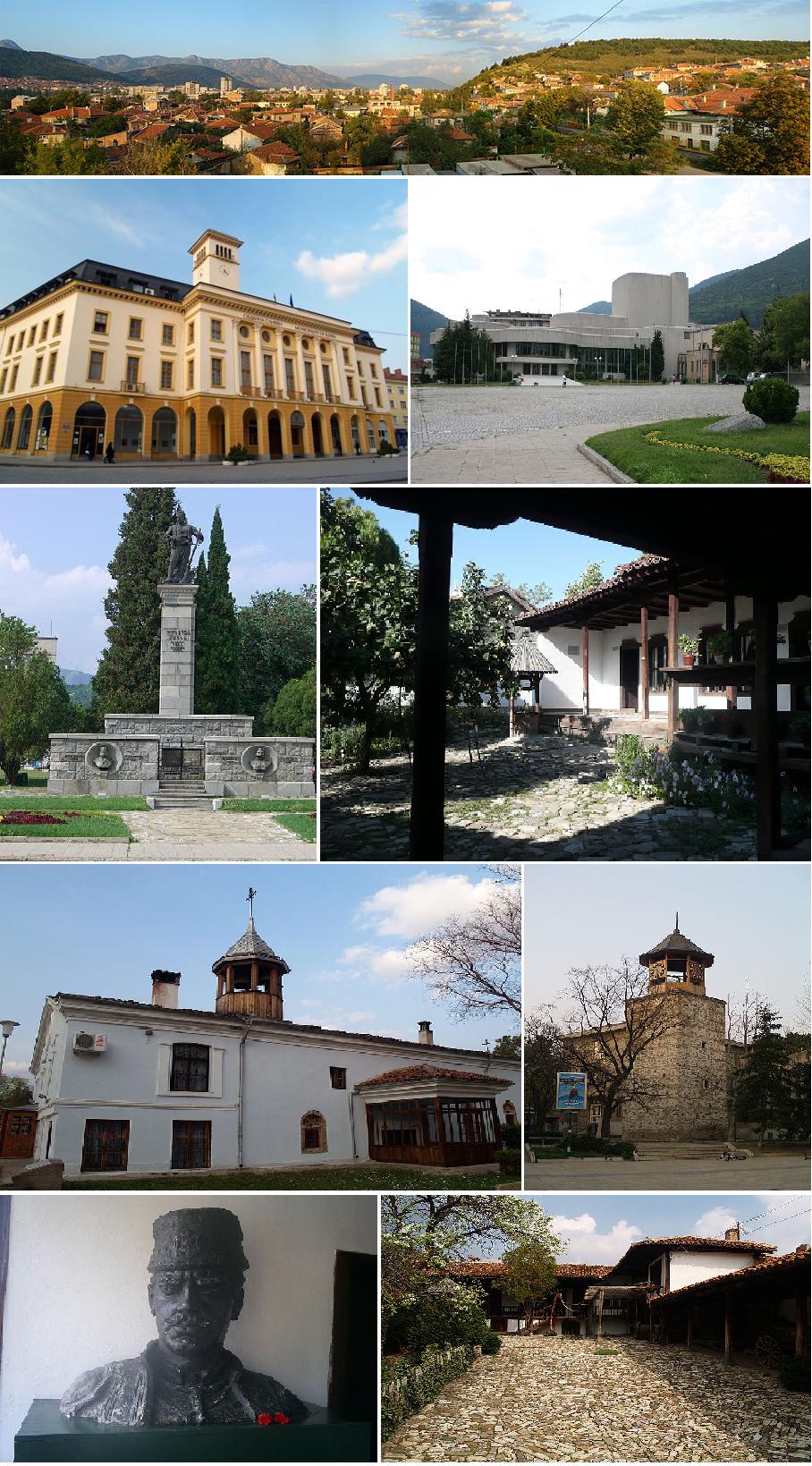
View on WikipediaSliven (Bulgarian: Сливен [ˈslivɛn]) is the eighth-largest city in Bulgaria and the administrative and industrial centre of Sliven Province and municipality in Northern Thrace. It is situated in the Sliven Valley at the foothills of the Balkan Mountains.
Key Information


Sliven is famous for its heroic haiduti who fought against the Ottoman Turks in the 19th century and is known as the "City of the 100 Voyvodi", a voyvoda being a leader of haiduti.
The famous rocky massif Sinite Kamani (Сините камъни, "The Blue Rocks") and the associated Sinite Kamani Nature Park, the fresh air and the mineral springs at Slivenski Mineralni Bani offer diverse opportunities for leisure and tourism. Investors are exploring the opportunity to use the local wind (Bora) for the production of electricity.
Another point of interest and a major symbol of the city as featured on the coat of arms, is the more than thousand-year-old Stariyat Briast (Старият Бряст, "The Old Elm"), a huge Smooth-leaved Elm in the center of the city. During Ottoman rule, Turkish officials used to hang Bulgarian revolutionaries on it. Today the city is helping the tree to live on by frequent evaluations and reinforcing its base. It was elected Bulgarian tree of the year in 2013. On 19 March 2014 the results of an online poll were revealed at a ceremony in the European Parliament. The Old Elm was voted European Tree of the Year 2014. The city also served as an important strategic centre for the Bulgarian Army, with the headquarters of the Bulgarian Third Army located in the centre of the city, being situated relatively near to the sensitive Turkish border.
Sliven Peak on Livingston Island in the South Shetland Islands, Antarctica is named after Sliven.
Etymology
[edit]The name comes from the Slavic word sliv ("pour, confluence") + the Slavic suffix or ending -en.[3] In Turkish the name of the city is İslimiye, while in Greek it is Σλίβεν.
Geography
[edit]
Sliven is situated in the Sliven Valley at the foothills of the Balkan Mountains. It is located 300 km east of Bulgaria's capital Sofia, 100 km from Burgas, the country's largest commercial port, 130 km from the border with Turkey and 130 km from the border with Greece. It is located in close proximity to the cities of Yambol and Nova Zagora.
West of the city lies the so-called Peach Valley which contains large peach orchards. The city is also known for the mineral baths at Slivenski Mineralni Bani some 12 km southeast, whose water is used to treat diseases of the liver and nervous system.[4]
The most visited geographical location and attraction in the city is the Karandila (Карандила). It is a hilltop 1050m above sea level, with great sights overlooking the city. The rock formation Halkata (Хaлката, "The Ring") is located on the Karandila. It is a rock protrusion with a peculiar hole in the center. According to myth, one would have their most sincere wish granted upon passing through the ring. Karandila is the site of the annual Karakachani festival, organized by the Federation of the Cultural and Educational Associations of Karakachans (ФКПДК) in Bulgaria each July.[5]
Karandila is located in Sinite Kamani Nature Park, whose peak Bulgarka (1181 m) is the highest in the eastern Balkan Mountains.[6]
Climate
[edit]Sliven Municipality is situated on the sub-Balkan plain in the zone of transitional-continental climate. In the region of Sliven, winter is mild and summer is relatively warm. Autumn is longer than spring. The local wind Bora is typical for the region.
| Climate data for Sliven (1991–2020, extremes since 1991) | |||||||||||||
|---|---|---|---|---|---|---|---|---|---|---|---|---|---|
| Month | Jan | Feb | Mar | Apr | May | Jun | Jul | Aug | Sep | Oct | Nov | Dec | Year |
| Record high °C (°F) | 21.2 (70.2) |
23.4 (74.1) |
27.4 (81.3) |
29.5 (85.1) |
34.5 (94.1) |
41.1 (106.0) |
42.2 (108.0) |
39.9 (103.8) |
35.8 (96.4) |
34.0 (93.2) |
25.6 (78.1) |
22.0 (71.6) |
42.2 (108.0) |
| Mean daily maximum °C (°F) | 6.1 (43.0) |
8.5 (47.3) |
12.6 (54.7) |
17.9 (64.2) |
23.1 (73.6) |
27.5 (81.5) |
30.1 (86.2) |
30.5 (86.9) |
25.4 (77.7) |
19.1 (66.4) |
12.7 (54.9) |
7.4 (45.3) |
18.4 (65.1) |
| Daily mean °C (°F) | 2.1 (35.8) |
3.8 (38.8) |
7.3 (45.1) |
12.1 (53.8) |
17.3 (63.1) |
21.7 (71.1) |
24.3 (75.7) |
24.2 (75.6) |
19.2 (66.6) |
13.6 (56.5) |
8.3 (46.9) |
3.5 (38.3) |
13.1 (55.6) |
| Mean daily minimum °C (°F) | −1.1 (30.0) |
0.1 (32.2) |
3.2 (37.8) |
7.3 (45.1) |
12.1 (53.8) |
16.4 (61.5) |
18.6 (65.5) |
18.6 (65.5) |
14.3 (57.7) |
9.7 (49.5) |
4.9 (40.8) |
0.4 (32.7) |
8.7 (47.7) |
| Record low °C (°F) | −15.4 (4.3) |
−13.5 (7.7) |
−11.5 (11.3) |
−2.5 (27.5) |
1.9 (35.4) |
4.6 (40.3) |
10.0 (50.0) |
9.4 (48.9) |
5.6 (42.1) |
−2.5 (27.5) |
−6.7 (19.9) |
−13.5 (7.7) |
−15.4 (4.3) |
| Average precipitation mm (inches) | 40 (1.6) |
40 (1.6) |
41 (1.6) |
41 (1.6) |
66 (2.6) |
70 (2.8) |
48 (1.9) |
39 (1.5) |
52 (2.0) |
48 (1.9) |
45 (1.8) |
54 (2.1) |
584 (23) |
| Average precipitation days (≥ 1.0 mm) | 6 | 5 | 7 | 7 | 9 | 7 | 5 | 4 | 5 | 5 | 5 | 6 | 71 |
| Average snowy days | 5.9 | 4.5 | 3.2 | 0.1 | 0 | 0 | 0 | 0 | 0 | 0 | 1 | 3.7 | 18.4 |
| Mean monthly sunshine hours | 104 | 125 | 166 | 205 | 257 | 292 | 330 | 322 | 244 | 177 | 117 | 95 | 2,434 |
| Source: NOAA NCEI,[7] Meteomanz(extremes since 2021, snowy days 2000-2020)[8] | |||||||||||||
| Climate data for Sliven (2002–2013) | |||||||||||||
|---|---|---|---|---|---|---|---|---|---|---|---|---|---|
| Month | Jan | Feb | Mar | Apr | May | Jun | Jul | Aug | Sep | Oct | Nov | Dec | Year |
| Mean daily maximum °C (°F) | 6.7 (44.1) |
8.5 (47.3) |
13.0 (55.4) |
18.5 (65.3) |
24.0 (75.2) |
28.1 (82.6) |
30.8 (87.4) |
31.3 (88.3) |
26.1 (79.0) |
19.5 (67.1) |
13.6 (56.5) |
7.7 (45.9) |
19.0 (66.2) |
| Daily mean °C (°F) | 2.3 (36.1) |
3.5 (38.3) |
8.2 (46.8) |
13.4 (56.1) |
18.7 (65.7) |
23.2 (73.8) |
25.2 (77.4) |
25.6 (78.1) |
20.9 (69.6) |
14.7 (58.5) |
9.6 (49.3) |
3.7 (38.7) |
14.3 (57.7) |
| Mean daily minimum °C (°F) | −0.5 (31.1) |
0.6 (33.1) |
3.5 (38.3) |
8.7 (47.7) |
12.7 (54.9) |
17.0 (62.6) |
19.0 (66.2) |
19.2 (66.6) |
15.0 (59.0) |
10.2 (50.4) |
5.6 (42.1) |
1.1 (34.0) |
9.3 (48.7) |
| Average precipitation mm (inches) | 46 (1.8) |
41 (1.6) |
31 (1.2) |
50 (2.0) |
67 (2.6) |
66 (2.6) |
54 (2.1) |
37 (1.5) |
32 (1.3) |
43 (1.7) |
61 (2.4) |
59 (2.3) |
587 (23.1) |
| Mean monthly sunshine hours | 94 | 122 | 171 | 213 | 264 | 293 | 327 | 319 | 232 | 191 | 123 | 87 | 2,441 |
| Source: weather.com[9] | |||||||||||||
Demographics
[edit]According to the Bulgarian National Statistical Institute, as of 2021, the total population of the Sliven Municipality is 115,241 inhabitants while 83,740 inhabitants live in the city of Sliven.[2] The town is called the under-age mother capital of Europe, with 177 such births in 2008.
| Year | Pop. | ±% |
|---|---|---|
| 1887 | 20,893 | — |
| 1910 | 25,142 | +20.3% |
| 1934 | 30,571 | +21.6% |
| 1946 | 34,291 | +12.2% |
| 1956 | 46,175 | +34.7% |
| 1965 | 68,384 | +48.1% |
| 1975 | 90,187 | +31.9% |
| 1985 | 102,423 | +13.6% |
| 1992 | 106,212 | +3.7% |
| 2001 | 100,366 | −5.5% |
| 2011 | 91,620 | −8.7% |
| 2021 | 83,371 | −9.0% |
| 2022 | 82,251 | −1.3% |
| Source: Censuses[10]"National statistical institute". 2024-10-31.[11] | ||
Ethnic groups
[edit]Members of the following ethnic groups are represented in the city's population:[12][13]
- Bulgarians: 68,853 (87.1%)
- Roma: 5,666 (7.2%)
- Turks: 2,637 (3.3%)
- Greeks (Sarakatsani), Armenians and others: 1,388 (1.8%)
- Undefinable: 491 (0.6%)
- Undeclared: 12,585 (13.7%)
Total: 91,620
In Sliven Municipality, 88,750 declared as Bulgarians, 12,153 as Roma, 4,209 as Turks, and 18,641 did not declare their ethnic group. The city of Sliven, Sliven Municipality and Sliven Province have the largest number of Roma in Bulgaria.
History
[edit]Antiquity
[edit]

Remains of the oldest settlements on the territory of Sliven date back to around 6000 BCE of the Neolithic. Ruins of a Thracian settlement dating to around 5th–3rd century BCE as well as Thracian ceramics and Hellenistic coins have been discovered in the area of Hisarlaka — a small hill in Sliven. In antiquity it was known as Selymnos (Σήλυμνος in Greek). The area occupied by present-day Sliven has in the past been settled by the Thracian tribes Asti, Kabileti and Seleti. These tribes held their independence until time of Philip II of Macedon and Alexander the Great who conquered them.
The 2nd century BCE marked the beginning of the Roman conquests of northeastern Thracia. Sliven was conquered by Rome around 72–71 BCE when the Thracian[14] Kabile and later Greek[15] cities of Kabile and Apolonia are conquered. With the emergence of the Roman Empire the region of the city became part of the Thracian province of the Roman Empire.
A new stage in the city's history began around 2nd-4th century. The first written records of the settlement's name, Tuida/Suida/Tsuida date to this period. This name is most likely of Thracian origin. Its etymology is currently not understood. It is also mentioned by Hierocles, who identifies it as one of the four cities in the province of Haemimontus, established as part of the Diocese of Thrace under Diocletian and also by Procopius of Caesarea. The Roman road from Anchialos (today Pomorie) along the Tundzha to Serdika was built.
In a written record from the 3rd century, the settlement was called ''Tarzhishte" and most likely belonged to the territory of the city of Augusta Traiana (today Stara Zagora).
The fortress avoided the Gothic War, but was destroyed in the Huns' raid in the 5th century. During the reign of Emperor Anastasius I Dicorus, it was rebuilt, which retained the previous one's plan, but was considerably fortified.
In the ancient fortress' interior and near its eastern wall, are excavated the remains of a basilica with a baptistery, which functioned in the 5th-6th centuries.[16] It was likely destroyed by the Huns and rebuilt under Justinian I. A larger church was founded in the south of the fortress, built in the 5th century and enlarged in the 6th century. This indicates that the settlement was not limited to the territory of the fortress, but also expanded in the surrounding area.[16]
The city of Tuida/Tsuida was the seat of a bishop, subordinate to the Metropolitanate of Adrianople. Until that time the bishop seat was in Cabyle. In the 4th century, most likely due to the proximity of the two cities, which were in different provinces, Cabyle was abandoned and its population moved to Diospolis. The seat of the bishop, however, for unknown reasons, was moved to Tuida, which very likely marked the beginning of the proverbial rivalry between Sliven and Yambol.
Tuida ceased to exist around 598-599, when it was again destroyed, most likely by the Avars and Slavs. There is a theory that this happened as part of a major battle between the Avars and the Byzantine general Comentius.
Middle Ages
[edit]The area of Sliven was incorporated into the First Bulgarian Empire around 705 as part of the Slav-settled Zagore, according to Tervel's treaty with the Byzantine Emperor Justinian II. A settlement was established on the area of Tuida, of which the etymology is unknown. The beginnings of the settlement weren't dated, but were before 870, when a lead seal of Boris I was discovered. The Bulgarians reconstructed the walls of the fortress and also the water supply at the northern gate. New buildings were built, some of which, have lined marble slabs made in Preslav's stonemasonry workshops.
Paleoornithologist Zlatozar Boev discovered bone remains of 14 species of wild and domestic birds in Hissarlaka from the 10th-12th centuries. The findings of Hawk eagle (Aquila fasciata) and grouse (Tetrao urogallus) are among the rarest in the country.
The town continued to exist after the dissolution of the first empire. The Pechenegs briefly controlled it in mid-10th century, after which it began to decline. In 1153, the town was rebuilt. The fortress was abandoned and ceased.
During the Second Bulgarian Empire, twenty-four monasteries were built in its vicinity, which formed a complex. Under Tsar Ivan Alexander, Sliven was a town near the Byzantine Empire.[17] During the Ottoman invasion of Bulgaria, the medieval town was destroyed and the monasteries were burnt. The city was known as "İslimye" by the Turks.
Early modern history
[edit]During Ottoman rule Sliven was a sanjak centre in first Rumelia eyalet, then Silistre (Özi) eyalet, Edirne vilayet. From the beginning of the 16th century it was the centre of a kaza, which retained its territory until the middle of the 19th century. In the 17th century Sliven developed as a crafts centre and also famous for the production of guns, pickaxes, iron tools. The town was the settlement of a strong Hajduk movement against the Ottomans and became known as "the town of the hundred voivodes". Among them were Hadzhi Dimitar, Zlati Voivoda and Panayot Hitov. As the chief priest of the Bulgarian Militia, Amphilohiy from Sliven consecrated the Samara flag in Ploiești. Sliven was also as a Jewish center. By 1859, 30 Jewish families lived in Sliven, where a synagogue and a Jewish school were built for them.[18]
In 1738, the population of Sliven was predominantly Turkish.[19] In a register from 1792, Sliven Sanjak is mentioned for the first time. Many Sliven residents participated in the Greek War of Independence. Hadzi Hristo was made a general and took the lead of the troops of Bulgarians, Albanians and Greeks, and was later elected to the Greek parliament.[20] The inhabitants of the town also supported the Brăila revolt, Crimean War and participated in the Second Bulgarian Legion.
During the Russo-Turkish War of 1828-1829, the troops of General Hans Karl von Diebitsch entered Sliven. Continuous massacres of the Muslim population and desecration of mosques were made, involving both Bulgarian and Russian soldiers and local residents.[21] The first Russian consulate was opened here in April 1830.[22] After the withdrawal of the Russian troops, more than 15,000 people from the town and surrounding villages were displaced to southern Russia, Bessarabia and Wallachia, while only 2,000-3,000 Bulgarians remained in the town.[23] With this, Sliven suffered a severe demographic and economic blow, which blunted the momentum of its former development.
During the Bulgarian National Revival, Sliven emerged as an important trade, craft and cultural centre. The town was divided into residential, commercial and craft and administrative parts. Through the efforts of Dobri Chintulov and other Sliven notables, the Zora Community Centre was founded in 1860. The founder of the Bulgarian theatrical work was the Sliven-born public and cultural worker Sava Dobroplodni, who wrote the first play in Bulgarian history - "Mihal Mishkoed". In 1843, the first textile industrial enterprise in the Ottoman Empire was established in Sliven, with Dobri Zhelyazkov as its head. In 1864 a second one was opened, and in 1872 tobacco and spirit factories were established.[24]
The inhabitants of Sliven became actively involved in the national church struggle. In 1859, the people of Sliven expelled the Greek bishop, and the Diocese of Sliven entered the borders of the Bulgarian Exarchate established on 28 February 1870. The first spiritual leader of the diocese was Metropolitan Seraphim of Sliven.
During the April Uprising, Sliven was the centre of the Second Revolutionary District. Battles were fought near the town during the Russo-Turkish Liberation War of 1877-1878 which in return burnt 800 shops and 100 houses in the town centre. Metropolitan Seraphim is particularly credited with saving Sliven and a number of settlements and chifliks in the region from complete destruction. Sliven was liberated by Russian troops on 16 January 1878.
In the 19th century, the town was a district centre and was one of the largest towns in Bulgaria with a population of over 20,000. The majority were Bulgarians. For a short period a centre of a department in the autonomous province of Eastern Rumelia before its inclusion in the Principality of Bulgaria in 1885.
Modern history
[edit]At the municipal elections in September 1911, the Bulgarian Social Democratic Workers Party won the most seats, but failed to take over the municipality until August 1912, when Dr. Yordan Danchev was elected mayor. The party won elections again in 1915 and 1919. A welfare bureau, a labor bureau, and municipal housing for the homeless were established. Binding regulations were issued on relations between workers and employers on wages, on weekends and holidays. The administration was dissolved on 31 January 1923 by a decision of the BZNS-dominated Sliven District Court.
During the First World War it was the site of the Sliven prisoner of war camp, the largest such camp in the country. It was the place of internment for Greek and Serbian civilians and soldiers, with peak numbers of 19,000.[25]
From the beginning of the Industrial Revolution in Bulgaria in the late 19th century until the beginning of the socialist economy in 1945, the industry was concentrated in the northern parts of the city. The new Socialist government gradually began to consolidate the existing factories and built new ones, with industry concentrating around the newly built station. At some point the industrial workforce numbered 20,000, 1/2 of whom were in textile production - wool and cotton textiles. The second most important is the food industry and the third is the machine building industry (ZMM - Sliven, Dinamo Plant, etc.).
As one of the most significant cultural centres during the Bulgarian National Revival, with much of its old heritage still preserved and enriched, modern Sliven offers to its citizens and visitors a lot of opportunities for cultural life. It served as the birthplace of many prominent Bulgarians, including Hadzhi Dimitar, Dobri Chintulov, Ivan Seliminski. Another notable native is Anton Pann who composed the Romanian national anthem. Another notable resident is Yordan Letchkov, whose goal in the 1994 World Cup eliminated defending champion Germany. Letchkov was mayor of Sliven from 2003 to 2011.

Politics
[edit]Mayors from Bulgarian Socialist Party have been in charge of Sliven Municipality in the period 1990–1991, 1999–2003 and 2011–2015. For his second term (2007–2011), Yordan Letchkov was nominated by GERB. Since 2015, Stefan Radev is the mayor of Sliven Municipality. In the local elections in 2011 and 2019, he was nominated by GERB (he won in 2019). Hristin Petkov was mayor of the SDS from 1991 to 1995.
In the 2011 local elections, the BSP candidate (and non-member of the party) General Kolyo Milev won in the second round with 52.94% of the votes counted against the GERB candidate (also non-member) Yordan Letchkov.[26]
Since 2015, the mayor of Sliven has been Stefan Radev, nominated by PP GERB (2015 and 2019), re-elected with 64.75% in the second round of local elections in 2019.[27] On 11 November 2019, he officially took office.
Economy
[edit]The economy of Sliven has centered around industry since the early 19th century. In 1834, Dobri Zhelyazkov established the first factory in Bulgarian lands, thus starting industrial development in Bulgaria. Sliven was one of the largest industrial centers in Bulgaria, playing an important role during the Bulgarian National Revival. It has long-lived traditions in textiles, machine-building, glass-making, chemical production, and the technical and food industries.
Following the beginning of communist rule in Bulgaria in 1944, most industries were nationalized and much industrial building and development was spurred. Industry continued to develop until the fall of communism, at which point much of the previously built industry stagnated; many plants and factories were shut down and there was little development.
In contemporary times, Sliven has experienced a surge in economy with increased investment, banking establishments and new industries have begun to emerge. The dairy industry, which has long been present, continues to grow and thrive. The wine industry, with companies such as Vinprom and Vini Sliven and about a dozen others, continues to grow as grapes are easily grown due to the climate conditions. In terms of heavy industry, the city produces electric lights and electrical machines. The city has also become notorious as a source of young girls who are trafficked into the sex industry.
Light industry in Sliven is mostly devoted to textiles with many companies making wool clothing, socks, and food.
In 2024, it was reported that a gang based in Sliven had been receiving up to £200 million annually in fraudulent welfare payments from the British government.[28]
Transportation
[edit]There is a military airport in the town, the Sliven Airfield.
The city has a trolleybus system which opened in 1986.
Culture
[edit]
Theatres
[edit]When the first theatre stage was opened, theatre traditions began in Sliven 140 years ago. In 1918 the first professional theatre troupe was established in the community centre "Zora". At present the Stefan Kirov Drama Theatre is a state theatre. The new building of the theatre was built in 1986 and has a large hall (484 seats), a chamber hall (121 seats), a ballet hall, a spacious lobby on two levels with a bar for spectators, an administrative part. In 2008 the theatre celebrated its 90th anniversary.
The State Puppet Theatre – Sliven[29] was established in 1961 (then an amateur theatre, since 1971 a state theatre), it is located in the renovated in the 1980s building of the former cinema "Balkan".
Museums
[edit]
- Simeon Tabakov Regional History Museum[30]
- Hadzhi Dimitar House Museum[31]
- National Museum of Textile Industry
- Dobri Chintulov House Museum[32]
- The House Museum of 19th Century Sliven Urban Life[33]
The Old Elm
[edit]The Old Elm which grows in the city center, is a tree of the species of Field elm (Ulmus glabra), and is about 1300 years old, it is declared a protected site. It is a remnant of the Great Bulgarian Forest, which stretched from the Rhodope Mountains to the Black Sea. About 20 such elms remain in the village of Samuilovo, 7 km from Sliven. All of them have been declared protected sites. The cavities are filled with reinforcing filler and have been left openings for natural ventilation to stop rotting processes or breedings of microorganisms. The tree was used by the Ottoman Turks to hang captured hajduk.[34][35]
Fortress Tuida
[edit]
Tuida was an early Byzantine and medieval fortress, the remains of which are located on the hill of Hisarlaka in the northeastern part of Sliven, which offers a unique view of the "Sinite kamani" and the city (the hill is located near the "Novo Selo" quarter). It is part of the old mountain fortification system, which played an extremely important role in the defence of the Roman Empire, and later of the early Byzantine Empire, as well as the medieval Bulgarian state.[36] After some interruption, archaeological excavations of the fortress began again in 2004. The aim of the excavations is the final study and conservation of the architectural and archaeological monuments, and the exposure of the fortress with a view to making it one of the city's notable tourist attractions.[37][38][39][40]
The old clock tower
[edit]The old clock tower is located in the centre of Sliven, built in 1808. In 1936, a strong storm destroyed the upper wooden part, which was rebuilt about sixty years later in its original 19th century form
Sinite Kamani
[edit]
The Sinite Kamani Nature Park is located in the Eastern Balkan Mountains just north of Sliven. It was declared a nature (then national) park in 1980. The park covers an area of 11 380 hectares, representing springs, peaks, rocks, forests and meadows. The highest point of the nature park is the peak of Bulgarka (1181 m). The local flora and fauna is represented by various species, some of which are included in the Red Book of Bulgaria.
Notable people
[edit]- Aleksandar Kraychev, Olympic silver medalist
- Anton Pann
- Azis
- Damyan Damyanov
- Dobri Chintulov
- Dobri Zhelyazkov
- Desislava Bozhilova
- Georgi Dinev
- Georgi Kalaydzhiev (violinist)
- Hadzhi Dimitar
- Ivan Slavov (philosopher)
- Janis Rozitis
- Jordan Malinovski
- Julia Kristeva
- Kamen Tchanev
- Kevork Kevorkyan
- Konstantin Konstantinov
- Margarita Hranova
- Norair Nurikyan, two-time Olympic gold medalist in weightlifting
- Radoi Ralin
- Sava Dobroplodni
- Sirak Skitnik
- Stanka Pencheva
- Stanka Zlateva
- Vasil Vasilev-Zueka
- Violeta Gindeva
- Yordan Letchkov
See also
[edit]Twin towns – sister cities
[edit] Alba Iulia, Romania
 Chongqing, China
 Gera, Germany
 Jerash, Jordan
 Kaisariani, Greece
 Melitopol, Ukraine
 Pécs, Hungary
 Svietlahorsk, Belarus
 Taraclia, Moldova
 Tekirdağ, Turkey
- Ternopil, Ukraine
 Voronezh, Russia
 Bydgoszcz, Poland


Gallery
[edit]-
 Municipality Hall
 -
 Regional Library Sava Dobroplodni
 -
 Gallery Dimitar Dobrovich
 -
 Museum of Textile
 -
 Lifestyle Museum
 -
 Remains of the fortress Tuida with the Sinite Kamani in the background
 -
 TPP Sliven
 -
 Chitalishte Zora


References
[edit]- ^ "National Statistical Institute - Main Towns Census 2011". Archived from the original on Apr 8, 2011. Retrieved Jul 20, 2022.
- ^ a b "Население по области, общини, местоживеене и пол | Национален статистически институт". nsi.bg. Retrieved Jul 20, 2022.
- ^ "За Сливен" (in Bulgarian). БНС – Сливен. Archived from the original on 2008-09-28. Retrieved 2008-09-14.
- ^ "Slivenski Mineralni Bani". Official Site of the Ministry of Tourism. Retrieved 20 April 2024.
- ^ Annual Karakachan Festival, Karandila
- ^ "BulgariaInside: online travel guide". May 15, 2014. Archived from the original on 2014-05-15. Retrieved Jul 20, 2022.
- ^ "1991-2020 climate normals: Silven" (CSV). NOAA. Retrieved 2024-01-02.
- ^ "SLIVEN - Weather data by months". meteomanz. Retrieved 7 July 2024.
- ^ "weatheronline.co.uk: Historical Weather for Sliven, Bulgaria". weatheronline.co.uk. 2012. Retrieved on May 9, 2013.
- ^ "Archived copy" (PDF). Archived from the original (PDF) on 2011-07-06. Retrieved 2010-02-14.
{{cite web}}: CS1 maint: archived copy as title (link) - ^ "Cities of Bulgaria". 2024-04-03.
- ^ "Population on 01.02.2011 by provinces, municipalities, settlements and age; National Statistical Institute". Retrieved Jul 20, 2022.
- ^ "Population by province, municipality, settlement and ethnic identification, by 01.02.2011; Bulgarian National Statistical Institute". Retrieved Jul 20, 2022.
- ^ Fol, Aleksandar. The Thracian Royal city of Kabyle. - In: Settlement Life in Ancient Thrace. IIIrd International Symposium “Cabyle”, 17–21 May 1993 Jambol. Jambol, 53-55.
- ^ An Inventory of Archaic and Classical Poleis: An Investigation Conducted by The Copenhagen Polis Centre for the Danish National Research Foundation by Mogens Herman Hansen,2005,Index
- ^ a b Dimitrov, Dimitŭr Alekseev; Димитров, Димитър Алексеев (2013). Khristii︠a︡nskite khramove po bŭlgarskite zemi (I-IX vek) (Pŭrvo izdanie ed.). Sofii︠a︡. pp. 50–51. ISBN 978-954-2972-17-4. OCLC 893974801.
{{cite book}}: CS1 maint: location missing publisher (link) - ^ Димитър Ангелов, Въпросът за политическите емигранти в отношенията между Византия и средновековна България // В: Античная древность и средние века. – Вып. 10. – 1973. – С. 121.
- ^ Raĭchevski, Stoi︠a︡n.; Райчевски, Стоян. (2008). Bŭlgari i evrei prez vekovete (1. izd ed.). Sofii︠a︡: Bŭlgarski bestselŭr. ISBN 978-954-463-021-8. OCLC 256501426.
- ^ Leo, Michel (2013). Bŭlgarii͡a i neĭnii͡at narod pod osmanka vlast : prez pogleda na anglosaksonskite pŭteshestvenit͡si (1586-1878) : otkrivaneto na edna narodnost. Marieta Glukharova (1. izd ed.). Sofii͡a: Tangra TanNakRa. ISBN 978-954-378-106-5. OCLC 1062162833.
- ^ "Every crucial battle in the Greek War of Independence involved Bulgarians". grreporter.info. Retrieved 2023-01-18.
- ^ Doĭnov, Stefan; Дойнов, Стефан. (2005). Bŭlgarite v Ukraĭna i Moldova prez Vŭzrazhdaneto (1751-1878) (1. izd ed.). Sofii︠a︡: Akademichno izdatelstvo "Marin Drinov". p. 86. ISBN 954-322-019-0. OCLC 63519471.
- ^ Doĭnov, Stefan; Дойнов, Стефан. (2005). Bŭlgarite v Ukraĭna i Moldova prez Vŭzrazhdaneto (1751-1878) (1. izd ed.). Sofii︠a︡: Akademichno izdatelstvo "Marin Drinov". p. 101. ISBN 954-322-019-0. OCLC 63519471.
- ^ Doĭnov, Stefan; Дойнов, Стефан. (2005). Bŭlgarite v Ukraĭna i Moldova prez Vŭzrazhdaneto (1751-1878) (1. izd ed.). Sofii︠a︡: Akademichno izdatelstvo "Marin Drinov". p. 109. ISBN 954-322-019-0. OCLC 63519471.
- ^ "Добри Желязков отхвърлил исляма и останал без фабрика". www.24chasa.bg. Retrieved 2023-01-18.
- ^ Pissari, Milovan (2013). "Bulgarian Crimes against Civilians in Occupied Serbia during the First World War" (PDF). Balcanica (44). Institute for Balkan Studies: 357–390. doi:10.2298/BALC1344357P. Retrieved 8 May 2016.
- ^ "Избор на кмет и общински съвет :: Избори 2011". 2012-01-03. Archived from the original on 2012-01-03. Retrieved 2023-01-18.
- ^ "Резултати :: Местни избори 27 октомври 2019". results.cik.bg. Retrieved 2023-01-18.
- ^ Bolton, Will (2024-05-28). "The Bulgarian town that boomed from UK's biggest benefits fraud". The Telegraph. ISSN 0307-1235. Retrieved 2024-05-29.
- ^ "Official Site of Puppet Theatre Sliven". puppets-sliven.eu. Retrieved 2023-01-19.
- ^ Регионален исторически музей в град Сливен, archived from the original on 2018-02-15, retrieved 2017-03-08
- ^ Къща музей "Хаджи Димитър", archived from the original on 2015-11-13, retrieved 2017-03-08
- ^ Къща музей "Добри Чинтулов", archived from the original on 2016-08-18, retrieved 2017-03-08
- ^ Къща музей на сливенския градски бит от XIX век, archived from the original on 2016-08-18, retrieved 2017-03-08
- ^ "Символи на Сливен". reglibsliven.iradeum.com. Retrieved 2023-01-19.
- ^ Сайт на Федерация на природозащитни сдружения "Зелени Балкани", archived from the original on 2011-08-19, retrieved 2011-03-13
- ^ Bgizlet
- ^ www.bulgariancastles.com, archived from the original on 2011-07-04, retrieved 2011-03-13
- ^ Крепостта Туида, dariknews.bg, 7 август 2006 г.
- ^ Тони Баев, Културно-историческо наследство на Сливен
- ^ За град Сливен в kaminata.net Archived 2011-09-13 at the Wayback Machine, 15 декември 2009 г.
- ^ "Градове-партньори". sliven.bg (in Bulgarian). Sliven. Retrieved 2021-04-02.
External links
[edit]

- . Encyclopædia Britannica. Vol. 25 (11th ed.). 1911.
- Digital photos from Sliven
- Official site of Sliven Municipality
- Sliven.net
- RegionSliven.org
- Sliven.government.bg
- Sliven.start.bg
42°41′N 26°20′E / 42.683°N 26.333°E


Sliven
View on GrokipediaThe city proper has a population of 78,232 as of recent national statistics, reflecting a decline from earlier peaks due to broader demographic trends in rural and industrial regions of Bulgaria.[2][3]
Geographically, Sliven occupies the southern foothills of the Balkan Mountains (Stara Planina), where the Novoselska and Asenovska rivers converge, contributing to its transitional continental climate with moderate temperatures and potential for viticulture and light industry.[4][1]
Historically, Sliven played a pivotal role in the Bulgarian National Revival, hosting the establishment of the country's first mechanized factory in 1834 by local entrepreneur Dobri Jelyaskov, which initiated modern industrial production in textiles and machinery prior to national independence.[5]
The city is also the birthplace of Hadji Dimitar (1840–1868), a renowned voivode and leader in the anti-Ottoman uprisings of the 1860s, whose legacy as a symbol of Bulgarian resistance is commemorated through monuments, museums, and cultural sites that preserve artifacts from his era.[6][7]
Economically, Sliven remains a key hub for textile manufacturing and food processing, leveraging its position in Sliven Province—home to about 170,000 residents overall—to sustain employment amid challenges like outmigration and deindustrialization pressures observed across post-communist Eastern Europe.[8][9][10]
Notable landmarks include the Hadji Dimitar House-Museum, the Clock Tower, and proximity to natural sites like Karandila Peak, underscoring Sliven's blend of industrial heritage, revolutionary symbolism, and scenic Balkan topography that defines its regional identity.[11]
Geography
Location and Topography
Sliven lies in southeastern Bulgaria at approximately 42.69°N 26.33°E, positioned within the Sliven Valley at the base of the eastern Balkan Mountains, including the Sliven Heights and the adjacent Sinite Kamani Nature Park.[12] The city's average elevation reaches 271 meters above sea level, with the surrounding terrain rising sharply to form a natural barrier that fosters a localized microclimate cooler and more isolated than the adjacent lowlands.[13] The topography is characterized by rugged, mountainous relief, with the Sinite Kamani area featuring steep slopes, rock formations, and peaks culminating at Balgarka Mount (1,181 meters), the highest in the eastern Stara Planina range; the park's lowest elevations start at 290 meters.[14] This configuration, deeply incised by tributaries of the Tundzha River, creates diverse environmental gradients from valley floors to highland plateaus.[14] Sliven's urban territory encompasses roughly 194 square kilometers, while the broader municipality covers 1,367 square kilometers, incorporating forested expanses and geological assets like mineral springs that enhance local hydrology and biodiversity.[15] [16] The steep gradients and underlying sedimentary rocks contribute to geohazards such as landslides, prevalent across Bulgaria's Balkan foothills due to tectonic activity and precipitation patterns.[17] Proximity to the Tundzha River and the western Rose Valley supports alluvial deposits conducive to valley agriculture, though constrained by the enclosing hills.[18]Climate
Sliven features a humid continental climate (Köppen classification Dfb), marked by distinct seasonal variations with hot, dry summers and cold, snowy winters. Average high temperatures reach 29°C (84°F) in July, the warmest month, while January, the coldest, sees average lows of -4°C (25°F) and highs around 6°C (43°F), yielding a monthly mean near 1°C. Annual precipitation totals approximately 650 mm, concentrated in late spring and early summer, with June recording the highest monthly average of about 70 mm due to convective thunderstorms.[19][20] The city's location at the northern foothills of the Balkan Mountains introduces microclimatic heterogeneity, where southern slopes and valleys experience slightly warmer conditions and enhanced orographic rainfall compared to the drier plains to the north. This elevational gradient results in 10-20% higher precipitation in upland areas surrounding Sliven, fostering conditions suitable for temperature-sensitive agriculture such as viticulture, which relies on the moderated summer heat and winter dormancy for grape maturation. Nearby rose cultivation, though centered slightly south in the Rose Valley, benefits from these variations, as the consistent moisture supports oil-yielding petal development without excessive humidity that could promote fungal diseases.[21][22] Observational data from 2000 to 2025 reveal a warming trend across Bulgaria's interior, with Sliven's winter minima increasing by roughly 1.2°C over this period, linked to regional atmospheric circulation shifts and reduced snow cover duration. This has extended frost-free periods, potentially enhancing early-season growth for perennial crops but raising risks of summer drought stress amid stable or slightly declining precipitation totals. Such changes align with broader empirical records showing accelerated warming in Eastern Europe's continental zones, influencing local livability through fewer extreme cold events offset by heightened heatwave frequency in July and August.[23][24]Demographics
Population Dynamics
As of the 2021 census conducted by Bulgaria's National Statistical Institute (NSI), the population of Sliven municipality was 115,241, while the city proper numbered 83,740 residents.[25] By 2024 estimates, the city population had decreased to approximately 78,232, marking an average annual decline of 0.85% since 2021.[25] This trend aligns with broader post-2010 patterns in regional Bulgarian cities, where NSI data record net annual losses of around 1% driven by combined negative natural growth and migration balances.[26] The decline stems primarily from sub-replacement fertility and sustained emigration. Bulgaria's total fertility rate reached 1.81 live births per woman in 2023, an improvement from earlier lows but still insufficient for population stability without immigration offsets.[27] In Sliven district, natural population change was -2.8 per mille in recent years, reflecting higher mortality than births amid an aging demographic structure.[28] Emigration accelerated following Bulgaria's 2007 EU accession, enabling labor mobility to higher-wage economies in Western Europe; national figures show over 175,000 net emigrants from 2010 to 2020, with Germany receiving 22% of outflows, disproportionately affecting working-age cohorts in provinces like Sliven.[29][30] Urban-rural dynamics within the municipality exacerbate the trend, with rural depopulation funneling limited inflows to the city core while overall outflows persist due to limited local economic opportunities in manufacturing and services. NSI migration data indicate persistent negative internal and external balances, contributing to a median age rise and labor force contraction.[31][32]Ethnic Composition
According to the 2021 Bulgarian census, the ethnic composition of Sliven Province, of which the city is the administrative center, consists of approximately 63% Bulgarians, 13% Roma, and 7% Turks, with the remainder comprising other groups or undeclared.[33] Within Sliven municipality specifically, the Bulgarian majority is higher, aligning with urban patterns where minorities are less concentrated than in rural peripheries of the province, though exact municipal breakdowns reflect similar proportions adjusted for city demographics. Roma populations are disproportionately represented in the province compared to national averages (4.4% Roma nationwide), with Sliven recording one of Bulgaria's highest regional shares at 15.3%. The Turkish minority traces its origins to migrations and settlements during the Ottoman period (14th–19th centuries), when Turkic populations were encouraged to inhabit conquered territories, forming enduring communities post-independence. Roma presence in Sliven intensified after their emancipation from de facto slavery under Ottoman rule in the 1850s, leading to settlement in marginal urban and peri-urban areas; historical records indicate nomadic groups gradually forming fixed neighborhoods amid post-liberation economic shifts. These patterns have resulted in spatial segregation, with Roma quarters often isolated on city fringes, fostering parallel social structures and limited inter-ethnic interaction. Integration challenges persist, particularly among Roma communities, where segregated neighborhoods correlate with elevated poverty and unemployment rates often surpassing 50% in affected areas, driven by informal economies and barriers to formal labor markets. Education disparities are stark, with over 60% of Roma children in Bulgaria attending segregated schools, yielding lower attendance and completion rates that perpetuate cycles of exclusion; EU monitoring attributes this to inadequate infrastructure and cultural mismatches rather than inherent traits. During the 2020 COVID-19 outbreak, enforcement of quarantines in Sliven's Roma neighborhoods encountered resistance due to overcrowding, distrust of authorities, and non-compliance, amplifying local tensions and infection clusters that strained municipal resources.[34] Such incidents underscore causal links between segregation and public health enforcement failures, without evidence of systemic resolution through prior policies.Religious Affiliation
The predominant religious affiliation in Sliven is Eastern Orthodox Christianity, with residents primarily adhering to the Bulgarian Orthodox Church. According to the 2021 Bulgarian census data for Sliven Province, approximately 79.5% of respondents identified as Christian, the overwhelming majority of whom are Eastern Orthodox, reflecting a strong historical and cultural linkage to Bulgarian national identity.[33] This dominance stems from the region's Thracian roots and adoption of Christianity in the 9th century under the First Bulgarian Empire, reinforced during periods of Ottoman rule through resistance movements centered on Orthodox institutions. A Muslim minority accounts for about 8.8% of the population in Sliven Province per the same census, largely Sunni adherents descended from Ottoman-era settlements, including Turkish and some Roma communities.[33] Other religious groups, such as Protestants, represent negligible shares, with fewer than 0.1% reporting alternative faiths.[33] Post-communist trends show a decline in self-reported Orthodox affiliation nationally, from 87% in 1992 to around 63% in 2021, attributed to secularization and census non-response, though local Orthodox sites like St. Dimitar Cathedral serve as focal points for community and nationalist expressions.[35] The Eparchy of Sliven, overseeing the diocese, underscores the institutional presence of Orthodoxy in the area.[36]Etymology
Name Origins and Historical Usage
The name Sliven derives from the Proto-Slavic root slivъ, meaning "to pour" or "confluence," reflecting the town's location at the junction of rivers such as the Asenovska and Novoselska, with the suffix -en common in Slavic toponyms denoting place or action.[37] Alternative derivations link it to slivati se ("to slide" or "flow"), alluding to the slippery terrain of the surrounding Balkan foothills, or to sliva ("plum"), tied to local fruit orchards, though linguistic evidence favors hydrological associations over botanical ones due to the site's geography.[38] These roots indicate a Slavic ethnolinguistic origin, consistent with the settlement's continuity amid Balkan migrations. The earliest attestation appears in 1153 in the work of Arab geographer Muhammad al-Idrisi, who recorded it as Istilifunos or Iztlifanost, a phonetic rendering of the Slavic Slivenъ in Arabic script, describing the site as a significant urban center without reference to prior non-Slavic nomenclature.[39] [40] This form persisted through medieval Bulgarian contexts, evidencing phonetic stability uncommon among regional toponyms that often underwent Thracian, Byzantine, or later Turkic modifications; claims of pre-Slavic substrates, such as hypothetical Thracian roots, lack documentary or archaeological corroboration and are unsupported by onomastic patterns in the eastern Balkans.[41] Under Ottoman administration from the 15th century, the name adapted to İslimye in Turkish defters and administrative records, a minor orthographic shift preserving the core Slavic structure rather than imposing a wholesale replacement, as seen in many conquered locales.[38] This consistency underscores ethnic and linguistic continuity of the Slavic population, with no evidence of substantive alteration until modern Bulgarian standardization post-independence in 1878, when Sliven was reaffirmed in official usage.[40]History
Antiquity and Thracian-Roman Period
The region encompassing modern Sliven was inhabited by Thracian tribes, including the Asti, Kabileti, and Seleti, during the first millennium BCE, maintaining independence until the conquests of Philip II of Macedon and Alexander the Great in the 4th century BCE.[42] Archaeological evidence from over 20 excavated tumuli (burial mounds) in the Sliven area reveals artifacts such as pottery, weapons, and jewelry indicative of advanced Thracian material culture and social organization, with findings displayed in the Sliven Regional Historical Museum.[43] A Late Iron Age Thracian settlement dating from the 6th to 1st century BCE has been identified at the site of Tuida on Hissarlaka Hill northeast of Sliven, featuring fortified structures and domestic remains that demonstrate continuity of occupation.[42][44] This settlement evolved into a Roman emporium (trade center) by the 3rd century CE, reflecting integration into Roman Thrace following the province's establishment after the Roman conquest of the region in 46 CE.[39] In the Late Roman period, Tuida developed into a fortress constructed around the mid-4th century CE on approximately 42 decares (about 4.2 hectares), serving defensive and administrative functions amid Roman colonization efforts that included road networks and villa estates in the broader Thracian territories.[45] Excavations uncover layers of destruction from barbarian invasions, such as those by Goths and Huns in the 3rd-5th centuries CE, alongside Roman military diplomas and coins attesting to veteran settlements and economic activity.[46] These findings indicate cultural continuity from Thracian roots through Roman overlay, with material evidence persisting into early post-Roman transitions prior to Slavic migrations.[42]Medieval and Byzantine Era
The fortress of Tuida, situated on Hisarlaka Hill overlooking modern Sliven, persisted as a key defensive site during the Early Byzantine period after the Late Roman era, forming part of the Stara Planina mountain fortification network against invasions by groups such as the Huns in the 5th century and Avars and Slavs around 598–599 AD.[42] Rebuilt following these destructions, it exemplified Byzantine engineering adaptations, including robust walls and potentially secret supply tunnels, which enhanced its resilience in a region prone to raids due to its position at a natural pass through the Balkan Mountains.[44] Archaeological finds, such as a solidus gold coin minted under Emperor Justin II (r. 565–578 AD), indicate Tuida's role in sustaining Byzantine military logistics and local trade amid 6th-century economic strains from imperial overextension and plague.[47] Following Byzantine reassertion of control over former Bulgarian territories after 1018 AD, the Sliven area remained integrated into the empire's thematic administration until the 1185 revolt led by Peter and Ivan Asen, which restored Bulgarian sovereignty as the Second Bulgarian Empire (1185–1422). Tuida transitioned into a medieval Bulgarian stronghold, bolstering defenses along the northern frontier where its elevated terrain provided tactical advantages for monitoring and repelling incursions, as evidenced by continued occupation layers in excavations. The site's strategic placement at the interface of Thrace and the mountainous interior facilitated its function as a nodal point for regional commerce in grains, livestock, and metals, though chronicles note repeated sieges driven by its control over vital routes rather than any singular economic dominance.[39] Under tsars like Ivan Alexander (r. 1331–1371), Sliven developed as a settled town amid the empire's cultural flourishing, incorporating Byzantine Orthodox influences in monastic foundations and administrative practices that blended imperial bureaucracy with local Slavic traditions.[48] However, the empire's fragmentation after 1371, exacerbated by internal strife and Ottoman expansion following victories at Sinigalia (1365) and Philippopolis (1363), exposed vulnerabilities; Tuida's defenses proved insufficient against sustained Ottoman assaults in the 1370s, leading to its fall and incorporation into Ottoman domains by the late 14th century, as advancing forces exploited the pass for rapid thrusts into the Bulgarian heartland.[49] This conquest reflected causal realities of superior Ottoman mobility and artillery against static fortifications, hastening the end of independent Bulgarian rule in the region.Ottoman Domination and Resistance
Following the Ottoman conquest of Bulgarian territories in the 1390s, Sliven came under imperial control as part of Rumelia eyalet, experiencing initial destruction amid the subjugation of local Thracian and Bulgarian populations.[50] The town was rebuilt in the 15th century during the consolidation of Ottoman administration, renamed Enidzhe Kariesi ("New Town"), and developed into a regional hub for textile production and handicrafts, serving administrative functions under local kadis and sipahis.[48] This reconstruction facilitated Ottoman governance but entrenched mechanisms of control, including the devshirme system, whereby Christian boys from Balkan provinces like those around Sliven were periodically levied—typically every few years from the 14th to 17th centuries—for conversion to Islam and induction into the janissary corps, depleting families and instilling long-term demographic and cultural pressures on rayah communities.[51] The timar system dominated Sliven's rural economy, granting land revenue rights to Ottoman cavalrymen in exchange for military service, which imposed cift resmi and other taxes on Christian peasants, often exceeding agricultural yields and prompting flight to urban areas or mountains during fiscal crises in the 16th and 17th centuries. Such exploitation contributed to documented depopulation cycles, as Ottoman defters recorded declining household numbers in Thrace amid heavy ispence head taxes and periodic campaigns, exacerbating poverty without infrastructure investment.[52] Conversions to Islam offered tax relief via the child tax exemption, leading to gradual Islamization in administrative centers like Sliven, though empirical resistance persisted through evasion and localized revolts suppressed by imperial ferocity. From the 17th century, haiduti—outlaw bands of displaced peasants and former sipahi—emerged in the Balkan Mountains near Sliven as proto-forms of defiance, conducting raids on tax convoys and Ottoman officials rather than organized nationalism, with records indicating over a hundred voyvodi (chieftains) operating regionally by the 18th century.[48] These groups, blending brigandage with anti-tax harassment, faced brutal Ottoman countermeasures, including mass executions and village burnings, as evidenced in imperial fermans ordering pacification; Sliven's proximity to haiduti refuges positioned it as an early focal point for such sporadic, non-ideological pushback against domination.[53]Bulgarian Revival and Independence Struggle
During the Bulgarian National Revival in the 19th century, Sliven emerged as a key economic and cultural hub, driven by local entrepreneurs who established early industrial ventures. In 1834, Dobri Zhelyazkov founded Bulgaria's first textile mill in Sliven, granted a special statute by Sultan Mahmud II to produce heavy cloth for the Ottoman army, marking the onset of mechanized production in the region.[54] This initiative, alongside widespread wool textile workshops from the 18th and early 19th centuries, positioned Sliven as a center for crafts that fueled economic awakening and supported emerging local elites.[55] These elites, through trade and manufacturing, accumulated resources that later financed revolutionary activities, underscoring their causal role in fostering self-reliance amid Ottoman rule.[56] Sliven also became a focal point for education, aligning with broader literacy drives inspired by figures like Paisiy Hilendarski, whose 1762 history promoted Bulgarian identity. The establishment of a State Male High School in 1835-1836 reflected the town's commitment to secular learning, producing enlightened leaders who bridged commerce and nationalism.[57] Such institutions cultivated a class of educated merchants and intellectuals, including poet Dobri Chintulov (1820-1887), whose works embodied the Revival's cultural resurgence.[58] In the push for independence, Sliven hosted a revolutionary district organized by the Bulgarian Central Revolutionary Committee, led by Ilarion Dragostinov, who coordinated uprisings with figures like Georgi Obretenov. The April Uprising erupted in Sliven on May 3, 1876, with Dragostinov announcing the revolt and rallying local chetas, including those under Stoil Voyvoda, in battles north of the city against Ottoman forces.[59] [60] Though suppressed with heavy local casualties—exacerbating the massacres that drew European condemnation—the events amplified calls for intervention.[60] The uprising's fallout precipitated the Russo-Turkish War of 1877-1878, during which Russian forces liberated Sliven in early 1878 as part of their Balkan advance, ending direct Ottoman control.[61] The Treaty of San Stefano in March 1878 initially granted Bulgaria broad autonomy including Sliven, though the Berlin Congress later delimited the Principality of Bulgaria, retaining minority privileges under Ottoman suzerainty. Local elites, leveraging Revival-era gains, influenced post-liberation administration, ensuring Sliven's integration into the nascent state while preserving economic privileges.[61]Communist Era and Suppression
Following the Soviet-backed communist coup on September 9, 1944, which installed the Fatherland Front government, Sliven's economy underwent immediate nationalization as part of Bulgaria's broader shift to state control over industry and agriculture. The city's pre-existing textile sector, a cornerstone since the 19th century, was seized by the state, eliminating private ownership and redirecting production toward centrally planned quotas aligned with Soviet priorities. This stifled entrepreneurial initiative, with small workshops and family-run operations consolidated into state enterprises that emphasized quantity over innovation, leading to inefficiencies inherent in command economies.[62][63] Agricultural collectivization, initiated in 1945 under the Bulgarian Communist Party's agrarian reform, forcibly merged private farms in Sliven's surrounding plains into collective farms (TKZS) by the late 1950s, marking Bulgaria's completion as the first Eastern Bloc nation to achieve near-total collectivization. Resistance from kulaks—defined as owners of over 25 decares (about 6.25 acres)—was met with expropriation, deportation, or liquidation, disrupting local food production chains and enforcing dependence on state directives that often prioritized ideological conformity over yields. While official statistics claimed agricultural output stabilization, chronic inefficiencies resulted in persistent shortages of staples, exacerbated by mismanagement and diversion of resources to industrialization.[64][65] Industrial development accelerated in Sliven during the 1960s and 1970s, transforming it into a key textile hub under the Five-Year Plans, with rapid urbanization drawing rural migrants into factory work and panel-block housing projects. State investments expanded production capacity, contributing to national industrial growth rates averaging 10-12% annually in the 1950s-1960s, though Sliven's light industry focus contrasted with the heavy sector emphasis elsewhere. Environmental degradation followed, as untreated effluents from textile dyeing and machinery polluted local rivers and air, with particulate emissions from coal-fired plants contributing to health issues in densely packed worker districts—costs downplayed in regime reports favoring output metrics over sustainability.[66][67][68] Cultural policies imposed Russification and socialist realism, suppressing glorification of pre-communist national symbols like the haiduti outlaws, including Sliven-linked figures such as Hadji Dimitar, whose anti-Ottoman exploits were recast as feudal banditry rather than patriotic resistance to fit Marxist historical materialism. Local folklore and revival-era narratives were curtailed in education and media, replaced by proletarian heroes and Soviet alliances, fostering a homogenized identity that marginalized ethnic and regional distinctiveness. Dissent, including underground samizdat or worker slowdowns, faced surveillance by the State Security (DS) apparatus, with arrests peaking during purges like the 1950s show trials.[62] The 1980s Revival Process intensified suppression targeting Sliven Province's Turkish minority, comprising about 10-15% of the local population, through forced name changes (e.g., Mehmet to Mikhail) and bans on Turkish language, dress, and mosques starting December 1984. By January 1985, over 550,000 nationwide had complied under duress, with non-compliance leading to job loss, imprisonment, or expulsion; this assimilation campaign, justified as unifying "Bulgarian Muslims," sparked underground resistance and presaged the 1989 exodus of 320,000 Turks. Empirical gains in GDP per capita—from around $1,200 in 1950 to $2,500 by 1989 in constant terms—masked systemic shortages of consumer goods, black-market reliance, and eroding legitimacy amid environmental ruin and coerced conformity.[69][70][67]Post-1989 Transition and Modern Challenges
Following the collapse of communist rule in 1989, Sliven, like much of Bulgaria, underwent a turbulent transition to a market economy marked by rapid deindustrialization and macroeconomic instability. State-owned enterprises, which had dominated local manufacturing in textiles and machinery, faced privatization delays and collapses, contributing to a sharp contraction in industrial output nationwide, with Bulgaria's GDP plummeting by over 30% between 1989 and 1997. Hyperinflation peaked at nearly 1,000% annually in 1997, eroding savings and exacerbating unemployment in industrial hubs like Sliven, where factory closures displaced thousands of workers. The introduction of a currency board in July 1997 stabilized the lev and curbed inflation to single digits by 1998, but the decade's reforms were hampered by incomplete privatization and weak institutions, leading to persistent regional disparities.[71][72][73] Bulgaria's accession to the European Union on January 1, 2007, unlocked structural funds aimed at infrastructure and economic modernization, yet Sliven's municipality faced scrutiny over mismanagement and fraud allegations involving EU allocations, mirroring national patterns where the Commission suspended hundreds of millions in aid due to corruption risks post-accession. While EU funds supported some urban renewal, persistent graft—evidenced by probes into local procurement irregularities—undermined absorption rates and fueled public distrust, with Bulgaria repeatedly cited for failing to curb high-level corruption despite reforms. This state capture, where elites influence policy for private gain, has constrained inclusive growth in lagging regions like Sliven, as noted in OECD assessments highlighting administrative barriers and uneven governance quality.[74][75][76] In the 2020s, Sliven grapples with demographic erosion, registering a net population loss exceeding 10,000 residents since 2010 amid high emigration rates to Western Europe, driven by better opportunities abroad and low domestic wages. Initiatives like the Sliven Industrial Park, which secured EU co-financing of nearly 20 million levs in 2024 for infrastructure to attract foreign direct investment in manufacturing, alongside partnerships with bilateral chambers of commerce, aim to revive economic prospects. Concurrently, reconstruction of the municipal wastewater treatment plant, launched in February 2023 and targeting capacity for over 96,000 equivalent inhabitants by year's end, addresses environmental compliance under EU directives. However, ongoing emigration and entrenched corruption continue to impede sustainable development, with regional analyses underscoring the need for stronger anti-capture measures to foster genuine FDI and retain talent.[29][77][78][79]Government and Politics
Municipal Administration
Sliven Municipality follows Bulgaria's standard local government framework, featuring a directly elected mayor serving a four-year term alongside a municipal council elected through proportional representation to handle legislative and oversight functions. The mayor leads executive operations, including policy implementation for urban services, infrastructure maintenance, and development projects such as industrial zones.[80] As of October 2025, Stefan Radev of the GERB party holds the mayoral position, having secured reelection in the November 2023 runoff with 59.33% of the vote against Plamen Stoyanov of the BSP.[81] The municipality encompasses the city of Sliven and 22 surrounding settlements, with urban administration coordinated through local neighborhoods and sectors that facilitate service delivery like waste management and public utilities.[82] Its budget, totaling approximately BGN 100-120 million annually in recent years, draws primarily from local taxes on property and income shares, central government transfers, and European Union operational program grants for targeted initiatives.[83] Local elections in Sliven reflect broader Bulgarian trends of moderate participation, with the 2023 first-round turnout estimated at around 30-35% municipality-wide, dropping to about 25-30% in the mayoral runoff amid national figures of 36.8% for the second round.[81] This administration plays a key role in zoning and preparatory infrastructure for economic zones, such as ongoing road and utility expansions to attract investment while adhering to national environmental regulations.[80]Electoral Trends and Local Governance
Following the transition from communism in 1989, the Bulgarian Socialist Party (BSP) maintained initial dominance in Sliven's local elections, leveraging its institutional continuity from the pre-1989 era to secure mayoral and council positions amid fragmented opposition. This pattern aligned with broader post-communist dynamics where former regime networks retained voter loyalty through patronage and control of local resources. By the early 2000s, however, center-right parties gained traction; Yordan Letchkov, a prominent former footballer, was elected mayor in 2003 as an independent candidate backed by the Union of Democratic Forces (UDF) and the emerging GERB party, defeating BSP incumbents. Letchkov secured re-election in 2007 with support from the same coalition, marking a shift towards pro-European, anti-corruption rhetoric that resonated in industrial municipalities like Sliven.[84] Letchkov's administration faced persistent corruption allegations, including irregularities in public procurement and influence peddling, culminating in 2010 charges of fraud and trading in influence by the Sliven Regional Prosecutor's Office. In 2011, he received a suspended two-year sentence, while the European Commission froze EU funds allocated to Sliven municipality due to evidence of misappropriation and inadequate oversight. These scandals eroded public confidence, contributing to Letchkov's defeat in the 2011 runoff by BSP candidate Kolyo Milev, who captured 56.72% of the vote amid heightened scrutiny of governance integrity. Such episodes highlight causal links between weak institutional checks—stemming from post-communist elite entrenchment—and recurring procurement abuses, rather than isolated misconduct.[85][86][87] Electoral trends since the 2010s reflect national polarization, with GERB consolidating center-right support against BSP and emerging populist formations, though Sliven's outcomes remain volatile due to low turnout—evident in the municipality's 15.4% participation rate in the 2024 parliamentary vote, the lowest nationally. Roma and Turkish minorities, constituting approximately 10-15% of Sliven's electorate each, exert disproportionate influence in tight races; empirical analyses show Roma voters coalescing around parties offering welfare promises, while Turkish communities lean towards ethnic-oriented lists like the Movement for Rights and Freedoms (DPS), amplifying bloc effects despite non-unified Roma turnout. National surveys underscore low trust in local institutions, with only 10% of Bulgarians expressing confidence in electoral integrity and municipalities rated highly vulnerable to corruption via elite collusion.[88][89][90][91][92]Economy
Industrial Development and Key Sectors
Sliven's industrial base originated in the 19th century, building on local crafts in textiles and metalworking that transitioned into mechanized production following Bulgaria's first textile factory established in the region. By the mid-20th century, the city developed as a center for woollen and cotton textile manufacturing, alongside machine tool engineering and metal processing. These sectors expanded under state-led industrialization, incorporating food and beverage production to leverage agricultural inputs from surrounding areas.[4] Contemporary key sectors encompass textiles and knitwear, which maintain historical prominence through garment and fabric output; machinery and equipment manufacturing, including tools and components; and food processing, focused on beverages and preserved goods. Electronics assembly and specialized equipment, such as laser and medical devices, have emerged as niche strengths, supporting precision engineering needs. These industries contribute significantly to local output, with firms exporting primarily within the European Union via improved logistics.[93][94] The Sliven Industrial Park, designated as a type A facility without production specialization, spans 2,684 decares and stands as one of Bulgaria's largest such projects, emphasizing connectivity to highways and railways for logistics efficiency. Infrastructure investments, valued at approximately 19.8 million leva as of 2025, aim to draw foreign direct investment by offering zoned development areas and access to a regional labor pool of over 160,000 within commuting distance. Recent agreements, including partnerships with chambers of commerce, facilitate cooperation for investor attraction and operational expansion.[95][96][97]Agriculture and Local Resources
Agriculture in the Sliven district centers on crop production leveraging the fertile soils of the Thracian Lowland and the mild climate, with key outputs including cereals, oil-bearing crops, grapes, and fruits. Arable land comprises 21.9% of the regional area, supporting viticulture and fruit-growing as prominent activities.[4] The district encompasses 14,681 agricultural holdings, equivalent to 4% of Bulgaria's national total, utilizing significant areas for these crops.[98] Viticulture stands out due to the region's position in the Thracian Lowland wine zone, where Sliven-area vineyards yield grapes primarily for white wines; local wineries process varieties suited to the terrain, contributing to Bulgaria's overall production of around 147,800 tons of grapes from 28,400 hectares harvested in 2023.[99][100] Fruit cultivation benefits from the valley's conditions, though specific yield data for Sliven remains tied to broader provincial outputs without isolated quantification in recent surveys. Livestock rearing focuses on cattle and sheep, exploiting vast mountain pastures in the Stara Planina foothills, where terrain constrains large-scale operations but enables grazing-based systems; as of 2010, the district held 26,512 cattle heads across herds averaging 11 animals, including 15,209 dairy cows, alongside sheep and goats.[98][4] Post-EU accession in 2007, Sliven's farmers have integrated sustainable practices under Bulgaria's Common Agricultural Policy strategic plan, emphasizing viable incomes, environmental safeguards, and competitiveness through incentives for reduced inputs and biodiversity maintenance.[101] Local resources such as mineral-rich soils and pastures underpin these efforts, though mountainous relief limits expansion of intensive farming.[93]Economic Challenges and Recent Initiatives
Sliven faces persistent economic challenges rooted in demographic decline and labor market imbalances. The city's population has decreased steadily, from 84,985 in 2019 to 83,371 in 2020, reflecting broader Bulgarian trends of emigration and low fertility rates that exacerbate workforce aging and skill shortages.[102] Brain drain, particularly among younger and educated residents seeking opportunities abroad, contributes to a shrinking labor pool, with Bulgaria losing over 2 million working-age individuals since 1989, disproportionately affecting regional centers like Sliven.[103] While national unemployment averaged 4.1% in 2024, disparities persist in Sliven, where rural-adjacent areas report rates up to 7.5% and the Roma community in neighborhoods like Nadezhda experiences unemployment exceeding 50%, limiting overall productivity and widening inequality.[104][105] Corruption remains a barrier to investment, with Bulgaria's persistent issues—ranked poorly in global indices—discouraging foreign direct investment in districts like Sliven through bureaucratic hurdles and unpredictability.[106] Local surveys and subnational studies highlight how governance quality hampers EU fund absorption and private sector growth, perpetuating underinvestment in infrastructure and human capital.[107] Rising property prices, up 14-18% nationally in 2024, strain affordability in Sliven despite lower baseline costs (around 150 BGN per square foot outside the center), as wage growth lags and credit dependency increases, further entrenching economic stagnation for lower-income groups.[108][109] Recent initiatives aim to counter these pressures through targeted development. The Sliven Industrial Park has pursued partnerships, including with the Bulgaria-Romania Bilateral Chamber of Commerce in 2024, to promote the area as an investment hub and attract manufacturing and logistics firms.[110] EU-co-financed projects, such as the EBRD-backed EUR 12.6 million loan to Sliven's water utility in recent years, have upgraded supply and sanitation infrastructure, supporting urban resilience and indirect economic activity.[111] Broader national efforts under EU cohesion funds, including operational programs for innovation and competitiveness through 2027, channel resources to regions like Sliven for skills training and green transitions, though absorption rates remain challenged by administrative inefficiencies.[112] These steps, while modest, seek to stem depopulation by fostering local employment, albeit with limited immediate impact on core structural issues.Infrastructure
Transportation Networks
Sliven is connected to major Bulgarian cities primarily via road and rail networks, with the city situated along the international E-773 route linking Sofia and Burgas. This route facilitates road travel, with regular bus services departing from Sliven's central bus station to Sofia, approximately 300 kilometers west, taking 4 to 5 hours, and to Burgas, about 100 kilometers east, via secondary roads intersecting the A1 Trakia Motorway.[113] The A1, a key east-west highway spanning 360 kilometers from Sofia through Plovdiv to Burgas, lies proximate to Sliven but requires junction access via local roads such as the II-53, which runs northwest-southeast through the region toward Yambol and Burgas.[114] The city's railway infrastructure centers on Sliven Railway Station, part of Bulgarian State Railways' Line 3 on the Sofia-Burgas corridor, offering multiple daily trains to Sofia (journey time around 4 hours 15 minutes) and connections eastward to the Black Sea coast.[115] Recent national rail modernizations, including electrification and signaling upgrades along this line, support speeds up to 160 km/h for conventional trains, though specific enhancements at Sliven station focus on operational efficiency rather than major expansions.[116] The mountainous terrain of the adjacent Stara Planina range imposes bottlenecks, limiting high-speed rail alignment and necessitating winding routes that constrain capacity during peak industrial freight periods.[117] Air access remains limited, with Sliven Airfield (ICAO: LBSL) serving primarily military purposes and lacking scheduled civilian flights; the nearest commercial airports are Burgas (BOJ), 98 kilometers away, and Sofia (SOF), over 300 kilometers distant.[118] Local public transit comprises bus routes managed through the municipal system, with recent procurements of electric buses and trolleybuses aimed at upgrading fleet sustainability and coverage within the urban area.[119] Infrastructure improvements, such as the restarted 26 million euro upgrade of the Polikraishte-Elena-Sliven road in 2023, enhance connectivity for industrial zones like the Sliven Industrial Park, addressing terrain-related access issues and supporting freight movement.[120][121]Public Utilities and Urban Development
Sliven's water supply and sewerage systems are operated by the municipal enterprise "Water Supply and Sewerage – Sliven" Ltd., which oversees infrastructure serving the city and surrounding areas. In February 2023, reconstruction of the local wastewater treatment plant commenced under an EU-funded project aimed at completing and rehabilitating water supply and sewerage networks, with the facility designed to handle wastewater from over 96,000 equivalent inhabitants upon completion later that year.[78] This initiative addressed aging infrastructure, including upgrades to treatment processes to meet EU environmental standards, building on earlier efforts such as 2020 contracts worth 22.3 million euros for reconstructing water and sewage pipelines.[122] Nationally, Bulgaria achieves approximately 98% coverage of piped water supply, though local systems like Sliven's face challenges from outdated pipes, contributing to occasional regional shortages exacerbated by climate factors.[123] Electricity in Sliven is supplied through Bulgaria's national grid, managed by the state-owned Electroenergien Sistemen Operator (ESO), ensuring universal access across urban areas. The country's power sector relies on a mix of nuclear (about 40%), coal (28%), and renewables like solar (17%), with ongoing grid modernization to integrate additional renewable capacity amid plans to double interconnections to 10 GW by 2030.[124][125] Sliven benefits from this interconnected system without notable local generation facilities, though national efforts to upgrade transmission lines—many dating to the mid-20th century—aim to reduce losses and support reliability.[126] Urban development in Sliven contends with demographic shrinkage, as the city's population declined by 0.91% annually in recent years, mirroring Bulgaria's broader trend of urban depopulation and aging infrastructure sprawl despite falling numbers.[3] While national strategies promote compact urban forms to counter expansion amid decline—evident in a 16% urban area growth from 1996 to 2010 despite a shrinking populace—Sliven's planning emphasizes rehabilitation over new builds, including environmental projects like sewerage upgrades to mitigate flood risks and improve sustainability.[127] Local initiatives focus on green space integration and infrastructure resilience, adapting to realities of population loss rather than pursuing aggressive expansion.[128]Culture and Society
Historical Landmarks and Monuments
The Medieval Tuida Fortress, situated on Hisarlaka Hill overlooking Sliven, represents the city's most prominent archaeological site from the late antique period. Constructed in the mid-4th century AD following the relocation of the Roman Empire's capital to Constantinople in 325 AD, the fortress spanned approximately 42 decares and served defensive roles for the Roman, Early Byzantine, and later Medieval Bulgarian states. Excavations have uncovered artifacts including a rare gold coin from the reign of Byzantine Emperor Justin II (565–578 CE), discovered in June 2025, underscoring ongoing archaeological interest and preservation efforts that have boosted tourist visits.[42][45][47] The Old Elm, a field elm (Ulmus minor) tree in central Sliven, stands as a natural historical monument symbolizing endurance. Estimated to date back to the 11th century AD, it survives as a remnant of the ancient Great Bulgarian Forest that once covered the region between the Rhodope Mountains and the Black Sea. Protected against threats like Dutch elm disease, the tree exceeds 1,000 years in age and serves as a focal point for local heritage awareness.[129][130] Sliven's Clock Tower, erected in 1808 by local craftsman Atanas, initially functioned as a firefighter watchtower visible from all city sides. A severe storm in 1936 damaged its upper wooden structure, prompting reconstruction that integrated a mechanical clock by 1939, with the tower reaching 53 meters in height. This Ottoman-era remnant highlights 19th-century urban development and fire safety measures in the region.[131][132] Monuments honoring hajduk (haidut) revolutionaries, particularly the Hadji Dimitar Monument in the city center, commemorate figures like Hadji Dimitar, a 19th-century leader in anti-Ottoman uprisings. Unveiled as a central symbol, it features in civic ceremonies and pairs with the preserved Hadji Dimitar House-Museum, a late 18th- to early 19th-century structure designated a cultural monument. These sites preserve Bulgarian revolutionary history, with the house exhibiting period artifacts tied to Dimitar's campaigns, drawing visitors focused on national independence struggles.[7][133][55]Cultural Institutions
The Regional Historical Museum "Ph. D. Simeon Tabakov" in Sliven, established in 1905, houses extensive collections of archaeological artifacts, including Thracian gold, metal, and stone items from ancient tombs and sites.[134][135] It manages additional specialized exhibits across four other locations, focusing on regional history from prehistoric times through the Ottoman period.[134] The museum's Thracian holdings feature burial gifts such as luxury red-figure pottery and personal items from elite aristocrats, underscoring Sliven's position in ancient Thrace.[43] Sliven hosts three state cultural institutes dedicated to performing arts: the Drama Theatre "Stefan Kirov," the Puppet Theatre, and a national museum of the textile industry.[55] The Drama Theatre "Stefan Kirov," operational as a professional state institution since 1948, performs a repertory of Bulgarian and international plays in a venue built in 1986 with 484 seats.[136] Originally established in 1918 within the Zora People's Community Center, it receives funding from Bulgaria's Ministry of Culture and stages productions drawing national audiences.[137][138] The city's library serves as a central hub for reference services, regional bibliography, and archival records of local publications, supporting scholarly research and public access to historical documents.[139] Complementing these are an art gallery and a symphony orchestra, which contribute to Sliven's cultural programming through exhibitions and concerts, funded municipally and tied to the Bulgarian revival traditions of the 19th century.[48][140]Traditions and Local Identity
Sliven's designation as the "City of 100 Voyvodi" encapsulates its historical identity as a cradle of resistance against Ottoman rule, where numerous local leaders, known as voyvodi, organized haiduk bands in the Balkan Mountains during the 18th and 19th centuries. This moniker symbolizes a collective ethos of defiance and self-reliance, drawn from the haiduk tradition of outlaw fighters who targeted Ottoman authorities and protected Bulgarian communities, fostering a cultural narrative of heroism over subjugation.[141] Central to this identity are haiduti songs and epic folklore, which recount voyvodi exploits and haiduk valor, performed by ensembles such as the Folklore Song and Dance Ensemble "Sliven." This group maintains a repertoire of over 100 traditional songs from Bulgarian regions, emphasizing rhythmic dances and vocal styles that evoke the rugged independence of the haiduks, distinct from state-orchestrated variants imposed during the communist era when nationalist motifs were often reframed to align with proletarian internationalism.[142][143] Local customs blend Orthodox Christian observances with pre-Christian rituals, including the Regional Festival of Masquerade Games, an annual event rotating through Sliven-region villages to revive winter and spring masquerades where masked performers enact rites to expel malevolent forces and ensure fertility. These practices, tied to holidays like Todorovden—marked by horse-racing competitions and communal feasts—reinforce social cohesion, while agricultural traditions such as rose-picking gatherings in late May, linked to the nearby Rose Valley's oil production, integrate economic pursuits with folklore, culminating in shared rituals of distillation and celebration. Communist-era policies curtailed such authentic expressions by prioritizing collective farm narratives over individual or regional heritage, prompting post-1989 revivals to reclaim unadulterated forms.[144][145][146]Notable Individuals
Revolutionary Figures
Hadzhi Dimitar (1840–1868), closely associated with Sliven through his house-museum and local veneration, emerged as a leading voivode in the Bulgarian resistance against Ottoman domination. In 1868, he organized and commanded a rebel detachment that crossed the Danube from Romania into the Balkan Mountains, aiming to spark a widespread uprising among the Bulgarian population.[147] This initiative, co-led with Stefan Karadja, involved approximately 150-200 fighters initially, targeting Ottoman garrisons to liberate rural areas and rally support.[148] The detachment achieved early successes in skirmishes but faced relentless Ottoman pursuit, resulting in significant attrition. By July 18, 1868, after burying 14 wounded comrades, Hadzhi Dimitar and 28 survivors ascended Buzludzha peak, where they repelled attacks but suffered heavy losses.[148] Hadzhi Dimitar himself was mortally wounded in a subsequent clash near the peak on July 30, 1868 (Old Style), dying from his injuries and symbolizing the sacrificial resistance that heightened Bulgarian awareness of Ottoman oppression.[148] Despite the uprising's suppression, it demonstrated the feasibility of organized mountain warfare, influencing later revolutionary strategies and contributing to the momentum for the 1876 April Uprising and the 1877-1878 Russo-Turkish War, which secured Bulgarian autonomy.[148] Panayot Hitov (1830–1918), born in Sliven's Novo Selo neighborhood to a prosperous family, became one of the era's most enduring voivodes, initiating armed opposition to Ottoman rule in the 1850s. Joining Georgi Trankin's band in 1858, Hitov assumed leadership after Trankin's death in 1860, commanding chetas that operated in the Sliven and Kotel regions, conducting raids to disrupt Ottoman supply lines and protect Christian villages from reprisals.[149] His groups, numbering up to several dozen fighters, avoided pitched battles in favor of guerrilla tactics, which sustained low-level insurgency and trained recruits including Hadzhi Dimitar and Stoyan Papazov.[150] Hitov's longevity—he continued activities into the 1870s and survived to witness independence—underscored the persistent, decentralized nature of anti-Ottoman resistance rooted in local leaders like him, whose efforts eroded imperial control without immediate mass mobilization.[151]Modern Contributors
Damyan Damyanov (1935–1999), a poet born in Sliven, contributed to Bulgarian literature through works reflecting local themes and humanism, earning recognition including the Konstantin Konstantinov National Award for Illustration, which highlighted his ties to the city.[152] A memorial fountain in Sliven commemorates his legacy.[153] Violeta Gindeva (1946–2019), born in Sliven, was an actress and associate professor of drama who appeared in numerous Bulgarian theater and film productions, including roles in historical dramas and contemporary series, influencing acting education in the country.[154] Her performances spanned over five decades, with notable acclaim for versatility despite limited international exposure. Vladimir Vodenicharov (1903–1961), originating from Sliven, advanced Bulgarian anarchist thought as an early member of the Bulgarian Anarchist Communist Federation, authoring texts on libertarian socialism amid interwar repression, though his ideas faced marginalization under state socialism.[155] His writings emphasized anti-authoritarian organizing but lacked widespread adoption due to political constraints.References
- https://en.wikivoyage.org/wiki/Sliven
- https://en.wikivoyage.org/wiki/Balkan_Mountains