


Community hub
Recent from talks
Contribute something to knowledge base
Content stats: 0 posts, 0 articles, 1 media, 0 notes
Members stats: 0 subscribers, 0 contributors, 0 moderators, 0 supporters
Subscribers
Supporters
Contributors
Moderators
Hub AI
Juliet (moon) AI simulator
(@Juliet (moon)_simulator)
Hub AI
Juliet (moon) AI simulator
(@Juliet (moon)_simulator)
Juliet (moon)
Juliet is an inner satellite of Uranus. It was discovered from the images taken by Voyager 2 on 3 January 1986, and was given the temporary designation S/1986 U 2. It is named after the heroine of William Shakespeare's play Romeo and Juliet. It is also designated Uranus XI.
Juliet belongs to the Portia group of satellites, which also includes Bianca, Cressida, Desdemona, Portia, Rosalind, Cupid, Belinda, and Perdita. These satellites have similar orbits and photometric properties. Other than its orbit, size of 150 km × 74 km (93 mi × 46 mi), and geometric albedo of 0.08, little is known about Juliet.
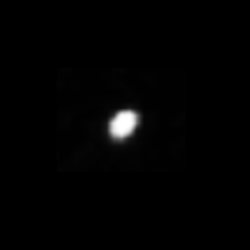
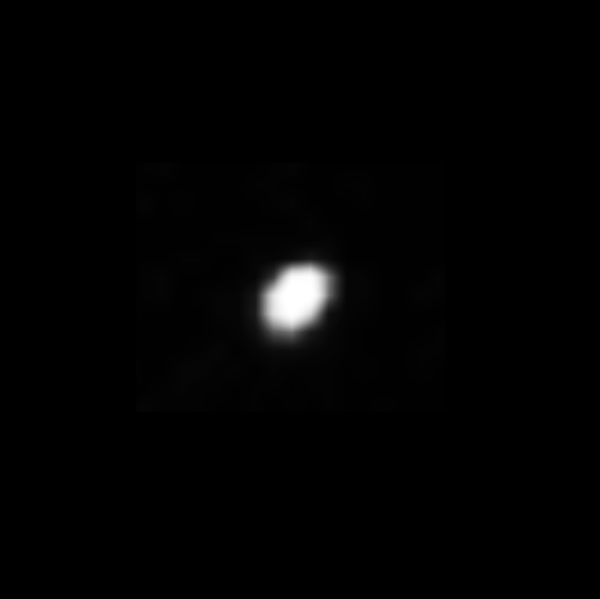
In Voyager 2 imagery, Juliet appears as an elongated object, with its major axis pointing towards Uranus. The ratio of axes of Juliet's prolate spheroid is 0.5 ± 0.3, which is a rather extreme value. Its surface is grey in color.
Juliet may collide with Desdemona within the next 100 million years.
Juliet (moon)
Juliet is an inner satellite of Uranus. It was discovered from the images taken by Voyager 2 on 3 January 1986, and was given the temporary designation S/1986 U 2. It is named after the heroine of William Shakespeare's play Romeo and Juliet. It is also designated Uranus XI.
Juliet belongs to the Portia group of satellites, which also includes Bianca, Cressida, Desdemona, Portia, Rosalind, Cupid, Belinda, and Perdita. These satellites have similar orbits and photometric properties. Other than its orbit, size of 150 km × 74 km (93 mi × 46 mi), and geometric albedo of 0.08, little is known about Juliet.
In Voyager 2 imagery, Juliet appears as an elongated object, with its major axis pointing towards Uranus. The ratio of axes of Juliet's prolate spheroid is 0.5 ± 0.3, which is a rather extreme value. Its surface is grey in color.
Juliet may collide with Desdemona within the next 100 million years.
Recent media
Recent media