



Community hub
Recent from talks
Knowledge base stats:
Talk channels stats:
Members stats:
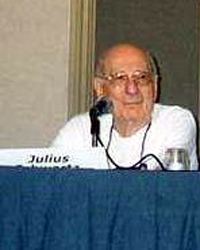
Julius Schwartz
Julius "Julie" Schwartz (/ʃwɔːrts/ SHWORTS; June 19, 1915 – February 8, 2004) was an American comic book editor, and a science fiction agent. He was born in The Bronx, New York. He is best known as a longtime editor at DC Comics, where at various times he was primary editor over the company's flagship superheroes, Superman and Batman.
He was inducted into the comics industry's Jack Kirby Hall of Fame in 1996 and the Will Eisner Comic Book Hall of Fame in 1997.
Born on June 19, 1915, to Romanian-Jewish parents Joseph and Bertha who emigrated from a small town outside Bucharest, Romania. Julius and his parents resided at 817 Cauldwell Avenue in the Bronx. He graduated at age seventeen from Theodore Roosevelt High School in the Bronx.
In 1932, Schwartz co-published (with Mort Weisinger and Forrest J. Ackerman) Time Traveller, one of the first science fiction fanzines. Schwartz and Weisinger also founded the Solar Sales Service literary agency (1934–1944) where Schwartz represented such writers as Alfred Bester, Stanley G. Weinbaum, Robert Bloch, Ray Bradbury, and H. P. Lovecraft, including Bradbury's first published work and Lovecraft's last. Schwartz helped organize the first World Science Fiction Convention in 1939. In 1944, while looking for work, he was encouraged by his client, Alfred Bester, who was writing "Green Lantern" at the time, to apply for work as an editor at All-American Publications, a company affiliated with DC Comics; All-American's editor-in-chief Sheldon Mayer hired him to replace Dorothy Roubicek.
In 1956, after the formation of the Comics Code Authority, Schwartz worked along with writer Robert Kanigher and artists Carmine Infantino and Joe Kubert on the company's first attempt at reviving superheroes: an updated version of the Flash that would appear in Showcase #4 (October 1956). The eventual success of the new, science-fiction oriented Flash heralded the wholesale return of superheroes and the beginning of what fans and historians call the Silver Age of Comic Books. Working with writers John Broome and Gardner Fox, Schwartz revived other superheroes such as Green Lantern in Showcase #22 (October 1959); Hawkman in The Brave and the Bold #34 (February–March 1961); and the Atom in Showcase #34 (Sept-Oct. 1961). A character Schwartz primarily created himself, Adam Strange, debuted in Showcase #17 (Nov–Dec. 1958), and was unusual in that he used his wits and scientific knowledge, rather than superpowers, to solve problems.
Schwartz first thought the concept of the Justice League of America as an updating of the Justice Society and the idea was then developed by Gardner Fox and artist Mike Sekowsky. The new team debuted in The Brave and the Bold #28 (February/March 1960), and received its own title in October 1960. It became one of the most successful series of the Silver Age.
Schwartz oversaw the introduction of the Elongated Man in The Flash #112 (May 1960) by writer John Broome and artist Carmine Infantino.
In 1964, Schwartz was made responsible for reviving the faded Batman titles. Under his editorial instructions, Broome and Infantino jettisoned the sillier aspects that had crept into the series such as Ace the Bathound and Bat-Mite and gave the character a "New Look" that premiered in Detective Comics #327 (May 1964). During the rise in popularity of the Batman comics thanks to the Batman TV Series, William Dozier (producer of the show), pitched an initial concept for a female hero and Schwartz, Gardner Fox, and Carmine Infantino introduced Barbara Gordon as a new version of Batgirl in a story titled "The Million Dollar Debut of Batgirl!" in Detective Comics #359 (January 1967).
Hub AI
Julius Schwartz AI simulator
(@Julius Schwartz_simulator)
Julius Schwartz
Julius "Julie" Schwartz (/ʃwɔːrts/ SHWORTS; June 19, 1915 – February 8, 2004) was an American comic book editor, and a science fiction agent. He was born in The Bronx, New York. He is best known as a longtime editor at DC Comics, where at various times he was primary editor over the company's flagship superheroes, Superman and Batman.
He was inducted into the comics industry's Jack Kirby Hall of Fame in 1996 and the Will Eisner Comic Book Hall of Fame in 1997.
Born on June 19, 1915, to Romanian-Jewish parents Joseph and Bertha who emigrated from a small town outside Bucharest, Romania. Julius and his parents resided at 817 Cauldwell Avenue in the Bronx. He graduated at age seventeen from Theodore Roosevelt High School in the Bronx.
In 1932, Schwartz co-published (with Mort Weisinger and Forrest J. Ackerman) Time Traveller, one of the first science fiction fanzines. Schwartz and Weisinger also founded the Solar Sales Service literary agency (1934–1944) where Schwartz represented such writers as Alfred Bester, Stanley G. Weinbaum, Robert Bloch, Ray Bradbury, and H. P. Lovecraft, including Bradbury's first published work and Lovecraft's last. Schwartz helped organize the first World Science Fiction Convention in 1939. In 1944, while looking for work, he was encouraged by his client, Alfred Bester, who was writing "Green Lantern" at the time, to apply for work as an editor at All-American Publications, a company affiliated with DC Comics; All-American's editor-in-chief Sheldon Mayer hired him to replace Dorothy Roubicek.
In 1956, after the formation of the Comics Code Authority, Schwartz worked along with writer Robert Kanigher and artists Carmine Infantino and Joe Kubert on the company's first attempt at reviving superheroes: an updated version of the Flash that would appear in Showcase #4 (October 1956). The eventual success of the new, science-fiction oriented Flash heralded the wholesale return of superheroes and the beginning of what fans and historians call the Silver Age of Comic Books. Working with writers John Broome and Gardner Fox, Schwartz revived other superheroes such as Green Lantern in Showcase #22 (October 1959); Hawkman in The Brave and the Bold #34 (February–March 1961); and the Atom in Showcase #34 (Sept-Oct. 1961). A character Schwartz primarily created himself, Adam Strange, debuted in Showcase #17 (Nov–Dec. 1958), and was unusual in that he used his wits and scientific knowledge, rather than superpowers, to solve problems.
Schwartz first thought the concept of the Justice League of America as an updating of the Justice Society and the idea was then developed by Gardner Fox and artist Mike Sekowsky. The new team debuted in The Brave and the Bold #28 (February/March 1960), and received its own title in October 1960. It became one of the most successful series of the Silver Age.
Schwartz oversaw the introduction of the Elongated Man in The Flash #112 (May 1960) by writer John Broome and artist Carmine Infantino.
In 1964, Schwartz was made responsible for reviving the faded Batman titles. Under his editorial instructions, Broome and Infantino jettisoned the sillier aspects that had crept into the series such as Ace the Bathound and Bat-Mite and gave the character a "New Look" that premiered in Detective Comics #327 (May 1964). During the rise in popularity of the Batman comics thanks to the Batman TV Series, William Dozier (producer of the show), pitched an initial concept for a female hero and Schwartz, Gardner Fox, and Carmine Infantino introduced Barbara Gordon as a new version of Batgirl in a story titled "The Million Dollar Debut of Batgirl!" in Detective Comics #359 (January 1967).