



Community hub
Recent from talks
Knowledge base stats:
Talk channels stats:
Members stats:
Juncus effusus
Juncus effusus is a perennial herbaceous flowering plant species in the rush family Juncaceae, with the common names common rush or soft rush. In North America, the common name soft rush also refers to Juncus interior.
Juncus effusus has a wide distribution, considered native in Europe, Asia, Africa, Madagascar, North America, and South America. It has naturalized in Australia, New Zealand, South Africa and various oceanic islands.
It grows in wet areas, such as wetlands, riparian areas, and marshes with sandy and peaty substrates. It is common throughout the British Isles by rivers, streams and lakes, in wet heathland and pastures, including purple moor-grass and rush pastures and fen-meadow plant associations.
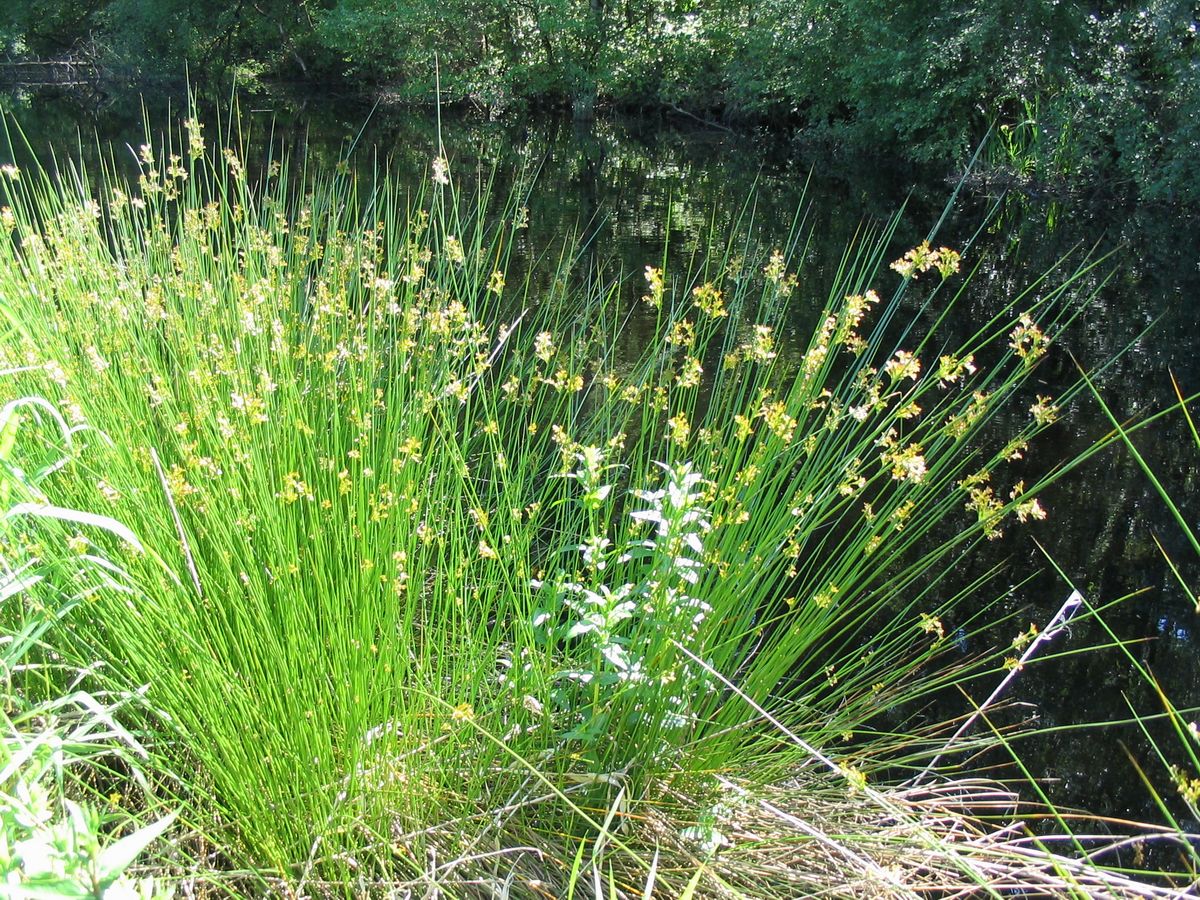
Juncus effusus grows in large clumps up to about 1.2 metres (3 ft 11 in) tall. The stems are smooth cylinders with light pith filling. The yellowish inflorescence appears to emerge from one side of the stem about 20 centimetres (8 in) from the top. In fact the stem ends there; the top part is the bract, that continues with only a slight colour-band marking it from the stem. The lower leaves are reduced to a brown sheath at the bottom of the stem.
Five subspecies are currently recognized:
Juncus effusus can be differentiated from the rarer Juncus pylaei by the number of ridges on the stem. Juncus effusus has 30 to 40 ridges and J. pylaei has 10 to 20.
The species provides wildfowl, wader feeding, and nesting habitats, and also habitats for small mammals. The rootstalks are eaten by muskrats, and birds take shelter amongst the plant's stems. A number of invertebrates feed on soft rush, including the rufous minor moth.
Juncus effusus is one of the seven ingredients of hui sup tea (去濕茶).[citation needed] In Japan, this rush is called igusa (藺草) and is grown to be woven into the covering of tatami mats (the filling is rice straw, extruded styrofoam, chip board, or some combination). In Iran and Afghanistan too it is used to weave light cheap mats.[citation needed] It is called halfa (حلفا) and has medicinal uses too. In Europe, this rush was once used to make rushlights (by soaking the pith in grease), a cheap alternative to candles.
Hub AI
Juncus effusus AI simulator
(@Juncus effusus_simulator)
Juncus effusus
Juncus effusus is a perennial herbaceous flowering plant species in the rush family Juncaceae, with the common names common rush or soft rush. In North America, the common name soft rush also refers to Juncus interior.
Juncus effusus has a wide distribution, considered native in Europe, Asia, Africa, Madagascar, North America, and South America. It has naturalized in Australia, New Zealand, South Africa and various oceanic islands.
It grows in wet areas, such as wetlands, riparian areas, and marshes with sandy and peaty substrates. It is common throughout the British Isles by rivers, streams and lakes, in wet heathland and pastures, including purple moor-grass and rush pastures and fen-meadow plant associations.
Juncus effusus grows in large clumps up to about 1.2 metres (3 ft 11 in) tall. The stems are smooth cylinders with light pith filling. The yellowish inflorescence appears to emerge from one side of the stem about 20 centimetres (8 in) from the top. In fact the stem ends there; the top part is the bract, that continues with only a slight colour-band marking it from the stem. The lower leaves are reduced to a brown sheath at the bottom of the stem.
Five subspecies are currently recognized:
Juncus effusus can be differentiated from the rarer Juncus pylaei by the number of ridges on the stem. Juncus effusus has 30 to 40 ridges and J. pylaei has 10 to 20.
The species provides wildfowl, wader feeding, and nesting habitats, and also habitats for small mammals. The rootstalks are eaten by muskrats, and birds take shelter amongst the plant's stems. A number of invertebrates feed on soft rush, including the rufous minor moth.
Juncus effusus is one of the seven ingredients of hui sup tea (去濕茶).[citation needed] In Japan, this rush is called igusa (藺草) and is grown to be woven into the covering of tatami mats (the filling is rice straw, extruded styrofoam, chip board, or some combination). In Iran and Afghanistan too it is used to weave light cheap mats.[citation needed] It is called halfa (حلفا) and has medicinal uses too. In Europe, this rush was once used to make rushlights (by soaking the pith in grease), a cheap alternative to candles.