


Community hub
Recent from talks
Contribute something
Nothing was collected or created yet.
Afghanistan
View on Wikipedia
Afghanistan,[e][f] officially the Islamic Emirate of Afghanistan,[g] is a landlocked country located at the crossroads of Central and South Asia. It is bordered by Pakistan to the east and south,[h] Iran to the west, Turkmenistan to the northwest, Uzbekistan to the north, Tajikistan to the northeast, and China to the northeast and east. Occupying 652,864 square kilometers (252,072 sq mi) of land, the country is predominantly mountainous with plains in the north and the southwest, which are separated by the Hindu Kush mountain range. Kabul is the country's capital and largest city. Afghanistan's population is estimated to be between 40 and 50 million.[d]
Key Information


![Coat of Arms of the Islamic Emirate[1]](https://en.wikipedia.org/wiki/File:Arms_of_the_Islamic_Emirate_of_Afghanistan.svg)
.svg)
_-_AFG_-_UNOCHA.svg)

Human habitation in Afghanistan dates to the Middle Paleolithic era. Popularly referred to as the graveyard of empires,[33] the land has witnessed numerous military campaigns, including those by the Persians, Alexander the Great, the Maurya Empire, Arab Muslims, the Mongols, the British, the Soviet Union, and a US-led coalition. Afghanistan also served as the source from which the Greco-Bactrians and the Mughals, among others, rose to form major empires.[34] Because of the various conquests and periods in both the Iranian and Indian cultural spheres,[35][36] the area was a center for Zoroastrianism, Buddhism, Hinduism, and later Islam.[37] The modern state of Afghanistan began with the Durrani Afghan Empire in the 18th century,[38] although Dost Mohammad Khan is sometimes considered to be the founder of the first modern Afghan state.[39] Afghanistan became a buffer state in the Great Game between the British Empire and the Russian Empire. From India, the British attempted to subjugate Afghanistan but were repelled in the First Anglo-Afghan War; the Second Anglo-Afghan War saw a British victory. Following the Third Anglo-Afghan War in 1919, Afghanistan became free of foreign political hegemony, and emerged as the independent Kingdom of Afghanistan in 1926. This monarchy lasted almost half a century, until Zahir Shah was overthrown in 1973, following which the Republic of Afghanistan was established.
Since the late 1970s, Afghanistan's history has been dominated by extensive warfare, including coups, invasions, insurgencies, and civil wars. The conflict began in 1978 when a communist revolution established a socialist state (itself a response to the dictatorship established following a coup d'état in 1973), and subsequent infighting prompted the Soviet Union to invade Afghanistan in 1979. The mujahideen won against the Soviets in Soviet–Afghan War, leading to the Soviets' withdrawal in 1989. The ensuing civil war overthrew the socialist republic and established the Islamic State of Afghanistan through Peshawar Accord, which could not remain in force and resulted in a second civil war between mujahideen factions in 1992. The Taliban controlled most of the country by 1996, but their Islamic Emirate of Afghanistan received little international recognition before its overthrow in the 2001 US invasion of Afghanistan. The Taliban returned to power in 2021 after capturing Kabul, ending the 2001–2021 war. As of July 2025[update], the Taliban government is widely unrecognized by the international community due to reported violations of human rights in Afghanistan, particularly regarding the rights of women in Afghanistan and the treatment of women by the Taliban.
Afghanistan is rich in natural resources, including lithium, iron, zinc, and copper. It is the second-largest producer of cannabis resin,[40][obsolete source] and third largest of both saffron[41] and cashmere.[42] The country is a member of the South Asian Association for Regional Cooperation and a founding member of the Organization of Islamic Cooperation. Due to the effects of war in recent decades, the country has dealt with high levels of terrorism, poverty, and child malnutrition. Afghanistan remains among the world's least developed countries, ranking 182nd on the Human Development Index. Afghanistan's gross domestic product (GDP) is $81 billion by purchasing power parity and $20.1 billion by nominal values. Per capita, its GDP is among the lowest of any country as of 2020[update].
Etymology
[edit]Some scholars suggest that the root name Afghān is derived from the Sanskrit word Aśvakan, which was the name used for ancient inhabitants of the Hindu Kush.[43] Aśvakan literally means "horsemen", "horse breeders", or "cavalrymen" (from aśva, the Sanskrit and Avestan words for "horse").[44]
Historically, the ethnonym Afghān was used to refer to ethnic Pashtuns.[45] The Arabic and Persian form of the name, Afġān, was first attested in the 10th-century geography book Hudud al-'Alam.[46] The last part of the name, "-stan", is a Persian suffix meaning "place of". Therefore, "Afghanistan" translates to "land of the Afghans", or "land of the Pashtuns" in a historical sense. According to the third edition of the Encyclopaedia of Islam:[47]
The name Afghanistan (Afghānistān, land of the Afghans / Pashtuns, afāghina, sing. afghān) can be traced to the early eighth/fourteenth century, when it designated the easternmost part of the Kartid realm. This name was later used for certain regions in the Ṣafavid and Mughal empires that were inhabited by Afghans. While based on a state-supporting elite of Abdālī / Durrānī Afghans, the Sadūzāʾī Durrānī polity that came into being in 1160 / 1747 was not called Afghanistan in its own day. The name became a state designation only during the colonial intervention of the nineteenth century.
The term "Afghanistan" was officially used in 1855, when the British recognized Dost Mohammad Khan as king of Afghanistan.[48]
History
[edit]Prehistory and antiquity
[edit]
Excavations of prehistoric sites suggest that humans were living in what is now Afghanistan at least 50,000 years ago, and that farming communities in the area were among the earliest in the world. An important site of early historical activities, many believe that Afghanistan compares to Egypt in the historical value of its archaeological sites.[49][50] Artifacts typical of the Paleolithic, Mesolithic, Neolithic, Bronze, and Iron Ages have been found in Afghanistan. Urban civilization is believed to have begun as early as 3000 BCE, and the early city of Mundigak (near Kandahar in the south of the country) was a center of the Helmand culture. More recent findings established that the Indus Valley Civilization stretched up towards modern-day Afghanistan. An Indus Valley site has been found on the Oxus River at Shortugai in northern Afghanistan.[51][52][53]
After 2000 BCE successive waves of semi-nomadic people from Central Asia began moving south into Afghanistan; among them were many Indo-European-speaking Indo-Iranians. These tribes later migrated further into South Asia, Western Asia, and toward Europe via the area north of the Caspian Sea. The region at the time was referred to as Ariana.[49][54] By the middle of the 6th century BCE, the Achaemenids overthrew the Medes and incorporated Arachosia, Aria, and Bactria within its eastern boundaries. An inscription on the tombstone of Darius I of Persia mentions the Kabul Valley in a list of the 29 countries that he had conquered.[55] The region of Arachosia, around Kandahar in modern-day southern Afghanistan, used to be primarily Zoroastrian and played a key role in the transfer of the Avesta to Persia and is thus considered by some to be the "second homeland of Zoroastrianism".[56][57][58]

Alexander the Great and his Macedonian forces arrived in Afghanistan in 330 BCE after defeating Darius III of Persia a year earlier in the Battle of Gaugamela. Following Alexander's brief occupation, the successor state of the Seleucid Empire controlled the region until 305 BCE, when they gave much of it to the Maurya Empire as part of an alliance treaty. The Mauryans controlled the area south of the Hindu Kush until they were overthrown in about 185 BCE. Their decline began 60 years after Ashoka's rule ended, leading to the Hellenistic reconquest by the Greco-Bactrians. Much of it soon broke away and became part of the Indo-Greek Kingdom. They were defeated and expelled by the Indo-Scythians in the late 2nd century BCE.[59][60] The Silk Road appeared during the first century BCE, and Afghanistan flourished with trade, with routes to China, India, Persia, and north to the cities of Bukhara, Samarkand, and Khiva in present-day Uzbekistan.[61] Goods and ideas were exchanged at this center point, such as Chinese silk, Persian silver and Roman gold, while the region of present Afghanistan was mining and trading lapis lazuli stones[62] mainly from the Badakhshan region.
During the first century BCE, the Parthian Empire subjugated the region but lost it to their Indo-Parthian vassals. In the mid-to-late first century CE the vast Kushan Empire, centered in Afghanistan, became great patrons of Buddhist culture, making Buddhism flourish throughout the region. The Kushans were overthrown by the Sassanids in the 3rd century CE, though the Indo-Sassanids continued to rule at least parts of the region. They were followed by the Kidarites who, in turn, was replaced by the Hephthalites. They were replaced by the Turk Shahi in the 7th century. The Buddhist Turk Shahi of Kabul was replaced by a Hindu dynasty before the Saffarids conquered the area in 870, this Hindu dynasty was called Hindu Shahi.[63] Much of the northeastern and southern areas of the country remained dominated by Buddhist culture.[64][65]
Medieval period
[edit]
Arab Muslims brought Islam to Herat and Zaranj in 642 CE and began spreading eastward; some of the native inhabitants they encountered accepted it while others revolted. Before the arrival of Islam, the region used to be home to various beliefs and cults, often resulting in Syncretism between the dominant religions[66][67] such as Zoroastrianism,[56][57][58] Buddhism or Greco-Buddhism, Ancient Iranian religions,[68] Hinduism, Christianity,[69][70] and Judaism.[71][72] An exemplification of the syncretism in the region would be that people were patrons of Buddhism but still worshipped local Iranian gods such as Ahura Mazda, Lady Nana, Anahita or Mihr (Mithra) and portrayed Greek gods as protectors of Buddha.[73][68][74] The Zunbils and Kabul Shahi were first conquered in 870 CE by the Saffarid Muslims of Zaranj. Later, the Samanids extended their Islamic influence south of the Hindu Kush. The Ghaznavids rose to power in the 10th century.[75][76][77]
By the 11th century, Mahmud of Ghazni had defeated the remaining Hindu rulers and effectively Islamized the wider region,[78] with the exception of Kafiristan.[79] Mahmud made Ghazni into an important city and patronized intellectuals such as the historian Al-Biruni and the poet Ferdowsi.[80] The Ghaznavid dynasty was overthrown by the Ghurids in 1186, whose architectural achievements included the remote Minaret of Jam. The Ghurids controlled Afghanistan for less than a century before being conquered by the Khwarazmian dynasty in 1215.[81]

In 1219 CE, Genghis Khan and his Mongol army overran the region. His troops are said to have annihilated the Khwarazmian cities of Herat and Balkh as well as Bamyan.[82] The destruction caused by the Mongols forced many locals to return to an agrarian rural society.[83] Mongol rule continued with the Ilkhanate in the northwest while the Khalji dynasty administered the Afghan tribal areas south of the Hindu Kush until the invasion of Timur (aka Tamerlane), who established the Timurid Empire in 1370. Under the rule of Shah Rukh, the city of Herat[84] served as the focal point of the Timurid Renaissance, whose glory matched Florence of the Italian Renaissance as the center of a cultural rebirth.[85][86]
In the early 16th century Babur arrived from Ferghana and captured Kabul from the Arghun dynasty.[87] Babur would go on to conquer the Afghan Lodi dynasty who had ruled the Delhi Sultanate in the First Battle of Panipat.[88] Between the 16th and 18th century, the Uzbek Khanate of Bukhara, Iranian Safavids, and Indian Mughals ruled parts of the territory.[89] During the medieval period, the northwestern area of Afghanistan was referred to by the regional name Khorasan, which was commonly used up to the 19th century among natives to describe their country.[90][91][92][93]
Hotak dynasty
[edit]
In 1709, Mirwais Hotak, a local Ghilzai tribal leader, successfully rebelled against the Safavids. He defeated Gurgin Khan, the Georgian governor of Kandahar under the Safavids, and established his own kingdom.[94] Mirwais died in 1715, and was succeeded by his brother Abdul Aziz, who was soon killed by Mirwais's son Mahmud for possibly planning to sign a peace with the Safavids. Mahmud led the Afghan army in 1722 to the Persian capital of Isfahan, and captured the city after the Battle of Gulnabad and proclaimed himself King of Persia.[94] The Afghan dynasty was ousted from Persia by Nader Shah after the 1729 Battle of Damghan.
In 1738, Nader Shah and his forces captured Kandahar in the siege of Kandahar, the last Hotak stronghold, from Shah Hussain Hotak. Soon after, the Persian and Afghan forces invaded India, Nader Shah had plundered Delhi, alongside his 16-year-old commander, Ahmad Shah Durrani who had assisted him on these campaigns. Nader Shah was assassinated in 1747.[95][96]
Durrani Empire
[edit]After the death of Nader Shah in 1747, Ahmad Shah Durrani had returned to Kandahar with a contingent of 4,000 Pashtuns. The Abdalis had "unanimously accepted" Ahmad Shah as their new leader. With his ascension in 1747, Ahmad Shah had led multiple campaigns against the Mughal empire, Maratha empire, and then-receding Afsharid empire. Ahmad Shah had captured Kabul and Peshawar from the Mughal appointed governor, Nasir Khan. Ahmad Shah had then conquered Herat in 1750, and had also captured Kashmir in 1752.[97] Ahmad Shah had launched two campaigns into Khorasan, 1750–1751 and 1754–1755.[98] His first campaign had seen the siege of Mashhad, however, he was forced to retreat after four months. In November 1750, he moved to siege Nishapur, but he was unable to capture the city and was forced to retreat in early 1751. Ahmad Shah returned in 1754; he captured Tun, and on 23 July, he sieged Mashhad once again. Mashhad had fallen on 2 December, but Shahrokh was reappointed in 1755. He was forced to give up Torshiz, Bakharz, Jam, Khaf, and Turbat-e Haidari to the Afghans, as well as accept Afghan sovereignty. Following this, Ahmad Shah sieged Nishapur once again, and captured it.
Ahmad Shah invaded India eight times during his reign,[99] beginning in 1748. Crossing the Indus River, his armies sacked and absorbed Lahore into the Durrani Realm. He met Mughal armies at the Battle of Manupur (1748), where he was defeated and forced to retreat back to Afghanistan.[100] He returned the next year in 1749 and captured the area around Lahore and Punjab, presenting it as an Afghan victory for this campaign.[101] From 1749 to 1767, Ahmad Shah led six more invasions, the most important being the last; the Third Battle of Panipat created a power vacuum in northern India, halting Maratha expansion.

Ahmad Shah Durrani died in October 1772, and a civil war over succession followed, with his named successor, Timur Shah Durrani succeeding him after the defeat of his brother, Suleiman Mirza.[102] Timur Shah Durrani ascended to the throne in November 1772, having defeated a coalition under Shah Wali Khan and Humayun Mirza. Timur Shah began his reign by consolidating power toward himself and people loyal to him, purging Durrani Sardars and influential tribal leaders in Kabul and Kandahar. One of Timur Shah's reforms was to move the capital of the Durrani Empire from Kandahar to Kabul. Timur Shah fought multiple series of rebellions to consolidate the empire, and he also led campaigns into Punjab against the Sikhs like his father, though more successfully. The most prominent example of his battles during this campaign was when he led his forces under Zangi Khan Durrani – with over 18,000 men total of Afghan, Qizilbash, and Mongol cavalrymen – against over 60,000 Sikh men. The Sikhs lost over 30,000 in this battle and staged a Durrani resurgence in the Punjab region.[103] The Durranis lost Multan in 1772 after Ahmad Shah's death. Following this victory, Timur Shah was able to lay siege to Multan and recapture it,[104] incorporating it into the Durrani Empire once again, reintegrating it as a province until the Siege of Multan (1818). Timur Shah was succeeded by his son Zaman Shah Durrani after his death in May 1793. Timur Shah's reign oversaw the attempted stabilization and consolidation of the empire. However, Timur Shah had over 24 sons, which plunged the empire in civil war over succession crises.[105]
Zaman Shah Durrani succeeded to the Durrani Throne following the death of his father, Timur Shah Durrani. His brothers Mahmud Shah Durrani and Humayun Mirza revolted against him, with Humayun centered in Kandahar and Mahmud Shah centered in Herat.[106] Zaman Shah would defeat Humayun and force the loyalty of Mahmud Shah Durrani.[106] Securing his position on the throne, Zaman Shah led three campaigns into Punjab. The first two campaigns captured Lahore, but he retreated due to intel about a possible Qajar invasion. Zaman Shah embarked on his third campaign for Punjab in 1800 to deal with a rebellious Ranjit Singh.[107] However, he was forced to withdraw, and Zaman Shah's reign was ended by Mahmud Shah Durrani.[107] However, just under two years into his reign, Mahmud Shah Durrani was deposed by his brother Shah Shuja Durrani on 13 July 1803.[108] Shah Shuja attempted to consolidate the Durrani Realm but was deposed by his brother at the Battle of Nimla (1809).[109] Mahmud Shah Durrani defeated Shah Shuja and forced him to flee, usurping the throne again. His second reign began on 3 May 1809.[110]
Barakzai dynasty and British wars
[edit]
By the early 19th century, the Afghan empire was under threat from the Persians in the west and the Sikh Empire in the east. Fateh Khan, leader of the Barakzai tribe, installed many of his brothers in positions of power throughout the empire. Fateh Khan was brutally murdered in 1818 by Mahmud Shah. As a result, the brothers of Fateh Khan and the Barakzai tribe rebelled, and a civil war brewed. During this turbulent period, Afghanistan fractured into many states, including the Principality of Qandahar, Emirate of Herat, Khanate of Qunduz, Maimana Khanate, and numerous other warring polities. The most prominent state was the Emirate of Kabul, ruled by Dost Mohammad Khan.[111][112]
With the collapse of the Durrani Empire, and the exile of the Sadozai Dynasty to be left to rule in Herat, Punjab and Kashmir were lost to Ranjit Singh, ruler of the Sikh Empire, who invaded Khyber Pakhtunkhwa in March 1823 and captured the city of Peshawar following the Battle of Nowshera. In 1834, Dost Mohammad Khan led numerous campaigns, firstly campaigning to Jalalabad, and then allying with his rival brothers in Kandahar to defeat Shah Shuja Durrani and the British in the Expedition of Shuja ul-Mulk.[113] In 1837, Dost Mohammad Khan attempted to conquer Peshawar and sent a large force under his son Wazir Akbar Khan, leading to the Battle of Jamrud. Akbar Khan and the Afghan army failed to capture the Jamrud Fort from the Sikh Khalsa Army, but killed Sikh Commander Hari Singh Nalwa, thus ending the Afghan-Sikh Wars. By this time the British were advancing from the east, capitalizing on the decline of the Sikh Empire after it had its own period of turbulence following the death of Ranjit Singh, which engaged the Emirate of Kabul in the first major conflict during "The Great Game".[114]

In 1839 a British expeditionary force marched into Afghanistan, invading the Principality of Qandahar, and in August 1839, seized Kabul. Dost Mohammad Khan defeated the British in the Parwan campaign, but surrendered following his victory. He was replaced with the former Durrani ruler Shah Shuja Durrani as the new ruler of Kabul, a de facto puppet of the British.[115][116] Following an uprising that saw the assassination of Shah Shuja, the 1842 retreat from Kabul of British-Indian forces and the annihilation of Elphinstone's army, and the punitive expedition of The Battle of Kabul that led to its sacking, the British gave up on their attempts to try to subjugate Afghanistan, allowing Dost Mohammad Khan to return as ruler. Following this, Dost Mohammad pursued a myriad of campaigns to unite most of Afghanistan in his reign, launching numerous incursions including against the surrounding states such as the Hazarajat campaign, conquest of Balkh, conquest of Kunduz, and the conquest of Kandahar. Dost Mohammad led his final campaign against Herat, conquering it and re-uniting Afghanistan. During his campaigns of re-unification, he held friendly relations with the British despite the First Anglo-Afghan War, and affirmed their status in the Second Anglo-Afghan treaty of 1857, while Bukhara and internal religious leaders pressured Dost Mohammad to invade India during the Indian Rebellion of 1857.[117]
Dost Mohammad died in June 1863, a few weeks after his successful campaign to Herat. Following his death, a civil war ensued among his sons, prominently Mohammad Afzal Khan, Mohammad Azam Khan, and Sher Ali Khan. Sher Ali won the resulting Afghan Civil War (1863–1869) and ruled Afghanistan until his death in 1879. In his final years, the British returned to Afghanistan in the Second Anglo-Afghan War to fight perceived Russian influence in the region. Sher Ali retreated to northern Afghanistan, intending to create a resistance there similar to his predecessors, Dost Mohammad Khan, and Wazir Akbar Khan. His untimely death however, saw Yaqub Khan declared the new Amir, leading to Britain gaining control of Afghanistan's foreign relations as part of the Treaty of Gandamak of 1879, making it an official British Protected State.[118][119] An uprising however, re-started the conflict, and Yaqub Khan was deposed. During this tumultuous period, Abdur Rahman Khan began his rise to power, becoming an eligible candidate to become Amir after he seized much of Northern Afghanistan. Abdur Rahman marched on Kabul, and was declared Amir, being recognized by the British as well. Another uprising by Ayub Khan threatened the British, where rebels confronted and defeated British forces in the Battle of Maiwand. Following up on his victory, Ayub Khan unsuccessfully besieged Kandahar, and his decisive defeat saw the end of the Second Anglo-Afghan War, with Abdur Rahman secured firmly as Amir.[120] In 1893, Abdur Rahman signed an agreement in which the ethnic Pashtun and Baloch territories were divided by the Durand Line, which forms the modern-day border between Pakistan and Afghanistan. Shia-dominated Hazarajat and pagan Kafiristan remained politically independent until being conquered by Abdur Rahman Khan in 1891–1896. He was known as the "Iron Amir" for his features and his ruthless methods against tribes.[121] He died in 1901, succeeded by his son, Habibullah Khan.
How can a small power like Afghanistan, which is like a goat between these lions [Britain and Russia] or a grain of wheat between two strong millstones of the grinding mill, stand in the midway of the stones without being ground to dust?
— Abdur Rahman Khan, the "Iron Amir", in 1900[122][123]
During the First World War, when Afghanistan was neutral, Habibullah Khan was met by officials of the central powers in the Niedermayer–Hentig Expedition. They called on Afghanistan to declare full independence from the United Kingdom, join them and attack British India, as part of the Hindu–German Conspiracy. The effort to bring Afghanistan into the Central Powers failed, but it sparked discontent among the population about maintaining neutrality with the British. Habibullah was assassinated in February 1919, and Amanullah Khan eventually assumed power. A staunch supporter of the 1915–1916 expeditions, Amanullah Khan invaded British India, beginning the Third Anglo-Afghan War, and entering British India via the Khyber Pass.[124]

After the end of the Third Anglo-Afghan War and the signing of the Treaty of Rawalpindi on 19 August 1919, Emir Amanullah Khan declared the Emirate of Afghanistan a sovereign and fully independent state. He moved to end his country's traditional isolation by establishing diplomatic relations with the international community, particularly with the Soviet Union and the Weimar Republic.[125][126] He proclaimed himself King of Afghanistan on 9 June 1926, forming the Kingdom of Afghanistan. He introduced several reforms intended to modernize his nation. A key force behind these reforms was Mahmud Tarzi, an ardent supporter of the education of women. He fought for Article 68 of Afghanistan's 1923 constitution, which made elementary education compulsory. Slavery was abolished in 1923.[127] King Amanullah's wife, Queen Soraya, was an important figure during this period in the fight for woman's education and against their oppression.[128]
Some of the reforms, such as the abolition of the traditional burqa for women and the opening of co-educational schools, alienated many tribal and religious leaders, leading to the Afghan Civil War (1928–1929). King Amanullah abdicated in January 1929, and soon after Kabul fell to Saqqawist forces led by Habibullah Kalakani.[129] Mohammed Nadir Shah, Amanullah's cousin, defeated and killed Kalakani in October 1929, and was declared King Nadir Shah.[130] He abandoned the reforms of King Amanullah in favor of a more gradual approach to modernization, but was assassinated in 1933 by Abdul Khaliq.[131]
Mohammed Zahir Shah succeeded to the throne and reigned as king from 1933 to 1973. During the tribal revolts of 1944–1947, King Zahir's reign was challenged by Zadran, Safi, Mangal, and Wazir tribesmen led by Mazrak Zadran, Salemai, and Mirzali Khan, among others – many of whom were Amanullah loyalists. Afghanistan joined the League of Nations in 1934. The 1930s saw the development of roads, infrastructure, the founding of a national bank, and increased education. Road links in the north played a large part in a growing cotton and textile industry.[132] The country built close relationships with the Axis powers, with Nazi Germany having the largest share in Afghan development at the time.[133]

Until 1946 King Zahir ruled with the assistance of his uncle, who held the post of prime minister and continued the policies of Nadir Shah. Another uncle, Shah Mahmud Khan, became prime minister in 1946 and experimented with allowing greater political freedom. He was replaced in 1953 by Mohammed Daoud Khan, a Pashtun nationalist who sought the creation of a Pashtunistan, leading to highly tense relations with Pakistan.[134] Daoud Khan pressed for social modernization reforms and sought a closer relationship with the Soviet Union. Afterward, the 1964 constitution was formed, and the first non-royal prime minister was sworn in.[132]
Zahir Shah, like his father Nadir Shah, had a policy of maintaining national independence while pursuing gradual modernization, creating nationalist feeling, and improving relations with the United Kingdom. Afghanistan was neither a participant in World War II nor aligned with either power bloc in the Cold War. However, it was a beneficiary of the latter rivalry as both the Soviet Union and the United States vied for influence by building Afghanistan's main highways, airports, and other vital infrastructure. On a per capita basis, Afghanistan received more Soviet development aid than any other country. In 1973, while the King was in Italy, Daoud Khan launched a bloodless coup and became the first president of Afghanistan, abolishing the monarchy.
Democratic Republic and Soviet war
[edit]
In April 1978, the communist People's Democratic Party of Afghanistan (PDPA) seized power in a bloody coup d'état against then-President Mohammed Daoud Khan, in what is called the Saur Revolution. The PDPA declared the establishment of the Democratic Republic of Afghanistan, with its first leader named as People's Democratic Party General Secretary Nur Muhammad Taraki.[135] This would trigger a series of events that would dramatically turn Afghanistan from a peaceful (albeit poor and secluded) country to a hotbed of conflict and terrorism.[136] The PDPA initiated various social, symbolic, and land distribution reforms that provoked strong opposition, while also brutally oppressing political dissidents. This caused unrest and quickly expanded into a state of civil war by 1979, waged by guerrilla mujahideen (and smaller Maoist guerrillas) against regime forces countrywide. It quickly turned into a proxy war as the Pakistani government provided these rebels with covert training centers, the United States supported them through Pakistan's Inter-Services Intelligence (ISI),[137] and the Soviet Union sent thousands of military advisers to support the PDPA regime.[138] Meanwhile, there was increasingly hostile friction between the competing factions of the PDPA – the dominant Khalq and the more moderate Parcham.[139]
In October 1979, PDPA General Secretary Taraki was assassinated in an internal coup orchestrated by then-prime minister Hafizullah Amin, who became the new general secretary of the PDPA. The situation in the country deteriorated under Amin, and thousands of people went missing.[140] Displeased with Amin's government, the Soviet Army invaded the country in December 1979, heading for Kabul and killing Amin.[141] A Soviet-organized regime, led by Parcham's Babrak Karmal but inclusive of both factions (Parcham and Khalq), filled the vacuum. Soviet troops in more substantial numbers were deployed to stabilize Afghanistan under Karmal, marking the beginning of the Soviet–Afghan War.[142] Lasting nine years, the war caused the deaths of between 562,000[143] and 2 million Afghans,[i] and displaced about 6 million people who subsequently fled Afghanistan, mainly to Pakistan and Iran.[151] Heavy air bombardment destroyed many countryside villages, millions of landmines were planted,[152] and some cities such as Herat and Kandahar were also damaged from bombardment. After the Soviet withdrawal, another civil war ensued until the communist regime under PDPA leader Mohammad Najibullah collapsed in 1992.[153][154][155]
The Soviet–Afghan War had drastic social effects on Afghanistan. The militarization of society led to heavily armed police, private bodyguards, openly armed civil defense groups and the like becoming the norm in Afghanistan for decades thereafter.[156] The traditional power structure had shifted from clergy, community elders, intelligentsia, and military in favor of powerful warlords.[157]
Post–Cold War conflict
[edit].png)
Another civil war broke out after the creation of a dysfunctional coalition government between leaders of various mujahideen factions. Amid a state of anarchy and factional infighting,[158][159][160] various mujahideen factions committed widespread rape, murder and extortion,[159][161][162] while Kabul was heavily bombarded and partially destroyed by the fighting.[162] Several failed reconciliations and alliances occurred between different leaders.[163] The Taliban emerged in September 1994 as a movement and militia of students (talib) from Islamic madrassas (schools) in Pakistan,[162][164] who soon had military support from Pakistan.[165]
Taking control of Kandahar city that year,[162] they conquered more territories until finally driving out the government of Rabbani from Kabul in 1996,[166][167] where they established an emirate.[168] The Taliban were condemned internationally for the harsh enforcement of their interpretation of Islamic sharia law, which resulted in the brutal treatment of many Afghans, especially women.[169][170] During their rule, the Taliban and their allies committed massacres against Afghan civilians, denied UN food supplies to starving civilians and conducted a policy of scorched earth, burning vast areas of fertile land and destroying tens of thousands of homes.[j]
After the fall of Kabul to the Taliban, Ahmad Shah Massoud and Abdul Rashid Dostum formed the Northern Alliance, later joined by others, to resist the Taliban. Dostum's forces were defeated by the Taliban during the Battles of Mazar-i-Sharif in 1997 and 1998; Pakistan's Chief of Army Staff, Pervez Musharraf, began sending thousands of Pakistanis to help the Taliban defeat the Northern Alliance.[k] By 2000, the Northern Alliance only controlled 10% of territory, cornered in the northeast. On 9 September 2001, Massoud was assassinated by two Arab suicide attackers in Panjshir Valley. Around 400,000 Afghans died in internal conflicts between 1990 and 2001.[181]
US invasion and Islamic Republic
[edit]In October 2001, the United States invaded Afghanistan to remove the Taliban from power after they refused to hand over Osama bin Laden, the prime suspect of the September 11 attacks, who was a "guest" of the Taliban and was operating his al-Qaeda network in Afghanistan.[182][183][184] The majority of Afghans supported the American invasion.[185][186] During the initial invasion, US and UK forces bombed al-Qaeda training camps, and later working with the Northern Alliance, the Taliban regime came to an end.[187]

In December 2001, after the Taliban government was overthrown, the Afghan Interim Administration under Hamid Karzai was formed. The International Security Assistance Force (ISAF) was established by the UN Security Council to help assist the Karzai administration and provide basic security.[188][189] By this time, after two decades of war as well as an acute famine at the time, Afghanistan had one of the highest infant and child mortality rates in the world, the lowest life expectancy, much of the population were hungry,[190][191][192] and infrastructure was in ruins.[193] Many foreign donors started providing aid and assistance to rebuild the war-torn country.[194][195] As coalition troops entered Afghanistan to help the rebuilding process,[196][197] the Taliban began an insurgency to regain control. Afghanistan remained one of the poorest countries in the world because of a lack of foreign investment, government corruption, and the Taliban insurgency.[198][199]
The Afghan government was able to build some democratic structures, adopting a constitution in 2004 with the name Islamic Republic of Afghanistan. Attempts were made, often with the support of foreign donor countries, to improve the country's economy, healthcare, education, transport, and agriculture. ISAF forces also began to train the Afghan National Security Forces. Following 2002, nearly five million Afghans were repatriated.[200] The number of NATO troops present in Afghanistan peaked at 140,000 in 2011,[201] dropping to about 16,000 in 2018.[202] In September 2014 Ashraf Ghani became president after the 2014 presidential election where for the first time in Afghanistan's history power was democratically transferred.[203][204][205] On 28 December 2014, NATO formally ended ISAF combat operations and transferred full security responsibility to the Afghan government. The NATO-led Operation Resolute Support was formed the same day as a successor to ISAF.[206][207] Thousands of NATO troops remained in the country to train and advise Afghan government forces[208] and continue their fight against the Taliban.[209] A report titled Body Count concluded that 106,000–170,000 civilians had been killed as a result of the fighting in Afghanistan at the hands of all parties to the conflict.[210]

On 19 February 2020, the US–Taliban deal was made in Qatar. The deal was one of the critical events that caused the collapse of the Afghan National Security Forces (ANSF);[211] following the signing of the deal, the US dramatically reduced the number of air attacks and deprived the ANSF of a critical edge in fighting the Taliban insurgency, leading to the Taliban takeover of Kabul.[212]
Second Taliban era
[edit]NATO Secretary General Jens Stoltenberg announced on 14 April 2021 that the alliance had agreed to start withdrawing its troops from Afghanistan by 1 May.[213] Soon after NATO troops began withdrawing, the Taliban launched an offensive against the Afghan government and quickly advanced in front of collapsing Afghan government forces.[214][215] The Taliban captured the capital city of Kabul on 15 August 2021, after regaining control over a vast majority of Afghanistan.[216] Several foreign diplomats and Afghan government officials, including president Ashraf Ghani,[217] were evacuated from the country, with many Afghan civilians attempting to flee along with them.[218] On 17 August, first vice president Amrullah Saleh proclaimed himself caretaker president and announced the formation of an anti-Taliban front with a reported 6,000+ troops[219][220] in the Panjshir Valley, along with Ahmad Massoud.[221][222] However, by 6 September, the Taliban had taken control of most of Panjshir province, with resistance fighters retreating to the mountains.[223] Clashes in the valley ceased mid-September.[224]
According to the Costs of War Project, 176,000 people were killed in the conflict, including 46,319 civilians, between 2001 and 2021.[225] According to the Uppsala Conflict Data Program, at least 212,191 people were killed in the conflict.[226] Though the state of war in the country ended in 2021, armed conflict persists in some regions[227][228][229] amid fighting between the Taliban and the local branch of the Islamic State, as well as an anti-Taliban Republican insurgency.[230]
.png)
The Taliban government is led by supreme leader Hibatullah Akhundzada[231] and acting prime minister Hasan Akhund, who took office on 7 September 2021.[232][233] Akhund is one of the four founders of the Taliban[234] and was a deputy prime minister of the previous emirate; his appointment was seen as a compromise between moderates and hardliners.[235] A new, all-male cabinet was formed, which included Abdul Hakim Haqqani as minister of justice.[236][237] On 20 September 2021, United Nations Secretary-General António Guterres received a letter from acting minister of foreign affairs Amir Khan Muttaqi to formally claim Afghanistan's seat as a member state for their official spokesman in Doha, Suhail Shaheen. The United Nations did not recognize the previous Taliban government and chose to work with the then government-in-exile instead.[238]
Western nations suspended most of their humanitarian aid to Afghanistan following the Taliban's August 2021 takeover of the country; the World Bank and International Monetary Fund also halted their payments.[239][240] More than half of Afghanistan's 39 million people faced an acute food shortage in October 2021.[241] Human Rights Watch reported on 11 November 2021 that Afghanistan was facing widespread famine due to an economic and banking crisis.[242]
The Taliban have significantly tackled corruption, improving on the corruption perceptions index from 174th to 150th best out of 180 countries from 2021 to 2022,[243] but dropping to 162nd in 2023.[244] The Taliban have also reportedly reduced bribery and extortion in public service areas.[243]

At the same time, the human rights situation in the country has deteriorated.[245] Following the 2001 invasion, more than 5.7 million refugees returned to Afghanistan;[246] however, in 2021, 2.6 million Afghans remained refugees, primarily in Iran and Pakistan, and another 4 million were internally displaced.[247]
In October 2023, the Pakistani government ordered the expulsion of Afghans from Pakistan.[248] Iran also decided to deport Afghan nationals back to Afghanistan.[249] Taliban authorities condemned the deportations of Afghans as an "inhuman act".[250] Afghanistan faced a humanitarian crisis in late 2023.[251]
On 10 November 2024, Afghanistan's Foreign Ministry confirmed that Taliban representatives would attend the 2024 United Nations Climate Change Conference, marking the first time the country participated since the Taliban's return to power in 2021. Afghanistan had been barred from previous summits due to the lack of global recognition of the Taliban regime.[252] In May 2025, Iran ordered the mass deportation of an estimated 4 million Afghan migrants and refugees.[253]
Geography
[edit]


Afghanistan is located in Southern-Central Asia.[254][255][256][257][258] The region centered at Afghanistan is considered the "crossroads of Asia",[259] and the country has had the nickname Heart of Asia.[260] The renowned Urdu poet Allama Iqbal once wrote about the country:
Asia is a body of water and earth, of which the Afghan nation is the heart. From its discord, the discord of Asia; and from its accord, the accord of Asia.
At over 652,864 km2 (252,072 sq mi),[261] Afghanistan is the world's 41st largest country.[262] It is slightly bigger than France and smaller than Myanmar, and about the size of Texas in the United States. There is no coastline, as Afghanistan is landlocked. Afghanistan shares its longest land border (the Durand Line) with Pakistan to the east and south, followed by borders with Tajikistan to the northeast, Iran to the west, Turkmenistan to the north-west, Uzbekistan to the north and China to the far northeast; India recognizes a border with Afghanistan through Pakistani-administered Kashmir.[263] Clockwise from south-west, Afghanistan shares borders with the Sistan and Baluchestan Province, South Khorasan Province and Razavi Khorasan Province of Iran; Ahal Region, Mary Region and Lebap Region of Turkmenistan; Surxondaryo Region of Uzbekistan; Khatlon Region and Gorno-Badakhshan Autonomous Region of Tajikistan; Xinjiang Uyghur Autonomous Region of China; and the Gilgit-Baltistan territory, Khyber Pakhtunkhwa province and Balochistan province of Pakistan.[264]
.jpg)
The geography in Afghanistan is varied, but is mostly mountainous and rugged, with some unusual mountain ridges accompanied by plateaus and river basins.[265] It is dominated by the Hindu Kush range, the western extension of the Himalayas that stretches to eastern Tibet via the Pamir Mountains and Karakoram Mountains in Afghanistan's far north-east. Most of the highest points are in the east consisting of fertile mountain valleys, often considered part of the "Roof of the World". The Hindu Kush ends at the west-central highlands, creating plains in the north and southwest, namely the Turkestan Plains and the Sistan Basin; these two regions consist of rolling grasslands and semi-deserts, and hot windy deserts, respectively.[266] Forests exist in the corridor between Nuristan and Paktika provinces (see East Afghan montane conifer forests),[267] and tundra in the northeast. The country's highest point is Noshaq, at 7,492 m (24,580 ft) above sea level.[268] The lowest point lies in Jowzjan Province along the Amu River bank, at 258 m (846 ft) above sea level.

Despite having numerous rivers and reservoirs, large parts of the country are dry. The endorheic Sistan Basin is one of the driest regions in the world.[269] The Amu Darya rises at the north of the Hindu Kush, while the nearby Hari Rud flows west towards Herat, and the Arghandab River from the central region southwards. To the south and west of the Hindu Kush flow a number of streams that are tributaries of the Indus River,[265] such as the Helmand River. The Kabul River flows in an easterly direction to the Indus ending at the Indian Ocean.[270] Afghanistan receives heavy snow during the winter in the Hindu Kush and Pamir Mountains, and the melting snow in the spring season enters the rivers, lakes, and streams.[271][272] However, two-thirds of the country's water flows into the neighboring countries of Iran, Pakistan, and Turkmenistan. As reported in 2010, the state needs more than US$2 billion to rehabilitate its irrigation systems so that the water is properly managed.[273]
In Afghanistan, forest cover is around 2% of the total land area, equivalent to 1,208,440 hectares (ha) of forest in 2020, which was unchanged from 1990. Of the naturally regenerating forest, 0% was reported to be primary forest (consisting of native tree species with no clearly visible indications of human activity) and around 0% of the forest area was found within protected areas. For the year 2015, 100% of the forest area was reported to be under public ownership.[274][275]
The northeastern Hindu Kush mountain range, in and around the Badakhshan Province of Afghanistan, is in a geologically active area where earthquakes may occur almost every year.[276] They can be deadly and destructive, causing landslides in some parts or avalanches during the winter.[277] In June 2022, a destructive 5.9 earthquake struck near the border with Pakistan, killing at least 1,150 people and sparking fears of a major humanitarian crisis.[278] On 7 October 2023, a 6.3 magnitude earthquake struck northwest of Herat, killing over 1,400 people.[279]
Climate
[edit]
Afghanistan has a continental climate with harsh winters in the central highlands, the glaciated northeast (around Nuristan), and the Wakhan Corridor, where the average temperature in January is below −15 °C (5 °F) and can reach −26 °C (−15 °F),[265] and hot summers in the low-lying areas of the Sistan Basin of the southwest, the Jalalabad basin in the east, and the Turkestan plains along the Amu River in the north, where temperatures average over 35 °C (95 °F) in July[268][281] and can go over 43 °C (109 °F).[265] The country is generally arid in the summers, with most rainfall falling between December and April. The lower areas of northern and western Afghanistan are the driest, with precipitation more common in the east. Although proximate to India, Afghanistan is mostly outside the monsoon zone,[265] except the Nuristan Province which occasionally receives summer monsoon rain.[282]
Although Afghanistan has contributed minimally to global greenhouse gas emissions, it is one of the most vulnerable countries to climate change and least prepared to cope with its impacts.[283] Climate change in Afghanistan is causing more frequent and severe droughts.[284][285] Severe drought conditions affect 25 of the country's 34 provinces, impacting over half the population.[286] These droughts cause desertification,[286][287] reduce food[288] and water security,[289] disrupt agriculture and cause internal displacement.[290] Extreme rainfall over short periods is also more likely, increasing the risk of floods and landslides.[291] Due to rising temperatures, almost 14% of Afghanistan's glacier coverage was lost between 1990 and 2015[292] increasing the risk of glacial lake outburst floods.[293] By 2050, climate change could displace an additional 5 million people within Afghanistan.[290][294]
Biodiversity
[edit]
Several types of mammals exist throughout Afghanistan. Snow leopards, Siberian tigers and brown bears live in the high elevation alpine tundra regions. The Marco Polo sheep exclusively live in the Wakhan Corridor region of north-east Afghanistan. Foxes, wolves, otters, deer, wild sheep, lynx and other big cats populate the mountain forest region of the east. In the semi-desert northern plains, wildlife include a variety of birds, hedgehogs, gophers, and large carnivores such as jackals and hyenas.[295]
Gazelles, wild pigs and jackals populate the steppe plains of the south and west, while mongoose and cheetahs exist in the semi-desert south.[295] Marmots and ibex also live in the high mountains of Afghanistan, and pheasants exist in some parts of the country.[296] The Afghan hound is a native breed of dog known for its fast speed and its long hair; it is relatively known in the west.[297]
Endemic fauna of Afghanistan includes the Afghan flying squirrel, Afghan snowfinch, Paradactylodon (or the "Paghman mountain salamander"), Stigmella kasyi, Vulcaniella kabulensis, Afghan leopard gecko, Wheeleria parviflorellus, among others. Endemic flora include Iris afghanica. Afghanistan has a wide variety of birds despite its relatively arid climate – an estimated 460 species of which 235 breed within.[297]
The forest region of Afghanistan has vegetation such as pine trees, spruce trees, fir trees and larches, whereas the steppe grassland regions consist of broadleaf trees, short grass, perennial plants and shrublands. The colder high elevation regions are composed of hardy grasses and small flowering plants.[295] Several regions are designated protected areas; there are three national parks: Band-e Amir, Wakhan and Nuristan. Afghanistan had a 2018 Forest Landscape Integrity Index mean score of 8.85/10, ranking it 15th globally out of 172 countries.[298]
Government and politics
[edit].jpg)
Following the effective collapse of the Islamic Republic of Afghanistan during the 2021 Taliban offensive, the Taliban declared the country an Islamic Emirate. A new caretaker government was announced on 7 September.[299] As of July 2025[update], only the Russian Federation has recognized the Islamic Emirate of Afghanistan as the de jure government of Afghanistan.[300] According to the V-Dem Democracy indices Afghanistan in 2023 was the third least electoral democratic country in Asia.[301]
A traditional instrument of governance in Afghanistan is the loya jirga (grand assembly), a Pashtun consultative meeting that was mainly organized for choosing a new head of state, adopting a new constitution, or to settle national or regional issue such as war.[302] Loya jirgas have been held since at least 1747,[303] with the most recent one occurring from June to July 2022.[304][305][306]
Development of Taliban government
[edit]
.png)


On 17 August 2021, the leader of the Taliban-affiliated Hezb-e-Islami Gulbuddin party, Gulbuddin Hekmatyar, met with both Hamid Karzai, the former President of Afghanistan, and Abdullah Abdullah, the former chairman of the High Council for National Reconciliation and former Chief Executive, in Doha, Qatar, with the aim of forming a national unity government.[307][308] President Ashraf Ghani, having fled the country during the Taliban advance to either Tajikistan or Uzbekistan, emerged in the United Arab Emirates and said that he supported such negotiations and was in talks to return to Afghanistan.[309][310] Many figures within the Taliban generally agreed that continuation of the 2004 Constitution of Afghanistan may, if correctly applied, be workable as the basis for the new religious state as their objections to the former government were political, and not religious.[311]
Hours after the final flight of American troops left Kabul on 30 August, a Taliban official interviewed said that a new government would likely be announced as early as Friday 3 September after Jumu'ah. It was added that Hibatullah Akhundzada would be officially named Emir, with cabinet ministers being revealed at the Arg in an official ceremony. Abdul Ghani Baradar would be named head of government as Prime Minister, while other important positions would go to Sirajuddin Haqqani and Mullah Yaqoob. Beneath the supreme leader, day-to-day governance will be entrusted to the cabinet.[312]
In a report by CNN-News18, sources said the new government was going to be governed similarly to Iran with Hibatullah Akhundzada as supreme leader similar to the role of Saayid Ali Khamenei, and would be based out of Kandahar. Baradar or Yaqoob would be head of government as Prime minister. The government's ministries and agencies will be under a cabinet presided over by the Prime Minister. The Supreme Leader would preside over an executive body known as the Supreme Council with anywhere from 11 to 72 members. Abdul Hakim Haqqani is likely to be promoted to Chief justice. According to the report, the new government will take place within the framework of an amended 1964 Constitution of Afghanistan.[313] Government formation was delayed due to concerns about forming a broad-based government acceptable to the international community.[314] It was later added however that the Taliban's Rahbari Shura, the group's leadership council was divided between the hardline Haqqani Network and moderate Abdul Ghani Baradar over appointments needed to form an "inclusive" government. Reports claimed that this culminated in a skirmish which led to Baradar being injured and treated in Pakistan, however this was denied by Baradar himself.[315][316]
As of early September 2021 the Taliban were planning the cabinet to be men-only. Journalists and other human rights activists, mostly women, protested in Herat and Kabul, calling for women to be included.[317] The acting Cabinet announced on 7 September was men-only, and the Ministry of Women's Affairs was abolished.[299]
As of July 2025, only Russia has recognized the Taliban government as the legitimate authorities of Afghanistan.[300] The U.N has stated that recognition was impossible so long as restrictions on female education and employment remained.[318][319] On 16 September 2024, the Taliban suspended polio vaccination campaigns in Afghanistan, as reported by the United Nations, posing a significant risk to global polio eradication efforts.[320] In a decree by Hibatullah Akhundzada on 15 August, the description of the government as interim was dropped, with all ministers remaining in their posts, but on a permanent rather than acting basis.[321][322]
Administrative divisions
[edit]Afghanistan is administratively divided into 34 provinces (wilayat).[323] Each province has a governor and a capital. The country is further divided into nearly 400 provincial districts, each of which normally covers a city or several villages. Each district is represented by a district governor.
The provincial governors are now appointed by the Prime Minister of Afghanistan, and the district governors are selected by the provincial governors.[324] The provincial governors are representatives of the central government in Kabul and are responsible for all administrative and formal issues within their provinces. There are also provincial councils that are elected through direct and general elections for four years.[325] The functions of provincial councils are to take part in provincial development planning and to participate in the monitoring and appraisal of other provincial governance institutions.
According to article 140 of the constitution and the presidential decree on electoral law, mayors of cities should be elected through free and direct elections for a four-year term. In practice however, mayors are appointed by the government.[326]

The 34 provinces in alphabetical order are:
Foreign relations
[edit]Afghanistan became a member of the United Nations in 1946.[327] Historically, Afghanistan had strong relations with Germany, one of the first countries to recognize Afghanistan's independence in 1919; the Soviet Union, which provided much aid and military training for Afghanistan's forces and includes the signing of a Treaty of Friendship in 1921 and 1978; and India, with which a friendship treaty was signed in 1950.[328] Relations with Pakistan have often been tense for various reasons such as the Durand Line border issue and alleged Pakistani involvement in Afghan insurgent groups.
The present Islamic Emirate of Afghanistan is currently partially recognized, but has had notable unofficial ties with China, Pakistan, and Qatar.[329][330] Under the previous Islamic Republic of Afghanistan, it enjoyed cordial relations with a number of NATO and allied nations, particularly the United States, Canada, United Kingdom, Germany, Australia, and Turkey. In 2012, the United States and the then-republic in Afghanistan signed their Strategic Partnership Agreement in which Afghanistan became a major non-NATO ally.[331] Such qualification was rescinded by US President Joe Biden in July 2022.[332]
Military
[edit]The Armed Forces of the Islamic Emirate of Afghanistan captured a large amount of weapons, hardware, vehicles, aerocrafts, and equipment from the Afghan National Security Forces following the 2021 Taliban offensive and the Fall of Kabul. The total value of the captured equipment has been estimated at US$83 billion.[333][334]
Human rights
[edit]Homosexuality is taboo in Afghan society;[335] according to the Penal Code, homosexual intimacy is punished by up to a year in prison.[336] Under Sharia law offenders can be punished by death.[337][338] However, an ancient tradition involving male homosexual acts between children and older men (typically wealthy warlords or elite people) called bacha bazi persists.
Religious minorities such as Sikhs,[339] Hindus,[340] and Christians have reportedly faced persecution.[341][342]
Since May 2022, all women in Afghanistan have been required by law to wear full-body coverings when in public (either a burqa or an abaya paired with a niqāb, which leaves only the eyes uncovered).[343][344] First Deputy Leader Sirajuddin Haqqani claimed the decree is only advisory and no form of hijab is compulsory in Afghanistan,[345] though this contradicts the reality.[346] It has been speculated that there is a genuine internal policy division over women's rights between hardliners, including leader Hibatullah Akhundzada, and pragmatists, though they publicly present a united front.[347] Another decree was issued shortly after the first, requiring female TV presenters to cover their faces during broadcasts.[348] Since the Taliban takeover, suicides among women have become more common, and the country could now be one of the few where the rate of suicide among women surpasses that among men.[349][350][351]
In May 2022, the Taliban dissolved Afghanistan's Human Rights Commission along with four other government departments, citing the country's budget deficit.[352]
In January 2025, International Criminal Court issued two warrants against the Taliban supreme leader Haibatullah Akhundzada and the Chief judge, Abdul Hakim Haqqani, for committing crimes against humanity with the oppression and persecution of Afghan women and girls, and deprived of their freedom of movement, the rights to control their bodies, to education, and to a private and family life, while the alleged resistance and opposition were brutally suppressed with murder, imprisonment, torture, rape, and other forms of sexual violence, since 2021. ICC member states are obliged to arrest wanted persons if they are on their territory.[353]
Economy
[edit]
Afghanistan's nominal GDP was $20.1 billion in 2020, or $81 billion by purchasing power parity (PPP).[354] Its GDP per capita is $2,459 (PPP) and $611 by nominal.[354] Despite having $1 trillion or more in mineral deposits,[355] it remains one of the world's least developed countries. Afghanistan's rough physical geography and its landlocked status has been cited as reasons why the country has always been among the least developed in the modern era – a factor where progress is also slowed by contemporary conflict and political instability.[265] The country imports over $7 billion worth of goods but exports only $784 million, mainly fruits and nuts. It has $2.8 billion in external debt.[268] The service sector contributed the most to the GDP (55.9%) followed by agriculture (23%) and industry (21.1%).[356]
Da Afghanistan Bank serves as the central bank of the nation[357] and the Afghani (AFN) is the national currency, with an exchange rate of about 75 Afghanis to 1 US dollar.[358] A number of local and foreign banks operate in the country, including the Afghanistan International Bank, New Kabul Bank, Azizi Bank, Pashtany Bank, Standard Chartered Bank, and the First Micro Finance Bank.

In 2010, one of the main drivers for the economic recovery of the was the return of over 5 million expatriates, who brought with them entrepreneurship and wealth-creating skills as well as much needed funds to start up businesses. Many Afghans got involved in construction, which was one of the largest industries in the country at the time.[359] Some of the major national construction projects include the $35 billion New Kabul City next to the capital, the Aino Mena project in Kandahar, and the Ghazi Amanullah Khan Town near Jalalabad.[360][361][362] Similar development projects have also begun in Herat, Mazar-e-Sharif, and other cities.[363] An estimated 400,000 people enter the labor market each year.[364]
Several small companies and factories began operating in different parts of the country, which not only provide revenues to the government but also create new jobs. Improvements to the business environment have resulted in more than $1.5 billion in telecom investment and created more than 100,000 jobs since 2003.[365] Afghan rugs are becoming popular again, allowing many carpet dealers around the country to hire more workers; in 2016–17 it was the fourth most exported group of items.[366]
Afghanistan is a member of WTO, SAARC, ECO, and OIC. It holds an observer status in SCO. In 2018, a majority of imports come from either Iran, China, Pakistan and Kazakhstan, while 84% of exports are to Pakistan and India.[367]
Since the Taliban's takeover of the country in August 2021, the United States has frozen about $9 billion in assets belonging to the Afghan central bank,[368] blocking the Taliban from accessing billions of dollars held in US bank accounts.[369][370]
The GDP of Afghanistan is estimated to have dropped by 20% following the Taliban return to power. Following this, after months of free-fall, the Afghan economy began stabilizing, as a result of the Taliban's restrictions on smuggled imports, limits on banking transactions, and UN aid. In 2023, the Afghan economy began seeing signs of revival. This has also been followed by stable exchange rates, low inflation, stable revenue collection, and the rise of trade in exports.[371] In the third quarter of 2023, the Afghani rose to be the best performing currency in the world, climbing over 9% against the US dollar.[372]
Agriculture
[edit]
Agricultural production is the backbone of Afghanistan's economy[373] and has traditionally dominated the economy, employing about 40% of the workforce as of 2018.[374] The country is known for producing pomegranates, grapes, apricots, melons, and several other fresh and dry fruits. Afghanistan also became the world's top producer of cannabis in 2010.[375] In March 2023, however, cannabis production was banned by a decree from Hibatullah Akhundzada.[376]
Saffron, the most expensive spice, grows in Afghanistan, particularly Herat Province. In recent years, there has been an uptick in saffron production, which authorities and farmers are using to try to replace poppy cultivation. Between 2012 and 2019, the saffron cultivated and produced in Afghanistan was consecutively ranked the world's best by the International Taste and Quality Institute.[377][378] Production hit record high in 2019 (19,469 kg of saffron), and one kilogram is sold domestically between $634 and $1147.[379]
The availability of cheap diesel-powered water pumps imported from China and Pakistan, and in the 2010s, of cheap solar power to pump water, resulted in expansion of agriculture and population in the southwestern deserts of Afghanistan in Kandahar, Helmand and Nimruz provinces in the 2010s. Wells have gradually been deepened, but water resources are limited. Opium is the major crop, but as of 2022, was under attack by the new Taliban government which, to suppress opium production, was systematically suppressing water pumping.[380][381] In a 2023 report, poppy cultivation in southern Afghanistan was reduced by over 80% as a result of Taliban campaigns to stop its use toward opium. This included a 99% reduction of opium growth in the Helmand Province.[382] In November 2023, a U.N report showed that in the entirety of Afghanistan, poppy cultivation dropped by over 95%, removing it from its place as being the world's largest opium producer.[383][384]
Mining
[edit]
The country's natural resources include: coal, copper, iron ore, lithium, uranium, rare earth elements, chromite, gold, zinc, talc, barite, sulfur, lead, marble, precious and semi-precious stones, natural gas, and petroleum.[385][386] In 2010, US and Afghan government officials estimated that untapped mineral deposits located in 2007 by the US Geological Survey are worth at least $1 trillion.[387]
Michael E. O'Hanlon of the Brookings Institution estimated that if Afghanistan generates about $10 billion per year from its mineral deposits, its gross national product would double and provide long-term funding for critical needs.[388] The United States Geological Survey (USGS) estimated in 2006 that northern Afghanistan has an average 460 million m3 (2.9 billion bbl) of crude oil, 440 billion m3 (15.7 trillion cu ft) of natural gas, and 67 billion L (562 million US bbl) of natural gas liquids.[389] In 2011, Afghanistan signed an oil exploration contract with China National Petroleum Corporation (CNPC) for the development of three oil fields along the Amu Darya river in the north.[390]
The country has significant amounts of lithium, copper, gold, coal, iron ore, and other minerals.[385][386][391] The Khanashin carbonatite in Helmand Province contains 1,000,000 tonnes (980,000 long tons; 1,100,000 short tons) of rare earth elements.[392] In 2007, a 30-year lease was granted for the Aynak copper mine to the China Metallurgical Group for $3 billion,[393] making it the biggest foreign investment and private business venture in Afghanistan's history.[394] The state-run Steel Authority of India won the mining rights to develop the huge Hajigak iron ore deposit in central Afghanistan.[395] Government officials estimate that 30% of the country's untapped mineral deposits are worth at least $1 trillion.[387] One official asserted that "this will become the backbone of the Afghan economy" and a Pentagon memo stated that Afghanistan could become the "Saudi Arabia of lithium".[396] The lithium reserves of 21 Mio. tons could amount to the ones of Bolivia, which is currently viewed as the country with the largest lithium reserves.[397] Other larger deposits are the ones of bauxite and cobalt.[397]
Access to biocapacity in Afghanistan is lower than world average. In 2016, Afghanistan had 0.43 global hectares[398] of biocapacity per person within its territory, much less than the world average of 1.6 global hectares per person.[399] In 2016 Afghanistan used 0.73 global hectares of biocapacity per person—their ecological footprint of consumption. This means they use just under double as much biocapacity as Afghanistan contains. As a result, Afghanistan is running a biocapacity deficit.[398]
In September 2023, the Taliban signed mining contracts worth $6.5 billion, with extractions based on gold, iron, lead, and zinc in the provinces of Herat, Ghor, Logar, and Takhar.[400]
Energy
[edit]
According to the World Bank, 98% of the rural population have access to electricity in 2018, up from 28% in 2008.[401] Overall the figure stands at 98.7%.[402] As of 2016, Afghanistan produces 1,400 megawatts of power, but still imports the majority of electricity via transmission lines from Iran and the Central Asian states.[403] The majority of electricity production is via hydropower, helped by the amount of rivers and streams that flow from the mountains.[404] However electricity is not always reliable and blackouts happen, including in Kabul.[405] In recent years an increasing number of solar, biomass and wind power plants have been constructed.[406] Currently under development are the CASA-1000 project which will transmit electricity from Kyrgyzstan and Tajikistan, and the Turkmenistan-Afghanistan-Pakistan-India (TAPI) gas pipeline.[405] Power is managed by the Da Afghanistan Breshna Sherkat (DABS, Afghanistan Electricity Company).
Important dams include the Kajaki Dam, Dahla Dam, and the Sardeh Band Dam.[270]
Tourism
[edit].jpg)
Tourism is a small industry in Afghanistan due to security issues. Nevertheless, some 20,000 foreign tourists visit the country annually as of 2016.[407] In particular an important region for domestic and international tourism is the picturesque Bamyan Valley, which includes lakes, canyons and historical sites, helped by the fact it is in a safe area away from insurgent activity.[408][409] Smaller numbers visit and trek in regions such as the Wakhan Valley, which is also one of the world's most remote communities.[410] From the late 1960s onwards, Afghanistan was a popular stop on the famous hippie trail, attracting many Europeans and Americans. Coming from Iran, the trail traveled through various Afghan provinces and cities including Herat, Kandahar and Kabul before crossing to northern Pakistan, northern India, and Nepal.[411][412] Tourism peaked in 1977, the year before the start of political instability and armed conflict.[413]

The city of Ghazni has significant history and historical sites, and together with Bamyan city have in recent years been voted Islamic Cultural Capital and South Asia Cultural Capital respectively.[414] The cities of Herat, Kandahar, Balkh, and Zaranj are also very historic. The Minaret of Jam in the Hari River valley is a UNESCO World Heritage Site. A cloak reputedly worn by Islam's prophet Muhammad is kept in the Shrine of the Cloak in Kandahar, a city founded by Alexander the Great and the first capital of Afghanistan. The citadel of Alexander in the western city of Herat has been renovated in recent years and is a popular attraction. In the north of the country is the Shrine of Ali, believed by many to be the location where Ali was buried.[415] The National Museum of Afghanistan in Kabul hosts a large number of Buddhist, Bactrian Greek and early Islamic antiquities; the museum suffered greatly by civil war but has been slowly restoring since the early 2000s.[416]
Unexpectedly, tourism has seen improvement in Afghanistan following the Taliban takeover. Active efforts by the Taliban encouraged tourism to increase from 691 tourists in 2021, to 2,300 in 2022, to 5,200 in 2023, with some estimates of between 7,000 and 10,000.[417][418][419] This is, however, threatened by the Islamic State – Khorasan Province, who took responsibility for attacks on tourists, such as the 2024 Bamyan shooting.[420]
Communication
[edit]Telecommunication services in Afghanistan are provided by Afghan Telecom, Afghan Wireless, Etisalat, MTN Group, and Roshan. The country uses its own space satellite called Afghansat 1, which provides services to millions of phone, internet, and television subscribers. By 2001 following years of civil war, telecommunications was virtually a non-existent sector, but by 2016 it had grown to a $2 billion industry, with 22 million mobile phone subscribers and 5 million internet users. The sector employs at least 120,000 people nationwide.[421]
Transportation
[edit]
Due to Afghanistan's geography, transport between various parts of the country has historically been difficult. The backbone of Afghanistan's road network is Highway 1, often called the "Ring Road", which extends for 2,210 kilometres (1,370 mi) and connects five major cities: Kabul, Ghazni, Kandahar, Herat and Mazar-i-Sharif,[422] with spurs to Kunduz and Jalalabad and various border crossings, while skirting around the mountains of the Hindu Kush.[423]
The Ring Road is crucially important for domestic and international trade and the economy.[424] A key portion of the Ring Road is the Salang Tunnel, completed in 1964, which facilitates travel through the Hindu Kush mountain range and connects northern and southern Afghanistan.[425] It is the only land route that connects Central Asia to the Indian subcontinent.[426] Several mountain passes allow travel between the Hindu Kush in other areas. Serious traffic accidents are common on Afghan roads and highways, particularly on the Kabul–Kandahar and the Kabul–Jalalabad Road.[427] Traveling by bus in Afghanistan remains dangerous due to militant activities.[428]

Air transport in Afghanistan is provided by the national carrier, Ariana Afghan Airlines,[429] and by the private company Kam Air. Airlines from a number of countries also provide flights in and out of the country. These include Air India, Emirates, Gulf Air, Iran Aseman Airlines, Pakistan International Airlines, and Turkish Airlines. The country has four international airports: Kabul International Airport (formerly Hamid Karzai International Airport), Kandahar International Airport, Herat International Airport, and Mazar-e Sharif International Airport. Including domestic airports, there are 43.[268] Bagram Air Base is a major military airfield.
The country has three rail links: one, a 75-kilometre (47 mi) line from Mazar-i-Sharif to the Uzbekistan border;[430] a 10-kilometre (6.2 mi) long line from Toraghundi to the Turkmenistan border (where it continues as part of Turkmen Railways); and a short link from Aqina across the Turkmen border to Kerki, which is planned to be extended further across Afghanistan.[431] These lines are used for freight only and there is no passenger service. A rail line between Khaf, Iran and Herat, western Afghanistan, intended for both freight and passengers, was under construction as of 2019.[432][433] About 125 kilometres (78 mi) of the line will lie on the Afghan side.[434][435]
Private vehicle ownership has increased substantially since the early 2000s. Taxis are yellow and consist of both cars and auto rickshaws.[436] In rural Afghanistan, villagers often use donkeys, mules or horses to transport or carry goods. Camels are primarily used by the Kochi nomads.[297] Bicycles are popular throughout Afghanistan.[437]
Demographics
[edit]
Population
[edit]The population of Afghanistan was estimated at 35.7 million as of 2024 by the Afghanistan National Statistics and Information Authority,[25] whereas the UN estimates over 42.0 million.[30] In 1979 the total population was reported to be about 15.5 million.[439] About 25.3% are urbanite, 70.4% live in rural areas, and the remaining 4.3% are nomadic.[25] An additional 3 million or so Afghans are temporarily housed in neighboring Pakistan and Iran, most of whom were born and raised in those two countries. As of 2013, Afghanistan was the largest refugee-producing country in the world, a title held for 32 years.
The current population growth rate is 2.37%,[268] one of the highest in the world outside of Africa. This population is expected to reach 82 million by 2050 if current population trends continue.[440] The population of Afghanistan increased steadily until the 1980s, when civil war caused millions to flee to other countries such as Pakistan.[441] Millions have since returned and the war conditions contribute to the country having the highest fertility rate outside Africa.[442] Afghanistan's healthcare has recovered since the turn of the century, causing falls in infant mortality and increases in life expectancy, although it has the lowest life expectance of any country outside Africa. This (along with other factors such as returning refugees) caused rapid population growth in the 2000s that has only recently started to slow down.[citation needed] The Gini coefficient in 2008 was 27.8.[443]
Fertility rate
[edit]Afghanistan 2024 total fertility rate has been estimated at 4.4.[444] In 2022 it was 4.5, about twice the world average rate.[445] The rate has fallen since the early 1980s.[446]
Urbanization
[edit]As estimated by the CIA World Factbook, 26% of the population was urbanized as of 2020. This is one of the lowest figures in the world; in Asia it is only higher than Cambodia, Nepal and Sri Lanka. Urbanization has increased rapidly, particularly in the capital Kabul, due to returning refugees from Pakistan and Iran after 2001, internally displaced people, and rural migrants.[447] Urbanization in Afghanistan is different from typical urbanization in that it is centered on just a few cities.[448]
Kabul is the largest city, with a population of 5 million.[25] The other large cities are located generally in the "ring" around the Central Highlands, namely Kandahar in the south, Herat in the west, Mazar-i-Sharif, Kunduz in the north, and Jalalabad in the east.
| Rank | Name | Province | Pop. | ||||||
|---|---|---|---|---|---|---|---|---|---|
| 1 | Kabul | Kabul Province | 4,273,200 | ||||||
| 2 | Kandahar | Kandahar Province | 614,300 | ||||||
| 3 | Herat | Herat Province | 556,200 | ||||||
| 4 | Mazar-i-Sharif | Balkh Province | 469,200 | ||||||
| 5 | Jalalabad | Nangarhar Province | 356,500 | ||||||
| 6 | Kunduz | Kunduz Province | 263,200 | ||||||
| 7 | Taloqan | Takhar Province | 253,700 | ||||||
| 8 | Puli Khumri | Baghlan Province | 237,900 | ||||||
| 9 | Ghazni | Ghazni Province | 183,000 | ||||||
| 10 | Khost | Khost Province | 153,300 | ||||||
Ethnicity and languages
[edit]
Afghans are divided into several ethnolinguistic groups. According to research data by several institutions in 2019, the Pashtuns are the largest ethnic group, comprising 42%, followed by Tajiks, comprising 27%[5][450][451][6] of the country's population. The other two major ethnic groups are the Hazaras and Uzbeks, each at 9%. A further 10 other ethnic groups are recognized and each are represented in the Afghan National Anthem.[452]
Dari and Pashto are the official languages of Afghanistan; bilingualism is very common.[453] Dari, which is also referred to as Eastern Persian as it is a variety of and mutually intelligible with Persian (and very often called 'Farsi' by some Afghans like in Iran), functions as the lingua franca in Kabul as well as in much of the northern and northwestern parts of the country.[454] Native speakers of Dari, of any ethnicity, are sometimes called Farsiwans.[455] Pashto is the native tongue of the Pashtuns, although many of them are also fluent in Dari while some non-Pashtuns are fluent in Pashto. Despite the Pashtuns having been dominant in Afghan politics for centuries, Dari remained the preferred language for government and bureaucracy.[456] According to CIA World Factbook, Dari Persian is spoken by 78% (L1 + L2) and functions as the lingua franca, while Pashto is spoken by 50%, Uzbek 10%, English 5%, Turkmen 2%, Urdu 2%, Pashayi 1%, Nuristani 1%, Arabic 1%, and Balochi 1% (2021 est). Data represent the most widely spoken languages; shares sum to more than 100% because there is much bilingualism in the country and because respondents were allowed to select more than one language. There are a number of smaller regional languages, including Uzbek, Turkmen, Balochi, Pashayi, and Nuristani.[268]
When it comes to foreign languages among the populace, many are able to speak or understand Hindustani (Urdu-Hindi), partly due to returning Afghan refugees from Pakistan and the popularity of Bollywood films respectively.[457] English is also understood by some of the population,[458] and has been gaining popularity as of the 2000s.[459] Some Afghans retain some ability in Russian, which was taught in public schools during the 1980s.[457]
Religion
[edit]
The CIA estimated in 2009 that 99.7% of the Afghan population was Muslim[268] and most are thought to adhere to the Sunni Hanafi school.[460] According to Pew Research Center, as much as 90% are of the Sunni denomination, 7% Shia and 3% non-denominational.[461] The CIA Factbook variously estimates up to 89.7% Sunni or up to 15% Shia.[268]
Afghan Sikhs and Hindus are also found in certain major cities (namely Kabul, Jalalabad, Ghazni, Kandahar)[462][463] accompanied by gurdwaras and mandirs.[464] According to Deutsche Welle in September 2021, 250 remain in the country after 67 were evacuated to India.[465]
There was a small Jewish community in Afghanistan, living mainly in Herat and Kabul. Over the years, this small community was forced to leave due to decades of warfare and religious persecution. By the end of the twentieth century, nearly the entire community had emigrated to Israel and the United States, with one known exception, Herat-born Zablon Simintov. He remained for years, being the caretaker of the only remaining Afghan synagogue. He left the country for the US after the second Taliban takeover. A woman who left shortly after him has since been identified as the likely last Jew in Afghanistan.[466][467][468]
Afghan Christians, who number 500–8,000, practice their faith secretly due to intense societal opposition, and there are no public churches.[469][470]
Education
[edit]
Education in Afghanistan is overseen by the Ministry of Education and the Ministry of Higher Education. There are over 16,000 schools in the country and roughly 9 million students. Of this, about 60% are males and 40% females. However, the new regime has thus far forbidden female teachers and female students from returning to secondary schools.[471][472] Over 174,000 students are enrolled in different universities around the country. About 21% of these are females.[473] Former Education Minister Ghulam Farooq Wardak had stated that construction of 8,000 schools is required for the remaining children who are deprived of formal learning.[474] As of 2018 the literacy rate of the population age 15 and older is 43.02% (males 55.48% and females 29.81%).[475]
The top universities in Afghanistan are the American University of Afghanistan (AUAF) followed by Kabul University (KU), both of which are located in Kabul. The National Military Academy of Afghanistan, modeled after the United States Military Academy at West Point, was a four-year military development institution dedicated to graduating officers for the Afghan Armed Forces. The Afghan Defense University was constructed near Qargha in Kabul. Major universities outside of Kabul include Kandahar University in the south, Herat University in the northwest, Balkh University and Kunduz University in the north, Nangarhar University and Khost University in the east.
After the Taliban regained power in 2021, it became unclear to what extent female education would continue in the country. In March 2022, after they had been closed for some time, it was announced that secondary education would be reopened shortly. However, shortly before reopening, the order was rescinded and schools for older girls remained closed.[476] Despite the ban, six provinces, Balkh, Kunduz, Jowzjan, Sar-I-Pul, Faryab, and the Day Kundi, still allow girl's schools from grade 6 and up.[477][478] In December 2023, investigations were being held by the United Nations on the claim that Afghan girls of all ages were allowed to study at religious schools.[479] As of November 2024, some parts of the country allow women to attend religious schools to pursue dentistry, nursing, and other subjects.[480]
Health
[edit]
According to the Human Development Index, Afghanistan is the 15th least developed country in the world. The average life expectancy is estimated to be around 60 years.[481][482] The country's maternal mortality rate is 396 deaths/100,000 live births and its infant mortality rate is 66[482] to 112.8 deaths in every 1,000 live births.[268] The Ministry of Public Health plans to cut the infant mortality rate to 400 for every 100,000 live births before 2020. The country has more than 3,000 midwives, with an additional 300 to 400 being trained each year.[483]
There are over 100 hospitals in Afghanistan,[484] with the most advanced treatments being available in Kabul. The French Medical Institute for Children and Indira Gandhi Children's Hospital in Kabul are the leading children's hospitals in the country. Some of the other leading hospitals in Kabul include the Jamhuriat Hospital and Jinnah Hospital.[485] In spite of all this, many Afghans travel to Pakistan and India for advanced treatment.
It was reported in 2006 that nearly 60% of the Afghan population lives within a two-hour walk of the nearest health facility.[486] The disability rate is also high in Afghanistan due to the decades of war.[487] It was reported recently that about 80,000 people are missing limbs.[488][489] Non-governmental charities such as Save the Children and Mahboba's Promise assist orphans in association with governmental structures.[490]
Culture
[edit]-_Menschen_-_Annemarie_Schwarzenbach_-_SLA-Schwarzenbach-A-5-21-110.jpg)
Afghans have both common cultural features and those that differ between the regions of Afghanistan, each with distinctive cultures partly as a result of geographic obstacles that divide the country.[265] Family is the mainstay of Afghan society and families are often headed by a patriarch.[491] In the southern and eastern region, the people live according to the Pashtun culture by following Pashtunwali (the Pashtun way).[492] Key tenets of Pashtunwali include hospitality, the provision of sanctuary to those seeking refuge, and revenge for the shedding of blood.[493] The Pashtuns are largely connected to the culture of Central Asia and the Iranian Plateau. The remaining Afghans are culturally Persian and Turkic. Some non-Pashtuns who live in proximity with Pashtuns have adopted Pashtunwali in a process called Pashtunization, while some Pashtuns have been Persianized. Those who have lived in Pakistan and Iran over the last 30 years have been further influenced by the cultures of those neighboring nations. The Afghan people are known to be strongly religious.[460]
Afghans, particularly Pashtuns, are noted for their tribal solidarity and high regard for personal honor.[494] There are various Afghan tribes, and an estimated 2–3 million nomads.[495] Afghan culture is deeply Islamic,[496] but pre-Islamic practices persist.[497] Child marriage is prevalent;[498] the legal age for marriage is 16.[499] The most preferred marriage in Afghan society is to one's parallel cousin, and the groom is often expected to pay a bride price.[500]

In the villages, families typically occupy mudbrick houses, or compounds with mudbrick or stone walled houses. Villages typically have a headman (malik), a master for water distribution (mirab) and a religious teacher (mullah). Men would typically work on the fields, joined by women during harvest.[491] About 15% of the population are nomadic, locally called kochis.[265] When nomads pass villages they often buy supplies such as tea, wheat and kerosene from the villagers; villagers buy wool and milk from the nomads.[491]
Afghan clothing for both men and women typically consists of various forms of shalwar kameez, especially perahan tunban and khet partug. Women would normally wear a chador for head covering; some women, typically from highly conservative communities, wear the burqa, a full body covering. These were worn by some women of the Pashtun community well before Islam came to the region, but the Taliban enforced this dress on women when they were in power.[501] Another popular dress is the chapan which acts as a coat. The karakul is a hat made from the fur of a specific regional breed of sheep. It was favored by former kings of Afghanistan and became known to much of the world in the 21st century when it was constantly worn by President Hamid Karzai.[502] The pakol is another traditional hat originating from the far east of the country; it was popularly worn by the guerrilla leader Ahmad Shah Massoud.[503] The Mazari hat originates from northern Afghanistan.[504]
Architecture
[edit]
The nation has a complex history that has survived either in its current cultures or in the form of various languages and monuments. Afghanistan contains many remnants from all ages, including Greek and Buddhist stupas, monasteries, monuments, temples, and Islamic minarets. Among the most well known are the Great Mosque of Herat, the Blue Mosque, the Minaret of Jam, the Chil Zena, the Qala-i Bost in Lashkargah, the ancient Greek city of Ai-Khanoum.[505] However, many of its historic monuments have been damaged in modern times due to the civil wars.[506] The two famous Buddhas of Bamiyan were destroyed by the Taliban, who regarded them as idolatrous. As there was no colonialism in the modern era in Afghanistan, European-style architecture is rare but does exist: the Victory Arch at Paghman and the Darul Aman Palace in Kabul were built in this style in the 1920s. Afghan architecture also ranges deep into India such as the city of Agra,[507] and the tomb of Sher Shah Suri, an Afghan Emperor of India.[508]
Art and ceramics
[edit]
Carpet weaving is an ancient practice in Afghanistan, and many of these are still handmade by tribal and nomadic people today.[448] Carpets have been produced in the region for thousands of years and traditionally done by women.[509] Some crafters express their feelings through the designs of rugs; for example after the outbreak of the Soviet–Afghan War, "war rugs", a variant of Afghan rugs, were created with designs representing pain and misery caused by the conflict.[510] Every province has its own specific characteristics in making rugs.[511] In some of the Turkic-populated areas in the north-west, bride and wedding ceremony prices are driven by the bride's weaving skills.[512]
Pottery has been crafted in Afghanistan for millennia. The village of Istalif, north of Kabul, is in particular a major center, known for its unique turquoise and green pottery,[513] and their methods of crafting have remained the same for centuries.[514][515] Much of lapis lazuli stones were earthed in modern-day Afghanistan which were used in Chinese porcelain as cobalt blue, later used in ancient Mesopotamia and Turkey.[516]
The lands of Afghanistan have a long history of art, with the world's earliest known usage of oil painting found in cave murals in the country.[517][518] A notable art style that developed in Afghanistan and eastern Pakistan is Gandhara Art, produced by a fusion of Greco-Roman art and Buddhist art between the 1st and 7th centuries CE.[519] Later eras saw increased use of the Persian miniature style, with Kamaleddin Behzad of Herat being one of the most notable miniature artists of the Timurid and early Safavid periods. Since the 1900s, the nation began to use Western techniques in art. Abdul Ghafoor Breshna was a prominent Afghan painter and sketch artist from Kabul during the 20th century.
Literature
[edit]Classic Persian and Pashto poetry are a cherished part of Afghan culture. Poetry has always been one of the major educational pillars in the region, to the level that it has integrated itself into culture.[520] One of the poetic styles is called landay. A popular theme in Afghan folklore and mythology are Divs, monstrous creatures.[521] Thursdays are traditionally "poetry night" in the city of Herat when men, women and children gather and recite both ancient and modern poems.[522]
Three mystical authors are considered true national glories (although claimed with equal ardor by Iran), namely: Khwaja Abdullah Ansari of Herat, a great mystic and Sufi saint in the 11th century, Sanai of Ghazni, author of mystical poems in the 12th century, and, finally, Rumi of Balkh, in the 13th century, considered the greatest mystical poet of the Muslim world. The Afghan Pashto literature, although quantitatively remarkable and in great growth in the last century, has always had an essentially local meaning and importance, feeling the influence of both Persian literature and the contiguous literatures of India. Both main literatures, from the second half of the nineteenth century, have shown themselves to be sensitive to genres, movements and stylistic features imported from Europe.
Khushal Khan Khattak of the 17th century is considered the national poet. Other notable poets include Rabi'a Balkhi, Jami, Rahman Baba, Khalilullah Khalili, and Parween Pazhwak.[523]
Music
[edit]
Afghan classical music has close historical links with Indian classical music and use the same Hindustani terminology and theories like raga. Genres of this style of music include ghazal (poetic music) and instruments such as the Indian tabla, sitar and harmonium, and local instruments like zerbaghali, as well as dayereh and tanbur which are also known in Central Asia, the Caucasus and the Middle East. The rubab is the country's national instrument and precurses the Indian sarod instrument. Some of the famous artists of classical music include Ustad Sarahang and Sarban.[524]
Pop music developed in the 1950s through Radio Kabul and was influential in social change. During this time female artists also started appearing, at first Mermon Parwin.[524] Perhaps the most famous artist of this genre was Ahmad Zahir, who synthesized many genres and continues to be renowned for his voice and rich lyrics long after his death in 1979.[525][524] Other notable masters of traditional or popular Afghan music include Nashenas, Ubaidullah Jan, Mahwash, Ahmad Wali, Farhad Darya, and Naghma.[526]
Attan is the national dance of Afghanistan, a group dance popularly performed by Afghans of all backgrounds.[527] The dance is considered part of Afghan identity.[528]
Media and entertainment
[edit]Afghanistan has around 350 radio stations and over 200 television stations.[529] Radio Television Afghanistan, originating from 1925, is the state public broadcaster. Television programs began airing in the 1970s and today there are many private television channels such as TOLO and Shamshad TV. The first Afghan newspaper was published in 1873,[530] and there are hundreds of print outlets today.[529] By the 1920s, Radio Kabul was broadcasting local radio services.[531] Voice of America, BBC, and Radio Free Europe/Radio Liberty (RFE/RL) broadcast in both of Afghanistan's official languages on radio.[532] Press restrictions have been gradually relaxed and private media diversified since 2002, after more than two decades of tight controls.
Afghans have long been accustomed to watching Indian Bollywood films and listening to its filmi songs.[533] It has been claimed that Afghanistan is among the biggest markets for the Hindi film industry.[534] The stereotypes of Afghans in India (Kabuliwala or Pathani) have also been represented in some Bollywood films by actors.[535] Many Bollywood film stars have roots in Afghanistan, including Salman Khan, Saif Ali Khan, Aamir Khan, Feroz Khan, Kader Khan, Naseeruddin Shah, Zarine Khan, Celina Jaitly, and a number of others. Several Bollywood films have been shot inside Afghanistan, including Dharmatma, Khuda Gawah, Escape from Taliban, and Kabul Express.
Cuisine
[edit]
Afghan cuisine is largely based upon the nation's chief crops, such as wheat, maize, barley and rice. Accompanying these staples are native fruits and vegetables as well as dairy products such as milk, yogurt, and whey. Kabuli palaw is the national dish of Afghanistan.[536] The nation's culinary specialties reflect its ethnic and geographic diversity.[537] Afghanistan is known for its high-quality pomegranates, grapes, and sweet melons.[538] Tea is a favorite drink among Afghans. A typical Afghan diet consists of naan, yogurt, rice, and meat.[491]
Holidays and festivals
[edit]
Afghanistan's official New Year starts with Nowruz, an ancient tradition that started as a Zoroastrian celebration in present-day Iran, and with which it shares the annual celebration along with several other countries. It occurs every year at the vernal equinox. In Afghanistan, Nowruz is typically celebrated with music and dance, as well as holding buzkashi tournaments.[539]
Yaldā, another nationally celebrated ancient tradition,[540] commemorates the ancient goddess Mithra and marks the longest night of the year on the eve of the winter solstice (čelle ye zemestān; usually falling on 20 or 21 December),[541][542] during which families gather together to recite poetry and eat fruit.[543][544]
As a predominantly Muslim country, Islamic events and festivals such as Ramadan, Eid al-Fitr and Ashura are widely celebrated annually in Afghanistan. The Sikh festival of Vaisakhi is celebrated by the Sikh community[545] and the Hindu festival Diwali by the Hindu community.[546]
National Independence Day is celebrated on 19 August to mark the Anglo-Afghan Treaty of 1919 and the country's full independence.[268] Several international celebrations are also officially held in Afghanistan, such as International Workers' Day,[547] and International Women's Day.[548] Some regional festivals include the Red Flower Festival (during Nowruz) in Mazar-i-Sharif,[549] and the Damboora Festival in Bamyan Province.[550]
Sports
[edit]
Sport in Afghanistan is managed by the Afghan Sports Federation. Cricket and association football are the two most popular sports in the country.[551][552] The Afghan Sports Federation promotes cricket, association football, basketball, volleyball, golf, handball, boxing, taekwondo, weightlifting, bodybuilding, track and field, skating, bowling, snooker, chess, and other sports.
The Afghanistan national basketball team won the first team sports title at the 2010 South Asian Games.[553] In 2012, the country's 3x3 basketball team won the gold medal at the 2012 Asian Beach Games. In 2013, Afghanistan's football team followed as it won the SAFF Championship.[554]
The Afghan national cricket team, which was formed in 2001, won the 2009–10 ICC Intercontinental Cup.[555] It won the ACC Twenty20 Cup in 2007, 2009, 2011 and 2013. The team played in the 2015, 2019, and 2023 Cricket World Cups.[556] The Afghanistan Cricket Board (ACB) is the official governing body of the sport and is based in Kabul. The Alokozay Kabul International Cricket Ground serves as the nation's main cricket stadium. There are several other stadiums throughout the country, including the Ghazi Amanullah Khan International Cricket Stadium near Jalalabad. Domestically, cricket is played between teams from different provinces.
The Afghanistan national football team has been competing in international football since 1941.[557] The national team plays its home games at the Ghazi Stadium in Kabul, while football in Afghanistan is governed by the Afghanistan Football Federation. The national team has never competed or qualified for the FIFA World Cup but won an international football trophy in 2013.[554] The country also has a national team in the sport of futsal, a 5-a-side variation of football.
The traditional and the national sport of Afghanistan is buzkashi, particularly popular in the north.[558] It is similar to polo, played by horsemen in two teams, each trying to grab and hold a goat carcass.[559] The Afghan Hound (a type of running dog) originated in Afghanistan and was used in wolf hunting.[560]
See also
[edit]
.svg)
Explanatory notes
[edit]- ^ The last census in Afghanistan was conducted in 1979, and was itself incomplete. Due to the ongoing conflict in the country, no official census has been conducted since.[5]
- ^ Other demonyms that have been used are Afghani,[11] Afghanese and Afghanistani (see Afghans for further details)[12]
- ^ Afghanistan is a pure autocracy, with all law ultimately originating from the supreme leader.[17][18] There is an advisory Leadership Council, which is not a legislature as it has no power to pass laws.
- ^ a b The last census was conducted in 1979. Sources disagree about the current population:
- The Afghani National Statistics and Information Authority gives an estimate of 35,695,527 for 2024.[25][26]
- The Encyclopædia Britannica gives an estimate of 36,432,000 for 2025.[27]
- The BBC gives a figure of 38.3 million for 2023.[28]
- The CIA gives an estimate of 40,121,552 for 2024.[29]
- The UN gives an estimate of 42,045,000 for 2024.[30][31]
- The US Census Bureau provides an estimate of 49,552,566 for 2025.[32]
- ^ /æfˈɡænɪstæn, æfˈɡɑːnɪstɑːn/ ⓘ
- ^
- Pashto: افغانستان, romanized: Afğānistān [ʔap.ɣɑ.nis.tɑn, ʔaʊ.ɣɑ.nis.tɑn]
- Dari: افغانستان, romanized: Afğānistān [ʔäv.ɣɑː.nɪs.t̪ʰɑ́ːn, ʔäf.ɣɑː.nɪs.t̪ʰɑ́ːn]
- ^
- Pashto: د افغانستان اسلامي امارت [d̪ə ʔap.ɣɑ.nis.tɑn ʔis.lɑ.mi ʔi.mɑ.ɾat̪, d̪ə ʔaʊ.ɣɑ.nis.tɑn ʔis.lɑ.mi ʔi.mɑ.ɾat̪]
- Dari: امارت اسلامی افغانستان [ʔɪ.mɑː.ɾä.t̪ʰɪ ʔɪs.lɑː.mi.jɪ ʔäf.ɣɑː.nɪs.t̪ʰɑ́ːn, ʔɪ.mɑː.ɾä.t̪ʰɪ ʔɪs.lɑː.mi.jɪ ʔäv.ɣɑː.nɪs.t̪ʰɑ́ːn]
- ^ The Government of India regards Afghanistan as a bordering country, as it considers all of Kashmir to be part of India. However, this is disputed, and the region bordering Afghanistan is administered by Pakistan as Gilgit-Baltistan.[24]
- ^ Attributed to multiple sources: [144][145][146][147][148][149][150]
- ^ Attributed to multiple sources: [171][172][173][174][175][176]
- ^ Attributed to multiple sources: [177][165][178][179][180]
References
[edit]Citations
[edit]- ^ "Document 77746". Archived from the original on 3 June 2019. Retrieved 17 September 2021.
- ^ Tharoor, Ishaan (19 June 2013). "The Taliban's Qatar Office: Are Prospects for Peace Already Doomed?". Time. ISSN 0040-781X. Archived from the original on 19 August 2021. Retrieved 19 August 2021.
- ^ RZEPKA, MARCIN. "HOW TO BUILD A NATION WITH WORDS. THE NEW NATIONAL ANTHEM OF AFGHANISTAN." In Proceedings of the Ninth Conference of the European Society for Central Asian Studies, p. 318. Cambridge Scholars Publishing, 2009.
- ^ Islamic Republic of Afghanistan in Geonames.org (CC BY)
- ^ a b "Population Matters". 3 March 2016. Archived from the original on 16 August 2021. Retrieved 18 September 2021.
- ^ a b "Afghan Ethnic Groups: A Brief Investigation". NATO CFC. 14 August 2011. Archived from the original on 18 September 2021. Retrieved 18 September 2021 – via ReliefWeb.
- ^ "Afghanistan". The Association of Religion Data Archives. Retrieved 9 February 2025.
- ^ "Afghanistan Country focus" (PDF). European Union Agency for Asylum. January 2022. Retrieved 22 February 2025.
- ^ Kawa, Amin (18 December 2023). "Taliban's Opposition to Islamic Sects; Nadeem: "All Afghans Are Followers of the Hanafi Denomination"". Hasht e Subh Daily. Retrieved 22 February 2025.
- ^ Siddique, Abubakar; Khosrow, Mansour (17 July 2023). "Afghanistan's Shi'ite Minority Suffers 'Systematic Discrimination' Under Taliban Rule". Radio Free Europe/Radio Liberty. Retrieved 22 February 2025.
- ^ Dictionary.com. The American Heritage Dictionary of the English Language, Fourth Edition. Houghton Mifflin Company, 2004. Reference.com Archived 3 March 2016 at the Wayback Machine (Retrieved 13 November 2007).
- ^ Dictionary.com. WordNet 3.0. Princeton University. Reference.com (Retrieved 13 November 2007). Archived 28 March 2014 at the Wayback Machine
- ^ "Constitution of Afghanistan". 2004. Archived from the original on 20 September 2016. Retrieved 16 February 2013.
- ^ Afghan | meaning in the Cambridge English Dictionary. the Cambridge English Dictionary. ISBN 978-1-107-66015-1. Archived from the original on 3 March 2021. Retrieved 27 March 2020.
- ^
- Sakhi, Nilofar (December 2022). "The Taliban Takeover in Afghanistan and Security Paradox". Journal of Asian Security and International Affairs. 9 (3): 383–401. doi:10.1177/23477970221130882. ISSN 2347-7970. S2CID 253945821.
Afghanistan is now controlled by a militant group that operates out of a totalitarian ideology.
- Madadi, Sayed (6 September 2022). "Dysfunctional centralization and growing fragility under Taliban rule". Middle East Institute. Archived from the original on 28 November 2022. Retrieved 28 November 2022.
In other words, the centralized political and governance institutions of the former republic were unaccountable enough that they now comfortably accommodate the totalitarian objectives of the Taliban without giving the people any chance to resist peacefully.
- Sadr, Omar (23 March 2022). "Afghanistan's Public Intellectuals Fail to Denounce the Taliban". Fair Observer. Archived from the original on 23 March 2022. Retrieved 28 November 2022.
The Taliban government currently installed in Afghanistan is not simply another dictatorship. By all standards, it is a totalitarian regime.
- "Dismantlement of the Taliban regime is the only way forward for Afghanistan". Atlantic Council. 8 September 2022. Archived from the original on 28 November 2022. Retrieved 28 November 2022.
As with any other ideological movement, the Taliban's Islamic government is transformative and totalitarian in nature.
- Akbari, Farkhondeh (7 March 2022). "The Risks Facing Hazaras in Taliban-ruled Afghanistan". George Washington University. Archived from the original on 14 January 2023. Retrieved 28 November 2022.
In the Taliban's totalitarian Islamic Emirate of Afghanistan, there is no meaningful political inclusivity or representation for Hazaras at any level.
- Sakhi, Nilofar (December 2022). "The Taliban Takeover in Afghanistan and Security Paradox". Journal of Asian Security and International Affairs. 9 (3): 383–401. doi:10.1177/23477970221130882. ISSN 2347-7970. S2CID 253945821.
- ^
- Bezhan, Frud (7 September 2021). "Key Figures In The Taliban's New Theocratic Government". Radio Farda. Radio Free Europe/Radio Liberty. Archived from the original on 6 February 2022. Retrieved 6 February 2022.
- George, Susannah (18 February 2023). "Inside the Taliban campaign to forge a religious emirate". The Washington Post. Archived from the original on 18 February 2023. Retrieved 19 February 2023.
- ^ Kraemer, Thomas (27 November 2022). "Afghanistan dispatch: Taliban leaders issue new orders on law-making process, enforcement of court orders from previous government". JURIST. Archived from the original on 17 January 2024. Retrieved 1 May 2023.
- ^ Dawi, Akmal (28 March 2023). "Unseen Taliban Leader Wields Godlike Powers in Afghanistan". Voice of America. Archived from the original on 13 April 2023. Retrieved 1 May 2023.
- ^ Central Statistics Office Afghanistan
- ^ a b c d "World Economic Outlook Database, October 2024 Edition. (Afghanistan)". www.imf.org. International Monetary Fund. 22 October 2024. Retrieved 27 December 2024.
- ^ "Human Development Report 2025" (PDF). United Nations Development Programme. 2025. Retrieved 11 May 2025.
- ^ "Half Hour and 45-Minute Time Zones". timeanddate.com. Archived from the original on 15 February 2016. Retrieved 23 December 2022.
- ^ "Taliban Changes Solar Year to Hijri Lunar Calendar". Hasht-e Subh Daily. 26 March 2022. Archived from the original on 4 September 2022. Retrieved 4 September 2022.
- ^ "Ministry of Home Affairs (Department of Border Management)" (PDF). Archived from the original (PDF) on 17 March 2015. Retrieved 1 September 2008.
- ^ a b c d "Library". nsia.gov.af. Archived from the original on 23 March 2022. Retrieved 23 January 2025.
- ^ "Estimated Population of Afghanistan 2024–25". National Statistics and Information Authority. Retrieved 23 January 2025.
- ^ "Afghanistan". www.britannica.com. Retrieved 25 January 2025.
- ^ "Afghanistan country profile". bbc.com. 15 August 2023. Retrieved 23 January 2025.
- ^ "Afghanistan". cia.gov. Retrieved 6 January 2025.
- ^ a b "World Population Prospects 2024 Summary of Results" (PDF). un.org. p61. Retrieved 6 January 2025.
- ^ "World Population Prospects 2024 Data Sources" (PDF). un.org. p11. Retrieved 6 January 2025.
- ^ "Afghanistan". nsia.gov.af. Retrieved 23 January 2025.
- ^ Pillalamarri, Akhilesh. "Why Is Afghanistan the 'Graveyard of Empires'?". The Diplomat. Archived from the original on 11 August 2021. Retrieved 25 February 2022.
- ^ Griffin, Luke (14 January 2002). "The Pre-Islamic Period". Afghanistan Country Study. Illinois Institute of Technology. Archived from the original on 3 November 2001. Retrieved 14 October 2010.
- ^ Cush, Denise; Robinson, Catherine; York, Michael (2012). Encyclopedia of Hinduism. Routledge. p. 200. ISBN 978-1-135-18979-2.
- ^ "The remarkable rugs of war, Drill Hall Gallery". The Australian. 30 July 2021. Archived from the original on 22 November 2021. Retrieved 22 November 2021.
{{cite web}}: CS1 maint: bot: original URL status unknown (link) - ^ "Professing Faith: Religious traditions in Afghanistan are diverse". 16 September 2021. Archived from the original on 6 October 2021. Retrieved 1 November 2021.
- ^ "Afghanistan: the land that forgot time". The Guardian. 26 October 2001. Archived from the original on 14 December 2021. Retrieved 14 December 2021.
- ^ "DŌST MOḤAMMAD KHAN". Encyclopaedia Iranica. 1995. Archived from the original on 29 April 2011. Retrieved 8 February 2023.
- ^ "Morocco seizes over 840 kg of cannabis – Xinhua | English.news.cn". Xinhua News Agency. Archived from the original on 18 October 2022. Retrieved 18 October 2022.
- ^ "Afghanistan's Saffron on Media | AfGOV". mail.gov.af. Archived from the original on 8 April 2023. Retrieved 18 October 2022.
- ^ "Taliban Takeover Puts Afghanistan's Cashmere, Silk Industries at Risk". The Business of Fashion. 25 August 2021. Archived from the original on 18 October 2022. Retrieved 18 October 2022.
- ^
- "The name Afghan has evidently been derived from Asvakan, the Assakenoi of Arrian... " (Megasthenes and Arrian, p 180. See also: Alexander's Invasion of India, p 38; J.W. McCrindle).
- "Even the name Afghan is Aryan being derived from Asvakayana, an important clan of the Asvakas or horsemen who must have derived this title from their handling of celebrated breeds of horses" (See: Imprints of Indian Thought and Culture Abroad, p 124, Vivekananda Kendra Prakashan).
- Cf: "Their name (Afghan) means "cavalier" being derived from the Sanskrit, Asva, or Asvaka, a horse, and shows that their country must have been noted in ancient times, as it is at the present day, for its superior breed of horses. Asvaka was an important tribe settled north to Kabul river, which offered a gallant resistance but ineffectual resistance to the arms of Alexander." (Scottish Geographical Magazine, 1999, p. 275, Royal Scottish Geographical Society)
- "Afghans are Assakani of the Greeks; this word being the Sanskrit Ashvaka meaning 'horsemen'." (Sva, 1915, p. 113, Christopher Molesworth Birdwood)
- Cf: "The name represents Sanskrit Asvaka in the sense of a cavalier, and this reappears scarcely modified in the Assakani or Assakeni of the historians of the expedition of Alexander" (Hobson-Jobson: A Glossary of Colloquial Anglo-Indian words and phrases, and of kindred terms, etymological. Henry Yule, A. D. Burnell).
- ^ Majumdar, Ramesh Chandra (1977) [1952]. Ancient India (Reprinted ed.). Motilal Banarsidass. p. 99. ISBN 978-8-12080-436-4.
- ^ Ch. M. Kieffer (15 December 1983). "Afghan". Encyclopædia Iranica (online ed.). Columbia University. Archived from the original on 16 November 2013.
- ^ Vogelsang, Willem (2002). The Afghans. Wiley Blackwell. p. 18. ISBN 0-631-19841-5. Archived from the original on 9 July 2019. Retrieved 6 July 2019.
- ^ Nölle-Karimi, Christine (2020). "Afghanistan until 1747". In Fleet, Kate; Krämer, Gudrun; Matringe, Denis; Nawas, John; Rowson, Everett (eds.). Encyclopaedia of Islam (3rd ed.). Brill Online. ISSN 1873-9830.
- ^ Lee 2019, p. 317.
- ^ a b Afghanistan – John Ford Shroder, University of Nebraska. Encarta. Archived from the original on 17 July 2004. Retrieved 19 May 2012.
- ^ "Afghanistan: A Treasure Trove for Archaeologists". Time. 26 February 2009. Archived from the original on 26 July 2013. Retrieved 13 July 2011.
- ^ Rita Wright (2009). The Ancient Indus: Urbanism, Economy, and Society. Cambridge University Press. p. 1. ISBN 978-0-521-57652-9. Archived from the original on 28 June 2016. Retrieved 11 December 2019.
- ^ Kenoyer, Jonathan Mark (1998). Ancient cities of the Indus Valley Civilisation. pp.96
- ^ Louis Depree (1981). Notes on Shortugai: An Harappan Site in Northern Afghanistan. Centre for the Study of the Civilization of Central Asia.
- ^ Bryant, Edwin F. (2001) The quest for the origins of Vedic culture: the Indo-Aryan migration debate Oxford University Press, ISBN 978-0-19-513777-4.
- ^ "Chronological History of Afghanistan – the cradle of Gandharan civilisation". Gandhara.com.au. 15 February 1989. Archived from the original on 9 September 2012. Retrieved 19 May 2012.
- ^ a b Gnoli, Gherado (1989). The Idea of Iran, an Essay on its Origin. Istituto italiano per il Medio ed Estremo Oriente. p. 133.
... he would have drawn inspiration from a ireligious policy which intended to counteract the Median Magi's influence and transfer the 'Avesta-Schule' from Arachosia to Persia: thus the Avesta would have arrived in Persia through Arachosia in the 6th century B.C. [...] Although ... Arachosia would have been only a second fatherland for Zoroastrianism, a significant role should still be attributed to this south-eastern region in the history of the Zoroastrian tradition.
- ^ a b Gnoli, Gherado (1989). The Idea of Iran, an essay on its Origin. Istituto italiano per il Medio ed Estremo Oriente. p. 133.
linguistic data [...] prove the presence of the Zoroastrian tradition in Arachosia both in the Achaemenian age, in the last quarter of the 6th century, and in the Seleucid age.
- ^ a b "ARACHOSIA – Encyclopaedia Iranica". iranicaonline.org. Archived from the original on 23 May 2021. Retrieved 19 February 2021.
- ^ "Country Profile: Afghanistan" (PDF). Library of Congress Country Studies on Afghanistan. August 2008. Archived from the original (PDF) on 8 April 2014. Retrieved 10 October 2010.
- ^ Runion 2007, p. 44.
- ^ "'Afghanistan and the Silk Road: The land at the heart of world trade' by Bijan Omrani". UNAMA. 8 March 2010. Archived from the original on 16 August 2021. Retrieved 17 June 2020.
- ^ "Afghanistan – Silk Roads Programme". UNESCO. Archived from the original on 18 June 2021. Retrieved 17 June 2020.
- ^ Wink, André (2002). Al-Hind, the Making of the Indo-Islamic World: Early Medieval India and the Expansion of Islam 7Th-11th Centuries. BRILL. p. 125. ISBN 0-391-04173-8. Archived from the original on 1 December 2019. Retrieved 11 December 2019.
- ^ "Afghan and Afghanistan". Abdul Hai Habibi. alamahabibi.com. 1969. Archived from the original on 23 October 2008. Retrieved 17 November 2015.
- ^ Charles Higham (2014). Encyclopedia of Ancient Asian Civilizations. Infobase Publishing. p. 141. ISBN 978-1-4381-0996-1.
- ^ Weber, Olivier; Unesco (2002). Eternal Afghanistan. Chêne. ISBN 978-92-3-103850-1.
Gradually there emerged a fabulous syncretism between the Hellenistic world and the Buddhist universe
- ^ Grenet, Grenet (2016). Zoroastriansm among the Kushans.
- ^ a b Allen, Charles (5 November 2015). The Search For Shangri-La: A Journey into Tibetan History. Little, Brown Book Group. ISBN 978-0-349-14218-0.
With Aurmuzd, Sroshard, Narasa and Mihr, we are on safer ground because all are Zoroastrian deities: Aurmuzd is the supreme god of light, Ahura Mazda; and Mihr, the sun god, is linked with the Iranian Mithra. Exactly the same non-Buddhist[...]
- ^ Gorder, A. Christian Van (2010). Christianity in Persia and the Status of Non-muslims in Iran. Rowman & Littlefield. ISBN 978-0-7391-3609-6.
- ^ Kennedy, Hugh (9 December 2010). The Great Arab Conquests: How the Spread of Islam Changed the World We Live In. Orion. ISBN 978-0-297-86559-9.
.. when the patriarch at Ctesiphon had to broker a compromise that left one bishop at the capital Zaranj and another further east at Bust, now in southern Afghanistan. A Christian text composed in about 850 also records a monastery of ...
- ^ Yossef, Noam Bar'am-Ben (1998). Brides and Betrothals: Jewish Wedding Rituals in Afghanistan. Israel Museum. ISBN 978-965-278-223-6.
The Jews of Afghanistan According to tradition, the first Jews reached ... in Hebrew script found in the Tang - e Azao Valley in the Ghor region ...
- ^ Ende, Werner; Steinbach, Udo (15 April 2010). Islam in the World Today: A Handbook of Politics, Religion, Culture, and Society. Cornell University Press. p. 257. ISBN 978-0-8014-6489-8.
At the time of the first Muslim advances, numerous local natural religions were competing with Buddhism, Zoroastrianism, and Hinduism in the territory of modern Afghanistan.
- ^ Adrych, Philippa; coins), Robert Bracey (Writer on; Dalglish, Dominic; Lenk, Stefanie; Wood, Rachel (2017). Images of Mithra. Oxford University Press. ISBN 978-0-19-879253-6.
The Rabatak inscription includes Miiro amongst a list of gods: Nana, Ahura Mazda, and Narasa. All of these gods likely had images dedicated at the Bagolaggo, presumably alongside statues of Kanishka
- ^ Allen, Charles (5 November 2015). The Search For Shangri-La: A Journey into Tibetan History. Little, Brown Book Group. ISBN 978-0-349-14218-0.
The two most important deities are goddesses: one is the lady Nana', daughter of the moon god and sister of the sun god, the Kushan form of Anahita, Zoroastrian goddess of fertility
- ^ "A.—The Hindu Kings of Kábul". Sir H. M. Elliot. London: Packard Humanities Institute. 1867–1877. Archived from the original on 8 April 2014. Retrieved 18 September 2010.
- ^ Hamd-Allah Mustawfi of Qazwin (1340). "The Geographical Part of the NUZHAT-AL-QULUB". Translated by Guy Le Strange. Packard Humanities Institute. Archived from the original on 26 July 2013. Retrieved 19 August 2011.
- ^ "A.—The Hindu Kings of Kábul (p.3)". Sir H. M. Elliot. London: Packard Humanities Institute. 1867–1877. Archived from the original on 26 July 2013. Retrieved 18 September 2010.
- ^ Ewans 2002, p. 22–23.
- ^ Richard F. Strand (31 December 2005). "Richard Strand's Nuristân Site: Peoples and Languages of Nuristan". nuristan.info. Archived from the original on 1 April 2019. Retrieved 2 June 2019.
- ^ Richard Nyrop; Donald Seekins, eds. (1986). Afghanistan: A Country Study. Foreign Area Studies, The American University. p. 10.
- ^ Ewans 2002, p. 23.
- ^ "Central Asian world cities". Faculty.washington.edu. 29 September 2007. Archived from the original on 23 July 2013. Retrieved 6 May 2012.
- ^ Page, Susan (18 February 2009). "Obama's war: Deploying 17,000 raises stakes in Afghanistan". USA Today. Archived from the original on 13 May 2011. Retrieved 19 May 2012.
- ^ Dale, Stephen Frederic (1998). "The Legacy of the Timurids". Journal of the Royal Asiatic Society. 8 (1): 43–58. doi:10.1017/S1356186300016424. ISSN 1356-1863. JSTOR 25183465. S2CID 154120015.
- ^ Periods of World History: A Latin American Perspective – Page 129
- ^ The Empire of the Steppes: A History of Central Asia – Page 465
- ^ Barfield 2012, pp. 92–93.
- ^ Barfield 2012, pp. 75.
- ^ Dupree 1997, pp. 319, 321.
- ^ Hanifi, Shah Mahmoud (15 July 2019). Mountstuart Elphinstone in South Asia: Pioneer of British Colonial Rule. Oxford University Press. ISBN 978-0-19-091440-0.
- ^ "Khurasan". The Encyclopaedia of Islam. Brill. 2009. p. 55. Archived from the original on 25 February 2024. Retrieved 20 June 2015.
In pre-Islamic and early Islamic times, the term "Khurassan" frequently had a much wider denotation, covering also parts of what are now Soviet Central Asia and Afghanistan
- ^ Ibn Battuta (2004). Travels in Asia and Africa, 1325–1354 (reprint, illustrated ed.). Routledge. p. 416. ISBN 978-0-415-34473-9. Archived from the original on 16 April 2017.
- ^ Muhammad Qasim Hindu Shah (1560). "Chapter 200: Translation of the Introduction to Firishta's History". The History of India. Vol. 6. Sir H. M. Elliot. London: Packard Humanities Institute. p. 8. Archived from the original on 26 July 2013. Retrieved 22 August 2010.
- ^ a b Edward G. Browne. "A Literary History of Persia, Volume 4: Modern Times (1500–1924), Chapter IV. An Outline of the History Of Persia During The Last Two Centuries (A.D. 1722–1922)". Packard Humanities Institute. Archived from the original on 26 July 2013. Retrieved 9 September 2010.
- ^ "Ahmad Shah Durrani". Encyclopædia Britannica Online. Archived from the original on 4 April 2014. Retrieved 9 September 2010.
- ^ Friedrich Engels (1857). "Afghanistan". Andy Blunden. The New American Cyclopaedia, Vol. I. Archived from the original on 27 April 2014. Retrieved 25 August 2010.
- ^ Snedden, Christopher (2015). Understanding Kashmir and Kashmiris. Oxford University Press. ISBN 978-1-84904-342-7.
- ^ Noelle-Karimi, Christine (2014). The Pearl in Its Midst: Herat and the Mapping of Khurasan (15th–19th Centuries). Austrian Academy of Sciences Press. ISBN 978-3-7001-7202-4.
- ^ Mehta, p. 248.
- ^ History of Islam, p. 509, at Google Books
- ^ Lee 2019, p. 122–123.
- ^ Lee 2019, p. 149.
- ^ Muhammad Katib Hazarah, Fayz (2012). "The History Of Afghanistan Fayż Muḥammad Kātib Hazārah's Sirāj Al Tawārīkh By R. D. Mcchesney, M. M. Khorrami". AAF: 131. Retrieved 11 November 2021.
- ^ Muhammad Khan, Ashiq (1998). THE LAST PHASE OF MUSLIM RULE IN MULTAN (1752–1818) (Thesis). University of Multan, MULTAN. p. 159. Archived from the original on 4 December 2021. Retrieved 4 December 2021.
- ^ Lee 2019, p. 155.
- ^ a b Lee 2019, p. 158.
- ^ a b Lee 2019, p. 162.
- ^ Lee 2019, p. 166.
- ^ Lee 2019, p. 172.
- ^ Lee 2019, p. 176.
- ^ Tanner, Stephen (2009). Afghanistan: A Military History from Alexander the Great to the War against the Taliban. Da Capo Press. p. 126. ISBN 978-0-306-81826-4.
- ^ Lee, Jonathan L. (15 January 2019). Afghanistan: A History from 1260 to the Present. Reaktion Books. ISBN 978-1-78914-010-1.
- ^ Lee 2019, p. 205.
- ^ Chahryar, Adle (2003). History of Civilizations of Central Asia: Development in contrast: from the sixteenth to the mid-nineteenth century. UNESCO. p. 296. ISBN 978-92-3-103876-1.
- ^ Ingram, Edward (1980). "Great Britain's Great Game: An Introduction". The International History Review. 2 (2): 160–171. doi:10.1080/07075332.1980.9640210. JSTOR 40105749. Archived from the original on 16 August 2016.
- ^ In Defence of British India: Great Britain in the Middle East, 1775–1842 Archived 6 January 2017 at the Wayback Machine By Edward Ingram. Frank Cass & Co, London, 1984. ISBN 0714632465. p7-19
- ^ Lee, Jonathan L. (1 January 1996). The "Ancient Supremacy": Bukhara, Afghanistan and the Battle for Balkh, 1731–1901. BRILL. p. 257. ISBN 978-90-04-10399-3.
- ^ Lee 2019, p. 359-366.
- ^ Onley, James (March 2009). "The Raj Reconsidered: British India's Informal Empire and Spheres of Influence in Asia and Africa" (PDF). Routledge. Page 9 of URL/Page 52. Archived (PDF) from the original on 9 October 2022. Retrieved 18 September 2021.
- ^ Lee 2019, p. 376-383.
- ^ "Afghan Women Hope for More Gains Under New Administration – Afghanistan". ReliefWeb. 22 October 2014. Archived from the original on 22 August 2021. Retrieved 14 June 2020.
- ^ "Afghanistan – HISTORY". Country Studies US.
- ^ Arnold, Anthony (June 1985). Afghanistan: The Soviet Invasion in Perspective. Hoover Press. ISBN 978-0-8179-8213-3.
- ^ Wyatt, Christopher (2 September 2015). "Afghanistan in the Great War". Asian Affairs. 46 (3): 387–410. doi:10.1080/03068374.2015.1081001. S2CID 159788830.
- ^ Roberts, Jeffery J. (14 June 2003). The Origins of Conflict in Afghanistan. Greenwood Publishing Group. ISBN 978-0-275-97878-5.
- ^ Nicosia, Francis R. (1997). "'Drang Nach Osten' Continued? Germany and Afghanistan during the Weimar Republic". Journal of Contemporary History. 32 (2): 235–257. doi:10.1177/002200949703200207. JSTOR 261243. S2CID 160565967.
- ^ "Afghanistan". Encyclopedia Americana. Vol. 25. Americana Corporation. 1976. p. 24.
- ^ "Queen Soraya of Afghanistan: A woman ahead of her time". Arab News. 10 September 2020. Archived from the original on 30 August 2021. Retrieved 3 July 2021.
- ^ Muḥammad, Fayz̤; McChesney, R. D. (1999). Kabul under siege: Fayz Muhammad's account of the 1929 Uprising. Markus Wiener Publishers. pp. 39, 40. ISBN 978-1-55876-154-4. Archived from the original on 4 April 2019. Retrieved 15 June 2019.
- ^ Muḥammad, Fayz̤; McChesney, R. D. (1999). Kabul under siege: Fayz Muhammad's account of the 1929 Uprising. Markus Wiener Publishers. pp. 275, 276. ISBN 978-1-55876-154-4. Archived from the original on 4 April 2019. Retrieved 15 June 2019.
- ^ Hafizullah, Emadi (2005). Culture and customs of Afghanistan. Greenwood Publishing Group. p. 35. ISBN 0-313-33089-1. Archived from the original on 25 February 2017. Retrieved 31 May 2019.
- ^ a b Eur (2002). The Far East and Australasia 2003. Psychology Press. p. 62. ISBN 978-1-85743-133-9.
- ^ Anthony Hyman (27 July 2016). Afghanistan under Soviet Domination, 1964–91. Springer. p. 46. ISBN 978-1-349-21948-3.
- ^ Ron Synovitz (18 July 2003). "Afghanistan: History Of 1973 Coup Sheds Light On Relations With Pakistan". Radio Free Europe/Radio Liberty. Archived from the original on 26 June 2019. Retrieved 6 July 2019.
- ^ Ewans 2002, p. 186–88.
- ^ Wadle, Ryan (1 October 2018). Afghanistan War: A Documentary and Reference Guide. ABC-CLIO. ISBN 978-1-4408-5747-8.
- ^ Meher, Jagmohan (2004). America's Afghanistan War: The Success that Failed. Gyan Books. pp. 68–69, 94. ISBN 978-81-7835-262-6.
- ^ Hussain, Rizwan (2005). Pakistan and the Emergence of Islamic Militancy in Afghanistan. Ashgate Publishing. pp. 108–109. ISBN 978-0-7546-4434-7.
- ^ Rasanayagam, Angelo (2005). Afghanistan: A Modern History. I.B.Tauris. p. 73. ISBN 978-1-85043-857-1. Retrieved 31 May 2019.
- ^ "Afghanistan: 20 years of bloodshed". BBC News. 26 April 1998. Archived from the original on 17 February 2019. Retrieved 4 July 2019.
- ^ Barfield 2012, p. 234.
- ^ Kalinovsky, Artemy M. (2011). A Long Goodbye: The Soviet Withdrawal from Afghanistan. Harvard University Press. pp. 25–28. ISBN 978-0-674-05866-8.
- ^ Lacina, Bethany; Gleditsch, Nils Petter (2005). "Monitoring Trends in Global Combat: A New Dataset of Battle Deaths" (PDF). European Journal of Population. 21 (2–3): 154. doi:10.1007/s10680-005-6851-6. S2CID 14344770. Archived from the original on 6 October 2014. Retrieved 1 March 2017.
- ^ Kakar, Mohammed (3 March 1997). The Soviet Invasion and the Afghan Response, 1979–1982. University of California Press. ISBN 978-0-520-20893-3. Archived from the original on 6 January 2017. Retrieved 7 January 2017.
The Afghans are among the latest victims of genocide by a superpower. Large numbers of Afghans were killed to suppress resistance to the army of the Soviet Union, which wished to vindicate its client regime and realize its goal in Afghanistan.
- ^ Klass, Rosanne (1994). The Widening Circle of Genocide. Transaction Publishers. p. 129. ISBN 978-1-4128-3965-5.
During the intervening fourteen years of Communist rule, an estimated 1.5 to 2 million Afghan civilians were killed by Soviet forces and their proxies- the four Communist regimes in Kabul, and the East Germans, Bulgarians, Czechs, Cubans, Palestinians, Indians and others who assisted them. These were not battle casualties or the unavoidable civilian victims of warfare. Soviet and local Communist forces seldom attacked the scattered guerilla bands of the Afghan Resistance except, in a few strategic locales like the Panjsher valley. Instead they deliberately targeted the civilian population, primarily in the rural areas.
- ^ Reisman, W. Michael; Norchi, Charles H. "Genocide and the Soviet Occupation of Afghanistan" (PDF). Archived (PDF) from the original on 26 October 2016. Retrieved 7 January 2017.
According to widely reported accounts, substantial programmes of depopulation have been conducted in these Afghan provinces: Ghazni, Nagarhar, Lagham, Qandahar, Zabul, Badakhshan, Lowgar, Paktia, Paktika and Kunar...There is considerable evidence that genocide has been committed against the Afghan people by the combined forces of the Democratic Republic of Afghanistan and the Soviet Union.
- ^ Goodson, Larry P. (2001). Afghanistan's Endless War: State Failure, Regional Politics, and the Rise of the Taliban. University of Washington Press. p. 5. ISBN 978-0-295-98050-8.
- ^ "Soldiers of God: Cold War (Part 1/5)". CNN. 1998. Archived from the original on 8 July 2013. Retrieved 11 October 2011.
- ^ UNICEF, Land-mines: A deadly inheritance Archived 5 August 2013 at the Wayback Machine
- ^ "Landmines in Afghanistan: A Decades Old Danger". Defenseindustrydaily.com. 1 February 2010. Archived from the original on 11 January 2014. Retrieved 6 May 2012.
- ^ "Refugee Admissions Program for Near East and South Asia". Bureau of Population, Refugees, and Migration. Archived from the original on 28 October 2020. Retrieved 29 December 2013.
- ^ Recknagel, Charles. "Afghanistan: Land Mines From Afghan-Soviet War Leave Bitter Legacy (Part 2)". RadioFreeEurope/RadioLiberty. Archived from the original on 14 August 2021. Retrieved 13 June 2020.
- ^ "Afghanistan: History – Columbia Encyclopedia". Infoplease.com. 11 September 2001. Archived from the original on 10 August 2012. Retrieved 19 May 2012.
- ^ 'Mujahidin vs. Communists: Revisiting the battles of Jalalabad and Khost Archived 2 August 2018 at the Wayback Machine. By Anne Stenersen: a Paper presented at the conference COIN in Afghanistan: From Mughals to the Americans, Peace Research Institute Oslo (PRIO), 12–13 February 2012. Retrieved 1 February 2018.
- ^ Barfield 2012, pp. 239, 244.
- ^ "Archived Version" (PDF). prr.hec.gov.pk. Archived from the original (PDF) on 9 September 2020.
- ^ "Afghanistan". publishing.cdlib.org. Archived from the original on 21 January 2023. Retrieved 25 August 2021.
- ^ Saikal, Amin (13 November 2004). Modern Afghanistan: A History of Struggle and Survival (2006 1st ed.). I.B. Tauris & Co Ltd., London New York. p. 352. ISBN 978-1-85043-437-5.
- ^ a b "Blood-Stained Hands, Past Atrocities in Kabul and Afghanistan's Legacy of Impunity". Human Rights Watch. 7 July 2005. Archived from the original on 12 December 2009.
- ^ GUTMAN, Roy (2008): How We Missed the Story: Osama bin Laden, the Taliban and the Hijacking of Afghanistan, Endowment of the United States Institute of Peace, 1st ed., Washington D.C.
- ^ "Casting Shadows: War Crimes and Crimes against Humanity: 1978–2001" (PDF). Afghanistan Justice Project. 2005. Archived from the original (PDF) on 4 October 2013. Retrieved 16 December 2013.
- ^ a b c d "Afghanistan: The massacre in Mazar-i Sharif. (Chapter II: Background)". Human Rights Watch. November 1998. Archived from the original on 2 November 2008. Retrieved 16 December 2013.
- ^ "Casting Shadows: War Crimes and Crimes against Humanity: 1978–2001" (PDF). Afghanistan Justice Project. 2005. p. 63. Archived from the original (PDF) on 4 October 2013. Retrieved 16 December 2013.
- ^ Matinuddin, Kamal, The Taliban Phenomenon, Afghanistan 1994–1997, Oxford University Press, (1999), pp. 25–26
- ^ a b "Documents Detail Years of Pakistani Support for Taliban, Extremists". George Washington University. 2007. Archived from the original on 3 December 2013.
- ^ Afghanistan: Chronology of Events January 1995 – February 1997 (PDF) (Report). Immigration and Refugee Board of Canada. February 1997. Archived (PDF) from the original on 12 October 2017. Retrieved 28 February 2018.
- ^ Coll, Ghost Wars (New York: Penguin, 2005), 14.
- ^ Country profile: Afghanistan (published August 2008) Archived 25 June 2018 at the Wayback Machine(page 3). Library of Congress. Retrieved 13 February 2018.
- ^ Skain, Rosemarie (2002). The women of Afghanistan under the Taliban. McFarland. p. 41. ISBN 978-0-7864-1090-3.
- ^ * James Gerstenzan; Lisa Getter (18 November 2001). "Laura Bush Addresses State of Afghan Women". Los Angeles Times. Archived from the original on 10 October 2012. Retrieved 14 September 2012.
- "Women's Rights in the Taliban and Post-Taliban Eras". A Woman Among Warlords. PBS. 11 September 2007. Archived from the original on 14 January 2013. Retrieved 14 September 2012.
- ^ Rashid, Ahmed (2002). Taliban: Islam, Oil and the New Great Game in Central Asia. I.B.Tauris. p. 253. ISBN 978-1-86064-830-4.
- ^ Gargan, Edward A (October 2001). "Taliban massacres outlined for UN". Chicago Tribune. Archived from the original on 16 September 2011. Retrieved 24 November 2010.
- ^ "Confidential UN report details mass killings of civilian villagers". Newsday. newsday.org. 2001. Archived from the original on 18 November 2002. Retrieved 12 October 2001.
- ^ "U.N. says Taliban starving hungry people for military agenda". Associated Press. 7 January 1998. Archived from the original on 13 September 2018. Retrieved 7 July 2019.
- ^ Goodson, Larry P. (2002). Afghanistan's Endless War: State Failure, Regional Politics and the Rise of the Taliban. University of Washington Press. p. 121. ISBN 978-0-295-98111-6.
- ^ "Re-Creating Afghanistan: Returning to Istalif". NPR. 1 August 2002. Archived from the original on 23 October 2013.
- ^ Marcela Grad. Massoud: An Intimate Portrait of the Legendary Afghan Leader (1 March 2009 ed.). Webster University Press. p. 310.
- ^ "Ahmed Shah Massoud". History Commons. 2010. Archived from the original on 25 January 2014. Retrieved 16 December 2013.
- ^ Maley, William (2009). The Afghanistan wars. Palgrave Macmillan. p. 288. ISBN 978-0-230-21313-5.
- ^ Rashid, Ahmed (11 September 2001). "Afghanistan resistance leader feared dead in blast". The Daily Telegraph. London. Archived from the original on 8 November 2013.
- ^ "Life under Taliban cuts two ways". CSM. 20 September 2001 Archived 30 December 2013 at the Wayback Machine
- ^ "Brigade 055". CNN. Archived from the original on 29 July 2013.
- ^ Rory McCarthy (17 October 2001). "New offer on Bin Laden". The Guardian. London. Archived from the original on 28 June 2013. Retrieved 17 July 2012.
- ^ 'Trump calls out Pakistan, India as he pledges to 'fight to win' in Afghanistan. CNN, 24 August 2017. Retrieved 1 September 2017.
- ^ "WPO Poll: Afghan Public Overwhelmingly Rejects al-Qaeda, Taliban". University of Maryland Libraries. 30 January 2006. Archived from the original on 2 January 2017. Retrieved 2 January 2017.
Equally large percentages endorse the US military presence in Afghanistan. Eighty-three percent said they have a favorable view of "the US military forces in our country" (39% very favorable). Just 17% have an unfavorable view.
- ^ "Afghan Futures: A National Public Opinion Survey" (PDF). Afghan Center for Socio-economic and Opinion Research. 29 January 2015. p. 4. Archived (PDF) from the original on 29 March 2017. Retrieved 2 January 2017.
Seventy-seven percent support the presence of U.S. forces; 67 percent say the same of NATO/ISAF forces more generally. Despite the country's travails, eight in 10 say it was a good thing for the United States to oust the Taliban in 2001. And much more blame either the Taliban or al Qaeda for the country's violence, 53 percent, than blame the United States, 12 percent. The latter is about half what it was in 2012, coinciding with a sharp reduction in the U.S. deployment.
- ^ Tyler, Patrick (8 October 2001). "A Nation challenged: The attack; U.S. and Britain strike Afghanistan, aiming at bases and terrorist camps; Bush warns 'Taliban will pay a price'". The New York Times. Archived from the original on 11 April 2014. Retrieved 28 February 2010.
- ^ United Nations Security Council Resolution 1386. S/RES/1386(2001) 31 May 2001. Retrieved 21 September 2007. – (UNSCR 1386)
- ^ "United States Mission to Afghanistan". Nato.usmission.gov. Archived from the original on 21 October 2010. Retrieved 14 November 2010.
- ^ "Afghanistan's Refugee Crisis". MERIP. 24 September 2001. Archived from the original on 16 June 2020. Retrieved 16 June 2020.
- ^ "Afghanistan: Civilians at Risk". Doctors Without Borders – USA. Archived from the original on 16 June 2020. Retrieved 16 June 2020.
- ^ Makhmalbaf, Mohsen (1 November 2001). "Limbs of No Body: The World's Indifference to the Afghan Tragedy". Monthly Review. Archived from the original on 7 April 2011. Retrieved 16 June 2020.
- ^ "Rebuilding Afghanistan". Return to Hope. Archived from the original on 14 August 2021. Retrieved 16 June 2020.
- ^ "Japan aid offer to 'broke' Afghanistan". CNN. 15 January 2002. Archived from the original on 19 November 2002. Retrieved 16 June 2020.
- ^ "Rebuilding Afghanistan: The U.S. Role". Stanford University. Archived from the original on 20 August 2014. Retrieved 16 June 2020.
- ^ Fossler, Julie. "USAID Afghanistan". USAID. Archived from the original on 17 October 2010. Retrieved 14 November 2010.
- ^ "Canada's Engagement in Afghanistan: Backgrounder". Afghanistan.gc.ca. 9 July 2010. Archived from the original on 15 December 2010. Retrieved 14 November 2010.
- ^ "Pakistan Accused of Helping Taliban". United States: ABC News. 31 July 2008. Archived from the original on 21 December 2013. Retrieved 28 September 2010.
- ^ Crilly, Rob; Spillius, Alex (26 July 2010). "Wikileaks: Pakistan accused of helping Taliban in Afghanistan attacks". The Daily Telegraph. London. Archived from the original on 29 January 2014. Retrieved 28 September 2010.
- ^ Howard Adelman (15 April 2016). Protracted Displacement in Asia: No Place to Call Home. Taylor & Francis. p. 167. ISBN 978-1-317-07407-6.
- ^ "The foreign troops left in Afghanistan". BBC News. 15 October 2015. Archived from the original on 19 August 2021. Retrieved 13 June 2020.
- ^ 18 May 2018 at 11:38 am (18 May 2018). "How Many Troops Are Currently in Afghanistan?". Forces Network. Archived from the original on 16 March 2020. Retrieved 13 June 2020.
- ^ "Huge security as Afghan presidential election looms". BBC News. 4 April 2014. Archived from the original on 21 October 2018. Retrieved 21 October 2018.
- ^ "Afghanistan votes in historic presidential election". BBC News. 5 April 2014. Archived from the original on 21 October 2018. Retrieved 21 October 2018.
- ^ Harooni, Mirwais; Shalizi, Hamid (4 April 2014). "Landmark Afghanistan Presidential Election Held Under Shadow of Violence". HuffPost. Reuters. Archived from the original on 3 March 2016. Retrieved 21 October 2018.
- ^ "U.S. formally ends the war in Afghanistan". No. online. CBA News. Associated Press. 28 December 2014. Archived from the original on 28 December 2014. Retrieved 28 December 2014.
- ^ Sune Engel Rasmussen in Kabul (28 December 2014). "Nato ends combat operations in Afghanistan". The Guardian. Kabul. Archived from the original on 2 January 2015. Retrieved 11 January 2015.
- ^ "U.S. formally ends the war in Afghanistan". CBS News. 28 December 2014. Archived from the original on 28 December 2014. Retrieved 12 April 2015.
- ^ "TSG IntelBrief: Afghanistan 16.0". The Soufan Group. Archived from the original on 9 August 2018. Retrieved 27 September 2018.
- ^
- "Body Count – Casualty Figures after 10 Years of the 'War on Terror' – Iraq Afghanistan Pakistan" Archived 30 April 2015 at the Wayback Machine (PDF), by IPPNW, PGS and PSR, First international edition (March 2015)
- Gabriela Motroc (7 April 2015). "U.S. War on Terror has reportedly killed 1.3 million people in a decade". Australian National Review. Archived from the original on 5 May 2015.
- "220,000 killed in US war in Afghanistan 80,000 in Pakistan: report". Daily Times. 30 March 2015. Archived from the original on 5 May 2015.
- ^ Borger, Julian (18 May 2022). "US withdrawal triggered catastrophic defeat of Afghan forces, damning watchdog report finds". The Guardian. Archived from the original on 21 May 2022. Retrieved 19 May 2022.
- ^ "US withdrawal prompted collapse of Afghan army: Report". Al Jazeera. 18 May 2022. Archived from the original on 20 June 2022. Retrieved 19 May 2022.
- ^ "NATO to Cut Forces in Afghanistan, Match US Withdrawal". VOA News. 14 April 2021. Archived from the original on 15 April 2021. Retrieved 26 July 2021.
- ^ Robertson, Nic (24 June 2021). "Afghanistan is disintegrating fast as Biden's troop withdrawal continues". CNN. Archived from the original on 9 July 2021. Retrieved 26 July 2021.
- ^ "Afghanistan stunned by scale and speed of security forces' collapse". The Guardian. 13 July 2021. Archived from the original on 15 August 2021. Retrieved 26 July 2021.
- ^ Watkins, Andrew H. (November 2021). Cruickshank, Paul; Hummel, Kristina (eds.). "An Assessment of Taliban Rule at Three Months" (PDF). CTC Sentinel. 14 (9). West Point, New York: Combating Terrorism Center: 1–14. Archived (PDF) from the original on 29 November 2021. Retrieved 29 November 2021.
- ^ "President Ashraf Ghani Flees Afghanistan, Taliban Take Over Kabul: Report". NDTV.com. Archived from the original on 15 August 2021. Retrieved 15 August 2021.
- ^ "The Afghan government's collapse is a humiliation for the US and Joe Biden". New Statesman. 15 August 2021. Archived from the original on 16 August 2021. Retrieved 15 August 2021.
- ^ "Operations". The National Resistance Front: Fighting for a Free Afghanistan. National Resistance Front of Afghanistan. Archived from the original on 6 September 2021. Retrieved 21 August 2021.
- ^ "Anti-Taliban forces say they've taken three districts in Afghanistan's north". Reuters. 21 August 2021. Archived from the original on 23 August 2021. Retrieved 21 August 2021.
- ^ "An anti-Taliban front forming in Panjshir? Ex top spy Saleh, son of 'Lion of Panjshir' meet at citadel". The Week. Archived from the original on 17 August 2021. Retrieved 17 August 2021.
- ^ "Afghan Vice President Saleh Declares Himself Caretaker President; Reaches Out To Leaders for Support". News18. 17 August 2021. Archived from the original on 17 August 2021. Retrieved 17 August 2021.
- ^ Kazmin, Amy; Findlay, Stephanie; Bokhari, Farhan (6 September 2021). "Taliban says it has captured last Afghan region of resistance". Financial Times. Archived from the original on 10 December 2022. Retrieved 6 September 2021.
- ^ Huylebroek, Jim; Blue, Victor J. (17 September 2021). "In Panjshir, Few Signs of an Active Resistance, or Any Fight at All". The New York Times. Archived from the original on 28 December 2021.
- ^ "Human and Budgetary Costs to Date of the U.S. War in Afghanistan, 2001–2022 | Figures | Costs of War". The Costs of War. Archived from the original on 6 September 2021. Retrieved 1 September 2021.
- ^ "UCDP – Uppsala Conflict Data Program". ucdp.uu.se. Archived from the original on 19 August 2021. Retrieved 25 December 2022.
- ^ "One year later, Austin acknowledges lasting questions over Afghanistan war's end". Stars and Stripes. Archived from the original on 1 October 2022. Retrieved 1 October 2022.
- ^ "Karzai says while the war has ended, unity has not yet been achieved | Ariana News". ariananews.af. 9 March 2022. Archived from the original on 1 October 2022. Retrieved 1 October 2022.
- ^ "Briefing by Special Representative Deborah Lyons to the Security Council". UNAMA. 26 January 2022. Archived from the original on 4 October 2022. Retrieved 1 October 2022.
- ^ "Hamid Karzai stays on in Afghanistan — hoping for the best, but unable to leave". NPR. Archived from the original on 19 January 2023. Retrieved 15 October 2022.
- ^ Zucchino, David (1 September 2021). "Shifting to Governing, Taliban Will Name Supreme Afghan Leader". The New York Times. ISSN 0362-4331. Archived from the original on 28 December 2021. Retrieved 6 September 2021.
- ^ "گروه طالبان حکومت جدید خود را با رهبری ملا حسن اخوند اعلام کرد". BBC News فارسی. Archived from the original on 7 September 2021. Retrieved 8 October 2021.
- ^ "Taliban announce new government for Afghanistan". BBC News. 7 September 2021. Archived from the original on 7 September 2021. Retrieved 9 September 2021.
- ^ "Profile: Who is Afghanistan's new caretaker prime minister?". The Express Tribune. 8 September 2021. Archived from the original on 8 September 2021. Retrieved 8 October 2021.
- ^ "Hardliners get key posts in new Taliban government". BBC News. 7 September 2021. Archived from the original on 7 September 2021. Retrieved 9 September 2021.
- ^ "Taliban Announces Head of State, Acting Ministers". TOLOnews. 7 September 2021. Archived from the original on 7 September 2021. Retrieved 7 September 2021.
- ^ "Taliban Name Their Deputy Ministers, Doubling Down On An All-Male Team". NPR. 21 September 2021. Archived from the original on 10 October 2021. Retrieved 8 October 2021.
- ^ "Who will speak for Afghanistan at the United Nations?". Al Jazeera. 26 September 2021. Archived from the original on 14 October 2021. Retrieved 8 October 2021.
- ^ "China urges World Bank, IMF to help Afghanistan". News24. 28 October 2021. Archived from the original on 2 June 2022. Retrieved 12 November 2021.
- ^ "Afghanistan: Can the Taliban avert a food crisis without foreign aid?". Deutsche Welle. 11 November 2021. Archived from the original on 26 December 2022. Retrieved 12 November 2021.
- ^ "'Countdown to catastrophe': half of Afghans face hunger this winter – UN". The Guardian. 25 October 2021. Archived from the original on 9 June 2022. Retrieved 12 November 2021.
- ^ "Afghanistan Facing Famine: UN, World Bank, US Should Adjust Sanctions, Economic Policies". Human Rights Watch. 11 November 2021. Archived from the original on 12 May 2022. Retrieved 12 November 2021.
- ^ a b "Can the Taliban Tackle Corruption in Afghanistan?". VOA. 31 January 2023. Archived from the original on 16 August 2023. Retrieved 16 August 2023.
Taliban-ruled Afghanistan is ranked 150th, a remarkable status upgrade from its 174th ranking in 2021. In 2011, at the height of U.S. military and developmental engagement in Afghanistan, the country was ranked 180th, next to North Korea and Somalia.
- ^ "2023 Corruption Perceptions Index: Explore the results". Transparency.org. 30 January 2024. Retrieved 30 December 2024.
- ^ "Taliban blasted for 'shocking oppression' of women". Arab News. 12 September 2023. Archived from the original on 12 September 2023. Retrieved 13 September 2023.
- ^ Afghan Refugees, Costs of War, "Afghan Refugees | Costs of War". Archived from the original on 10 March 2013. Retrieved 5 March 2013., 2012
- ^ "In numbers: Life in Afghanistan after America leaves". BBC News. 13 July 2021. Archived from the original on 23 August 2021. Retrieved 15 July 2021.
- ^ "'What's wrong?': The silence of Pakistanis on expulsion of Afghan refugees". Al Jazeera. 22 November 2023. Archived from the original on 26 January 2024. Retrieved 26 January 2024.
- ^ "Afghans Banned From 16 Provinces In Iran As Forced Exodus Continues". Radio Free Europe/Radio Liberty. 4 December 2023. Archived from the original on 26 January 2024. Retrieved 26 January 2024.
- ^ "Taliban: Iran Deports Almost 350,000 Afghans Within 3 Months". VOA News. 11 December 2023. Archived from the original on 26 January 2024. Retrieved 26 January 2024.
- ^ "Over 1 mn Afghan children facing severe malnutrition, says WHO chief". Business Standard. 22 December 2023. Archived from the original on 1 January 2024. Retrieved 26 January 2024.
- ^ "Afghanistan's Taliban send delegation to COP climate summit". DW News. 10 November 2024. Retrieved 11 November 2024.
- ^ "'They threw us out like garbage': Iran rushes deportation of 4 million Afghans before deadline". The Guardian. 7 July 2025.
- ^ * "U.S. maps". Pubs.usgs.gov. Archived from the original on 25 December 2013. Retrieved 19 May 2012.
- "South Asia: Data, Projects, and Research". Archived from the original on 1 March 2015. Retrieved 2 March 2015.
- "Maps Showing Geology, Oil and Gas Fields and Geological Provinces of South Asia (Includes Afghanistan)". Archived from the original on 25 December 2013. Retrieved 2 March 2015.
- "University of Washington Jackson School of International Studies: The South Asia Center". Archived from the original on 2 April 2015. Retrieved 2 March 2015.
- "Syracruse University: The South Asia Center". 26 March 2013. Archived from the original on 26 March 2015. Retrieved 2 March 2015.
- "Center for South Asian Studies (CSAS)". U-M LSA. Archived from the original on 11 December 2007. Retrieved 2 March 2015.
- ^ "Composition of macro geographical (continental) regions, geographical sub-regions, and selected economic and other groupings". UNdata. 26 April 2011. Archived from the original on 13 July 2011. Retrieved 13 July 2011.
- ^ "Afghanistan". Encyclopædia Britannica. Archived from the original on 25 February 2010. Retrieved 17 March 2010.
- ^ Tan, Anjelica (18 February 2020). "A new strategy for Central Asia". The Hill. Archived from the original on 16 August 2021. Retrieved 28 March 2020.
, as Afghan President Ashraf Ghani has noted, Afghanistan is itself a Central Asian country.
- ^ Afghanistan | meaning in the Cambridge English Dictionary. Cambridge University. ISBN 978-1-107-61950-0. Archived from the original on 6 October 2019. Retrieved 28 March 2020.
- ^ Neelis, Jason (19 November 2010). Early Buddhist Transmission and Trade Networks: Mobility and Exchange Within and Beyond the Northwestern Borderlands of South Asia. BRILL. ISBN 978-90-04-18159-5.
- ^ "Afghanistan: Cultural Crossroad at the Heart of Asia". Archived from the original on 30 August 2020. Retrieved 17 June 2020.
- ^ "Land area (sq. km)". World Development Indicators. World Bank. 2011. Archived from the original on 29 October 2013. Retrieved 13 October 2011.
- ^ "CIA Factbook – Area: 41". Central Intelligence Agency. 26 November 1991. Archived from the original on 31 January 2014. Retrieved 4 February 2012.
- ^ "International Land Border." Archived 8 March 2021 at the Wayback Machine India Ministry of Home Affairs. Retrieved 13 November 2021.
- ^ Cary Gladstone (2001). Afghanistan Revisited. Nova Publishers. p. 121. ISBN 978-1-59033-421-8.
- ^ a b c d e f g h Fisher, W. B. (2002). "Afghanistan: Physical and Social Geography". The Far East and Australasia 2003. Psychology Press. pp. 59–60. ISBN 978-1-85743-133-9.
- ^ Whitehead, Kim (21 October 2014). Afghanistan. Simon and Schuster. ISBN 978-1-63355-989-9.
- ^ "Forests of Afghanistan" (PDF). cropwatch.unl.edu. Archived (PDF) from the original on 9 October 2022. Retrieved 28 June 2021.
- ^ a b c d e f g h i j "Afghanistan". The World Factbook (2025 ed.). Central Intelligence Agency. Retrieved 24 September 2022. (Archived 2022 edition.)
- ^ "History of Environmental Change in the Sistan Basin 1976–2005" (PDF). Archived (PDF) from the original on 7 August 2007. Retrieved 20 July 2007.
- ^ a b "Afghanistan Rivers Lakes – Afghanistan's Web Site". afghanistans.com. Archived from the original on 15 August 2021. Retrieved 12 June 2020.
- ^ "Snow in Afghanistan: Natural Hazards". NASA. 3 February 2006. Archived from the original on 30 December 2013. Retrieved 6 May 2012.
- ^ "Snow may end Afghan drought, but bitter winter looms". Reuters. 18 January 2012. Archived from the original on 30 December 2013.
- ^ "Afghanistan's woeful water management delights neighbors". The Christian Science Monitor. 15 June 2010. Archived from the original on 14 November 2010. Retrieved 14 November 2010.
- ^ Terms and Definitions FRA 2025 Forest Resources Assessment, Working Paper 194. Food and Agriculture Organization of the United Nations. 2023.
- ^ "Global Forest Resources Assessment 2020, Afghanistan". Food Agriculture Organization of the United Nations.
- ^ Crone, Anthony J. (April 2007). Earthquakes Pose a Serious Hazard in Afghanistan (PDF) (Technical report). US Geological Survey. Fact Sheet FS 2007–3027. Archived from the original (PDF) on 27 July 2013. Retrieved 14 October 2011.
- ^ "Earthquake Hazards". USGS Projects in Afghanistan. US Geological Survey. 1 August 2011. Archived from the original on 4 October 2011. Retrieved 13 October 2011.
- ^ Noroozi, Ebrahim (25 June 2022). "Deadly quake a new blow to Afghans enervated by poverty". CTV News. Associated Press. Archived from the original on 3 July 2022. Retrieved 3 July 2022.
- ^ "Afghanistan: Earthquakes in Herat Province, Health Situation Report No. 12, November 2023". reliefweb.int. 2 December 2023. Archived from the original on 5 April 2024. Retrieved 19 February 2024.
- ^ Beck, Hylke E.; Zimmermann, Niklaus E.; McVicar, Tim R.; Vergopolan, Noemi; Berg, Alexis; Wood, Eric F. (30 October 2018). "Present and future Köppen-Geiger climate classification maps at 1-km resolution". Scientific Data. 5 180214. Bibcode:2018NatSD...580214B. doi:10.1038/sdata.2018.214. PMC 6207062. PMID 30375988.
- ^ "Afghanistan | History, Map, Flag, Capital, Population, & Languages". Encyclopædia Britannica. Archived from the original on 11 November 2021. Retrieved 23 March 2021.
- ^ Kladnik, Drago (1 September 2017). Terraced Landscapes. Založba ZRC. ISBN 978-961-05-0019-3.
- ^ Notre Dame Global Adaptation Initiative. "Country Index Rankings". Retrieved 2 December 2024.
- ^ "Afghanistan: The alarming effects of climate change | OCHA". www.unocha.org. Retrieved 2 December 2024.
- ^ Clark, Kate (6 November 2021). "Global Warming and Afghanistan: Drought, hunger and thirst expected to worsen". Afghanistan Analysts Network – English (in Pashto). Retrieved 2 December 2024.
- ^ a b United Nations Office for the Coordination of Humanitarian Affairs (OCHA) (1 August 2023). "Afghanistan: The alarming effects of climate change | OCHA". www.unocha.org. Retrieved 3 December 2024.
- ^ "Socio-Economic Impacts of Climate Change in Afghanistan. A Report to the Department for International Development" (PDF). Archived (PDF) from the original on 28 June 2020. Retrieved 7 September 2021.
- ^ World Food Programme. "Afghanistan". www.wfp.org. Retrieved 5 December 2024.
- ^ Akhundzadah, Noor Ahmad; Soltani, Salim; Aich, Valentin (23 September 2020). "Impacts of Climate Change on the Water Resources of the Kunduz River Basin, Afghanistan". Climate. 8 (10): 102. Bibcode:2020Clim....8..102A. doi:10.3390/cli8100102. ISSN 2225-1154.
- ^ a b "Women and children most at risk as climate change and conflict drive migration in Afghanistan | ActionAid International". actionaid.org. 22 July 2021. Retrieved 3 December 2024.
- ^ "Afghanistan's impending climate disaster – DW – 08/30/2021". dw.com. Retrieved 3 December 2024.
- ^ Bjelica, Jelena (5 January 2021). "Shrinking, Thinning, Retreating: Afghan glaciers under threat from climate change". Afghanistan Analysts Network – English (in Pashto). Retrieved 3 December 2024.
- ^ International Centre for Integrated Mountain Development (12 July 2019). "Learning from a disaster event: Investigating the 2018 Panjshir flood in Afghanistan". ICIMOD. Retrieved 3 December 2024.
- ^ Welle (www.dw.com), Deutsche. "Amid Taliban takeover, climate change could drive conflict | DW | 30 August 2021". DW.COM. Archived from the original on 7 September 2021. Retrieved 8 September 2021.
- ^ a b c Gritzner, Jeffrey A.; Shroder, John F. (14 June 2009). Afghanistan, Second Edition. Infobase Publishing. ISBN 978-1-4381-0480-5.
- ^ "Afghanistan Plant and Animal Life – Afghanistan's Web Site". afghanistans.com. Archived from the original on 11 July 2021. Retrieved 14 June 2020.
- ^ a b c Wahab, Shaista; Youngerman, Barry (14 June 2007). A Brief History of Afghanistan. Infobase Publishing. ISBN 978-1-4381-0819-3.
- ^ Grantham, H. S.; Duncan, A.; Evans, T. D.; Jones, K. R.; Beyer, H. L.; Schuster, R.; Walston, J.; Ray, J. C.; Robinson, J. G.; Callow, M.; Clements, T.; Costa, H. M.; DeGemmis, A.; Elsen, P. R.; Ervin, J.; Franco, P.; Goldman, E.; Goetz, S.; Hansen, A.; Hofsvang, E.; Jantz, P.; Jupiter, S.; Kang, A.; Langhammer, P.; Laurance, W. F.; Lieberman, S.; Linkie, M.; Malhi, Y.; Maxwell, S.; Mendez, M.; Mittermeier, R.; Murray, N. J.; Possingham, H.; Radachowsky, J.; Saatchi, S.; Samper, C.; Silverman, J.; Shapiro, A.; Strassburg, B.; Stevens, T.; Stokes, E.; Taylor, R.; Tear, T.; Tizard, R.; Venter, O.; Visconti, P.; Wang, S.; Watson, J. E. M. (2020). "Anthropogenic modification of forests means only 40% of remaining forests have high ecosystem integrity – Supplementary Material". Nature Communications. 11 (1): 5978. Bibcode:2020NatCo..11.5978G. doi:10.1038/s41467-020-19493-3. ISSN 2041-1723. PMC 7723057. PMID 33293507.
- ^ a b "Hardliners get key posts in new Taliban government". BBC News. 7 September 2021. Archived from the original on 7 September 2021. Retrieved 9 September 2021.
- ^ a b Trevelyan, Mark; Trevelyan, Mark (3 July 2025). "Russia becomes first country to recognise Taliban government of Afghanistan". Reuters. Retrieved 3 July 2025.
- ^ V-Dem Institute (2023). "The V-Dem Dataset". Archived from the original on 8 December 2022. Retrieved 14 October 2023.
- ^ "Q&A: What is a loya jirga?". BBC News. 1 July 2002. Archived from the original on 23 May 2019. Retrieved 2 June 2019.
- ^ Barfield 2012, p. 295.
- ^ "Taliban meet tribal leaders, minority reps in first loya jirga since takeover". Arab News. 30 June 2022. Retrieved 8 April 2025.
- ^ Xu, Weiwei (3 July 2022). "Loya Jirga appeals for recognition of Taliban". China Daily. Retrieved 8 April 2025.
- ^ Khan, Omer Farooq (28 June 2022). "Taliban convene 'Loya Jirga' in Kabul". The Times of India. ISSN 0971-8257. Retrieved 8 April 2025.
- ^ "Afghanistan's Hekmatyar says heading for Doha with Karzai, Abdullah Abdullah to meet Taliban – Al Jazeera". Reuters. 16 August 2021. Archived from the original on 16 August 2021. Retrieved 18 August 2021.
- ^ AFP (18 August 2021). "Taliban met ex-Afghan leader Karzai, Abdullah Abdullah". Brecorder. Archived from the original on 18 August 2021. Retrieved 18 August 2021.
- ^ Macias, Amanda; Turak, Natasha (18 August 2021). "Ousted Afghan President Ashraf Ghani resurfaces in UAE after fleeing Kabul, Emirati government says". CNBC. Archived from the original on 18 August 2021. Retrieved 19 August 2021.
- ^ "Ghani says he backs talks as Taliban meet with Karzai, Abdullah". New Age. Archived from the original on 18 August 2021. Retrieved 18 August 2021.
- ^ Osman, Borhan (July 2016). Taliban Views on a Future State (PDF). New York University. p. 7. Archived (PDF) from the original on 9 October 2022.
- ^ "Afghanistan: Taliban expected to announce new government". The Guardian. 2 September 2021. Archived from the original on 2 September 2021. Retrieved 2 September 2021.
- ^ "Taliban to Follow Iran Model in Afghanistan; Reclusive Hibatullah Akhundzada to be Supreme Leader". News18. 31 August 2021. Archived from the original on 31 August 2021. Retrieved 3 September 2021.
- ^ "Taliban again postpone Afghan govt formation announcement". The Economic Times. Archived from the original on 4 September 2021. Retrieved 4 September 2021.
- ^ "New 'inclusive' Afghanistan government to be announced soon: Taliban". mint. 5 September 2021. Archived from the original on 6 September 2021. Retrieved 5 September 2021.
- ^ "Afghanistan: Taliban deputy denies reports of leadership row in new video". 15 September 2021. Retrieved 1 July 2024.
- ^ "Afghanistan: Women protest against all-male Taliban government". BBC News. 8 September 2021. Archived from the original on 8 September 2021. Retrieved 9 September 2021.
- ^ "The Taliban confirm they will attend a UN-led meeting in Qatar on Afghanistan". AP News. 25 June 2024. Retrieved 1 July 2024.
- ^ Kumar, Ruchi. "Why has China recognised Taliban's envoy to Beijing?". Al Jazeera. Retrieved 1 July 2024.
- ^ "Taliban have suspended polio vaccination campaigns in Afghanistan, the UN says". ABC News. 16 September 2024. Retrieved 17 September 2024.
- ^ "Taliban Leader Removes 'Acting' Designation From All Government Posts". Afghanistan International. 15 August 2025. Retrieved 31 October 2025.
- ^ Malikzada, Natiq (19 August 2025). "Taliban Officials Are No Longer 'Acting'". The Diplomat. Retrieved 25 August 2025.
- ^ "Afghanistan Provinces". Ariana News. Archived from the original on 4 July 2019. Retrieved 4 July 2019.
- ^ Ahmed, Azam (8 December 2012). "For Afghan Officials, Prospect of Death Comes With Territory". The New York Times. ISSN 0362-4331. Archived from the original on 19 October 2017. Retrieved 7 April 2017.
- ^ "Explaining Elections, Independent Election Commission of Afghanistan". Iec.org.af. 9 October 2004. Archived from the original on 27 August 2010. Retrieved 4 February 2012.
- ^ Jamie Boex; Grace Buencamino; Deborah Kimble. "An Assessment of Afghanistan's Municipal Governance Framework" (PDF). Urban Institute Center on International Development and Governance. Archived (PDF) from the original on 4 July 2019. Retrieved 4 July 2019.
- ^ Dupree 1997, p. 642.
- ^ "Treaty of Friendship". mea.gov.in. Archived from the original on 19 January 2021. Retrieved 31 December 2020.
- ^ "China Embraces High-Stakes Taliban Relationship as U.S. Exits". Bloomberg News. 16 August 2021. Archived from the original on 20 August 2021. Retrieved 17 October 2021.
- ^ Latifi, Ali M (7 October 2021). "Taliban still struggling for international recognition". Al Jazeera Media Network. Archived from the original on 13 October 2021. Retrieved 15 October 2021.
- ^ "Hillary Clinton says Afghanistan 'major non-Nato ally'". BBC News. 7 July 2012. Archived from the original on 5 July 2019. Retrieved 4 July 2019.
- ^ Mizelle, Shawna; Fossum, Sam (7 July 2022). "Biden will rescind Afghanistan's designation as a major non-NATO ally". CNN. Archived from the original on 10 August 2022.
- ^ "White House defends letting billions in military equipment fall into Taliban hands". Yahoo News. 12 October 2021. Archived from the original on 12 October 2021. Retrieved 12 October 2021.
- ^ Andrzejewski, Adam. "Staggering Costs – U.S. Military Equipment Left Behind In Afghanistan". Forbes. Archived from the original on 11 October 2021. Retrieved 12 October 2021.
- ^ Ahmadzai, Aria (7 October 2016). "The LGBT community living under threat of death". BBC News. Archived from the original on 21 November 2022. Retrieved 13 June 2020.
- ^ "Afghanistan | Human Dignity Trust". humandignitytrust.org. Archived from the original on 14 April 2021. Retrieved 13 June 2020.
- ^ Bezhan, Frud. "'Fake Life': Being Gay in Afghanistan". RadioFreeEurope/RadioLiberty. Archived from the original on 19 August 2021. Retrieved 12 June 2020.
- ^ "LGBT relationships are illegal in 74 countries, research finds". The Independent. 17 May 2016. Archived from the original on 14 June 2019. Retrieved 3 June 2019.
- ^ Kumar, Ruchi (28 March 2020). "For Afghan Sikhs, it's between violence and exodus". The Hindu. ISSN 0971-751X. Archived from the original on 3 April 2022. Retrieved 11 September 2021.
- ^ Mashal, Mujib; Abed, Fahim (19 July 2020). "India Offers Escape to Afghan Hindus and Sikhs Facing Attacks". The New York Times. ISSN 0362-4331. Archived from the original on 3 April 2022. Retrieved 11 September 2021.
- ^ Lyons, Kate; Blight, Garry (27 July 2015). "Where in the world is the worst place to be a Christian?". The Guardian. Archived from the original on 25 April 2022. Retrieved 26 April 2022.
- ^ Afghan clerics call for Christian convert to be killed despite Western outrage, AP Archive, 23 March 2006, archived from the original on 26 April 2022, retrieved 26 April 2022
- ^ George, Susannah (7 May 2022). "Taliban orders head-to-toe coverings for Afghan women in public". The Washington Post. Archived from the original on 7 May 2022. Retrieved 8 May 2022.
- ^ Graham-Harrison, Emma (7 May 2022). "Taliban order all Afghan women to cover their faces in public". The Guardian. Archived from the original on 14 May 2022. Retrieved 8 May 2022.
- ^ Shelley, Jo; Popalzai, Ehsan; Mengli, Ahmet; Picheta, Rob (19 May 2022). "Top Taliban leader makes more promises on women's rights but quips 'naughty women' should stay home". Kabul, Afghanistan: CNN. Archived from the original on 20 May 2022. Retrieved 20 May 2022.
- ^ Zucchino, David; Akbary, Yaqoob (21 May 2022). "The Taliban Pressure Women in Afghanistan to Cover Up". The New York Times. Kabul, Afghanistan. Archived from the original on 22 May 2022. Retrieved 22 May 2022.
- ^ Gannon, Kathy (8 May 2022). "Taliban divisions deepen as Afghan women defy veil edict". Associated Press News. Kabul, Afghanistan. Archived from the original on 20 May 2022. Retrieved 20 May 2022.
- ^ Fraser, Simon (19 May 2022). "Afghanistan's female TV presenters must cover their faces, say Taliban". BBC News. Archived from the original on 20 May 2022. Retrieved 20 May 2022.
- ^ Nader, Zahra (28 August 2023). "'Despair is settling in': female suicides on rise in Taliban's Afghanistan". The Guardian. Retrieved 28 August 2023.
- ^ Thoms, Silja (8 July 2023). "How the Taliban are violating women's rights in Afghanistan". DW. Archived from the original on 28 August 2023. Retrieved 28 August 2023.
- ^ Ali, Rabia (1 August 2023). "Activists sound alarm over surge in suicides among Afghan women". Anadolu Ajansı. Archived from the original on 28 August 2023. Retrieved 28 August 2023.
- ^ "Taliban dissolves Afghanistan's human rights commission as 'unnecessary'". The Guardian. Reuters. 16 May 2022. Archived from the original on 21 May 2022. Retrieved 20 May 2022.
- ^ "Internationaler Strafgerichtshof beantragt Haftbefehl gegen Taliban-Anführer" [International Criminal Court requests arrest warrant against Taliban leaders]. Der Spiegel (in German). The Hague, Netjherlands. 21 January 2025. Retrieved 21 January 2025.
- ^ a b "Afghanistan". International Monetary Fund. Archived from the original on 1 May 2023. Retrieved 1 May 2023.
- ^ Mehrotra, Kartikay (16 December 2013). "Karzai Woos India Inc. as Delay on U.S. Pact Deters Billions". Bloomberg News. Archived from the original on 11 October 2017. Retrieved 23 May 2017.
- ^ "Field Listing :: GDP – composition, by sector of origin – The World Factbook". Central Intelligence Agency. Archived from the original on 11 November 2020. Retrieved 12 June 2020.
- ^ "Interest Rate Cut in Place, Says Central Bank". TOLOnews. Archived from the original on 4 July 2019. Retrieved 28 May 2019.
- ^ "Afghani Falls Against Dollar By 3% In A Month". TOLOnews. 18 April 2019. Archived from the original on 19 April 2019. Retrieved 28 May 2019.
- ^ Gall, Carlotta (7 July 2010). "Afghan Companies Say U.S. Did Not Pay Them". The New York Times. Archived from the original on 2 April 2013. Retrieved 30 September 2011.
- ^ "DCDA | Welcome to our Official Website". dcda.gov.af. Archived from the original on 30 December 2013. Retrieved 4 February 2012.
- ^ "Welcome to Ghazi Amanullah Khan Website". najeebzarab.af. 2009. Archived from the original on 29 April 2013. Retrieved 15 August 2011.
- ^ Ephgrave, Oliver (2011). "Case study: Aino Mina". Designmena. Archived from the original on 6 January 2014. Retrieved 4 February 2012.
- ^ "A Humane Afghan City?" by Ann Marlowe. Forbes. 2 September 2009. Archived 31 December 2013 at the Wayback Machine.
- ^ Michael Sprague. "Afghanistan country profile" (PDF). USAID. Archived from the original (PDF) on 1 May 2017. Retrieved 23 May 2017.
- ^ "Economic growth". USAID Afghanistan. Archived from the original on 29 September 2013. Retrieved 25 September 2011.
- ^ Nickel, Rod (12 April 2018). "Sales of Afghanistan's renowned carpets unravel as war intensifies". Reuters. Archived from the original on 12 June 2020.
- ^ "Afghanistan trade balance, exports and imports by country 2019". World Integrated Trade Solution. Retrieved 13 June 2020.
- ^ "Taliban blames U.S. as 1 million Afghan kids face death by starvation". CBS News. 20 October 2021. Archived from the original on 12 July 2023.
- ^ Fisher, Max; Taub, Amanda (29 October 2021). "Is the United States Driving Afghanistan Toward Famine?". The Interpreter. Archived from the original on 26 March 2023.
- ^ "Afghanistan's hunger crisis is a problem the U.S. can fix". MSNBC. 10 November 2021.
- ^ "Two Years into Taliban Rule, New Shocks Weaken Afghan Economy". United States Institute of Peace. Archived from the original on 11 August 2023. Retrieved 16 August 2023.
- ^ "Taliban Controls the World's Best Performing Currency This Quarter". Bloomberg.com. 25 September 2023. Retrieved 27 September 2023.
- ^ "Agriculture". USAID. Archived from the original on 29 September 2013. Retrieved 23 May 2017.
- ^ "Unlocking the Potential of Agriculture for Afghanistan's Growth". World Bank.
- ^ Burch, Jonathon (31 March 2010). "Afghanistan now world's top cannabis source: U.N." Reuters.
- ^ Sultan, Abid. "Taliban leader bans cannabis cultivation in Afghanistan". Taliban leader bans cannabis cultivation in Afghanistan. Archived from the original on 1 July 2024. Retrieved 1 July 2024.
- ^ "Afghanistan's red gold 'saffron' termed world's best". Arab News. 22 December 2019.
- ^ "Afghan Saffron, World's Best". TOLOnews.
- ^ "Saffron production hits record high in Afghanistan". Xinhua News Agency. Archived from the original on 28 December 2019.
- ^ Bryan Denton; David Zucchino; Yaqoob Akbary (29 May 2022). "Green Energy Complicates the Taliban's New Battle Against Opium: The multibillion-dollar trade has survived previous bans. Now, the Taliban are going after solar-powered water pumps to try to dry up poppy crops in the middle of a national economic crisis". The New York Times. Retrieved 29 May 2022.
Do not destroy the fields, but make the fields dry out.... We are committed to fulfilling the opium decree.
- ^ David Mansfield (23 May 2022). "When the Water Runs Dry: What is to be done with the 1.5 million settlers in the deserts of southwest Afghanistan when their livelihoods fail?". areu.org.af. The Afghanistan Research and Evaluation Unit (AREU). Archived from the original on 29 May 2022. Retrieved 29 May 2022.
- ^ "Poppy Cultivation in South of Afghanistan Down by 80%: Report". ToloNews. 7 June 2023. p. 1. Retrieved 8 June 2023.
- ^ "Afghan opium poppy cultivation plunges by 95 percent under Taliban: UN". Al Jazeera. Retrieved 7 November 2023.
- ^ "Opium cultivation declines by 95 per cent in Afghanistan: UN survey | UN News". United Nations. 5 November 2023. Retrieved 7 November 2023.
- ^ a b Peters, Steven G. (October 2007). Preliminary Assessment of Non-Fuel Mineral Resources of Afghanistan, 2007 (PDF) (Technical report). USGS Afghanistan Project/US Geological Survey/Afghanistan Geological Survey. Fact Sheet 2007–3063. Archived from the original (PDF) on 27 July 2013. Retrieved 13 October 2011.
- ^ a b "Minerals in Afghanistan" (PDF). British Geological Survey. Archived from the original (PDF) on 26 July 2013. Retrieved 4 December 2010.
- ^ a b "Afghans say US team found huge potential mineral wealth". BBC News. 14 June 2010. Archived from the original on 9 August 2013. Retrieved 13 October 2011.
- ^ O'Hanlon, Michael E. "Deposits Could Aid Ailing Afghanistan" (Archived 23 September 2011 at the Wayback Machine), The Brookings Institution, 16 June 2010.
- ^ Klett, T.R. (March 2006). Assessment of Undiscovered Petroleum Resources of Northern Afghanistan, 2006 (PDF) (Technical report). USGS-Afghanistan Ministry of Mines & Industry Joint Oil & Gas Resource Assessment Team. Fact Sheet 2006–3031. Archived from the original (PDF) on 27 July 2013. Retrieved 13 October 2011.
- ^ "Afghanistan signs '$7 bn' oil deal with China". 28 December 2011. Archived from the original on 30 December 2013. Retrieved 29 December 2013.
- ^ "Afghanistan's Mineral Fortune". Institute for Environmental Diplomacy and Security Report. 2011. Archived from the original on 12 December 2013. Retrieved 16 December 2013.
- ^ Tucker, Ronald D. (2011). Rare Earth Element Mineralogy, Geochemistry, and Preliminary Resource Assessment of the Khanneshin Carbonatite Complex, Helmand Province, Afghanistan (PDF) (Technical report). USGS. Open-File Report 2011–1207. Archived from the original (PDF) on 27 July 2013. Retrieved 13 October 2011.
- ^ "China, Not U.S., Likely to Benefit from Afghanistan's Mineral Riches". Daily Finance. 14 June 2010 Archived 31 December 2013 at the Wayback Machine
- ^ "China Willing to Spend Big on Afghan Commerce". The New York Times. 29 December 2009. Archived from the original on 31 July 2011.
- ^ "Indian Group Wins Rights to Mine in Afghanistan's Hajigak" (Archived 10 October 2013 at the Wayback Machine). Businessweek. 6 December 2011
- ^ Risen, James (17 June 2010). "U.S. Identifies Vast Riches of Minerals in Afghanistan". The New York Times. Archived from the original on 17 June 2010. Retrieved 14 November 2010.
- ^ a b Hosp, Gerald (31 August 2021). "Afghanistan: die konfliktreichen Bodenschätze". Neue Zürcher Zeitung (in German). Retrieved 1 September 2021.
- ^ a b "Country Trends". Global Footprint Network. Retrieved 23 June 2020.
- ^ Lin, David; Hanscom, Laurel; Murthy, Adeline; Galli, Alessandro; Evans, Mikel; Neill, Evan; Mancini, MariaSerena; Martindill, Jon; Medouar, FatimeZahra; Huang, Shiyu; Wackernagel, Mathis (2018). "Ecological Footprint Accounting for Countries: Updates and Results of the National Footprint Accounts, 2012–2018". Resources. 7 (3): 58. Bibcode:2018Resou...7...58L. doi:10.3390/resources7030058.
- ^ "Taliban Sign Multibillion-Dollar Afghan Mining Deals". Voice of America. 31 August 2023. Retrieved 1 July 2024.
- ^ "Access to electricity, rural (% of rural population) – Afghanistan | Data". World Bank. Retrieved 28 March 2021.
- ^ "Access to electricity (% of population) – Afghanistan". World Bank.
- ^ "Afghanistan Has Capacity To Produce 310,000MW Power". TOLOnews.
- ^ "Afghanistan Resurrects its Largest Hydropower Plant Toward a Brighter Future". World Bank.
- ^ a b "Power to the People: How to extend Afghans' access to electricity". Afghanistan Analysts Network – English. 3 February 2015.
- ^ "The Power of Nature: How Renewable Energy is Changing Lives in Afghanistan". UNDP in Afghanistan. Archived from the original on 14 April 2021. Retrieved 14 June 2020.
- ^ Navid Ahmad Barakzai, ed. (27 September 2016). "20,000 foreign tourists visit Afghanistan annually". Pajhwok Afghan News (PAN). Archived from the original on 23 November 2016. Retrieved 15 May 2017.
- ^ "Coronavirus shatters tourism hopes in Afghanistan's Bamyan province". The National. 26 April 2020.
- ^ Basharat, Hakim (3 September 2017). "More than 200,000 tourists visit Bamyan this year". pajhwok.com.
- ^ "Where Instagramers and Taliban play". South China Morning Post. 14 July 2018.
- ^ "Origins of the hippie trail". richardgregory.org.uk. Archived from the original on 11 November 2020. Retrieved 13 June 2020.
- ^ "The hippie trail". richardgregory.org.uk. Archived from the original on 8 March 2021. Retrieved 13 June 2020.
- ^ Smith, Oliver (20 April 2018). "When Afghanistan was just a laid-back highlight on the hippie trail". The Daily Telegraph. Archived from the original on 10 January 2022.
- ^ "Bamyan, First Ever Cultural Capital of South Asia: A big party, but what else?". Afghanistan Analysts Network – English. 8 June 2015.
- ^ Dupree 1997, p. 115.
- ^ Kumar, Ruchi (4 February 2020). "The Afghan artefacts that survived Taliban destruction". BBC Travel.
- ^ "The Taliban are working to woo tourists to Afghanistan". AP News. 30 April 2024. Retrieved 1 July 2024.
- ^ "Photos: Tourist numbers up in post-war Afghanistan". Al Jazeera. Retrieved 1 July 2024.
- ^ "'A remarkable development': How Western tourism is on the rise in this controversial nation". Sky News. Retrieved 1 July 2024.
- ^ "Attack on tourists rocks fledgling Afghanistan tourism sector". France 24. 20 May 2024. Retrieved 1 July 2024.
- ^ "Connecting Afghanistan: The rise of technology in governance and society – The Embassy of Afghanistan in London". afghanistanembassy.org.uk. Archived from the original on 21 January 2018. Retrieved 20 January 2018.
- ^ Qayoom Suroush (16 January 2015). "Going in Circles: The never-ending story of Afghanistan's unfinished Ring Road". Afghanistan Analysts Network. Archived from the original on 7 July 2019. Retrieved 7 July 2019.
- ^ Gopalakrishnan, Ramamoorthy (13 June 1982). "The Geography and Politics of Afghanistan". Concept Publishing Company.
- ^ "Going in Circles: The never-ending story of Afghanistan's unfinished Ring Road". Afghanistan Analysts Network – English. 16 January 2015.
- ^ Cary Gladstone (2001). Afghanistan Revisited. Nova Publishers. p. 122. ISBN 978-1-59033-421-8.
- ^ Azimy, Yousuf (9 February 2010). "Afghan avalanches kill dozens, trap hundreds". Reuters.
- ^ "Afghan bus crash kills 45". The Guardian. 26 April 2013. Archived from the original on 5 November 2014. Retrieved 4 November 2014.
- ^ "Driving in Afghanistan". Caravanistan. Archived from the original on 4 September 2016. Retrieved 22 November 2016.
- ^ "EU To Impose Ban on Afghan Planes". Airwise News. 22 November 2010. Archived from the original on 24 May 2013. Retrieved 28 May 2019.
Kabul-based Safi is the country's No. 2 airline after national carrier Ariana Afghan Airlines
- ^ "Hairatan to Mazar-i-Sharif railway – Railways of Afghanistan". andrewgrantham.co.uk. Archived from the original on 24 December 2017. Retrieved 3 January 2018.
- ^ Salehai, Zarghona (28 November 2016). "Afghan-Turkmenistan railroad inaugurated". pajhwok.com. Archived from the original on 12 May 2017. Retrieved 6 January 2018.
- ^ "Khaf-Herat railroad to be launched in Iran soon". 7 August 2018. Archived from the original on 28 September 2018. Retrieved 27 September 2018.
"Iran-Afghanistan railway networks through Khaf-Herat Railroad will be completed in the next few months," Yazdani said, according to Mehr news agency on 3 August
- ^ "Iran Strongly Condemns Herat Railway Mine Blast". Iran Front Page. 20 May 2019. Archived from the original on 21 May 2019. Retrieved 7 July 2019.
- ^ "Rail Linkup With Afghanistan by March 2018". 25 February 2017. Archived from the original on 22 September 2018. Retrieved 3 January 2018.
- ^ "Khaf-Herat railway". RaillyNews | Dailly Railway News in English. 10 December 2013. Archived from the original on 20 December 2017. Retrieved 1 June 2014.
- ^ Rahmat, Mohibullah; Mizokami, Shoshi; Fujiwara, Akimasa (2018). "The Possibility of Introducing a Regular Bus System in Kandahar". Asian Transport Studies. 5 (2): 292–309.
- ^ Porter, Valerie; Alderson, Lawrence; Hall, Stephen J.G.; Sponenberg, D. Phillip (9 March 2016). Mason's World Encyclopedia of Livestock Breeds and Breeding, 2 Volume Pack. p. 23. ISBN 978-1-84593-466-8.
[Donkeys] are the primary means of transportation in the countryside (along with bicycles) and are sometimes described as the 'Jeeps' of Afghanistan — or even as the country's 'helicopters'.
- ^ Glatzer, Bernt (2002). "The Pashtun Tribal System" (PDF). New Delhi: Concept Publishers. Archived (PDF) from the original on 9 October 2022.
- ^ "United Nations and Afghanistan". UN News Centre. Archived 31 October 2013 at the Wayback Machine
- ^ "Afghanistan – Population Reference Bureau". Population Reference Bureau. Archived from the original on 2 December 2013. Retrieved 29 December 2009.
- ^ Wickramasekara, Piyasiri; Sehgal, Jag; Mehran, Farhad; Noroozi, Ladan; Eisazadeh, Saeid. "Afghan Households in Iran: Profile and Impact" (PDF). United Nations High Commissioner for Refugees. Archived from the original (PDF) on 23 February 2018.
- ^ Nasir, Jamal Abdul; Akhtar, Sohail; Zaidi, Syed Arif Ahmed; Rani, Andleeb; Bano, Hina; Hinde, Andrew (16 October 2019). "Is recent Afghanistan survey data suitable for fertility analysis? A regional investigation based on fertility inhibiting determinants". PLOS ONE. 14 (10) e0223111. Bibcode:2019PLoSO..1423111N. doi:10.1371/journal.pone.0223111. PMC 6795489. PMID 31618275.
- ^ "Gini Index". World Bank. Archived from the original on 11 May 2014. Retrieved 2 March 2011.
- ^ "Total fertility rate Comparison – The World Factbook". www.cia.gov.
- ^ "World Bank Open Data". World Bank Open Data.
- ^ "World Bank Open Data". World Bank Open Data.
- ^ Karimi, Ali (20 March 2015). "Can Cities Save Afghanistan?".
- ^ a b "Unravelling the Afghan art of carpet weaving". Al Jazeera.
- ^ "Afghan Population Estimates 1398" (PDF). Central Statistics Organization. 2019. Retrieved 4 July 2019.
- ^ "Afghanistan's ethnic mosaic". The Times of India. 23 August 2021. Archived from the original on 18 September 2021. Retrieved 18 September 2021.
- ^ "Distribution of Afghan population by ethnic group 2020". 20 August 2021.
- ^ "The roots of Afghanistan's tribal tensions". The Economist. 31 August 2017.
- ^ "The Constitution of Afghanistan". Ministry of Foreign Affairs of the Islamic Republic of Afghanistan. Archived from the original on 29 August 2021. Retrieved 2 September 2020.
- ^ "Article Sixteen of the 2004 Constitution of Afghanistan". 2004. Archived from the original on 28 October 2013. Retrieved 13 June 2012.
Pashto and Dari are the official languages of the state. Uzbek, Turkmen, Baluchi, Pashai, Nuristani and Pamiri are – in addition to Pashto and Dari – the third official language in areas where the majority speaks them
- ^ The Encyc. Iranica makes clear in the article on Afghanistan — Ethnography that "The term Farsiwan also has the regional forms Parsiwan and Parsiban. In religion they are Imami Shia. In the literature they are often mistakenly referred to as Tajik." Dupree, Louis (1982) "Afghanistan: (iv.) Ethnography", in Encyclopædia Iranica Online Edition 2006.
- ^ Bodetti, Austin (11 July 2019). "What will happen to Afghanistan's national languages?". alaraby.
- ^ a b Afroz, Nazes; Najib, Moska; Smart!, Culture (1 December 2013). Afghanistan – Culture Smart!: The Essential Guide to Customs & Culture. Kuperard. ISBN 978-1-85733-680-1.
- ^ The Asia Foundation. Afghanistan in 2018: A Survey of the Afghan People. Archived 7 August 2019 at the Wayback Machine
- ^ Khan, M. Ilyas (12 September 2015). "Pakistan's confusing move to Urdu". BBC News.
- ^ a b "Religion in Afghanistan". The Swedish Committee for Afghanistan (SCA).
- ^ "Chapter 1: Religious Affiliation". The World's Muslims: Unity and Diversity. Pew Research Center's Religion & Public Life Project. 9 August 2012. Archived from the original on 26 December 2016. Retrieved 22 August 2018.
- ^ Majumder, Sanjoy (25 September 2003). "Sikhs struggle in Afghanistan". BBC News. Archived from the original on 22 February 2009. Retrieved 19 May 2012.
- ^ Lavina Melwani. "Hindus Abandon Afghanistan". Hinduism Today. Archived from the original on 11 January 2007. Retrieved 19 May 2012.
- ^ "Afghanistan: Sikhs rebuilding gurdwaras". Religioscope. 25 August 2005.
- ^ Chabba, Seerat (8 September 2021). "Afghanistan: What does Taliban rule mean for Sikhs and Hindus?". Deutsche Welle. Retrieved 25 October 2021.
- ^ N.C. Aizenman (27 January 2005). "Afghan Jew Becomes Country's One and Only". The Washington Post. Archived from the original on 16 May 2011. Retrieved 19 May 2012.
- ^ "Last Jew in Afghanistan en route to US: report". The New Arab. 7 September 2021. Retrieved 17 September 2021.
- ^ Ben Zion Gad (1 December 2021). "'Last Jew in Afghanistan' loses title to hidden Jewish family". The Jerusalem Post. Retrieved 7 February 2023.
- ^ Gebauer, Matthias (20 March 2006). "Christians in Afghanistan: A Community of Faith and Fear". Der Spiegel. Archived from the original on 27 January 2012. Retrieved 25 April 2019.
- ^ USSD Bureau of Democracy, Human Rights, and Labor (2009). "International Religious Freedom Report 2009". Archived from the original on 30 November 2009. Retrieved 6 March 2010.
- ^ "Afghanistan: Girls excluded as Afghan secondary schools reopen". BBC News. 18 September 2021. Retrieved 20 September 2021.
- ^ Blue, Victor J.; Zucchino, David (20 September 2021). "A Harsh New Reality for Afghan Women and Girls in Taliban-Run Schools". The New York Times. ISSN 0362-4331. Archived from the original on 28 December 2021. Retrieved 20 September 2021.
- ^ "Education". USAID. Archived from the original on 10 November 2018. Retrieved 26 May 2017.
- ^ Adina, Mohammad Sabir (18 May 2013). "Wardak seeks $3b in aid for school buildings". Pajhwok Afghan News. Archived from the original on 30 December 2013. Retrieved 13 August 2013.
- ^ "UNESCO UIS: Afghanistan". UNESCO. Retrieved 6 August 2020.
- ^ "Taliban reverses decision, barring Afghan girls from attending school beyond 6th grade". NPR. Retrieved 5 April 2022.
- ^ "Afghanistan: Six provinces keep schools open for girls despite nationwide ban". AmuTV. 1 January 2023. Retrieved 17 February 2023.
- ^ Neda Safi, Tooba (17 February 2023). "Girls return to high school in some regions of Afghanistan". Geneva Solutions. Retrieved 17 February 2023.
- ^ "UN is seeking to verify that Afghanistan's Taliban are letting girls study at religious schools". The Seattle Times. 20 December 2023. Retrieved 21 December 2023.
- ^ "Taliban seeks international aid for Afghanistan's reconstruction". South China Morning Post. 18 November 2024. Retrieved 18 November 2024.
- ^ "Afghanistan" (PDF). World Health Organization (WHO). Archived (PDF) from the original on 22 July 2017. Retrieved 17 May 2017.
- ^ a b "Afghanistan". UNESCO. 27 November 2016. Archived from the original on 23 June 2017.
- ^ Peter, Tom A. (17 December 2011). "Childbirth and maternal health improve in Afghanistan". The Christian Science Monitor. Archived from the original on 31 December 2013. Retrieved 12 January 2012.
- ^ "Afghanistan National Hospital Survey" (PDF). Afghan Ministry of Health. August 2004. Archived from the original (PDF) on 7 August 2019. Retrieved 28 May 2019.
- ^ Gul, Ayaz (20 April 2019). "Pakistan-funded Afghan Hospital Begins Operations". VOA News. Archived from the original on 23 April 2019. Retrieved 28 May 2019.
It opens a new chapter in the friendship of the two countries... This is the second-largest hospital [in Afghanistan] built with your support that will serve the needy," Feroz told the gathering.
- ^ "Health". United States Agency for International Development (USAID). Archived from the original on 29 September 2013. Retrieved 20 October 2010.
- ^ DiNardo, Anne-Marie; LPA/PIPOS (31 March 2006). "Empowering Afghanistan's Disabled Population – 31 March 2006". USAID. Archived from the original on 8 May 2004. Retrieved 19 May 2012.
- ^ Norton-Taylor, Richard (13 February 2008). "Afghanistan's refugee crisis 'ignored'". The Guardian. London. Archived from the original on 15 December 2010. Retrieved 19 May 2012.
- ^ "Afghanistan: People living with disabilities call for integration". The New Humanitarian. 2 December 2004. Archived from the original on 20 September 2011. Retrieved 28 June 2021.
- ^ Haussegger, Virginia (2 July 2009). "Mahboba's Promise". Australia: ABC News. Archived from the original on 26 July 2013. Retrieved 15 July 2009.
- ^ a b c d "Afghanistan Way of Life | Afghanistan's Web Site". afghanistans.com. Archived from the original on 8 March 2021. Retrieved 14 June 2020.
- ^
 This article incorporates text from this source, which is in the public domain: Blood, Peter R., ed. (1998). "Pashtun". Afghanistan: a country study. Washington, D.C.: Library of Congress, Federal Research Division. OCLC 904447770. Retrieved 23 January 2021.
- ^ Dupree 1997, p. 126.
- ^ Barfield 2012, p. 59.
- ^ "Afghanistan: Kuchi nomads seek a better deal". IRIN Asia. 18 February 2008. Archived 10 September 2011 at the Wayback Machine
- ^ Barfield 2012, p. 40–41.
- ^ Dupree 1997, p. 104.
- ^ Bahgam, S; Mukhatari (2004). "Study on Child Marriage in Afghanistan" (PDF). Medica Mondiale: 1–20. Archived from the original (PDF) on 6 May 2012. Retrieved 15 March 2014.
- ^ "Afghanistan Has a Tougher Law on Child Marriage than Florida". Human Rights Watch. 20 October 2017. Archived from the original on 25 July 2019. Retrieved 15 September 2019.
In Afghanistan girls can marry at 16, or at 15 with permission from their father or a judge.
- ^ Dupree 1997, p. 122, 198.
- ^ Amer, Sahar (2 September 2014). What Is Veiling?. UNC Press Books. ISBN 978-1-4696-1776-3.
- ^ "Karzai heads for hat trouble". BBC News. 28 April 2002.
- ^ "Traditional Afghan Clothes". 12 March 2018. Archived from the original on 13 August 2021. Retrieved 13 June 2020.
- ^ "Hats Proliferate as Symbol of Pashtun Protest Movement". Voice of America.[dead link]
- ^ "Afghanistan Art and Architecture | Afghanistan's Web Site". afghanistans.com. Archived from the original on 7 March 2021. Retrieved 14 June 2020.
- ^ G.V. Brandolini. Afghanistan cultural heritage. Orizzonte terra, Bergamo. 2007. p. 64.
- ^ ud-Din, Hameed (1960). "THE AFGHAN ARCHITECTURE OF INDIA: An historical study, 1451–1526". Rivista degli studi orientali. 35: 149–155. ISSN 0392-4866. JSTOR 41922907.
- ^ Habib, Irfan (2007). Medieval India the study of a civilization. National Book Trust, India. p. 228. ISBN 978-81-237-5255-6.
- ^ "In Afghanistan, weaving ancient industry back into global market". The Christian Science Monitor. 21 August 2019.
- ^ "Selling war: commodifying the (in)security of Afghan women". SPERI. 15 January 2020.
- ^ "Weaving Culture through the Afghan rug". 7 December 2017. Archived from the original on 30 August 2021. Retrieved 13 June 2020.
- ^ "Rug Weavers and Bride Prices in the Northwest: Still expensive in spite of government and Taleban rules". Afghanistan Analysts Network – English. 12 May 2019.
- ^ "Giving Back – Seret and Sons".
- ^ "The Potter: Crafting Afghanistan's future". The Khaama Press News Agency. 27 January 2015.
- ^ Fahim, Kareem (18 August 2016). "War and Pillaging Couldn't Break an Afghan Village, but a Tumbling Economy May". The New York Times. Archived from the original on 1 January 2022.
- ^ Wilkinson, Isambard (14 June 2018). "How the quest for the 'perfect blue' changed art forever". CNN.
- ^ "First-ever oil paintings found in Afghanistan". CNN. 24 April 2008. Archived from the original on 20 March 2018. Retrieved 3 December 2012.
- ^ "World's Oldest Oil Paintings Found in Afghanistan". Fox News. 24 April 2008. Archived from the original on 27 April 2008. Retrieved 3 December 2012.
- ^ "Gandhara art". Encyclopædia Britannica. Retrieved 22 August 2018.
- ^ "FEATURE: In Western Afghanistan, an ancient love of poetry thrives again". UN News. 5 October 2017.
- ^ Fee, Christopher R.; Webb, Jeffrey B. (29 August 2016). American Myths, Legends, and Tall Tales: An Encyclopedia of American Folklore [3 volumes]: An Encyclopedia of American Folklore (3 Volumes). ABC-CLIO. ISBN 978-1-61069-568-8.
- ^ "Afghanistan: 10 facts you may not know". BBC News. 6 July 2011. Archived from the original on 4 March 2018. Retrieved 21 June 2018.
- ^ "Classical Dari and Pashto Poets". Afghan-web.com. Archived from the original on 12 April 2014. Retrieved 4 February 2012.
- ^ a b c "Afghanistan – The Rough Guide to World Music". Songlines.
- ^ "Ahmad Zahir: The Voice of Afghanistan". daily.redbullmusicacademy.com.
- ^ "Artist Biographies". Afghanland.com. Archived from the original on 9 August 2013. Retrieved 17 October 2011.
- ^ "Afghanistan's Traditional Dance-Attan". 7 July 2012. Archived from the original on 14 April 2021. Retrieved 12 June 2020.
- ^ "Attan – the fascinating national dance of Afghanistan". Afghan Zariza. Archived from the original on 8 March 2021. Retrieved 14 June 2020.
- ^ a b "Suspects Sentenced To Death For Killing Journalist in Kandahar". TOLOnews. 16 April 2019. Archived from the original on 17 April 2019. Retrieved 28 July 2019.
- ^ Dupree 1997, p. 405.
- ^ Monica Whitlock (24 October 2003). Land Beyond the River: The Untold Story of Central Asia. St. Martin's Press. p. 127. ISBN 978-0-312-27727-7.
- ^ "Freedom of the Press 2016: Afghanistan". Freedom House. 2016. Archived from the original on 5 February 2017. Retrieved 28 July 2016.
- ^ "Encounters with Bollywood in Kabul". Himal Southasian. 14 September 2013.
- ^ "Bollywood's Panipat irks Afghans over founding father's portrayal". Al Jazeera.
- ^ "Vilifying Afghans in Bollywood". The Telegraph. India.
- ^ Ali, Tanveer (31 July 2012). "Everything You Need To Know About Afghan Food". foodrepublic. Archived from the original on 13 February 2013.
- ^ Brittin, Helen (2011). The Food and Culture Around the World Handbook. Boston: Prentice Hall. pp. 20–21.
- ^ "Rare Heirloom Seeds – Baker Creek Heirloom Seeds". Baker Creek Heirloom Seeds. Archived from the original on 4 March 2016. Retrieved 28 October 2013.
- ^ "Afghanistan Holidays and Festivals". iexplore.com. Archived from the original on 14 April 2021. Retrieved 12 June 2020.
- ^ Rezaian, Lachin (20 December 2015). "Yalda: Iranian celebration of winter solstice". Mehr News Agency.
- ^ Roessing, Lesley (2012). No More "us" and "them": Classroom Lessons and Activities to Promote Peer Respect. R&L Education. p. 89. ISBN 978-1-61048-812-9.
- ^ Hamedy, Saba (20 December 2013). "In ancient tradition, Iranians celebrate winter solstice". Los Angeles Times.
- ^ Foltz, Richard (2013). Religions of Iran: From Prehistory to the Present. Oneworld Publications. p. 29. ISBN 978-1-78074-307-3.
- ^ Alavi, Nasrin (8 November 2015). We Are Iran: The Persian Blogs. Soft Skull Press. p. 135. ISBN 978-1-55192-871-5.
- ^ Mahbob, Mahbob Shah (11 April 2013). "Sikhs throng temples to celebrate Vaisakhi". pajhwok.com.
- ^ "Afghan Hindus and Sikhs celebrate Diwali without 'pomp and splendour' amid fear". The National. 19 October 2017.
- ^ "International Workers Day 2024: List of Countries that Celebrate Labor Day on 1st May, Check Here". Jagranjosh.com. 30 April 2024. Retrieved 1 July 2024.
- ^ Ellingwood, Anselma (11 March 2024). "International Women's Day: Afghan Women Endure Gender Apartheid". Feminist Majority Foundation. Retrieved 1 July 2024.
- ^ "Nowruz celebration in Afghanistan". Mehr News Agency. 24 March 2022. Retrieved 1 July 2024.
- ^ "Traditional Dambora Musical Festival organized in Bamyan province". Khaama Press. 30 June 2018. Retrieved 1 July 2024.
- ^ Uthra Ganesan (11 January 2016). "Cricket is now the biggest sport in Afghanistan". The Hindu. Retrieved 4 July 2019.
- ^ "Sport in Afghanistan". Top End Sports. Archived from the original on 11 July 2018. Retrieved 4 July 2019.
- ^ "South Asian Games: Shooters, swimmers shine as India consolidate dominance". The Times of India. 5 February 2010. Archived from the original on 13 June 2019. Retrieved 28 May 2019.
- ^ a b Lyse, Doucet (12 September 2013). "Precious moments of unity touch Afghans after football triumph". BBC News. Archived from the original on 25 September 2013. Retrieved 28 May 2019.
- ^ "2009–10 Intercontinental Cup". CricketEurope. Archived from the original on 24 February 2013. Retrieved 28 May 2019.
- ^ "Afghanistan Makes History in Cricket World Cup, Despite Debut Loss to Bangladesh". 20 February 2015. Archived from the original on 28 May 2019. Retrieved 28 May 2019.
- ^ "Statistics: Iran". Team Melli. Archived from the original on 3 November 2019. Retrieved 28 May 2019.
- ^ "Afghanistan's buzkashi horses prepare for the game of courage". The Hindu. 17 January 2018.
- ^ Abi-Habib, Maria; Fazly, Walid (13 April 2011). "In Afghanistan's National Pastime, It's Better to Be a Hero Than a Goat". The Wall Street Journal. Archived from the original on 26 May 2015. Retrieved 13 April 2011.
- ^ Stewart, Rory (2007). The Places in Between. HMH Books. p. 100. ISBN 978-0-15-603593-4.

General and cited sources
[edit]- Mehta, Jaswant Lal (January 2005). Advanced Study in the History of Modern India 1707–1813. Sterling Publishers. ISBN 978-1-932705-54-6.
Further reading
[edit]- Barfield, Thomas (2012). Afghanistan: A Cultural and Political History. Princeton University Press. ISBN 978-0-691-15441-1.
- Bleaney, C. H.; Gallego, María Ángeles (2006). Afghanistan: a bibliography. BRILL. ISBN 978-90-04-14532-0.
- Cox, Michael, ed. (2022). Afghanistan: Long War, Forgotten Peace. LSE Press. doi:10.31389/lsepress.afg. ISBN 978-1-911712-00-8.
- Dupree, Louis (1997). Afghanistan (2nd ed.). Oxford Pakistan Paperbacks. ISBN 978-0-19-577634-8.
- Ewans, Martin (2002). Afghanistan: A Short History of Its People and Politics. Curzon Press. ISBN 0-06-050508-7.
- Fowler, Corinne (2007). Chasing Tales: Travel Writing, Journalism and the History of British Ideas About Afghanistan. Rodopi. ISBN 978-90-420-2262-1.
- Griffiths, John C (2001). Afghanistan: a History of Conflict. Carlton Books. ISBN 978-1-84222-597-4.
- Habibi, Abdul Hai (2003). Afghanistan: An Abridged History. Fenestra Books. ISBN 978-1-58736-169-2.
- Hopkins, B.D. (2008). The Making of Modern Afghanistan. Palgrave Macmillan. ISBN 978-0-230-55421-4.
- Johnson, Robert (2011). The Afghan Way of War: How and Why They Fight. Oxford University Press. ISBN 978-0-19-979856-8.
- Levi, Peter (1972). The Light Garden of the Angel King: Journeys in Afghanistan. Collins. ISBN 978-0-00-211042-6.
- Malleson, George Bruce (2005). History of Afghanistan, from the Earliest Period to the Outbreak of the War of 1878 (Elibron Classic Replica ed.). Adamant Media Corporation. ISBN 978-1-4021-7278-6.
- Olson, Gillia M (2005). Afghanistan. Capstone Press. ISBN 978-0-7368-2685-3.
- Omrani, Bijan; Leeming, Matthew (2011). Afghanistan: A Companion and Guide (2nd ed.). Odyssey Publications. ISBN 978-962-217-816-8.
- Reddy, L.R. (2002). Inside Afghanistan: End of the Taliban Era?. APH Publishing. ISBN 978-81-7648-319-3.
- Runion, Meredith L. (2007). The History of Afghanistan. Greenwood Publishing Group. ISBN 978-0-313-33798-7.
External links
[edit] Definitions from Wiktionary
 Media from Commons
 News from Wikinews
 Quotations from Wikiquote
 Texts from Wikisource
 Textbooks from Wikibooks
 Resources from Wikiversity
 Travel information from Wikivoyage


- Afghanistan. The World Factbook. Central Intelligence Agency.
- Afghanistan web resources provided by GovPubs at the University of Colorado Boulder Libraries
 Wikimedia Atlas of Afghanistan
- Research Guide to Afghanistan Archived 23 August 2015 at the Wayback Machine


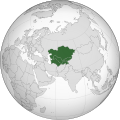


| International | |
|---|---|
| National | |
| Geographic | |
| Artists | |
| People | |
| Other | |

Afghanistan
View on GrokipediaEtymology
Origins and historical usage
The name "Afghanistan" derives from "Afghan," the historical ethnonym for the Pashtun people, combined with the Persian suffix "-stān," denoting "land" or "place of."[8] This construction signifies "land of the Afghans" or "place of the Pashtuns," reflecting the ethnic core of the region's identity.[9] The earliest recorded mention of "Afghan" appears as "Abgân" in Sassanid Empire inscriptions from the 3rd century CE, attributed to Shapur I (r. 240–270 CE), who listed it among conquered peoples in eastern territories during campaigns against Kushan Empire remnants.[10] This usage predates Islamic-era references and applies specifically to tribal groups in what is now eastern Afghanistan and adjacent areas, without implying a unified polity.[11] By the medieval period, the term evolved in Persianate texts to denote Pashtun-inhabited lands distinct from the broader Khorasan region, which encompassed parts of modern Iran, Turkmenistan, and northeastern Afghanistan. In the Baburnama, the memoirs of Mughal founder Babur (1483–1530), "Afghanistan" explicitly refers to territories south of Kabulistan, highlighting Pashtun tribal confederacies engaged in conflicts with Timurid forces around 1507 CE.[9] Mughal administrative records continued this usage, treating "Afghans" as a cohesive ethnic-military entity amid interactions with Central Asian and Indian polities.[12] The name's adoption as a formal polity designation occurred with the Durrani Empire's founding in 1747 by Ahmad Shah Durrani (r. 1747–1772), who unified Pashtun tribes following Nader Shah's assassination and centralized authority in Kandahar.[13] This marked "Afghanistan" as the self-proclaimed realm of Pashtun dominance, extending from Herat to the Indus, though internal tribal divisions persisted.[14] Prior to this, the term lacked connotations of statehood, serving instead as a geographic-ethnic descriptor amid fragmented principalities.[15]History
Prehistory and ancient civilizations
Archaeological evidence indicates human presence in present-day Afghanistan from the Paleolithic era, with stone tools found in caves and along river terraces in northern and eastern regions, suggesting early hunter-gatherer adaptations to diverse terrains.[16] By the Neolithic period around 7000–5000 BCE, settlements emerged in the northern foothills, marking one of the early centers of incipient agriculture with evidence of transitional farming practices between foraging and domestication.[17] These sites, including ceramic remains from northern Afghanistan, reflect rudimentary pottery and settled communities predating widespread urbanization.[18] The Bronze Age saw the development of the Bactria-Margiana Archaeological Complex (BMAC), flourishing from approximately 2300 to 1700 BCE across northern Afghanistan, southern Turkmenistan, and adjacent areas.[19] This culture featured advanced urban centers with fortified mud-brick structures, irrigation systems, and artifacts like chlorite vessels and seals, indicating sophisticated craftsmanship and possible proto-urban trade networks. BMAC sites in Afghan Bactria, such as those near Balkh, show influences from Mesopotamian and Indus Valley styles, evidencing long-distance exchanges without direct textual records of governance or ethnicity.[20] In the 6th century BCE, the Achaemenid Empire incorporated much of modern Afghanistan as satrapies, including Arachosia (southern regions around Kandahar), Bactria (northern plains), Aria (Herat area), and Drangiana (Sistan basin).[21] These provinces contributed tribute, troops, and resources to the Persian administration under Darius I, with cuneiform inscriptions and administrative tablets from sites like Old Kandahar attesting to integrated taxation and military obligations.[22] Local populations, blending indigenous groups with Persian oversight, maintained semi-autonomous structures until Alexander the Great's invasion in 330 BCE, when his forces subdued Bactria and Sogdiana after campaigns against satrap Bessus, establishing Hellenistic outposts amid guerrilla resistance.[23] The Greco-Bactrian Kingdom emerged around 256 BCE when satrap Diodotus I declared independence from the Seleucids, ruling Bactria and surrounding territories until circa 120 BCE.[24] Centered in the fertile Amu Darya valley, it fostered urban development, as seen in Ai-Khanoum, a fortified city with Greek-style gymnasia, theaters, and colonnaded streets, alongside eastern architectural elements, highlighting syncretic Hellenistic influences.[25] Coinage from kings like Euthydemus I depicted Zeus and Athena, facilitating trade along proto-Silk Road routes.[24] Nomadic incursions by Indo-Scythians (Sakas), eastern Iranian pastoralists, contributed to the kingdom's decline by the late 2nd century BCE, with their migrations from Central Asia establishing control over eastern satrapies and introducing steppe warfare tactics.[26] These groups settled in areas like Sakastan (Sistan), blending with local populations while issuing coins that echoed Greco-Bactrian styles.[26] The Kushan Empire, founded by Yuezhi confederates around the 1st century CE, dominated Afghanistan and adjacent regions until the 3rd century CE, serving as a pivotal Silk Road nexus.[27] Under rulers like Kanishka I (circa 127–150 CE), it unified diverse territories from Bactria to northern India, promoting trade in silk, spices, and gems through cities like Balkh and Begram, where hoards of Roman glass and Chinese lacquer attest to extensive commerce.[27] Kushan coinage, featuring deities from Greek, Iranian, and Indian pantheons, and monumental art like Gandharan Buddha statues, exemplify cultural fusion without imposing a singular ethnic identity on the populace.[28]Islamic conquests and medieval eras
The Arab Muslim conquests reached the territories of modern Afghanistan in the mid-7th century, following the defeat of the Sasanian Empire, with Umayyad Caliphate forces capturing Herat in 651 and advancing into Khorasan and Sistan by 652. Balkh fell to Umayyad governor Qutayba ibn Muslim in 708–709 after prolonged resistance, marking a key step in subduing Buddhist and Zoroastrian centers in northern Afghanistan.[29] The Kabul region, a stronghold of Hindu Shahi rulers, resisted until becoming a tributary around 870 under Abbasid Caliphate pressure, though full incorporation involved ongoing campaigns and local alliances rather than immediate submission. These incursions imposed jizya taxes on non-Muslims and razed some idol temples, driving gradual conversions through economic coercion and military dominance, shifting polytheistic populations toward Islam over generations. The Ghaznavid Empire, founded in 977 by the Turkic slave-soldier Sabuktigin from Ghazna, consolidated Sunni Muslim rule across eastern Iran and Afghanistan by enforcing orthodoxy against Ismaili and other sects.[30] Under Mahmud of Ghazni (r. 998–1030), the empire peaked with seventeen raids into northern India from 1001 to 1026, targeting wealthy temples like Somnath in 1025 for plunder estimated at millions in gold and jewels, which funded Ghaznavid architecture and military while propagating jihad rhetoric to legitimize expansion.[30] These campaigns weakened Indian kingdoms but strained resources, contributing to territorial losses; the empire fragmented after 1186 when Ghorid forces under Mu'izz al-Din Muhammad captured Ghazna.[30] The Ghorid Sultanate, emerging from the mountainous Ghur region in central Afghanistan around 1149 under Ala al-Din Husayn's sack of Ghazna, represented a local Pashtun-Tajik dynasty that overthrew Ghaznavid remnants by the 1170s.[31] Mu'izz al-Din Muhammad (r. 1173–1206) extended control eastward, defeating the Rajput confederacy at Tarain in 1192 and establishing Muslim governors in Delhi, which laid groundwork for the Delhi Sultanate despite Ghorid reliance on Turkic slaves for administration.[32] The sultanate enforced Sunni Hanafi jurisprudence, suppressing Shia elements, but its overextension ended abruptly with Muhammad's assassination in 1206 and subsequent slave revolts.[31] Genghis Khan's Mongol invasion of 1219–1221, triggered by Khwarezmshah Muhammad II's execution of Mongol envoys and merchants, devastated Afghan cities in retaliation, with forces sacking Bamiyan in 1221—where Genghis's favorite son was killed earlier—and slaughtering up to 1.6 million in Herat alone per contemporary accounts. Balkh was razed to ruins, its irrigation systems destroyed, leading to urban depopulation estimated at 90% in affected areas and long-term agricultural collapse from severed qanats. This cataclysmic event, involving systematic massacres and pyramid-building from skulls as terror tactics, shattered centralized governance and facilitated nomadic pastoralism over settled Islamicate society.[33] The Timurids, under Timur (Tamerlane), reconquered the region in the late 14th century, sacking Herat in 1381 but later promoting reconstruction; [Shah Rukh](/page/Shah Rukh) (r. 1405–1447) established Herat as capital, fostering a renaissance in Persianate arts, sciences, and architecture blending Turco-Mongol and Islamic elements.[34] Under Husayn Bayqara (r. 1469–1506), Herat hosted scholars like Ali Sher Navai and miniaturists, producing illuminated manuscripts and madrasas that exemplified centralized autocracy with waqf-endowed institutions, influencing subsequent Mughal and Safavid models despite underlying reliance on tribal militias. This era's cultural efflorescence masked fragile succession, ending with Uzbek conquests by 1507.[35]Early modern dynasties
The Hotak dynasty, led by Ghilji Pashtun tribesmen, arose in 1709 when Mirwais Hotak orchestrated a revolt against Safavid Persian governance in Kandahar, executing the governor Gurgin Khan and securing local autonomy by April of that year.[36] Under Mirwais's son Mahmud, the Hotaks expanded aggressively, defeating Safavid forces at the Battle of Gulnabad in 1722 and besieging Isfahan, which fell after six months, allowing Mahmud to claim the Persian throne and briefly control much of Iran.[37] However, internal divisions, including Mahmud's mental instability and tribal dissent among Pashtuns, eroded Hotak authority; by 1729, Nader Shah Qoli of the Afsharids repelled them at Damghan and Mehmandust, confining Hotak rule to Kandahar until Nader's full reconquest in 1738.[38] This collapse highlighted Pashtun tribal fragmentation, with Ghilji cohesion fracturing under the pressures of overextension and rivalries with other groups like the Abdalis.[39] Following Nader Shah's assassination in 1747, Ahmad Shah Abdali, a leader of the Abdali (later Durrani) Pashtun confederation who had served in Nader's campaigns, convened a loya jirga in Kandahar in June, where tribal elders elected him sovereign, marking the foundation of the Durrani Empire with Kandahar as initial capital.[40] Ahmad Shah consolidated Pashtun support through strategic alliances and military prowess, reclaiming Kandahar and Herat while extending control over Khorasan regions including Mashhad by 1750, though tribal loyalties remained conditional and prone to defection amid entrenched rivalries between Durrani elites and Ghilji warriors.[41] To the east, he launched nine invasions into Mughal India between 1748 and 1767, capturing Punjab and Lahore in 1752, sacking Delhi in 1757 while nominally upholding Mughal suzerainty, and decisively defeating the Marathas at the Third Battle of Panipat in 1761 with an army of approximately 60,000, thereby establishing Pashtun hegemony over eastern territories.[42] These conquests relied on loose tribal levies, underscoring the empire's confederative nature rather than centralized administration, as Pashtun segments prioritized segmental lineage interests over unified state-building. Ahmad Shah's death in 1772 initiated a period of dynastic instability, with his son Timur Shah relocating the capital to Kabul in 1773 and facing persistent succession disputes that fragmented authority among over two dozen sons.[43] Timur's successor Zaman Shah (r. 1793–1800) contended with internal revolts and external incursions, including Persian advances under Agha Mohammad Khan Qajar reclaiming Khorasan territories like Herat by 1796, while Sikh forces under Ranjit Singh seized Peshawar in 1818 after repeated Afghan defeats.[44] By the early 19th century, these pressures—compounded by Pashtun tribal enmities such as tarburwali (cousin rivalry) and Ghilji-Durrani antagonism—led to territorial contractions, with the empire devolving into semi-autonomous principalities amid chronic civil strife and the inability to enforce cohesion beyond short-term campaigns.[45] This empirical pattern of fragmentation, rooted in decentralized tribal structures, repeatedly undermined Pashtun unification efforts despite intermittent empire-building successes.[46]19th-century emirates and British incursions
Following the fragmentation of the Durrani Empire, Dost Mohammad Khan of the Barakzai clan established control over Kabul in 1826, founding an emirate that encompassed much of modern Afghanistan by consolidating power amid rival tribal and external pressures from Persian, Sikh, and Russian influences.[47] [48] As emir until 1839 and again from 1843 to 1863, he navigated Afghanistan's role as a geopolitical buffer between expanding Russian and British spheres, seeking alliances while resisting direct subjugation, though internal divisions and terrain-limited logistics hindered full centralization.[49] British concerns over Russian encroachment prompted the First Anglo-Afghan War in 1839, when East India Company forces, totaling around 39,000 troops and auxiliaries, invaded to depose Dost Mohammad and install the pro-British Shah Shuja.[50] Initial successes included the capture of key cities like Ghazni and Kabul by mid-1839, but sustained Afghan guerrilla resistance, exacerbated by harsh mountainous terrain and supply line vulnerabilities, fueled resentment against the occupation.[51] An uprising in Kabul on November 2, 1841, led to the massacre of British residents; on January 6, 1842, a retreating column of approximately 4,500 combat troops and 12,000 civilians departed Kabul for Jalalabad, only to be annihilated by tribal fighters in the passes, with sole European survivor William Brydon reaching safety on January 13.[6] [52] British reprisal forces under George Pollock recaptured Kabul in September 1842, razing parts of the city before a full withdrawal, restoring Dost Mohammad and underscoring the futility of conquest against local agency and geography.[6] Succession struggles after Dost Mohammad's death in 1863 weakened the emirate, culminating in the Second Anglo-Afghan War of 1878–1880, triggered by Emir Sher Ali Khan's rejection of British diplomatic overtures amid perceived Russian advances.[53] British invasions from multiple fronts overwhelmed Afghan regulars at battles like Peiwar Kotal (December 1878) and Ali Masjid (November 1878), leading to Sher Ali's flight and death in 1879; the British then backed Abdur Rahman Khan, a Barakzai claimant exiled in Russian territories, who ascended as emir in 1880 after defeating rival Ayub Khan at Kandahar in September.[54] [55] Abdur Rahman, receiving British subsidies and arms totaling over £1 million annually by the 1890s, centralized authority through brutal suppression of revolts, forging a more unified state while ceding foreign policy control to Britain in exchange for recognition and protection against external threats.[53] In 1893, Abdur Rahman negotiated the Durand Line agreement with British envoy Mortimer Durand, delineating a frontier that bisected Pashtun tribal territories, allocating roughly 40% of Pashtun lands to British India and igniting enduring irredentist claims by fragmenting kinship networks and pastoral economies without tribal consultation.[56] [57] This arbitrary demarcation, spanning about 2,640 kilometers through rugged mountains and deserts, prioritized imperial buffer strategies over ethnic realities, sowing seeds for future cross-border militancy.[58] The Third Anglo-Afghan War erupted on May 3, 1919, when Emir Amanullah Khan, seeking to reclaim foreign policy autonomy post-World War I, ordered invasions into British India across the North-West Frontier, exploiting tribal unrest and British overextension.[59] Afghan forces achieved initial penetrations, such as at Bagh Springs, but British air and ground counteroffensives, including RAF bombings—the first combat use of aircraft in the region—repelled advances by July, with key victories at Thal (May 11) and Dakka.[60] An armistice on August 8, 1919, formalized by the Rawalpindi Treaty, ended British subsidies and veto over Afghan diplomacy, granting de facto independence while affirming the Durand Line, though terrain-fueled guerrilla tactics had again demonstrated invasion's high costs.[59]20th-century monarchy and republic
Mohammed Zahir Shah ascended to the throne of Afghanistan on November 8, 1933, following the assassination of his father, Nadir Shah, and ruled as king until his deposition in 1973.[61] His reign saw gradual modernization efforts, including infrastructure projects like the Helmand Valley Authority for irrigation and agriculture, which aimed to boost cotton production and rural development, though implementation was hampered by technical challenges and corruption.[62] The 1964 constitution established a constitutional monarchy with a bicameral parliament, introducing limited democratic elements such as elections and women's suffrage, but real power remained concentrated in the royal family and urban Pashtun elites, exacerbating tribal disenfranchisement.[61] Despite these reforms, Afghanistan's economy under Zahir Shah persisted in feudal patterns, with over 90% of the population engaged in subsistence agriculture and land ownership dominated by a small class of khans and tribal leaders, leading to widespread inequality and illiteracy rates exceeding 80% in rural areas.[63] Corruption permeated the bureaucracy, fueled by patronage networks that prioritized loyalty over merit, while modernization initiatives largely bypassed tribal structures rooted in Pashtunwali codes and Islamic norms, fostering resentment among rural majorities who viewed urban-centric policies as cultural imposition.[64] On July 17, 1973, Zahir Shah's cousin, Lieutenant General Mohammed Daoud Khan, orchestrated a bloodless coup while the king was abroad, proclaiming a republic and assuming the presidency with promises to address corruption and accelerate development.[64][65] Daoud's regime pursued secular reforms, including expanded education and industrialization, increasingly reliant on Soviet economic and military aid, which deepened urban-rural divides by favoring Kabul's technocrats over provincial tribes.[66][67] The republic's fragility culminated in the Saur Revolution on April 27-28, 1978, when the People's Democratic Party of Afghanistan (PDPA), a Marxist-Leninist group, overthrew and killed Daoud, installing Nur Muhammad Taraki as leader.[66] The PDPA's Khalq faction enacted radical decrees, including land redistribution that confiscated estates from traditional owners without compensation, compulsory literacy campaigns promoting atheism, and women's emancipation policies that clashed with conservative Islamic practices, igniting rural uprisings as farmers and mullahs perceived these as assaults on property rights and faith.[68][69] These impositions, driven by urban intellectuals disconnected from the 85% rural population's tribal and religious worldview, rapidly eroded the regime's legitimacy, as evidenced by widespread revolts in provinces like Herat and Kunar, where Marxist ideology's materialist denial of Islamic causality alienated allies and unified disparate factions against the state.[70][71]Soviet invasion and resistance
The Soviet Union invaded Afghanistan on December 24, 1979, deploying airborne and ground forces to overthrow Hafizullah Amin and install Babrak Karmal as leader of the People's Democratic Party of Afghanistan (PDPA), a communist regime facing widespread internal rebellions and desertions.[5] Soviet troop numbers peaked at approximately 100,000 by the mid-1980s, supporting PDPA efforts to suppress Islamist and tribal insurgencies through urban sieges, aerial bombings, and scorched-earth tactics in rural areas.[72] The intervention stemmed from Moscow's aim to preserve a strategic buffer state amid fears of PDPA collapse, but it ignited a protracted guerrilla war characterized by the insurgents' intimate knowledge of terrain and hit-and-run ambushes.[73] Afghan mujahideen fighters, organized into disparate ethnic and ideological factions, mounted fierce resistance motivated by religious opposition to atheistic communism and defense of traditional autonomy against centralizing reforms like land redistribution.[74] External support proved decisive: the U.S. CIA's Operation Cyclone funneled over $3 billion in arms and training via Pakistan's Inter-Services Intelligence (ISI), which operated border training camps for up to 80,000 fighters annually.[75] Saudi Arabia matched U.S. funding dollar-for-dollar, framing aid as jihad against Soviet infidels, while drawing thousands of foreign Arab volunteers—including precursors to al-Qaeda—who bolstered morale and logistics despite comprising a small fraction of combatants.[75] The introduction of U.S.-supplied FIM-92 Stinger man-portable air-defense systems in 1986 dramatically shifted the conflict's dynamics, enabling mujahideen to down over 270 Soviet aircraft and helicopters, eroding Moscow's air superiority and forcing reliance on costly low-altitude operations.[76][74] This technological edge, combined with sustained guerrilla attrition—inflicting roughly 15,000 Soviet fatalities—compelled negotiations, culminating in the Geneva Accords signed on April 14, 1988, which outlined a phased Soviet withdrawal beginning May 15 and completing February 15, 1989.[77] The war exacted a staggering toll, with estimates of 1 to 2 million Afghan deaths from combat, bombings, mines, and famine-induced displacement affecting over 5 million refugees, underscoring the invasion's role as primary aggressor in a conflict rooted in Soviet expansionism rather than mere proxy dynamics.[78][72] Soviet forces withdrew without securing PDPA viability or neutralizing mujahideen networks, leaving a militarized society primed for further instability.[77]Civil war and Taliban emergence
Following the Soviet military withdrawal in February 1989 and the subsequent collapse of President Mohammad Najibullah's government in April 1992, Afghanistan fragmented into civil war as rival mujahideen factions competed for dominance.[79] Key groups included the Tajik-led Jamiat-e Islami under Burhanuddin Rabbani and Ahmad Shah Massoud, the Pashtun Hezb-e Islami under Gulbuddin Hekmatyar, the Uzbek Junbish-i Milli under Abdul Rashid Dostum, and the Shia Hezb-e Wahdat representing Hazaras, leading to fragmented alliances and betrayals.[79] [80] Intense urban warfare, particularly the bombardment of Kabul from 1992 to 1996, killed an estimated 50,000 civilians, displaced hundreds of thousands, and reduced much of the capital to rubble through indiscriminate rocket attacks and factional atrocities including summary executions and rapes.[80] [81] The power vacuum enabled warlords to impose predatory rule, with checkpoints extorting travelers, forced conscription, and sexual violence against women becoming rampant, eroding public trust in the mujahideen who had previously united against Soviet occupation.[79] In this context, the Taliban movement arose in 1994 in Kandahar province, founded by Mullah Mohammed Omar, a former mujahideen fighter, drawing recruits primarily from Pashtun youth educated in Deobandi madrassas in Pakistan.[3] [82] The group's initial appeal rested on internal Afghan dynamics: Pashtun ethnic grievances against non-Pashtun dominance in Kabul, widespread disgust at warlord corruption, and a fervent commitment to purifying society through unadulterated Sharia law, positioning the Taliban as restorers of moral and physical security rather than mere proxies.[79] [83] Advancing methodically with promises of safe passage and justice, the Taliban seized Kandahar in late 1994, then expanded northward, capturing Kabul on September 27, 1996, and executing Najibullah after parading him publicly.[82] By 1998, they controlled about 90% of Afghan territory, leaving pockets in the north to the Northern Alliance—a coalition of Massoud's forces and allies—while declaring the Islamic Emirate of Afghanistan.[79] [82] Their governance imposed hudud punishments such as amputations for theft and stonings for adultery, alongside edicts banning television, music, and women's public employment, which correlated with sharp declines in highway robbery and local disorder as armed enforcers patrolled roads and enforced curfews.[79] This stability, however, facilitated hosting al-Qaeda; from 1996, Osama bin Laden operated training camps under Taliban protection, with the regime rejecting U.S. extradition demands, as documented in the 9/11 Commission Report attributing the sanctuary to ideological affinity and strategic leverage.[84][84]U.S.-led overthrow and nation-building attempts
Following the September 11, 2001, attacks, the United States launched Operation Enduring Freedom on October 7, 2001, targeting al-Qaeda and the Taliban regime harboring them.[85] U.S. special forces partnered with the Northern Alliance, an anti-Taliban militia, while airstrikes supported ground advances, leading to the fall of Kabul on November 13, 2001, and the collapse of Taliban control by mid-December 2001.[86] This rapid overthrow dismantled the Taliban's central authority but left a power vacuum in a fragmented tribal society.[87] The Bonn Agreement, signed on December 5, 2001, under UN auspices, established an interim Afghan administration led by Hamid Karzai as head of the interim government.[88] This framework culminated in the 2004 constitution, which created a centralized presidential republic emphasizing unitary governance and separation of powers modeled on Western systems.[89] However, the constitution's heavy centralization clashed with Afghanistan's decentralized tribal structures and preferences for local dispute resolution and Sharia-based justice, fostering governance inefficiencies and elite capture in Kabul.[90] [91] U.S.-led nation-building efforts from 2002 onward aimed to build democratic institutions, security forces, and infrastructure, with total U.S. costs for the Afghanistan war estimated at $2.26 trillion through 2021, including military operations, reconstruction, and veteran care.[92] Despite this investment, persistent Taliban insurgency eroded gains, as U.S. strategies overlooked entrenched patronage networks and failed to align with local power dynamics.[93] Corruption permeated the Hamid Karzai (2001–2014) and Ashraf Ghani (2014–2021) governments, with SIGAR documenting how elite-level graft alienated the population and bolstered Taliban narratives of moral superiority.[94] [93] The Afghan National Security Forces (ANSF), built with over $80 billion in U.S. aid, suffered chronic high desertion rates, with the Afghan army replacing about one-third of its 170,000 soldiers in 2015 alone due to desertions, casualties, and low reenlistment.[95] ANSF strength declined by roughly 10% to under 300,000 by 2018 amid these losses.[96] "Green-on-blue" attacks, where Afghan forces or infiltrators turned on NATO troops, resulted in at least 157 coalition deaths from 102 documented incidents since 2007.[97] Opium production, suppressed under the 2000–2001 Taliban ban to historic lows, surged post-intervention, with Afghanistan accounting for over 90% of global supply by the mid-2000s as cultivation expanded in insecure areas, undermining counternarcotics efforts.[98] These empirical shortcomings—exacerbated by ignoring tribal alliances and Islamic legal traditions—rendered centralized state-building unsustainable against insurgency and societal resistance.[93]Taliban resurgence and 2021 reconquest
Following the drawdown of U.S. surge forces initiated under President Obama, which began in 2011 after the addition of approximately 30,000 troops announced in December 2009, the Taliban expanded its territorial influence throughout the 2010s.[99] [85] By 2018, assessments indicated the Taliban maintained influence over or contested roughly 50% of Afghanistan's districts, with government control limited to about 54% and the insurgents holding 12% outright, amid widespread corruption and ineffective Afghan National Security Forces (ANSF) performance that eroded morale and operational capacity.[100] This resurgence was facilitated by persistent insurgent attacks, safe havens in Pakistan, and the Afghan government's legitimacy deficits, including disputed elections and systemic graft under President Ashraf Ghani's administration, which prioritized centralization over tribal and provincial cohesion.[63] [94] The February 29, 2020, Doha Agreement between the United States and the Taliban committed to a full U.S. troop withdrawal by May 1, 2021, contingent on Taliban reductions in violence and initiation of intra-Afghan talks, but lacked robust enforcement mechanisms and excluded the Ghani government, undermining its authority while Taliban offensives continued unabated.[101] Under President Biden, the timeline was extended to August-September 2021, yet the abrupt U.S. departure from Bagram Airfield on July 2, 2021—without prior notification to Afghan partners—severed critical air support, logistics, and intelligence for the ANSF, accelerating desertions and collapses across provincial capitals.[102] [103] SIGAR evaluations later attributed the ANSF's rapid disintegration to a combination of overreliance on U.S. enablers, internal divisions, low morale from unpaid salaries and corruption, and the psychological impact of the Doha deal's perceived abandonment, rather than solely combat inferiority.[94] [104] The Taliban's 2021 spring offensive overwhelmed ANSF defenses, capturing over half of provincial capitals by early August, with U.S. intelligence assessments predicting Kabul's potential fall in 30 to 90 days proving overly optimistic as the speed of collapse caught evacuees and officials unprepared.[105] On August 15, 2021, President Ghani fled the country amid reports of cash-laden suitcases, prompting minimal resistance as Taliban forces entered Kabul unopposed, marking the reconquest of the capital.[63] During the ensuing chaotic evacuation from Kabul International Airport, an ISIS-K suicide bombing on August 26 killed 13 U.S. service members and nearly 170 Afghans, underscoring vulnerabilities in the hasty withdrawal logistics despite prior warnings of such threats.[106] Prior nation-building efforts, as critiqued in SIGAR reports, had fostered dependency and illusory stability through unchecked aid flows that fueled corruption, contributing to the regime's fragility independent of the final withdrawal decisions.[107]  has persisted as a primary internal threat, conducting bombings and attacks including the August 26, 2021, Kabul airport suicide bombing that killed over 170 Afghans and 13 U.S. servicemembers, as well as inspiring the March 2024 Crocus City Hall attack in Moscow by operatives linked to Afghan-based ISIS-K networks.[111] [112] United Nations reports indicate that al-Qaeda maintains operational sanctuaries in Afghanistan, with Taliban tolerance enabling senior leaders to reside and train under de facto protection.[113] Afghanistan's economy experienced an initial contraction post-takeover due to frozen international reserves and aid suspension, but recorded a modest GDP growth of 2.5% in 2024 amid ongoing fragility and deflationary pressures from weak demand.[114] This limited expansion occurs against a backdrop of non-recognition by most states—though Russia granted formal diplomatic recognition in July 2025—exacerbating aid dependency and banking restrictions that hinder trade and investment.[115] A humanitarian crisis persists, with 23.7 million people—over half the population—requiring assistance in 2024 due to food insecurity, displacement, and economic collapse.[116] Taliban edicts have systematically curtailed women's public participation, including a ban on girls' secondary education imposed in September 2021 affecting 2.2 million by 2025, alongside prohibitions on university attendance, most employment, and medical training enacted in December 2024.[117] [118] Over 50 specific directives by 2023 targeted women, enforcing dress codes, mobility limits, and voice restrictions in public, escalating under Akhundzada's centralized authority and contributing to gender apartheid characterizations by observers.[119] These policies, justified by the Taliban as Sharia compliance, have deepened social isolation and economic stagnation by excluding half the population from education and workforce contributions.[120]Geography
Topography and regional divisions
Afghanistan spans 652,230 square kilometers of predominantly rugged terrain, rendering it one of the most mountainous countries globally, with over 75 percent of its land dominated by high-elevation ranges that impede centralized control and enable insurgent mobility through narrow passes and remote valleys.[121] The Hindu Kush, extending approximately 800 kilometers from the Pamir Mountains in the northeast to central Afghanistan, forms the primary topographic backbone, with peaks exceeding 7,000 meters, including Noshaq at 7,492 meters, creating steep escarpments and deep gorges that historically fragment authority and provide defensible sanctuaries for armed groups.[122] This range's alignment fosters physical isolation between northern lowlands and southern highlands, channeling conflicts along predictable axes like eastern border corridors where porous ridges facilitate cross-border incursions.[123] The country is entirely landlocked, hemmed by Pakistan to the east and south, Iran to the west, Turkmenistan, Uzbekistan, and Tajikistan to the north, and a narrow Chinan sliver to the northeast, exacerbating logistical vulnerabilities in a terrain where mountain barriers limit overland access and amplify the strategic value of air routes or limited highways.[124] At the Pamir-Hindu Kush junction in northeastern Afghanistan, tectonic convergence drives intense seismic activity, with subduction of the Indian plate beneath Eurasia generating frequent deep-focus earthquakes up to 200 kilometers depth, contributing to geological instability that underscores the region's vulnerability to natural disruptions amid human conflicts.[125] Counterbalancing the highlands are arid intermontane basins, such as the Helmand River valley in the southwest, a closed endorheic system spanning southern Afghanistan where seasonal flooding supports limited irrigated agriculture amid otherwise desolate plains, though overexploitation has strained groundwater reserves critical for sustaining sparse population centers.[126] These basins contrast with the elevated central plateaus and northern foothills, delineating regional physiographic zones: the southern and eastern sectors feature extension of the Hindu Kush into arid ridges bordering Pakistan's tribal areas, forming natural conduits for unregulated movement, while northern peripheries transition to flatter, sediment-filled depressions that historically enabled trade but remain severed from the core by meridional ridgelines.[127] Such divisions, rooted in Miocene-era uplift and Quaternary glaciation, perpetuate a geography conducive to balkanized power dynamics, as valleys and passes dictate viable invasion or resistance pathways rather than unified infrastructure.[128]Climate patterns and environmental challenges
Afghanistan possesses a continental climate dominated by arid to semi-arid conditions, with extreme seasonal temperature fluctuations: winter lows frequently drop to -20°C in highland areas like the Hindu Kush, while summer highs surpass 50°C in the southwestern deserts. Annual precipitation averages around 300 mm, concentrated in winter snowfall at elevations above 1,800 meters and irregular spring rains, resulting in prolonged dry periods across 80% of the landmass. These patterns foster steppe and desert landscapes, limiting reliable surface water to major river basins such as the Amu Darya and Helmand. Precipitation variability exacerbates vulnerability to droughts, which have intensified in recent decades; the multi-year drought from 2021 to 2024, classified as one of the worst in 30 years, affected over 11 million people by disrupting agriculture and livestock, with agricultural drought peaking from mid-March to July annually. This scarcity drives resource competition and internal displacement, as reduced groundwater recharge and depleted pastures force rural populations toward urban centers. Environmental degradation compounds climatic stresses through widespread deforestation, with nearly 70% of original forest cover lost since the 1950s due to fuelwood extraction, illegal logging, and conflict-fueled neglect. Overgrazing by livestock—estimated at levels exceeding sustainable carrying capacity in many provinces—and wartime land abandonment have accelerated soil erosion, rendering over 80% of arable land susceptible to degradation and reducing fertility by promoting salinization and dust storms. These processes diminish water retention, heighten flood risks during rare heavy rains, and perpetuate a cycle of scarcity that underlies migration from degraded rural areas. Transboundary water disputes further strain supplies, as Afghanistan's upstream position on rivers like the Helmand (shared with Iran) and Kunar (flowing to Pakistan) leads to allocation conflicts; Iran has accused Afghanistan of reduced flows violating 1973 treaty terms, while Pakistan faces threats from proposed dams on Afghan tributaries amid border tensions. Climate change amplifies these challenges, with IPCC assessments highlighting accelerated glacial melt in high-mountain regions, where nearly 14% of glacier area vanished between 1990 and 2015 due to rising temperatures, initially boosting seasonal runoff but risking long-term shortages and glacial lake outburst floods that exacerbate food insecurity for dependent downstream communities.[129][130]Biodiversity and resource distribution
Afghanistan's biodiversity encompasses a range of endemic and endangered species adapted to its rugged Hindu Kush mountains and arid steppes, including the snow leopard (Panthera uncia), which inhabits high-altitude northeastern ranges where surveys have identified stable populations despite ongoing threats.[131][132] The Marco Polo sheep (Ovis ammon polii), a subspecies of argali, is similarly confined to eastern mountainous habitats above 3,000 meters, with habitat suitability assessments highlighting transboundary conservation needs across the Wakhan Corridor.[133] Avifauna is diverse, with approximately 472 to 510 bird species recorded, including birds of prey and migratory waterfowl, though populations have declined due to widespread habitat fragmentation from deforestation and overgrazing.[134] Mineral resources are distributed unevenly across geological provinces, with significant copper deposits at Mes Aynak in Logar Province southeast of Kabul, estimated at 11.3 million metric tons of high-grade ore, alongside iron ore reserves exceeding 2.2 billion tonnes primarily in central and northern regions.[135][136] Lithium prospects, potentially among the world's largest, occur in pegmatites in eastern provinces like Nuristan and Kunar, while natural gas fields are concentrated in the northern Amu Darya basin, and gemstones such as lapis lazuli and emeralds are sourced from southern and eastern Badakhshan areas.[137][136] These resources represent substantial untapped potential, valued in estimates up to $1 trillion, but extraction remains limited by insecurity and infrastructure deficits.[138] Conservation efforts are undermined by pervasive poaching, which targets species like snow leopards and Marco Polo sheep for pelts and horns, exacerbating declines in already fragmented habitats.[139] Decades of conflict have left ecosystems polluted by unexploded ordnance, heavy metals from munitions, and depleted uranium residues, contaminating soil and water in former battle zones and hindering ecological recovery.[140][141] Such disruptions, compounded by weak enforcement under successive regimes, prevent systematic protection of biodiversity hotspots and delay assessment of resource viability, perpetuating a cycle of environmental degradation amid political instability.[136]Government and Politics
Theocratic structure under Taliban
The Taliban administers Afghanistan as an emirate, vesting supreme authority in a single leader who embodies religious and political command, drawing from Deobandi Hanafi jurisprudence rather than elective or constitutional mechanisms. Hibatullah Akhundzada has served as Supreme Leader (Amir al-Mu'minin) since 2016, exercising unilateral control over military, judicial, and executive decisions without institutional checks.[142] His edicts, issued sporadically via spokesmen, function as de facto law, supplanting any prior constitutional framework following the August 2021 takeover. The Rahbari Shura, or Leadership Council, comprises around 26 senior clerics and commanders advising Akhundzada, but its role remains consultative and subordinate, with the leader centralizing power post-2021 by bypassing consensus on key rulings.[109] This council nominally oversees ministries and provinces, yet Akhundzada's direct interventions—such as reshuffling officials—underscore hierarchical command over collective deliberation.[143] Governance eschews elections entirely; provincial governors and district chiefs are appointed by Akhundzada or his deputies, ensuring ideological alignment among Taliban loyalists, with over 40 such appointments announced by November 2021 to consolidate control.[144] Traditional tribal assemblies, or jirgas, operate at local levels for dispute resolution but are integrated subordinately, subject to veto by religious edicts rather than holding autonomous authority.[145] This structure contrasts with the 2004 Islamic Republic's presidential system, which featured a constitution, parliamentary elections, and decentralized appointments but eroded due to systemic graft—exemplified by ghost soldiers, aid diversion, and elite capture that fueled Taliban recruitment and the government's 2021 collapse.[94] The Taliban's model prioritizes vetting for piety and anti-corruption oaths, yielding perceptions of reduced venality in initial assessments, though opacity limits empirical verification beyond anecdotal purges of prior officials.Implementation of Sharia law
Following the Taliban's reconquest of Afghanistan in August 2021, the regime has pursued a rigorous enforcement of its interpretation of Sharia law, emphasizing hudud punishments derived from classical Islamic jurisprudence for crimes such as theft and adultery. In November 2022, supreme leader Hibatullah Akhundzada issued a decree mandating judges to apply all aspects of Sharia, explicitly including amputations for theft, stonings for adultery (zina), and public floggings.[146][147] While full-scale amputations and stonings have not been systematically documented as widespread by mid-2025, public floggings as hadd punishments have occurred, such as an 80-lash sentence in Parwan province in December 2024 for false accusation of adultery, signaling a return to corporal penalties for moral and property offenses.[148] These measures serve as tools for social control, deterring dissent through visible deterrence, though enforcement varies by province and local commanders, reflecting the regime's decentralized authority structure.[149] The Ministry for the Propagation of Virtue and the Prevention of Vice, revived in September 2021, oversees moral policing through vice squads that patrol streets to enforce dress codes, grooming standards, and behavioral norms. Men face detention for insufficient beard length—defined as fist-width—or "Western" hairstyles, with over 280 security personnel dismissed in August 2024 for non-compliance, alongside arrests of barbers during Ramadan 2025.[150][151] Women are compelled to fully cover faces in public under codified rules finalized in August 2024, with squads empowered to intervene against perceived violations like music listening or hookah smoking.[152][153] This apparatus crushes individual autonomy in favor of ideological conformity, prioritizing regime stability over personal freedoms, as patrols extend to mosques to ensure prayer attendance.[154] By January 2023, the Taliban had issued over 80 edicts, with more than half targeting women's public conduct and media operations, including bans on female media voices and unapproved reporting.[119] Human Rights Watch documented intensified restrictions on journalists by 2025, including arbitrary detentions, aligning with broader Sharia-derived controls on expression deemed immoral or subversive.[155] Sharia's prohibition on intoxicants prompted a 2022 poppy cultivation ban, yielding a 95-99% reduction in opium acreage by 2023-2024 per UNODC monitoring, though local Taliban involvement in residual trade persists into 2025, undermining long-term eradication.[156][157] These implementations have correlated with diminished large-scale insurgency violence, fostering a coercive stability that suppresses opposition but entrenches authoritarian control without addressing underlying governance deficits.[158]Provincial administration and tribal influences
Afghanistan is administratively divided into 34 provinces, each headed by a governor (wali) appointed directly by the Taliban's supreme leader in Kabul to ensure loyalty to the central theocratic authority.[3] [108] These walis oversee provincial councils and coordinate with district-level officials, but their authority is constrained by directives from the Islamic Emirate's leadership, emphasizing sharia implementation over local autonomy.[159] Provinces are further subdivided into approximately 425 districts as of 2023, following the Taliban's creation of 27 additional districts in 12 provinces to refine local control and resource allocation.[160] [161] District administration often involves qazi (judges) who apply sharia rulings, supplemented by vice and virtue enforcers, though enforcement varies by terrain and population density. Tribal structures exert significant influence on provincial governance, particularly in rural Pashtun-majority areas where Pashtunwali—the unwritten Pashtun tribal code emphasizing nanawatai (hospitality/asylum), badal (revenge), and nang (honor)—intersects with Taliban edicts to facilitate dispute resolution and social order.[162] Tribal maliks (elders or leaders) traditionally mediate conflicts through jirgas (assemblies), a practice the Taliban has co-opted rather than supplanted, enabling pacts with local powerbrokers that prioritize customary norms over rigid central fiat.[163] This decentralization stems from causal realities of Afghanistan's rugged topography and weak state penetration, where tribal loyalties provide informal enforcement mechanisms absent in urban settings; for instance, rural districts exhibit higher compliance with Taliban dress and movement codes due to malik-mediated consensus, contrasting with urban alienation in cities like Kabul where resistance to perceived cultural impositions fosters noncompliance.[164] Data from Taliban-controlled areas indicate uneven sharia application: rural provinces report near-total adherence to bans on music and female public employment (over 90% in surveys of Pashtun villages), driven by tribal integration, while urban centers see sporadic defiance and underground economies evading vice patrols.[164] This rural-tribal alignment has stabilized provincial peripheries against insurgency but perpetuates hybrid governance, where maliks retain veto power in land and water disputes, often overriding wali directives if they conflict with Pashtunwali honor codes.[162] Such dynamics underscore the limits of Kabul's centralization efforts, as tribal influences causal to Taliban resilience during their insurgency continue to shape post-2021 administration.[108]Foreign policy and international isolation
As of early 2026, the Taliban regime in Afghanistan lacks formal diplomatic recognition from the United Nations or most major powers, with Russia becoming the first country to grant de jure recognition on July 3, 2025, primarily to advance its regional influence and counter Western isolation efforts.[115][165] This isolation stems from the Taliban's failure to meet key commitments under the 2020 Doha Agreement, including preventing Afghanistan from serving as a base for transnational terrorist groups and establishing an inclusive political system, as highlighted in UN Security Council reports documenting ongoing ties to al-Qaeda and restrictions on political participation, alongside UN expert calls to recognize the regime's gender policies as "gender apartheid."[166][167][168] Despite rhetorical adherence to Doha Agreement pledges on countering groups like ISIS-K, empirical evidence from UN monitoring shows limited progress in dismantling safe havens for affiliated networks, prioritizing regime survival over full compliance.[169] Pragmatic engagement with neighboring states has driven Taliban foreign policy, focusing on economic access and security cooperation rather than ideological alignment. China has pursued limited involvement through Belt and Road Initiative projects and mining investments, such as copper and lithium deposits, without formal recognition, viewing the regime as a stabilizing buffer against extremism but wary of reputational risks from human rights concerns; following Pakistan-Afghanistan border clashes in October 2025, China urged both sides to remain "cool-headed" and exercise restraint.[170][171] Russia, post-recognition, has deepened ties via diplomatic visits and trade discussions, aiming to leverage Afghanistan for influence in Central Asia and as a counterweight to ISIS-K threats.[172] Pakistan maintains operational proximity due to shared borders and historical support but faces strains from the Taliban's sheltering of Tehrik-i-Taliban Pakistan militants; relations deteriorated further with Pakistan's airstrikes in October 2025 targeting TTP positions, leading to a temporary ceasefire mediated by third parties amid ongoing friction, despite opportunities like the July 2025 Trans-Afghan Railway agreement with Uzbekistan.[173][174] Pakistan's mass expulsion of over 844,000 undocumented Afghan refugees between September 2023 and February 2025, citing security threats, prompted Taliban protests and border closures.[175][176] India, traditionally cautious due to Pakistan's influence, shifted toward de facto engagement with Taliban Foreign Minister Amir Khan Muttaqi's October 2025 visit—the highest-level since 2021—focusing on trade and security without recognition, alongside announcing the reopening of its Kabul embassy on October 10, 2025, and exchanging diplomats; this has elicited concerns from Pakistan over expanding Afghanistan-India ties.[177][178][179][180] This outreach reflects survival imperatives, as the Taliban balances anti-Western invective—rooted in grievances over the 2021 U.S. withdrawal—with practical anti-ISIS-K operations, including arrests and clashes that have suppressed the group's domestic attacks since 2022, to attract investment and avert sanctions.[181][182] Such tactics underscore causal priorities: economic desperation and border security outweigh ideological purity, though persistent al-Qaeda presence undermines broader credibility.[111]Security apparatus and internal control
The Taliban's security apparatus, primarily composed of its fighters and auxiliary forces, has established a monopoly on internal control following the August 2021 takeover, with estimates placing the total number of personnel at approximately 100,000 to 150,000, including core mujahideen, provincial police, and intelligence operatives.[110] These forces absorbed elements of the former Afghan National Security Forces (ANSF), as the Taliban issued calls for recruitment and integration of ex-soldiers into their ranks, though many former ANSF members remain in hiding due to fears of reprisals.[183] Initially lacking an operational air force despite capturing equipment from the collapsed ANSF, the Taliban has relied on ground-based capabilities, with unconfirmed reports of interest in acquiring air defense systems from Russia to bolster defenses.[184] Internal control is enforced through an extensive network of checkpoints on major roadways and intelligence operations modeled on the Taliban's pre-takeover shadow governance structures, which have effectively quelled independent warlords and tribal militias by co-opting or neutralizing them.[185] The Taliban proclaimed a general amnesty for former government officials and ANSF personnel upon seizing power on August 15, 2021, urging surrender and reintegration, yet United Nations documentation records over 200 targeted killings of ex-troops and officials between August 2021 and mid-2023, indicating selective enforcement against perceived threats.[159][186] Empirical data shows a marked decline in improvised explosive device (IED) incidents and rural ambushes post-takeover, with overall conflict-related civilian casualties dropping dramatically after the cessation of large-scale ANDSF-Taliban fighting, as reported by UNAMA.[187] However, urban areas have seen sporadic unrest, including suppressed protests in cities like Kabul and Herat, managed through rapid deployments of Taliban security units to maintain order without escalating to widespread insurgency.[110] This shift reflects the Taliban's prioritization of ground-level surveillance and rapid response over sustained aerial capabilities, consolidating de facto authority amid persistent low-level dissent.[188]Security and Terrorism
Persistent insurgencies and ISIS-K threats
The Islamic State Khorasan Province (ISIS-K), an affiliate of the Islamic State seeking to establish a caliphate transcending national boundaries, has persisted as the principal insurgent adversary to the Taliban since the latter's August 2021 takeover of Afghanistan. Unlike the Taliban, which prioritizes local Pashtun-centric governance under a narrower interpretation of jihad, ISIS-K denounces the Taliban as apostates for compromising with non-jihadist elements and failing to wage perpetual global war against perceived enemies including Shia Muslims, Western powers, and rival Sunni groups. This intra-jihadist rivalry manifests in targeted bombings and clashes, with ISIS-K leveraging suicide operations and small-unit tactics in eastern provinces like Nangarhar and Kunar, where it maintains core operational cells.[189][190] ISIS-K's lethality was starkly evident in the August 26, 2021, suicide bombings outside Kabul's Hamid Karzai International Airport, which killed 13 U.S. service members, approximately 169 Afghan civilians, and injured hundreds more during the chaotic U.S. withdrawal. The group has sustained such mass-casualty attacks domestically, including a September 2, 2024, suicide bombing in Kabul targeting the Taliban prosecution service that killed at least six and wounded 13. Its transnational ambitions were underscored by the March 22, 2024, assault on Moscow's Crocus City Hall, where gunmen affiliated with ISIS-K killed 150 people and injured over 600; U.S. intelligence and the group's own claim linked the perpetrators—primarily Tajik nationals—to ISIS-K's Afghan-based networks, highlighting the affiliate's capacity to export violence beyond South Asia despite Taliban border controls.[191][192][193] As of 2024, ISIS-K is bolstered by foreign recruits from Central Asia and local disenfranchised youth radicalized via propaganda decrying Taliban pragmatism. The Taliban has responded with aggressive counteroperations, including the April 2023 killing of the ISIS-K cell leader responsible for the 2021 airport bombing and subsequent arrests of hundreds of suspected members in 2023 raids across Kabul and eastern regions. However, although their ideologies differ sharply—ISIS-K follows Salafi-Jihadist ideology, while the Taliban follow Deobandi Hanafi Islam; both oppose Shia Muslims and Western influence—this shared animus limits the Taliban's incentives for total annihilation, as evidenced by occasional prisoner exchanges and incomplete territorial sweeps that allow ISIS-K to regenerate in remote areas.[190][189] These confrontations inflict hundreds of casualties yearly, with United Nations monitoring indicating ongoing ISIS-K-linked violence causing significant casualties, and the UN Security Council emphasizing ISIS-K as one of the most dangerous global branches despite fewer high-profile attacks, alongside Taliban losses in ambushes and IED strikes. Such attrition strains the Taliban's under-resourced security forces, estimated at 100,000-150,000 personnel lacking advanced surveillance, compelling reliance on tribal militias and diverting focus from economic stabilization to perpetual low-level warfare that perpetuates instability without decisive resolution.[194]Al-Qaeda and transnational jihadist networks
The Taliban has maintained deep ties with al-Qaeda since the 1990s, providing sanctuary that enabled the group's global operations, including the planning of the September 11 attacks from Afghan soil.[3] These bonds persisted after the Taliban's 2021 takeover, as evidenced by the presence of al-Qaeda leader Ayman al-Zawahiri in a Taliban safe house in Kabul, where he was killed by a U.S. Hellfire missile drone strike on July 31, 2022.[195][196] This event contradicted the Taliban's commitments under the February 2020 Doha Agreement, in which they pledged to prevent al-Qaeda and other terrorist groups from using Afghanistan to threaten the United States, its allies, or other countries.[197] Shared ideological foundations in Deobandi Islam—a strict Hanafi school originating from 19th-century Indian seminaries—have sustained mutual tolerance between the Taliban and al-Qaeda, overriding public disavowals of operational alliances.[198][199] United Nations Analytical Support and Sanctions Monitoring Team reports from 2024 detail al-Qaeda's expansion of training camps in at least 12 provinces, including new camps in Kandahar and Takhar, alongside earlier sites in Ghazni, Laghman, Parwan, Uruzgan, Helmand, Zabul, Nangarhar, Nuristan, Badghis, and Kunar, accommodating up to 10-15 foreign fighters each for weapons, explosives, and ideological instruction.[200] These camps, often disguised as madrasas, facilitate recruitment and capacity-building for transnational operations, with al-Qaeda core leadership retaining influence over affiliates despite leadership losses.[201] Afghanistan serves as a hub for broader jihadist networks, notably providing safe haven to the Tehrik-e-Taliban Pakistan (TTP), which has relocated thousands of fighters across the border since 2021 and conducted over 1,500 attacks in Pakistan in 2023 alone.[202] UN assessments describe the Taliban-TTP relationship as "close," with the Afghan regime supplying logistics, funding, and protection in exchange for ideological alignment and occasional military support against rivals like ISIS-K.[189] This dynamic exemplifies the causal risks of hosting ideologically congruent groups, mirroring the 1990s precedent where Taliban sheltering of al-Qaeda enabled external plotting that directly threatened distant targets.[203] While direct post-2021 plots exported to Europe remain limited in public reporting, the reconstituted safe havens heighten vulnerabilities for renewed transnational attacks, as noted in analyses of al-Qaeda's resilient global command structure.[204]Counterterrorism efforts and safe havens
The Taliban has undertaken operations against the Islamic State Khorasan Province (ISKP), its primary domestic rival, including raids and arrests of operatives. U.S. government reports indicate that the Taliban publicly announced detentions and killings of ISKP members responsible for attacks, with at least 36 counterterrorism raids documented between late 2021 and mid-2023. In 2023, Taliban forces arrested several high-profile ISKP figures, contributing to a temporary reduction in some attack frequencies, though independent assessments highlight limitations in intelligence-sharing and defensive measures that allow ISKP to regroup. Despite these efforts, ISKP claimed responsibility for a September 3, 2024, suicide bombing in Kabul targeting Taliban prosecution offices, killing at least one and injuring dozens, demonstrating the group's ongoing operational capacity.[205][206][207][192] Afghanistan under Taliban rule has served as a safe haven for al-Qaeda, despite the group's 2020 Doha Agreement pledge to prevent terrorist use of Afghan territory against the U.S. or allies. Al-Qaeda leader Ayman al-Zawahiri's residency in a Taliban-controlled safe house in Kabul—confirmed by his killing in a U.S. Hellfire missile drone strike on July 31, 2022—provided direct evidence of such harboring, with no Taliban accountability for facilitating his presence. U.S. intelligence evaluations through 2024 describe al-Qaeda as maintaining a low-profile footprint in Afghanistan, with training camps and leadership reconstitution, though the network has not orchestrated major external attacks from there in recent years. The Taliban's tolerance of al-Qaeda contrasts with its anti-ISKP actions, reflecting ideological alignment rather than comprehensive enforcement.[208][195][109] Counterterrorism analysts critique the Taliban's approach as selectively enforced, prioritizing elimination of ideological competitors like ISKP while shielding historical allies such as al-Qaeda and affiliated networks. This selective posture, evident in the absence of disruptions to al-Qaeda's Afghan operations post-Zawahiri, undermines broader threat mitigation and sustains transnational risks, per assessments from institutions tracking jihadist dynamics. U.S. over-the-horizon capabilities, including the 2022 strike, have compensated for Taliban inaction but rely on persistent intelligence access amid reduced on-ground presence. Regional engagements, such as limited anti-terrorism discussions with neighbors, have yielded minimal verifiable cooperation against cross-border groups.[209][189][210]Economy
Macroeconomic overview and contraction
Afghanistan's economy, prior to the Taliban's takeover in August 2021, had a gross domestic product (GDP) of approximately $20 billion in 2020, heavily reliant on foreign aid that constituted about 40 percent of GDP and funded over half of public expenditures.[211][212] Following the regime change, the economy experienced a severe contraction, with GDP shrinking by around 20 percent in 2021 alone due to the abrupt halt in international aid inflows, freezing of $9.4 billion in central bank reserves by the United States and allies, and international sanctions that restricted access to global financial systems.[114][213][214] This downturn compounded existing vulnerabilities, including the prior collapse of the banking sector marked by liquidity shortages and public distrust, leading to widespread reliance on informal hawala networks for transactions amid frozen formal banking operations.[215] The cumulative contraction reached approximately 27 percent across 2021 and 2022, driven primarily by the cessation of donor funding—previously averaging around $4 billion annually—which forced a shift toward domestic resource mobilization but triggered a liquidity crisis that stifled commerce and investment. Inflation surged above 10 percent in subsequent years, exacerbated by supply disruptions, currency depreciation of the afghani, and import dependencies, though informal cross-border trade via hawala mitigated some formal banking paralysis.[216][217] By 2024, with a population estimated at over 43 million, GDP showed modest recovery with 2.5 percent growth, reflecting stabilization through Taliban efforts to boost customs revenues and reduce expenditures, yet per capita output remained depressed far below pre-2021 levels due to ongoing isolation and aid reductions to about $1 billion annually in non-humanitarian forms.[114][218] This partial rebound underscores causal links to policy-induced isolation rather than inherent structural reforms, as the economy's contraction persists without reintegration into global finance.[219]Agricultural sector and opium economy
Agriculture remains the backbone of Afghanistan's economy, employing about 45% of the total workforce in 2023.[220] The sector is predominantly subsistence-oriented, with wheat as the dominant crop, cultivated on both irrigated and rainfed lands to meet staple food needs; annual wheat production fluctuates between 4-5 million tons depending on weather and inputs.[221] Other key crops include rice, barley, maize for grains, and fruits such as grapes, pomegranates, apricots, and melons, which support limited exports and local markets but suffer from poor infrastructure and post-harvest losses exceeding 30%.[221] Recurrent droughts, particularly severe in 2021-2023, have reduced yields by up to 20-40% in rainfed areas, compounding reliance on fragile irrigation systems covering only 40% of arable land.[222] Opium poppy cultivation has long overshadowed legitimate agriculture, with Afghanistan historically accounting for over 80% of global illicit opium supply, much of which is processed into heroin. In 2022, production peaked at 6,200 metric tons, generating an estimated $1.4 billion in farm-gate income for cultivators amid post-conflict economic collapse.[223] The Taliban authorities enacted a nationwide ban in April 2022—exempting that year's harvest but enforcing eradication thereafter—resulting in a 95% drop in cultivation area to 10,800 hectares and output to 333 tons in 2023, a level unseen since the early 2000s.[224] This echoes the 2000-2001 ban under prior Taliban rule, which slashed production from 4,600 tons to 185 tons through coercive measures, demonstrating that strict enforcement can rapidly suppress output despite stockpiles buffering global markets short-term.[156] Such bans debunk persistent myths that eradication inevitably fails without farmer consent or alternatives; data show compliance under threat of Sharia penalties, with southern provinces—traditional hubs—seeing over 99% eradication in surveyed areas by 2023.[224] However, opium's appeal stems causally from acute rural poverty (affecting 80% of farmers), food insecurity, and state weakness that undermines irrigation, credit, and market access for wheat or fruits, rendering poppy's high returns (up to 10 times alternatives) a rational hedge against famine and debt.[222] Weak governance exacerbates this, as warlord-era taxes and insecurity historically shielded cultivation, while post-ban shifts to wheat expanded arable use by 194,000 hectares in 2023 but yielded insufficient income replacement without seeds, fertilizers, or roads.[225] Production edged up 30% to 433 tons in 2024, signaling potential rebound risks absent sustained enforcement and development, though levels remain 93% below 2022 peaks.[226]Mining, energy, and untapped resources
Afghanistan holds substantial untapped mineral deposits, including copper, iron ore, rare earth elements such as lithium and uranium, and other commodities like gold and chromium, with USGS and other estimates placing the potential economic value between $1 trillion and $3 trillion depending on extraction feasibility and global prices.[227][228] These reserves, concentrated in remote and insecure provinces, remain largely unexploited due to persistent conflict, inadequate infrastructure, and high extraction costs that exceed current market incentives for many investors.[229] The Mes Aynak copper deposit in Logar Province, containing an estimated 11 million metric tons of copper ore valued at up to $102 billion, exemplifies these challenges; awarded to China's Metallurgical Corporation of China (MCC) in a $3 billion deal in November 2008, development stalled amid Taliban attacks, archaeological preservation of ancient Buddhist sites, and disputes over power supply and royalties.[230][231][232] Groundbreaking occurred in July 2024 under Taliban oversight, with limited site preparation advancing by mid-2025, but full operations remain uncertain given ongoing security risks and MCC's historical hesitancy.[233][234] In August 2023, the Taliban administration signed mining contracts totaling over $6.5 billion with firms from China, Iran, and local entities for various deposits, including rare earths and copper, as part of efforts to attract non-Western investment amid United States and allied sanctions that deter broader participation.[235][229] These deals, however, have yielded minimal production due to corruption allegations, weak governance, and Taliban demands for upfront payments that strain partners like Chinese state-owned enterprises already facing reputational risks from association with the regime.[236] The energy sector suffers from acute shortages, with domestic hydroelectric capacity—concentrated in rivers like the Helmand and Kabul—generating only about 300 megawatts reliably, far below demand, exacerbated by drought, poor maintenance, and underinvestment leading to widespread blackouts averaging 12-20 hours daily in Kabul as of 2025.[237][238] Coal reserves, estimated at over 400 million tons in northern basins, remain underdeveloped due to transportation bottlenecks and security threats, forcing reliance on costly imports from Uzbekistan and Tajikistan that were partially suspended in 2023 over unpaid debts.[239] The Turkmenistan-Afghanistan-Pakistan-India (TAPI) pipeline, designed to deliver 33 billion cubic meters annually through 1,800 kilometers including 800 in Afghanistan, has encountered repeated delays since inception in the 1990s, primarily from insurgent sabotage risks and funding shortfalls, with only 14 kilometers laid in Herat Province by April 2025 despite renewed Turkmen commitments.[240][241] Taliban initiatives to secure Chinese involvement in energy exploration, including oil blocks in the Amu Darya basin, faltered by mid-2025 when a $540 million contract with Xinjiang Central Asia Petroleum and Gas was terminated over alleged breaches, underscoring barriers from regime opacity and international isolation.[242][243]Infrastructure, trade, and aid reliance
Afghanistan's road network spans approximately 35,000 kilometers, with only about half paved as of recent assessments, though much of it suffers from poor maintenance, conflict damage, and seasonal disruptions due to the rugged terrain and lack of investment since 2021.[244] Rail infrastructure is minimal, totaling under 30 kilometers of operational track, primarily the Khaf-Herat line connecting to Iran, which handled 60,000 tons of cargo in the year ending April 2025; ambitious projects like the proposed Trans-Afghan Railway remain in planning stages without significant progress.[245] [246] Kabul International Airport has emerged as the dominant air transport hub post-2021, handling most international flights under Taliban oversight, though operations are constrained by sanctions, limited airlines, and occasional security threats.[247] Trade volumes reflect acute imbalances, with exports valued at roughly $1.7 billion in 2024—dominated by fruits and nuts (around $590 million), carpets, and wool—far outpaced by imports exceeding $10.8 billion, yielding a trade deficit of over $9 billion and underscoring dependency on foreign goods like petroleum, machinery, and food.[248] [249] [250] Primary transit routes traverse Pakistan's border crossings, such as Torkham and Chaman, which facilitate the bulk of overland trade but face frequent closures from disputes and smuggling crackdowns; access to China via the Wakhan Corridor exists but is underdeveloped, with minimal direct volume due to logistical barriers.[251] [252] [253] Humanitarian aid constitutes a critical lifeline, with 23.7 million people—over half the population—requiring support in 2024 amid food insecurity and economic collapse, backed by a $3.06 billion UN-coordinated plan that has received only partial funding.[254] [255] However, delivery is hampered by Taliban interference, including documented cases of coercion, taxation, and redirection of resources to regime affiliates and favored ethnic groups, as detailed in U.S. oversight reports; implementing partners have reported payments totaling at least $10.9 million under duress to avoid disruptions.[256] [257] This diversion dynamic, enabled by the regime's control over local distribution, undermines aid efficacy and perpetuates reliance without fostering self-sufficiency.[258]Demographics
Population size and growth trends
Afghanistan's population is estimated at 43.8 million as of 2025 by the United Nations Population Fund, reflecting projections that account for high birth rates offset by mortality and net out-migration.[259] However, the Afghan government's National Statistics and Information Authority reported a lower figure of 36.4 million for the same year, attributing the difference to unverified refugee returns, internal displacements, and challenges in data collection amid ongoing instability.[260] No comprehensive national census has been conducted since 1979 due to protracted conflicts, leading to reliance on extrapolations from partial surveys and international models, which often diverge based on assumptions about undocumented movements.[261] The population growth rate stood at approximately 2.8% annually in 2024, driven primarily by a total fertility rate of 4.84 children per woman recorded in 2023, one of the highest globally.[262][263] This sustains a pronounced youth bulge, with about 63% of the population under 25 years old as of 2024, creating demographic pressures for employment and services while amplifying vulnerability to economic shocks.[264] Historical warfare, including the Soviet invasion, civil wars, and the 2001-2021 international intervention, has intermittently elevated mortality and emigration, temporarily curbing growth, though fertility has remained elevated due to cultural norms favoring large families and limited access to contraception.[265] The 2021 Taliban resurgence triggered acute outflows, with at least 1.6 million Afghans fleeing to neighboring countries by mid-2022, contributing to a net population decline in some estimates before partial returns and forced repatriations reversed the trend by 2024-2025.[266] Urbanization remains low at around 27% of the total population in 2023, with rural areas predominant due to agrarian lifestyles and conflict-induced avoidance of cities.[267] Kabul, the capital, hosts an estimated 6.1 million residents in its province as of 2025 per official data, exacerbating resource strains on water, housing, and infrastructure amid rapid, unmanaged influxes from rural provinces and returnees.[268]Ethnic groups and linguistic diversity
Afghanistan's population is ethnically diverse, with Pashtuns constituting the largest group at approximately 42% according to multiple estimates derived from surveys and historical data, though figures range from 40% to 50% due to the absence of a comprehensive census since 1979. Tajiks follow at around 27%, Hazaras at 9%, and Uzbeks at 9%, with smaller groups including Turkmen (3%), Baloch (2%), and Aimak (4%), alongside others such as Nuristani, Pashai, and Gujar making up the remainder. These proportions reflect concentrations: Pashtuns predominantly in the south and east, Tajiks in urban centers and the northeast, Hazaras in central highlands, and Uzbeks in the north. [269] [270] [1] The lack of a recent national census—disrupted by decades of conflict and political instability—relies on extrapolations from partial surveys, household data, and ethnographic studies, leading to debates over accuracy; for instance, some analyses suggest Tajik and Hazara shares may be understated due to Pashtun self-identification inflation in southern regions. Pashtun dominance has historically fueled ethnic tensions, as their numerical plurality and control of key political and military structures often marginalize other groups, contributing to cycles of rivalry and insurgency. [271] [272]| Ethnic Group | Estimated Percentage | Primary Regions |
|---|---|---|
| Pashtun | 42% | South, East |
| Tajik | 27% | North, Urban |
| Hazara | 9% | Central Highlands |
| Uzbek | 9% | North |
| Others | 13% | Varied |