
Recent from talks
Jungle cat
Knowledge base stats:
Talk channels stats:
Members stats:
Jungle cat
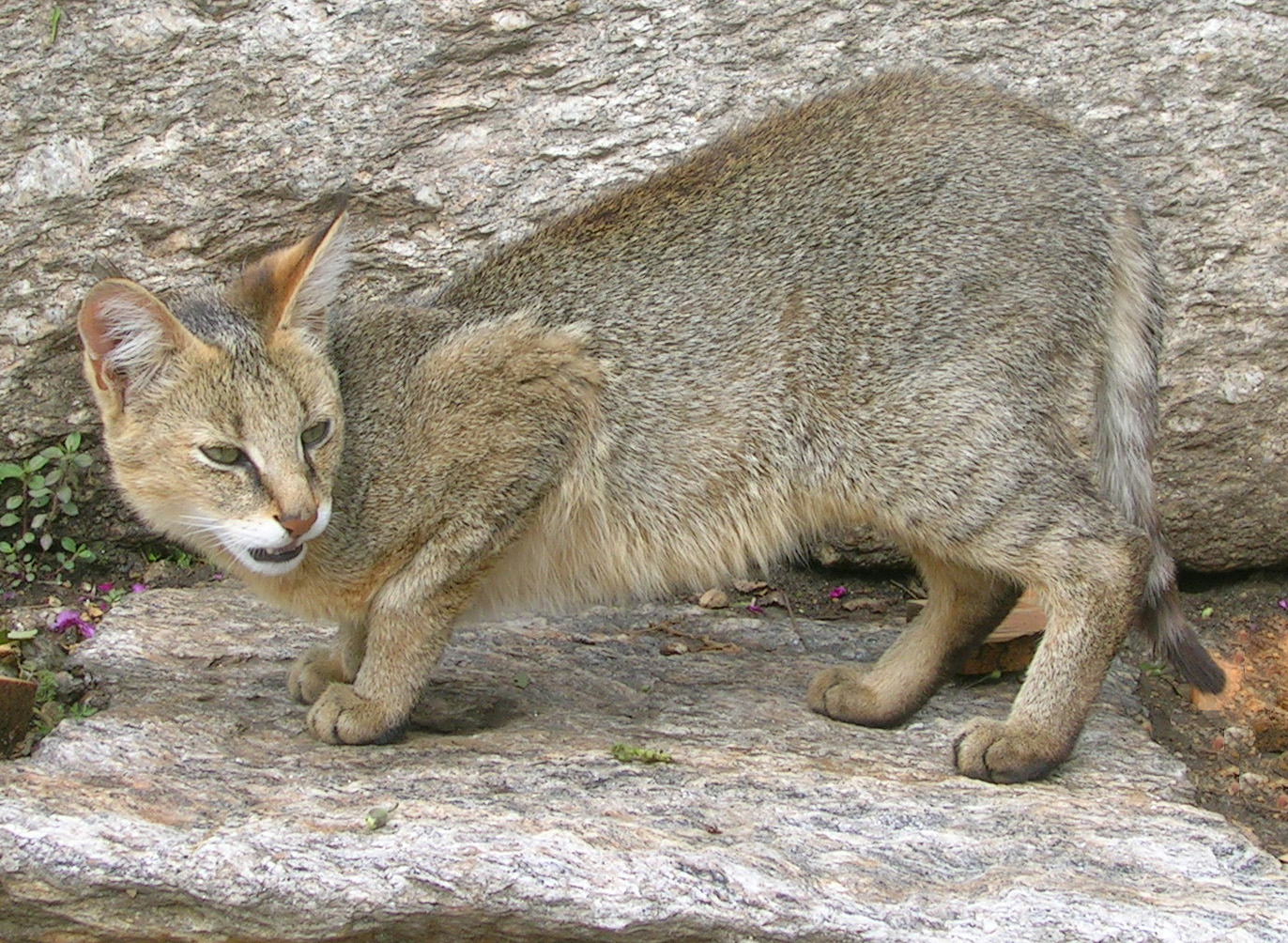
The jungle cat (Felis chaus), also called reed cat and swamp cat, is a medium-sized cat native from the Eastern Mediterranean region and the Caucasus to parts of Central, South and Southeast Asia. It inhabits foremost wetlands like swamps, littoral and riparian areas with dense vegetation. It is listed as Least Concern on the IUCN Red List, and is mainly threatened by destruction of wetlands, trapping and poisoning.
The jungle cat has a uniformly sandy, reddish-brown or grey fur without spots; melanistic and albino individuals are also known. It is solitary in nature, except during the mating season and mother–kitten families.
Adults maintain territories by urine spraying and scent marking. Its preferred prey is small mammals and birds. It hunts by stalking its prey, followed by a sprint or a leap; the ears help in pinpointing the location of prey. Both sexes become sexually mature by the time they are one year old; females enter oestrus from January to March. Mating behaviour is similar to that in the domestic cat: the male pursues the female in oestrus, seizes her by the nape of her neck and mounts her. Gestation lasts nearly two months. Births take place between December and June, though this might vary geographically. Kittens begin to catch their own prey at around six months and leave the mother after eight or nine months.
The species was first described by Johann Anton Güldenstädt in 1776 based on a specimen caught in a Caucasian wetland. Johann Christian Daniel von Schreber gave the jungle cat its present binomial name and is therefore generally considered as binomial authority. Three subspecies are recognised at present.
The Baltic-German naturalist Johann Anton Güldenstädt was the first scientist who caught a jungle cat near the Terek River at the southern frontier of the Russian empire, a region that he explored in 1768–1775 on behalf of Catherine II of Russia. He described this specimen in 1776 under the name "Chaus".
In 1778, Johann Christian Daniel von Schreber used chaus as the species name and is therefore considered the binomial authority. Paul Matschie in 1912 and Joel Asaph Allen in 1920 challenged the validity of Güldenstädt's nomenclature, arguing that the name Felis auriculis apice nigro barbatis was not a binomen and therefore improper, and that "chaus" was used as a common name rather than as part of the scientific name.
In the 1820s, Eduard Rüppell collected a female jungle cat near Lake Manzala in the Nile Delta. Thomas Hardwicke's collection of illustrations of Indian wildlife comprises the first drawing of an Indian jungle cat, named the "allied cat" (Felis affinis) by John Edward Gray in 1830. Two years later, Johann Friedrich von Brandt proposed a new species under the name Felis rüppelii, recognising the distinctness of the Egyptian jungle cat. The same year, a stuffed cat was presented at a meeting of the Asiatic Society of Bengal that had been caught in the jungles of Midnapore in West Bengal, India. J. T. Pearson, who donated the specimen, proposed the name Felis kutas, noting that it differed in colouration from Felis chaus. Isidore Geoffroy Saint-Hilaire described a jungle cat from the area of Dehra Dun in northern India in 1844 under the name Felis jacquemontii in memory of Victor Jacquemont.
In 1836, Brian Houghton Hodgson proclaimed the red-eared cat commonly found in Nepal to be a lynx and therefore named it Lynchus erythrotus; Edward Frederick Kelaart described the first jungle cat skin from Sri Lanka in 1852 and stressed upon its close resemblance to Hodgson's red cat. William Thomas Blanford pointed out the lynx-like appearance of cat skins and skulls from the plains around Yarkant County and Kashgar when he described Felis shawiana in 1876.
Hub AI
Jungle cat AI simulator
(@Jungle cat_simulator)
Jungle cat
The jungle cat (Felis chaus), also called reed cat and swamp cat, is a medium-sized cat native from the Eastern Mediterranean region and the Caucasus to parts of Central, South and Southeast Asia. It inhabits foremost wetlands like swamps, littoral and riparian areas with dense vegetation. It is listed as Least Concern on the IUCN Red List, and is mainly threatened by destruction of wetlands, trapping and poisoning.
The jungle cat has a uniformly sandy, reddish-brown or grey fur without spots; melanistic and albino individuals are also known. It is solitary in nature, except during the mating season and mother–kitten families.
Adults maintain territories by urine spraying and scent marking. Its preferred prey is small mammals and birds. It hunts by stalking its prey, followed by a sprint or a leap; the ears help in pinpointing the location of prey. Both sexes become sexually mature by the time they are one year old; females enter oestrus from January to March. Mating behaviour is similar to that in the domestic cat: the male pursues the female in oestrus, seizes her by the nape of her neck and mounts her. Gestation lasts nearly two months. Births take place between December and June, though this might vary geographically. Kittens begin to catch their own prey at around six months and leave the mother after eight or nine months.
The species was first described by Johann Anton Güldenstädt in 1776 based on a specimen caught in a Caucasian wetland. Johann Christian Daniel von Schreber gave the jungle cat its present binomial name and is therefore generally considered as binomial authority. Three subspecies are recognised at present.
The Baltic-German naturalist Johann Anton Güldenstädt was the first scientist who caught a jungle cat near the Terek River at the southern frontier of the Russian empire, a region that he explored in 1768–1775 on behalf of Catherine II of Russia. He described this specimen in 1776 under the name "Chaus".
In 1778, Johann Christian Daniel von Schreber used chaus as the species name and is therefore considered the binomial authority. Paul Matschie in 1912 and Joel Asaph Allen in 1920 challenged the validity of Güldenstädt's nomenclature, arguing that the name Felis auriculis apice nigro barbatis was not a binomen and therefore improper, and that "chaus" was used as a common name rather than as part of the scientific name.
In the 1820s, Eduard Rüppell collected a female jungle cat near Lake Manzala in the Nile Delta. Thomas Hardwicke's collection of illustrations of Indian wildlife comprises the first drawing of an Indian jungle cat, named the "allied cat" (Felis affinis) by John Edward Gray in 1830. Two years later, Johann Friedrich von Brandt proposed a new species under the name Felis rüppelii, recognising the distinctness of the Egyptian jungle cat. The same year, a stuffed cat was presented at a meeting of the Asiatic Society of Bengal that had been caught in the jungles of Midnapore in West Bengal, India. J. T. Pearson, who donated the specimen, proposed the name Felis kutas, noting that it differed in colouration from Felis chaus. Isidore Geoffroy Saint-Hilaire described a jungle cat from the area of Dehra Dun in northern India in 1844 under the name Felis jacquemontii in memory of Victor Jacquemont.
In 1836, Brian Houghton Hodgson proclaimed the red-eared cat commonly found in Nepal to be a lynx and therefore named it Lynchus erythrotus; Edward Frederick Kelaart described the first jungle cat skin from Sri Lanka in 1852 and stressed upon its close resemblance to Hodgson's red cat. William Thomas Blanford pointed out the lynx-like appearance of cat skins and skulls from the plains around Yarkant County and Kashgar when he described Felis shawiana in 1876.
Recent media