
Recent from talks
K-means clustering
Knowledge base stats:
Talk channels stats:
Members stats:
K-means clustering
k-means clustering is a method of vector quantization, originally from signal processing, that aims to partition n observations into k clusters in which each observation belongs to the cluster with the nearest mean (cluster centers or cluster centroid). This results in a partitioning of the data space into Voronoi cells. k-means clustering minimizes within-cluster variances (squared Euclidean distances), but not regular Euclidean distances, which would be the more difficult Weber problem: the mean optimizes squared errors, whereas only the geometric median minimizes Euclidean distances. For instance, better Euclidean solutions can be found using k-medians and k-medoids.
The problem is computationally difficult (NP-hard); however, efficient heuristic algorithms converge quickly to a local optimum. These are usually similar to the expectation–maximization algorithm for mixtures of Gaussian distributions via an iterative refinement approach employed by both k-means and Gaussian mixture modeling. They both use cluster centers to model the data; however, k-means clustering tends to find clusters of comparable spatial extent, while the Gaussian mixture model allows clusters to have different shapes.
The unsupervised k-means algorithm has a loose relationship to the k-nearest neighbor classifier, a popular supervised machine learning technique for classification that is often confused with k-means due to the name. Applying the 1-nearest neighbor classifier to the cluster centers obtained by k-means classifies new data into the existing clusters. This is known as nearest centroid classifier or Rocchio algorithm.
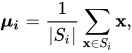
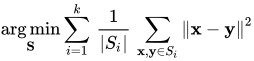
Given a set of observations (x1, x2, ..., xn), where each observation is a -dimensional real vector, k-means clustering aims to partition the n observations into k (≤ n) sets S = {S1, S2, ..., Sk} so as to minimize the within-cluster sum of squares (WCSS) (i.e. variance). Formally, the objective is to find: where μi is the mean (also called centroid) of points in , i.e. is the size of , and is the usual L2 norm . This is equivalent to minimizing the pairwise squared deviations of points in the same cluster: The equivalence can be deduced from identity . Since the total variance is constant, this is equivalent to maximizing the sum of squared deviations between points in different clusters (between-cluster sum of squares, BCSS). This deterministic relationship is also related to the law of total variance in probability theory.






The term "k-means" was first used by James MacQueen in 1967, though the idea goes back to Hugo Steinhaus in 1956. The standard algorithm was first proposed by Stuart Lloyd of Bell Labs in 1957 as a technique for pulse-code modulation, although it was not published as a journal article until 1982. In 1965, Edward W. Forgy published essentially the same method, which is why it is sometimes referred to as the Lloyd–Forgy algorithm.
The most common algorithm uses an iterative refinement technique. Due to its ubiquity, it is often called "the k-means algorithm"; it is also referred to as Lloyd's algorithm, particularly in the computer science community. It is sometimes also referred to as "naïve k-means", because there exist much faster alternatives.
Given an initial set of k means m1(1), ..., mk(1) (see below), the algorithm proceeds by alternating between two steps:
The objective function in k-means is the WCSS (within cluster sum of squares). After each iteration, the WCSS monotonically decreases, giving a nonnegative monotonically decreasing sequence. This guarantees that the k-means always converges, but not necessarily to the global optimum.
Hub AI
K-means clustering AI simulator
(@K-means clustering_simulator)
K-means clustering
k-means clustering is a method of vector quantization, originally from signal processing, that aims to partition n observations into k clusters in which each observation belongs to the cluster with the nearest mean (cluster centers or cluster centroid). This results in a partitioning of the data space into Voronoi cells. k-means clustering minimizes within-cluster variances (squared Euclidean distances), but not regular Euclidean distances, which would be the more difficult Weber problem: the mean optimizes squared errors, whereas only the geometric median minimizes Euclidean distances. For instance, better Euclidean solutions can be found using k-medians and k-medoids.
The problem is computationally difficult (NP-hard); however, efficient heuristic algorithms converge quickly to a local optimum. These are usually similar to the expectation–maximization algorithm for mixtures of Gaussian distributions via an iterative refinement approach employed by both k-means and Gaussian mixture modeling. They both use cluster centers to model the data; however, k-means clustering tends to find clusters of comparable spatial extent, while the Gaussian mixture model allows clusters to have different shapes.
The unsupervised k-means algorithm has a loose relationship to the k-nearest neighbor classifier, a popular supervised machine learning technique for classification that is often confused with k-means due to the name. Applying the 1-nearest neighbor classifier to the cluster centers obtained by k-means classifies new data into the existing clusters. This is known as nearest centroid classifier or Rocchio algorithm.
Given a set of observations (x1, x2, ..., xn), where each observation is a -dimensional real vector, k-means clustering aims to partition the n observations into k (≤ n) sets S = {S1, S2, ..., Sk} so as to minimize the within-cluster sum of squares (WCSS) (i.e. variance). Formally, the objective is to find: where μi is the mean (also called centroid) of points in , i.e. is the size of , and is the usual L2 norm . This is equivalent to minimizing the pairwise squared deviations of points in the same cluster: The equivalence can be deduced from identity . Since the total variance is constant, this is equivalent to maximizing the sum of squared deviations between points in different clusters (between-cluster sum of squares, BCSS). This deterministic relationship is also related to the law of total variance in probability theory.
The term "k-means" was first used by James MacQueen in 1967, though the idea goes back to Hugo Steinhaus in 1956. The standard algorithm was first proposed by Stuart Lloyd of Bell Labs in 1957 as a technique for pulse-code modulation, although it was not published as a journal article until 1982. In 1965, Edward W. Forgy published essentially the same method, which is why it is sometimes referred to as the Lloyd–Forgy algorithm.
The most common algorithm uses an iterative refinement technique. Due to its ubiquity, it is often called "the k-means algorithm"; it is also referred to as Lloyd's algorithm, particularly in the computer science community. It is sometimes also referred to as "naïve k-means", because there exist much faster alternatives.
Given an initial set of k means m1(1), ..., mk(1) (see below), the algorithm proceeds by alternating between two steps:
The objective function in k-means is the WCSS (within cluster sum of squares). After each iteration, the WCSS monotonically decreases, giving a nonnegative monotonically decreasing sequence. This guarantees that the k-means always converges, but not necessarily to the global optimum.