


Community hub
Recent from talks
Contribute something
Nothing was collected or created yet.
KAMAZ-7850
View on Wikipedia
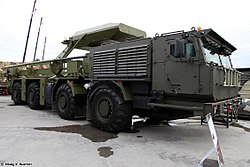
The KAMAZ-7850 (Platforma-O) is a new unified family of very heavy load wheeled transporters developed by KAMAZ for the Russian Ministry of Defence. This family is designed to replace the Belarusian-made MZKT transporter erector launchers that currently carry Russian ICBMs.
The Platforma-O family includes several vehicles: KAMAZ-7850 16x16: Has a capacity of 85 tons. KAMAZ-78509 12x12: Capable of carrying 60 tons. KAMAZ-78504 8x8: Can tow a 90-ton semi-trailer. KAMAZ-78508 8x8: Used for transporting aircraft on airfields.
One of the primary applications of these vehicles will be carrying RS-24 Yars missiles.[1]
State tests of the Platforma-O family were completed in August 2018, and it entered service in March 2019. The Russian military is set to receive five versions of the vehicle: - 8x8: Payload capacity of 25 tons.
- 12x12: Payload capacity of 50 tons.
- 16x16: Payload capacity of 85 tons.
- 8x8 semi-trailer: Towing capacity of 165 tons.
- 8x8 ballast tractor: Towing capacity of 400 tons.
The 12x12 and 16x16 tractors will be used as transporter erector launchers, while the other vehicles will carry various support systems.[2][3][4]
See also
[edit]
References
[edit]- ^ Administrator. "Russian Company KAMAZ to develop new family of heavy transporters for Russian MoD TASS 11708162 - July 2016 Global Defense Security news industry - Defense Security global news industry army 2016 - Archive News year". www.armyrecognition.com. Retrieved 1 November 2017.
- ^ "ЦАМТО / Новости / Завершены госиспытания новейшего тягача для стратегических ракетных комплексов на базе КАМАЗа". www.armstrade.org.
- ^ "KAMAZ-7850 Platform-O". www.globalsecurity.org.
- ^ "Platforma-O heavy tractors for Topol and Yars ICBM systems enter service in Russia". TASS.
External links
[edit] Media related to KamAZ-7850 at Wikimedia Commons

 | This military vehicle article is a stub. You can help Wikipedia by adding missing information. |
KAMAZ-7850
View on GrokipediaDevelopment and History
Origins and Design Requirements
The development of the KAMAZ-7850, known as the Platforma-O, originated in 2008 when PJSC KAMAZ won a competition tendered by the Russian Ministry of Defense to conduct research and development (R&D) work on creating a new generation of special wheeled chassis and tractors (SKShT).[4] This initiative aimed to establish a domestic alternative to imported heavy transporters, particularly those from Belarusian manufacturer MZKT, which had been the primary supplier for Russian Strategic Rocket Forces equipment.[5] In 2008-2009, the Ministry of Defense specified requirements for a modular family of heavy wheeled platforms, including 8x8, 12x12, and 16x16 configurations, to support mobile intercontinental ballistic missile (ICBM) systems and other ultra-heavy loads.[6] The primary design imperatives focused on achieving high payload capacities—up to 85 tons for the 16x16 variant—while ensuring enhanced cross-country mobility, all-wheel drive capability, and unification across variants to streamline logistics and production.[1] These platforms were engineered to transport and erect heavy strategic weaponry, such as ICBMs, in rugged terrains, prioritizing reliability, load distribution across multiple axles, and independent suspension systems to maintain stability under extreme weights.[2] The Platforma-O program emphasized reducing dependence on foreign suppliers by developing indigenous technologies, including specialized engines and chassis designs capable of operating in Russia's diverse climatic and geographic conditions.[1] Key requirements included a lifting capacity scaling with axle count—25 tons for 8x8, 50 tons for 12x12, and 85 tons for 16x16—to accommodate various mission profiles, from transporter-erector-launchers (TELs) to support vehicles for the Strategic Missile Forces.[1]Prototyping and Public Demonstrations
Development of the KAMAZ-7850, known as Platforma-O, involved prototyping under the Russian Ministry of Defense's "Platform-O" program starting in the mid-2010s. Initial prototypes, including a multi-wheeled tractor with an 8x8 wheel arrangement, were constructed by October 2015 to meet requirements for heavy-load transport capabilities.[7] A closed presentation of three such prototypes took place at the Army-2015 international military-technical forum, marking an early evaluation stage before broader testing.[7] Further prototypes emerged by 2017, advancing toward the full 16x16 configuration designed for extreme off-road mobility and heavy payloads exceeding 50 tons.[6] These efforts addressed challenges in electric drive systems and weight distribution, though early models reportedly exceeded mass targets by several tons due to component integrations.[6] The first public demonstration occurred at the Army-2018 forum in August 2018, where a KAMAZ-7850 16x16 variant performed a dynamic display.[1] During the event, the vehicle experienced a breakdown attributed to onboard electronics failure, resulting in mobility issues with several wheels.[1] This incident highlighted ongoing technical refinements needed prior to state trials, which concluded later that month.[1]Production Delays and Technical Challenges
The KAMAZ-7850 Platforma-O chassis faced substantial technical difficulties during its development and testing phases, hindering progression toward full-scale production. Russian media reports from 2015 highlighted serious problems in the program's early stages, including persistent issues with wheel functionality across nearly all axle pairs, where wheels failed to rotate properly during initial vehicle operations.[1] These mechanical shortcomings were compounded by onboard electronics failures observed in public demonstrations, which immobilized the vehicle by rendering multiple wheels inoperable.[1] The vehicle's innovative electric transmission system, designed to enhance efficiency in heavy-load scenarios, introduced additional challenges suited more to civilian applications than military demands. Overcoming technological barriers in reliability, power management under combat conditions, and integration with strategic payloads required extensive redesigns, as electric drives proved vulnerable to environmental stresses and maintenance complexities not adequately addressed in prototypes.[6] Reliability concerns extended to overall chassis durability and serviceability, with KAMAZ struggling to match the proven performance of Belarusian MZKT transporters, leading to delays in meeting Russian Ministry of Defence requirements.[2] By mid-2015, these unresolved issues in testing had stalled advancement, preventing timely certification and serial production despite initial contracts awarded around 2014.[3] As a result, the Platforma-O family remains largely developmental, with no verified entry into operational fleets as of 2024, reflecting broader Russian defense industry constraints in heavy vehicle innovation.[1]Design Features and Specifications
Chassis and Mobility Systems
The KAMAZ-7850 chassis utilizes an 8-axle configuration with a 16×16 wheel formula, providing all-wheel drive and all-wheel steering to facilitate high maneuverability under heavy loads exceeding 85 tons.[1][2] This setup supports the vehicle's role as a mobile platform for strategic missile systems, enabling transport over varied terrains.[3] Independent hydropneumatic suspension is incorporated across the axles, permitting dynamic adjustment of ground clearance by up to 400 mm to optimize stability and cross-country performance.[6][2] The system integrates dual braking mechanisms for enhanced control during operations involving semi-trailers or erector-launcher configurations.[2] Mobility features emphasize off-road capability, with the chassis designed to handle rough surfaces while maintaining load integrity for ICBM transporter-loader applications, such as the 15T528 variant.[1] Early prototypes demonstrated potential for electric transmission to further improve traction, though implementation details remain limited in verified technical disclosures.[6]Powertrain and Engine
The KAMAZ-7850 employs a diesel-electric hybrid powertrain, integrating a central diesel engine with generators that supply power to electric hub motors at each wheel, enabling independent torque vectoring and superior off-road performance for heavy loads. This serial hybrid architecture prioritizes reliability and maneuverability over conventional mechanical drivetrains, though prototypes have revealed integration challenges contributing to overall program delays.[8][6] The primary engine is a high-output diesel unit, with reported specifications including 686 horsepower, sufficient to achieve a maximum speed of 70 km/h under load. Associated manufacturer details point to production by AO Remdizel, potentially a variant adapted for military extremes.[9] However, ongoing development emphasizes the TMZ-880 series engines from Tutaev Motor Plant, incorporating basic components cast from specialized iron alloys to withstand prolonged high-stress operations in remote and adverse environments. Transmission specifics remain geared toward the electric system's advantages, forgoing traditional gearboxes in favor of inverter-controlled motor drives, which facilitate centralized tire pressure management and axle synchronization across the 16x16 configuration. Exact fuel efficiency, torque figures, and emissions compliance have not been publicly detailed, consistent with the platform's strategic classification.[8]Load Capacity and Performance
The KAMAZ-7850, configured as a 16x16 wheeled chassis within the Platforma-O family, possesses a payload capacity of 85 metric tons, enabling it to serve as a transporter for heavy strategic systems such as intercontinental ballistic missile (ICBM) launchers.[1][2] This capacity supports full-weight operations for mobile ICBM platforms like the RS-24 Yars, where the vehicle's lifting capability must accommodate missile containers exceeding 80 tons in loaded configurations.[1] Performance characteristics include a maximum road speed of 45 km/h and an operational range of 500 km under full load conditions, as derived from developmental specifications for the heavy transporter series.[2] The diesel-electric drivetrain, featuring individual electric motors per wheel, contributes to these metrics by optimizing torque distribution for heavy payloads while prioritizing reliability over high-speed travel.[2] The 16x16 all-wheel-drive arrangement enhances cross-country mobility, allowing traversal of rough terrain typical for strategic redeployment scenarios, though specific gradients or obstacle clearances remain classified or unpublicized in available technical disclosures.[1] In comparative context, the KAMAZ-7850's load-to-curb weight ratio supports payloads approaching 85 tons against an estimated vehicle mass exceeding 40 tons in running order, though actual field weights have reportedly deviated higher due to design iterations addressing power and stability demands.[6] These parameters position it as a specialized platform for low-speed, high-capacity haulage rather than versatile logistics, with performance tuned for survivability in contested environments over rapid transit.[2]Variants and Configurations
Rocket Transporter Models
The KAMAZ-7850 Platforma-O series features variants engineered for rocket transport, primarily targeting intercontinental ballistic missile (ICBM) systems within Russia's strategic arsenal. The flagship 16×16 configuration, designated KAMAZ-7850, employs an eight-axle setup with independent suspension on each wheel, supporting a payload of 85 metric tons. This model serves as the base chassis for transporter-erector-launchers (TELs), facilitating the mobility, erection, and potential launch of heavy ICBMs such as derivatives of the RS-24 Yars or future systems.[1][2] Complementing the heavy-lift 16×16, the KAMAZ-78509 12×12 variant utilizes six axles and accommodates up to 60 metric tons, positioning it for transporting lighter rocket components, support equipment, or mid-weight TELs in ICBM deployments. Both configurations incorporate all-wheel drive and centralized tire inflation systems to maintain operational efficacy across varied terrains, including off-road conditions typical for strategic missile basing.[1] These designs emerged from a Russian Ministry of Defence initiative to indigenize heavy transporter production, reducing reliance on foreign suppliers like Belarusian MZKT vehicles previously used for similar roles.[2] Prototypes of the 16×16 rocket transporter have been adapted for specific ICBM loader applications, such as the 15T528 transporter-loader, which mounts directly on the KAMAZ-7850 chassis to handle missile canister loading and unloading operations. Public demonstrations of these models occurred as early as 2013, showcasing dynamic mobility tests at military proving grounds like Alabino, though full-scale production integration into active service remains pending as of 2024 due to ongoing development hurdles.[1] The 12×12 model's lighter profile allows for enhanced maneuverability in logistical chains supporting rocket force operations, with both variants prioritizing modularity for rapid reconfiguration between transport modes.[2]Other Specialized Variants
The KAMAZ-78504 is an 8x8 configuration within the Platforma-O family, designed as a heavy-duty truck tractor capable of towing semi-trailers with up to 90 tons of payload via a specialized rigid hitch.[1] This variant supports the transport of tanks, heavy armored vehicles, or construction equipment, featuring an armored cabin prototype developed for Russian Ministry of Defense requirements.[11] It addresses the need to replace imported heavy-duty vehicles like those from MZKT with domestically produced alternatives.[12] The KAMAZ-78508 serves as an 8x8 ballast prime mover variant, equipped with a lifting capacity of 45 tons and intended for towing 90-ton semi-trailers.[2] Primarily utilized for airfield operations, including the transportation of aircraft, it incorporates ballast systems to enhance stability during heavy-load maneuvers.[2] Like other Platforma-O models, it employs electric transmission for improved off-road performance in military logistics scenarios.[1] These variants expand the Platforma-O lineup beyond strategic missile applications, enabling versatile heavy-lift capabilities for broader Russian armed forces needs, though production emphasis has remained on core chassis for missile systems.[2] Development contracts awarded to KAMAZ in 2016 aimed at unifying platforms for various oversized cargo, but deployment details for non-missile uses remain limited in public records.[2]Operational Deployment
Military Trials and Testing
The KAMAZ-7850 underwent preliminary state testing of technological prototypes in autumn 2015, during which Remdizel, a KAMAZ subsidiary, encountered difficulties that delayed full evaluation.[1] These challenges prevented completion of the comprehensive test volume by the end of 2016, necessitating timeline adjustments for further development and validation.[1] State trials of the base 16x16 KAMAZ-7850 model, intended as a chassis for mobile ground-based missile systems, concluded successfully in August 2018, as announced by the Russian Ministry of Defense.[13][14] The testing regimen evaluated the vehicle's heavy-load transport capabilities, maneuverability on varied terrain, and integration potential with strategic rocket carriers, confirming its suitability for replacing older Belarusian wheeled tractors in Russian service.[15] Demonstrations at the Army-2018 forum highlighted its dynamic performance, including tight turning radii despite the 85-ton payload capacity.[16] Following state acceptance, limited units entered trial operation with the Russian Strategic Rocket Forces starting in 2019, focusing on real-world reliability under combat-like conditions with payloads such as RS-24 Yars ICBM transporters.[6] Reports indicated persistent issues with the electric power steering system, including prototype weights exceeding military specifications (300 kg versus a required 60 kg maximum), which complicated field maintenance and contributed to operational hesitancy.[17] By 2021, only five missile carrier variants based on the platform were in trial use, with no confirmed shift to mass production, reflecting ongoing assessments of durability in extreme environments.[6]Integration into Russian Armed Forces
The KAMAZ-7850, as part of the Platforma-O family, entered service with the Russian Armed Forces in March 2019 after state trials concluded in August 2018.[18] Developed to ensure technological independence for strategic nuclear forces, it primarily supports the Strategic Rocket Forces by serving as a chassis for transporter erector launchers (TELs) and support vehicles for intercontinental ballistic missile (ICBM) systems, including Topol-M and Yars.[18] This integration aims to replace Belarusian-manufactured MZKT-79221 and MZKT-7930 series transporters, which had been used in Russian missile complexes.[18] Production of the Platforma-O variants is conducted by Remdizel, a subsidiary of KAMAZ, with the initial batch encompassing five configurations: 8x8 (25-ton payload), 12x12 (50-ton payload), and 16x16 (85-ton payload) wheeled platforms, alongside 8x8 semi-trailer tractors (165-ton towing capacity) and 8x8 ballast tractors (400-ton towing capacity).[18] The 12x12 and 16x16 models are designated for TEL duties, while the others handle auxiliary transport and towing in missile support operations.[18] Adoption orders were prepared by late 2018, enabling operational deployment across branches such as the Strategic Rocket Forces, Aerospace Forces, Ground Forces, and Navy.[19] A complete transition from imported heavy chassis to domestic Platforma-O systems is anticipated over 10-15 years, reflecting a strategic shift toward unified, high-mobility platforms with 86% component commonality across variants.[18] [19] Initial deliveries focused on equipping missile units with prototype and early production units for evaluation in real-world conditions, though mass procurement details remain limited in public records.[1]Criticisms and Controversies
Reliability and Maintenance Issues
The KAMAZ-7850, part of the Platforma-O family, experienced a notable public failure during its demonstration at the Army-2018 forum on August 25, 2018, where the vehicle's all-wheel steering system malfunctioned, preventing the wheels from returning to a straight position and halting forward movement.[20] This incident involved issues with nearly all wheel pairs, as the front wheels remained angled, rendering straight-line travel impossible despite attempts to reposition them manually.[1] Development and testing of the Platforma-O chassis faced significant challenges as early as 2015, with Russian media reporting delays and technical hurdles in achieving reliable performance for heavy strategic loads.[3] By 2016, defense analysts noted persistent reliability and maintenance difficulties with the KAMAZ-7850 compared to established alternatives like Belarusian MZKT platforms, which offer proven durability and simpler upkeep for similar transporter roles.[2] The vehicle's complex 16×16 configuration, incorporating advanced electric-hydraulic steering and independent suspension, contributes to higher failure risks in these systems under field conditions, exacerbating maintenance demands in remote or harsh environments typical for ICBM mobility.[6] These issues have led to limited adoption within Russian Strategic Rocket Forces operations, with preferences leaning toward more robust foreign-sourced chassis despite national development goals, highlighting systemic challenges in scaling unproven heavy wheeled platforms without extensive redundancy testing.[2] Publicly available data on long-term maintenance remains sparse due to military classification, but observed breakdowns underscore vulnerabilities in the KAMAZ-7850's electromechanical components, which require specialized diagnostics and parts availability prone to supply chain disruptions.[1]Comparisons with Alternative Platforms
The KAMAZ-7850 Platforma-O family was developed primarily to supplant Belarusian MZKT wheeled chassis, such as the MZKT-79221 16×16 transporter-erector-launcher (TEL), which have historically supported Russian ICBM systems like the RS-24 Yars and RT-2PM2 Topol-M.[1] Whereas the MZKT-79221 offers a proven payload capacity exceeding 80 tons with established cross-country mobility derived from decades of refinement, the KAMAZ-7850 matches this in its baseline 16×16 variant with an 85-ton load limit but incorporates modular scalability across 8×8, 12×12, and 16×16 configurations for broader application flexibility.[2] Both platforms share dimensional similarities, including split forward cabs optimized for elongated missile payloads and identical tire specifications (1600×600×685 mm), facilitating comparable ground clearance and traction profiles.[1] In terms of drivetrain and suspension, the KAMAZ-7850 diverges from the MZKT's conventional double-wishbone independent setup on torsion bars, which effectively lowers the center of gravity for enhanced stability under heavy loads; the Russian design instead employs a centralized hydraulic all-wheel steering and potentially electrified transmission elements, aiming for reduced mechanical complexity but introducing unproven elements in field endurance.[6] Reliability assessments highlight MZKT's advantage in maintenance predictability, with the Belarusian vehicles benefiting from extensive operational data in Russian service since the 1990s, contrasted against KAMAZ-7850 prototypes exhibiting early breakdowns during 2019 trials, such as axle failures under simulated combat loads.[2] Geopolitically, the shift to KAMAZ reduces reliance on foreign suppliers amid tensions with Belarus, though at the cost of forgoing MZKT's battle-tested durability in arctic and rugged terrains.[1]| Feature | KAMAZ-7850 (16×16) | MZKT-79221 (16×16) |
|---|---|---|
| Payload Capacity | 85 tons | >80 tons |
| Wheel Formula | 16×16 (modular variants available) | 16×16 |
| Suspension Type | Hydraulic all-wheel steering | Double-wishbone on torsion bars |
| Primary Advantage | Domestic production, modularity | Proven reliability, low CoG |
| Operational Maturity | Prototype/testing phase (post-2016) | In-service since ~2010 |
Impact on Russian Defense Procurement
The development of the KAMAZ-7850 Platform-O was initiated in 2008 as part of Russia's efforts to indigenize heavy wheeled transporter production, aiming to replace Belarusian MZKT platforms used for systems like S-400 air defenses, Iskander missiles, and ICBMs such as Yars, thereby reducing foreign dependency in strategic mobility procurement.[2][6] Allocated approximately 10 billion rubles in funding, the project sought to create a unified family of 16x16 and larger chassis capable of carrying payloads exceeding 50 tons, with initial prototypes demonstrated at Army-2018 featuring electric transmission and multi-axle steering.[6] Despite plans for initial military acceptance of two units by 2020, the program encountered persistent technical setbacks, including overweight motor-wheel units (300 kg each versus a 60 kg design requirement) and vulnerabilities in the electric hub-drive system to environmental factors like water and temperature extremes, leading to prototype rejections and abandonment of the motor-wheel configuration in favor of a motor-axle alternative.[1][6] Only limited trial operations of related variants, such as five KAMAZ-7950 units since 2019, have occurred, with reports deeming them unreliable for combat deployment, resulting in no serial production or integration for key assets like Yars ICBM transporters as of 2021 assessments.[6] These delays have prolonged Russia's reliance on imported Belarusian chassis, complicating procurement timelines for missile and heavy equipment systems amid geopolitical strains with Minsk and Western sanctions on components like engines.[6][21] The program's inefficiencies, including rushed timelines (one year imposed versus five requested by engineers) and lack of specialized assembly facilities, exemplify broader challenges in Russian defense industrial policy, diverting resources from viable alternatives like BAZ platforms without yielding scalable domestic capacity.[6] As of late 2024, absence of confirmed fielding underscores sunk costs impacting budget allocation for urgent modernization needs, exacerbating vulnerabilities in heavy-lift logistics during ongoing conflicts.[1]References
- https://www.[globalsecurity.org](/page/GlobalSecurity.org)/wmd/world/russia/kamaz-7850.htm