Hubbry Logo
KaanteKaanteMain
Open search
Kaante
Community hub
Kaante
logo
8 pages, 0 posts
0 subscribers
Be the first to start a discussion here.
Kaante
Kaante
from Wikipedia

Kaante
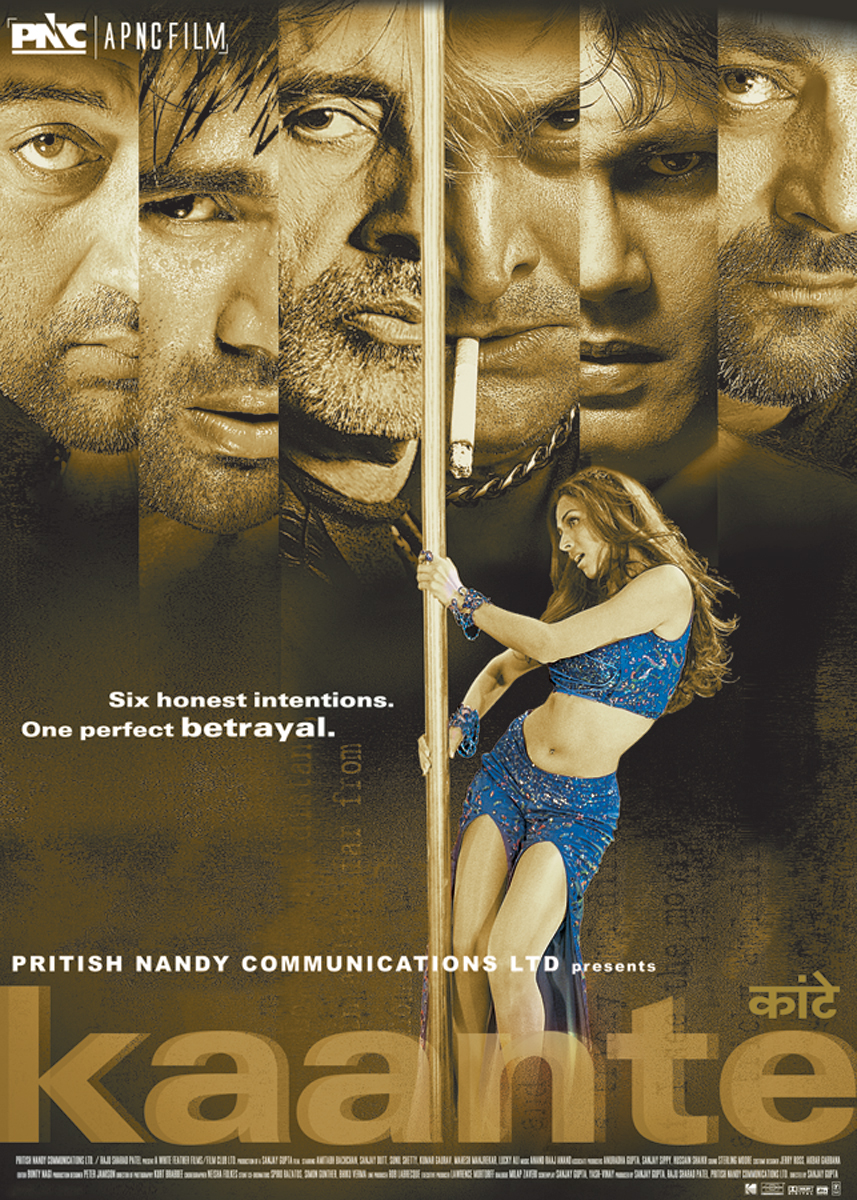
Theatrical release poster
Directed bySanjay Gupta
Written byMilap Zaveri
(dialogue)
Screenplay bySanjay Gupta
Yash-Vinay
Produced byPritish Nandy
Film Club Limited
Larry Mortoff
Sanjay Sippy
StarringAmitabh Bachchan
Sanjay Dutt
Sunil Shetty
Lucky Ali
Mahesh Manjrekar
Kumar Gaurav
CinematographyKurt Brabbee
Edited byBunty Nagi
Music byAnand Raj Anand
Vishal–Shekhar
Lucky Ali
Gregor Narholz
Production
companies
Pritish Nandy Communications
The Film Club
White Feather Films
Release date
  • 20 December 2002 (2002-12-20)
Running time
145 minutes
CountryIndia
LanguageHindi
Budget₹30 crore[1][2][3]
Box office₹42.96 crore[4]

Kaante (lit.'Thorns') is a 2002 Indian Hindi-language action thriller film[5][6] directed by Sanjay Gupta, written by Milap Zaveri, and starring an ensemble cast including Amitabh Bachchan, Sanjay Dutt, Sunil Shetty, Lucky Ali, Mahesh Manjrekar, Kumar Gaurav, Namrata Singh Gujral, Rati Agnihotri, Rohit Roy, Isha Koppikar and Malaika Arora.

Set in Los Angeles, the film follows six Indian men who are detained without evidence by the police. Feeling wronged and vengeful, they team up to plot a bank heist that would leave the Los Angeles Police Department penniless. However, once things go out of hand, they start suspecting each other's identities, resulting in violence and chaos.

Kaante was heavily inspired by Quentin Tarantino's Reservoir Dogs (1992) as well as the film that inspired it, Ringo Lam's City on Fire (1987).[7][8] According to Tarantino, Kaante is his favorite among the many films that were heavily inspired by his work.[9]

Kaante was released theatrically on 20 December 2002. The film was a success at the box office despite clashing with Saathiya, another box office success, with first-week earnings of £1.8 million in India, nearly $1 million in the United States, and £268,507 in Britain.[10] The film's final worldwide gross was 430 million[4][2]

Plot

[edit]

In Los Angeles, six men of Indian origin with a criminal record are detained by the police and interrogated about stealing a truck full of laptops and its whereabouts. Their deep antipathy towards the police for arresting them without any evidence, just because the witnesses had seen an Indian at the crime scene, grows into a daring plot. Sparked off by Jay "Ajju" Trehan and seconded by Yashvardhan "Major" Rampal, they all hatch a plan to rob the American Services Bank, in which lies the funding for the Los Angeles Police Department.

Marc Issak is a bouncer with a girlfriend working as a club dancer. Major has no stable job and lives with his sick wife. Andy is a software engineer having divorce and child custody problems, and is also jobless. Bali is a drug peddler who lives off the street; he has a mentally disabled sister in the asylum. Bali meets Mak one day, being chased by some drug dealers in an alley, who agrees to save him only if he splits his loot. They begin to work thereafter.

After the six are released from jail a day later, they meet up again to discuss the bank robbery. It is revealed Ajju had stolen the truck and sold it, and he gives everyone a share for the trouble they went through. Andy walks away with his, but when his lawyer tells him that the money is insufficient, he returns to the gang. On a hotel rooftop, they start planning the robbery, in which they familiarize themselves with the bank and get cars, weapons, and gadgets to do this. Soon they establish their hideout in a warehouse, where Major reveals that the bank will be looted the next day instead of the day after as previously planned, to thwart anyone's hidden agendas.

The robbery proceeds as planned, but they find a SWAT team waiting for them outside the bank. A gunfight ensues, and Mak is hit by a bullet while saving Major. The gang escape and meet at their hideout. Ajju reveals that he has kidnapped the police chief Det. MacQuarrie. They interrogate him and learn that one of them is an undercover cop. This strikes suspicion among them, yet they decide to bring the stolen amount to their hideout to divide the spoils. Back home Major learns that his wife has died. Ajju befriends Marc and both go to the club, where Marc take away his girlfriend from the club owner Cyrus, and it is then revealed that Ajju actually knows some English but was pretending not to all this while. When everyone returns, they find Bali dead, shot by Mak for his inhuman interrogation of MacQuarrie. Ajju them shoots Macquarie, and he reasons with the others that Mak is the undercover cop, but Major disagrees because he believes Mak saved him during the gunfight at the bank, and orders Ajju at gunpoint not to shoot Mak. Marc backs up Ajju and points his gun at Major and Mak, while Mak points his gun at Marc. The remaining four arrive at a Mexican standoff, as Andy retreats and scampers with the money. The four of them shoot each other, after which Major apologizes to Mak for not being able to save him. In reply, Mak says he was just doing his duty as he is the undercover cop, sent by the police to watch the team and that he was the one who buzzed the cops at the bank to arrive. Major shoots the already dying Mak in the head.

The film ends with Mak's voice narrating the story, as the bodies lie dead, stating they will all meet in hell soon, and he will have no explanation for his betrayal, as Marc's girlfriend is shown waiting for him in the aircraft, Bali's sister in the asylum, Andy's wife and son living happily with the step-father, and Andy driving off the highway pursued by a police helicopter, leaving Andy's fate to the discretion of the audience.

Cast

[edit]

Production

[edit]

The film was to star Sanjay Dutt, Sunil Shetty, Mahesh Manjrekar, Kumar Gaurav, Akshaye Khanna, Shilpa Shetty and Lisa Ray initially.[11] Akshaye Khanna opted out and was replaced by Lucky Ali,[12] Malaika Arora stepped into Lisa Ray's shoes[13] and Namrata Singh Gujral was cast opposite Kumar Gaurav in lieu of Shilpa Shetty.[14] Sunny Deol was offered Kumar Gaurav's role at one point.[15] Isha Koppikar was signed for a full-fledged role opposite Sanjay Dutt which got relegated to just the song "Ishq Samandar" because of length concerns. Rohit Roy (from Shootout at Lokhandwala and a popular television actor) also makes an appearance in the song.[16]

The film was the first Bollywood film to be completely shot in Los Angeles.[17] The film's production team used Hollywood technicians.[17] The filming was completed in 35 days.[3] Namrata Singh Gujral was the only role cast in Hollywood from the principal cast. All other principals including Amitabh Bachchan were flown in from Mumbai for the Hollywood shoot.

Reception

[edit]

On the review aggregator website Rotten Tomatoes, 83% of 6 critics' reviews are positive, with an average rating of 6.4/10.[18] Taran Adarsh of Bollywood Hungama gave the film three and a half stars out of five and stated, "Kaante takes a step forward in terms of content and technique. An apt example of progressive cinema that breaks the shackles of stereotype, the film has everything to woo the cinegoer: an impressive cast, grandiose look, an excellent second half, well executed stunts, popular music and eroticism in plenty".[19] Prem Panicker of Rediff criticized the film saying "A more taut script, a little less of indulgence in directing, a tad more ruthlessness in editing, and this film could have pulled off a badly needed box office heist."[20] A reviewer at Sify awarded the film three and a half stars out of five and wrote, "A film far ahead of its time in terms of execution, Kaante is a visual delight. And combined with good performances and superb action, it's a must-see this season."[21]

Derek Elley of Variety praised the direction and performances of the lead cast, saying, "From the protags' initial meeting, heavy on closeups, Gupta directs the film primarily as a character piece, with Bachchan, Dutt and semi-comic relief Manjrekar driving the drama with richly characterized roles. Shetty, a tightly wound actor at the best of times, strikes few sparks as the nightclub bouncer, and his scenes with Arora as the chanteuse are flat."[22] Dave Kehr of The New York Times reviewed the film writing, "A delirious Bollywood reimagining of Reservoir Dogs, complete with musical numbers, Sanjay Gupta's Kaante shifts as fluidly between cinematic idioms as it does between Hindi and English."[23] Kevin Thomas of the Los Angeles Times said, "there is a steadfast earnestness in director Sanjay Gupta's deluded attempt to equal or even better Hollywood on its own ground that is rather touching -- but not to the degree that it sustains the film's many tedious stretches."[24]

Quentin Tarantino cited Kaante as his favourite among the many films that were heavily inspired by his work. He praised the film's character-building for going beyond what he was able to do with Reservoir Dogs. Tarantino stated: "Here I am, watching a film that I've directed and then it goes into each character's background. And I'm like, 'Whoa'. For, I always write backgrounds and stuff, and it always gets chopped off during the edit. And so I was amazed on seeing this. I felt, this isn't Reservoir Dogs. But then it goes into the warehouse scene, and I am like, 'Wow, it's back to Reservoir Dogs'. Isn't it amazing!" He also praised Amitabh Bachchan's performance.[9] Tarantino later screened Kaante at his New Beverly Cinema alongside Reservoir Dogs and City on Fire.[25]

Awards

[edit]

Soundtrack

[edit]
Kaante
Soundtrack album by
Released28 June 2002
GenreFeature film soundtrack
LanguageHindi
LabelT-Series
DirectorSanjay Gupta
ProducerPritish Nandy

The songs were mainly composed by Anand Raj Anand, while Vishal–Shekhar and Lucky Ali were guest composers. Lyrics are penned by Dev Kohli and Vishal Dadlani. According to the Indian trade website Box Office India, with around 1,800,000 units sold, this film's soundtrack addalbum was the year's fourth highest-selling.[26] Tracks like 'Maahi ve', 'Rama re' and 'Ishq Samundar' got good popularity. The soundtrack was #94 on the list of "100 Greatest Bollywood Soundtracks of All Time", as compiled by Planet Bollywood.

The song "Ishq Samundar", was re-made for the film Teraa Surroor (2016) which was sung by Himesh Reshammiya and Kanika Kapoor. The song "Maahi Ve" was recreated by Gourav-Roshin in the voice of Neha Kakkar for the film Wajah Tum Ho (2016).

Track listing

[edit]
No.TitleLyricsMusicSinger(s)Length
1."Baby Baby"Dev KohliAnand Raj AnandSunidhi Chauhan 
2."Chhod Na Re" Vishal–ShekharUdit Narayan, Sanjay Dutt, Sudesh Bhosle, Mahesh Manjrekar 
3."Dil Kya Kare" Anand Raj AnandKumar Sanu, Kavita Krishnamurthy 
4."Ishq Samundar"Dev KohliAnand Raj AnandSunidhi Chauhan, Anand Raj Anand 
5."Maahi Ve"Dev KohliAnand Raj AnandZubeen Garg, Sukhwinder Singh, Richa Sharma 
6."Maut" Lucky AliLucky Ali 
7."Rama Re"Dev KohliAnand Raj AnandZubeen Garg, Shaan, Sanjay Dutt 
8."Socha Nahin Tha" Anand Raj AnandShaan 
9."Yaar Maangiyasi" Anand Raj AnandSonu Nigam 

References

[edit]
[edit]
Revisions and contributorsEdit on WikipediaRead on Wikipedia
from Grokipedia
Kaante is a 2002 Indian Hindi-language action thriller film co-written by Sanjay Gupta, Yash Keswani, and Vinay Shukla, and directed by Sanjay Gupta. The film serves as a Bollywood reinterpretation of Quentin Tarantino's 1992 crime classic Reservoir Dogs, blending high-octane heist elements with Indian cinema's signature melodrama, song-and-dance sequences, and ensemble dynamics. Set in Los Angeles, it follows six men of Indian origin—portrayed by Amitabh Bachchan as Yashvardhan "Major" Rampal, Sanjay Dutt as Jay "Ajju" Rehan, Suniel Shetty as Marc Issak, Mahesh Manjrekar as Raj "Bali" Yadav, Kumar Gaurav as Anand "Andy" Saxena, and Lucky Ali as Maqbool "Mak" Haider—who are wrongfully arrested and humiliated by police, prompting them to orchestrate a daring bank robbery as revenge, only to unravel amid paranoia over an undercover informant. Released on December 20, 2002, the 2-hour-30-minute film features a pulsating soundtrack composed by Anand Raj Anand, including hits like "Ishq Samundar," and was produced on a budget of approximately ₹28 crore, grossing around ₹38 crore worldwide despite mixed critical reception for its stylistic excesses. Praised for its star-studded cast and kinetic action, Kaante marked a bold stylistic shift in early 2000s Bollywood, influencing the genre's embrace of Hollywood-inspired narratives while retaining cultural flair.

Plot

The film Kaante is set in and centers on six Indian-origin men who, after repeated harassment by the LAPD, unite to execute a as an act of and survival. The protagonists are Yashvardhan "Major" Rampal (), a principled ex-army officer struggling to support his ailing wife and dreaming of returning to ; Jay "Ajju" Rehan (), a hot-tempered hustler with a code of loyalty; Marc Issak (), a devoted protecting his Lisa from exploitation; Raj "Bali" Yadav (), a volatile drug dealer caring for his mentally challenged younger brother; Anand "Andy" (), a tech-savvy software facing personal troubles; and Maqbool "Mak" Haider (), the quiet narrator who bonds the group through subtle persuasion. The narrative unfolds chronologically, beginning with the LAPD's arbitrary roundup of South Asian men following a stolen truck incident, during which the six are detained, strip-searched, and interrogated without evidence, fueling their resentment toward systemic racism and police brutality. Released due to lack of proof, they cross paths at a local bar and, driven by shared grievances and personal desperation—Major's financial woes, Bali's family burdens, Marc's desire to escape his dead-end job, and the others' aimless criminal fringes—decide to target the Services Bank, which handles LAPD salary deposits, viewing the robbery as poetic justice. Over tense planning sessions in seedy Los Angeles motels and garages, they assign roles: Andy hacks security systems, Marc handles muscle, Bali drives the getaway, Ajju leads the entry, Major strategizes, and Mak scouts locations, forging a fragile brotherhood tested by egos and doubts. The heist commences at dawn in the bank's vault, where the group, disguised and armed, subdues guards and customers to access the cash deposits. Chaos erupts when a resists, leading Bali to shoot him in panic, turning a clean operation into a case and alerting authorities via silent alarms. The team escapes in a hijacked armored van amid initial gunfire, but Mak sustains a stomach wound during the getaway through downtown Los Angeles traffic, heightening paranoia as they split up temporarily to evade patrols. Brief hospital scenes intercut here reveal backstories more deeply: Major visits his wife, confiding his fears of failure; Bali checks on his brother; Marc shares a tender moment with Lisa, promising a better life—moments underscoring their motivations beyond greed, rooted in familial loyalty and immigrant hardship. Regrouping at an isolated on the city's outskirts, the atmosphere sours as Mak's worsens and news reports detail the botched , identifying them loosely through witness sketches. Ajju reveals he has abducted their longtime tormentor, LAPD MacQuarrie, binding him in the warehouse for leverage. Under duress and —escalating when threatens to sever the detective's ear in rage—the captive confesses that police intelligence came from an undercover within the group, shattering their trust and sparking accusations. Loyalties fracture: Major advocates calm division of the loot; Ajju demands a vote on suspects; Marc defends Mak, citing his wounds as proof of commitment; Andy grows evasive, hinting at his own hesitations during planning; Bali's volatility peaks, viewing as personal affront to his sacrifices. Tensions boil into fistfights and drawn guns, with each man's arc exposed—Ajju's bravado masking vulnerability, Bali's aggression stemming from desperation—highlighting themes of misplaced brotherhood amid survival instincts. The revelation unfolds dramatically when Mak, writhing in pain, admits he is the undercover cop, planted by the LAPD to dismantle what they perceived as a rising ethnic syndicate; his narration throughout the retroactively frames his subtle manipulations, like luring reluctant with false promises of equal shares. Stunned, the group confronts him, but police sirens announce a SWAT siege on the warehouse, triggered by the 's hidden tracker. In the ensuing melee, , unhinged, executes the detective but is shot dead by Mak in ; Andy falls in crossfire while attempting to flee with a share of the money; Marc dies shielding Major during a breach. Ajju, enraged, kills Mak execution-style before succumbing to wounds in the final standoff. Major, the last standing, empties his clip at advancing officers but is gunned down, his body slumping beside the others amid scattered cash. As the camera pans over the carnage, Mak's echoes from beyond, musing on their inevitable reunion in hell and his inability to justify the failed operation to his superiors, leaving the robbery loot unclaimed and their quests for redemption unfulfilled.

Cast

Kaante boasts an of established Bollywood stars, each bringing their signature intensity to the roles of six unlikely allies drawn together by circumstance in a high-stakes heist scenario. The selection emphasized known for their commanding presence in action-oriented films, highlighting the film's departure from conventional youthful leads by featuring mature performers over 40 to portray weathered, complex criminals. The principal cast includes:
ActorCharacterDescription
Yashvardhan "Major" RampalAn educated and intelligent former military man, now unemployed and caring for his ailing wife, serving as the authoritative leader of the group with a strategic mindset.
Jay "Ajju" RehanA non-English speaking tough enforcer with a rough background, known for his raw physicality and street-smart instincts.
Marc IssakA skilled mechanic with a tactical edge, contributing technical expertise to the group's plans.
Raj "Bali" YadavA hot-tempered former cop grappling with corruption and inner conflicts, adding volatility to the ensemble.
Maqbool "Mak" HaiderA laid-back cab driver with a musical flair, providing comic relief and youthful energy to the older group.
Anand "Andy" SaxenaA software facing and issues, bringing technical skills to the group.
Notable supporting roles include as Major's devoted wife, underscoring his personal stakes; in a special appearance as the seductive Lisa during the item's song sequence; and as a club dancer, whose role was initially larger but trimmed for pacing. Other key appearances feature as a and as Nancy, enhancing the film's tense underworld atmosphere.

Production

Development

Sanjay Gupta conceived Kaante in 2000, drawing inspiration from Quentin Tarantino's Reservoir Dogs (1992), as well as influences from The Usual Suspects and Ringo Lam's City on Fire (1987), adapting the heist narrative to focus on Indian immigrants navigating life in Los Angeles. The story originated from the real-life Tribhovandas Bhimji Zaveri & Sons jewellers robbery in Mumbai, initially envisioned as a tale of six newcomers from the city's Dagdi Chawl area, before being relocated to an international setting at producer Raju Patel's suggestion to heighten the sense of alienation among the characters. The screenplay was written by Sanjay Gupta and Milap Zaveri, building on an initial collaboration with Makrand Deshpande who developed it as a play, with dialogues contributed by Milap Zaveri. It incorporated cultural adaptations, such as tensions between Hindu and Muslim characters, to reflect the dynamics among the Indian protagonists in a foreign environment. During pre-production, Gupta narrated the script to key actors, including a tense session with Amitabh Bachchan, whose eventual approval helped secure the star for the role of Major. The film was produced on a budget of approximately ₹28 crore, financed primarily by Pritish Nandy Communications, with co-production support from White Feather Films, established by Gupta and . Development began in 2000, with the script finalized by early 2001, though challenges arose in securing international locations in due to strict union regulations and disruptions following the , which restricted access to sensitive sites, caused a four-day halt, and escalated costs necessitating planning adjustments and actors waiving their fees (except ).

Filming

Principal photography for Kaante took place primarily in , , utilizing urban locations such as warehouses, streets in San Pedro, the Alexandria Hotel in Downtown , and to capture the film's gritty heist atmosphere. The production marked one of the first major Bollywood films largely shot in the United States (with musical numbers filmed in ), employing Hollywood technicians and equipment for authenticity. Filming commenced on August 20, 2001, and wrapped after a tight 33-day schedule on October 20, 2001, focusing on exterior and action-heavy sequences to evoke the film's inspirations from Tarantino's . The shoot faced significant logistical challenges, including temporary halts due to the , 2001, terrorist attacks, which led to heightened security concerns and the cancellation of several days of filming. Post-9/11 tensions also resulted in incidents such as actor being briefly detained at gunpoint by police due to his appearance, while the cast, including , faced suspicion owing to their beards and South Asian features. These disruptions complicated permit acquisitions for public locations and actor scheduling, requiring the crew to adapt Tarantino-inspired violence sequences to Bollywood's stylistic constraints while navigating American filming regulations. Technically, the was shot in format using Foto-Kem color processing, with Kurt Brabbee emphasizing dynamic action to blend high-energy heists with noir visuals. Innovative slow-motion sequences featured prominently in the , showcasing the lead actors in stylized poses and movements to introduce characters amid dramatic tension. In post-production, editor Bunty Nagi handled the assembly, focusing on pacing the and intense confrontations to heighten suspense. artists, including digital compositors Mahesh Baria and , enhanced the heist scenes with subtle integrations for gunfire and explosions, contributing to the extended post-production phase that outlasted the principal shoot. was applied to amplify the shadowy, noir aesthetic, underscoring the themes of and .

Soundtrack

Composition

The soundtrack for Kaante was primarily composed by Anand Raj Anand, who handled the majority of the songs, with guest contributions from the duo and singer . Lyrics were written by for most tracks, alongside contributions from and . The background score, which amplifies the film's tense heist sequences and urban atmosphere, was composed by German Gregor Narholz, incorporating rhythmic, hard-driven elements to underscore the narrative's suspense. Initially, director envisioned Kaante as India's first major film without music to emphasize its gritty, Western-inspired style, but songs were ultimately added in the early to secure lucrative music rights sales. Anand Raj Anand approached Gupta with a spontaneous Sufi-inspired demo, earning the lead composition role despite initial plans involving multiple composers like and . During a creative session, Anand crafted the film's signature track—"Collar ko thoda sa upar chada ke"—on the spot, drawing from the actors' as they raised their collars, smoked, and plotted in a cave-like setting, blending rhythmic beats with melodic hooks suited to the 40-plus cast and absence of a central romance. Stylistically, the score reflects the film's setting through a mix of fast-paced, interval-driven rhythms and hard-edged that heightens action and camaraderie among the protagonists, prioritizing commercial appeal while syncing with the plot's high-stakes tension. Tracks like "Ishq Samundar" and "Maahi Ve" feature bar-dance vibes with energetic percussion, while the overall was designed to stand alone as an engaging listen beyond the screen. This approach marked a shift toward more narrative-integrated music in Bollywood heist films, influenced by the story's international urban backdrop.

Track listing

The soundtrack of Kaante features eight songs, primarily composed by Anand Raj Anand, with contributions from and ; lyrics for several tracks were penned by . Released by T-Series in 2002 on CD and audio cassette formats, the includes vocal performances by a range of playback singers, along with on-screen renditions by cast members such as .
No.TitleSinger(s)DurationComposer(s)
1Ishq Samundar, Anand Raj Anand5:22Anand Raj Anand
2Maahi Ve, Richa Sharma6:04Anand Raj Anand
3Rama ReShaan, , Anand Raj Anand, Sudesh Bhosle, 6:51Anand Raj Anand
4Yaar Mangiyasi6:17Anand Raj Anand
5Dil Kya Kare, Kavita Krishnamurthy5:06Anand Raj Anand
6Chhod Na Re, Sudesh Bhosle, 5:05
7Maut4:33
8Socha Nahin ThaShaan, 5:35

Release

Theatrical release

Kaante was released theatrically on 20 December in and select overseas markets, marking the final major Bollywood release of the year. The film's rollout coincided with the holiday season, positioning it for wide accessibility in urban multiplexes and single-screen theaters across major Indian cities like and . Internationally, it premiered simultaneously in the , with screenings in theaters, and expanded to the shortly thereafter. In , distribution was handled by Shringar Films in and other regional distributors through established exhibitors. Overseas rights were sold to entities like Film Club for the market, facilitating releases in key diaspora areas such as the and , where the film targeted NRI audiences with its blend of action and ensemble star appeal. The (CBFC) awarded the film an 'A' (adults only) rating, requiring a single audio cut to excise a strong expletive, though no visual alterations for violence were mandated. In the , it received an R rating from the for strong violence and language, aligning with its intense heist thriller tone. Marketing strategies focused on the film's all-star cast—including , , , , , and —and its high-stakes action sequences, showcased through teaser trailers that emphasized stylish shootouts and ensemble dynamics. Promoters drew explicit parallels to Quentin Tarantino's (1992), positioning Kaante as a Bollywood reinterpretation to generate buzz among cinephiles familiar with the Hollywood original's narrative structure and dialogue-driven tension. Pre-release hype was amplified via press conferences, such as one held on 18 December 2002 in , where the cast and director discussed the project's ensemble chemistry and thematic inspirations. These efforts culminated in a strong opening weekend, underscoring the campaign's effectiveness.

Box office

Kaante was produced on a reported budget of approximately ₹30 . Upon its release on 20 December 2002, the film earned ₹2.04 on its opening day in . Its opening weekend collection in stood at ₹5.87 , contributing to a strong initial performance. The film collected a total nett of ₹20.45 in , translating to a gross of ₹33.12 domestically. Internationally, Kaante grossed $2.05 million (approximately ₹9.84 ), with notable contributions from markets like the , , and Gulf regions, reflecting its appeal to the . According to , the worldwide gross reached ₹42.96 , recovering a significant portion of the budget but falling short of blockbuster expectations. classified Kaante as a "Below " performer, ranking it third among 2002's top nett grossers in , behind Devdas (₹41.66 nett) and Raaz (₹21.46 nett). Despite this, it demonstrated solid multiplex occupancy and overseas traction compared to contemporaries.

Reception

Critical response

Upon its release in December 2002, Kaante received mixed reviews from critics, who praised its high-energy action sequences and the strong ensemble chemistry among the lead actors while criticizing the film's derivative plot and uneven pacing. The Rediff review highlighted the well-executed heist and scenes, along with the effective , but noted the story's heavy inspiration from Tarantino's , resulting in a lack of originality and logical inconsistencies in character decisions. Similarly, of awarded the film 3.5 out of 5 stars, commending the technical polish and progressive Hollywood-influenced look, though he pointed out script fumbles in the first half, such as unconvincing robbery planning, and moments that felt overly talkative. Critics widely acclaimed the performances, particularly Amitabh Bachchan's portrayal of the dignified veteran Major, which was described as proficient and intense, especially in the second half, bringing to the . and also drew praise for their richly characterized roles, with Manjrekar's psychotic yet lovable killer standing out as a highlight. 's turn as the hot-headed Ajju was generally well-received for its commitment to character, though some noted it blended into the group's dynamics without dominating. Stylistically, the film earned appreciation for its sleek visuals, courtesy of cinematographer Brabbee, and Anand Raaj Anand's tuneful , including the "Mahi Ve," which integrated seamlessly into the narrative. However, reviewers faulted the pacing for being self-indulgent with overlong scenes and unnecessary sentimental digressions, as well as curious that occasionally disrupted the flow. described it as a delirious Bollywood reimagining with fluid shifts between action, drama, and musical numbers, but suggested the excessive content could overwhelm viewers. On aggregate sites, Kaante holds an 83% approval rating on Rotten Tomatoes based on six critic reviews, with an average score of 6.4/10, reflecting its niche appeal in Bollywood action cinema. User ratings on IMDb average 6.6 out of 10 from 5,698 votes as of November 2025, indicating a solid but not exceptional consensus among audiences.

Awards and nominations

At the 48th Filmfare Awards, held on 20 February 2003, Kaante garnered six nominations, primarily in acting and technical categories, though it secured no wins. Amitabh Bachchan was nominated for Best Actor for his lead role, while Sanjay Dutt received a nod for Best Actor in a Supporting Role and Mahesh Manjrekar for Best Performance in a Comic Role. The film also earned nominations for Best Film (produced by Pritish Nandy and Sanjay Gupta), Best Director (Sanjay Gupta), and Best Music Director (Anand Raj Anand). Kaante achieved recognition at other major ceremonies, emphasizing its technical achievements and performances. At the 2003 International Indian Film Academy (IIFA) Awards, held in Sun City, South Africa, Mahesh Manjrekar won Best Performance in a Comic Role for his portrayal of Balli. Additionally, at the 2003 IIFA Awards, Amitabh Bachchan was nominated for Popular Award for Best Actor in a Leading Role. At the Screen Videocon Awards 2003, Kaante won the Reader's Choice Award for Best Film of the Year and received nominations for Best Actor (Amitabh Bachchan) and Best Supporting Actor (Mahesh Manjrekar); it also clinched the Best Action award, highlighting Allan Amin's stunt direction. Across these events, the film accumulated five key nominations focused on action and choreography, including a Filmfare nod for Best Choreography (Bosco-Caesar for the title song).
CeremonyCategoryRecipient/NomineeOutcome
48th (2003)Best ActorNominated
48th (2003)Best Actor in a Supporting RoleNominated
48th (2003)Best Performance in a Comic RoleNominated
48th (2003)Best ChoreographyBosco-Caesar (title song)Nominated
IIFA Awards (2003)Best Performance in a Comic RoleWon
Screen Videocon Awards (2003)Best ActionWon
Screen Videocon Awards (2003)Reader's Choice Best FilmKaanteWon

Legacy

Cultural impact

Kaante garnered significant international attention through its connection to , whose 1992 film heavily inspired Sanjay Gupta's project. In a 2007 interview at the Indian Film Festival of Los Angeles, Tarantino praised Kaante as "fabulous," describing it as his favorite among numerous adaptations of his work and expressing honor at its depiction of Indian characters robbing a U.S. bank. This endorsement highlighted the film's stylistic homages, including its ensemble dynamics. Tarantino further acknowledged Kaante by programming it for a double bill screening at his in West Hollywood on April 12 and 13, 2017, paired with to mark the latter's 25th anniversary. Within Bollywood, Kaante contributed to the evolution of stylish crime thrillers by blending high-octane action with character-driven tension, influencing subsequent films in the genre. It paved the way for director Sanjay Gupta's later works, such as (2007), which adopted a similar gritty, ensemble-based approach to depicting underworld conflicts while grounding them in Mumbai's real-life events. The film's Los Angeles setting and visual flair, including slow-motion sequences and a pulsating , encouraged a wave of Hollywood-inflected heist narratives in Indian cinema during the mid-2000s. The film's portrayal of Indian immigrants navigating racial prejudice and economic hardship in the United States resonated with diaspora audiences, offering a narrative of solidarity amid alienation. Shot entirely in Los Angeles, Kaante explored themes of cultural displacement and the immigrant hustle, providing a rare Bollywood lens on South Asian experiences abroad that appealed to communities in the U.S. and UK. In the 2020s, Kaante has featured in retrospectives examining Tarantino's global influence and Bollywood's adaptations of his style. Articles and analyses have highlighted its stylistic homages, such as the ensemble warehouse confrontation, positioning it as a key example of cross-cultural cinematic dialogue. Fan discussions often emphasize these elements, celebrating Kaante as a bold fusion of Bollywood energy with Tarantino-esque pulp aesthetics. In September 2024, director Sanjay Gupta expressed interest in re-releasing the film theatrically, citing its enduring cult status.

Home media and availability

The home video release of Kaante began shortly after its theatrical debut, with distributing the DVD in various international markets starting in late 2002 and early 2003. The edition featured the film in with 2.0 audio and supported both and PAL formats, catering to global audiences including in and . A collector's edition two-disc DVD set was later made available, including the and additional content, though specific details on a 2010 special edition with extras like a making-of remain unconfirmed in primary distribution records. VCD formats were released in , including region 3 editions for Southeast Asian markets, facilitating wider accessibility in that region during the early when dominated home viewing. In terms of digital distribution, Kaante was added to in around 2018 but was removed by 2022, reflecting shifting licensing agreements for older Bollywood titles. As of November 2025, the film is available for streaming on in , where it can be watched with ads or via subscription, ensuring continued access for contemporary viewers. No official remastered 4K version has been announced or released as of 2024, despite occasional discussions of editions for the film's .

References

Add your contribution
Related Hubs
User Avatar
No comments yet.