



Community hub
Recent from talks
Knowledge base stats:
Talk channels stats:
Members stats:
Kabufuda
Kabufuda (株札) are Japanese playing cards used for gambling games such as Oicho-Kabu mainly used in the Kansai region.
Like the related hanafuda (lit. 'flower cards'), kabufuda is a descendant of mekuri karuta, which ultimately descends from 16th century Portuguese playing cards. Since suits are irrelevant in kabu games, decks used for those games became single-suited during the 18th-century. Like in baccarat, the object of most kabu games is to get a total closest to nine. Early kabufuda decks had three ranks of face cards but since they have no value, only the knaves were kept in most variants.
The word kabu is believed to derive from the Portuguese slang cavo meaning a stake, bet, or wager.[inconsistent] Closely related are the gabo games played with Korean tujeon cards and the Indian Ganjapa game of komi.
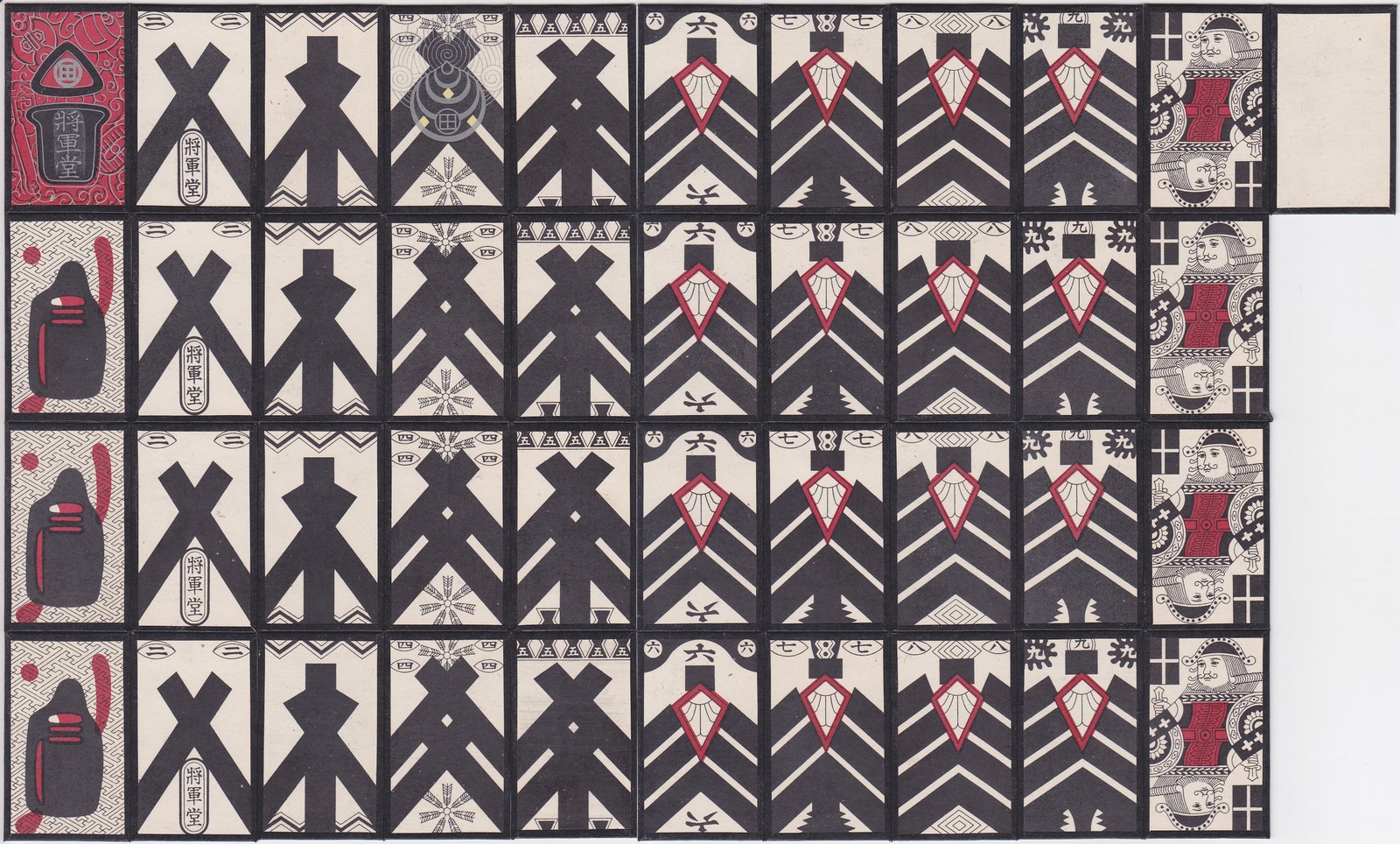
Kabufuda cards, like hanafuda, are smaller and stiffer than Western playing cards. The standard Kabufuda pattern deck contains 40 cards, representing the numbers 1 through 10, with four cards for each number. Additionally, a blank card is often included as a spare. Standard Kabufuda uses only the Latin suit of clubs from mekuri karuta and old Portuguese cards.
One of the 1's has a red background and is decorated gold or silver, called the Aka-pin (赤ピン 'red pin') or Aza-pin (アザピン 'Ace-pin') from Portuguese 'às pintas' ('Ace spots'). The twos often have the manufacturer or distributor's trademark. One of the 4's is also decorated gold or silver, called the Tamashi (玉四 'round four') or Kinshi (金四 'gold four'), which allows it to have a special role in certain games.
Iri no kichi (入の吉) is a local variant of kabufuda where all three face cards from mekurifuda are retained, also featuring a knight and king alongside the knave, for a total of 48 cards. Many decks additionally include an oni card that acts as a wild card. Unlike standard kabufuda cards, modern iri no kichi cards typically remain close to the old face card designs from the pre-modern Edo period.
Other small single-suited regional card patterns such as "Komaru" (小丸), "Mefuda" (目札), and "Daini" (大二) may also be classified as Kabufuda. These patterns are based on the Latin coin suit, have one of their 3's specially decorated, and they also have an additional oni wild card.
Oicho-Kabu (おいちょかぶ) is similar to baccarat where players add up the numbers and compete based on the size and strength of the cards. There is no limit on number of players. The name comes from kabu game terms for 8 and 9, the two highest scores one can have (disregarding special hands), which are believed to be derived from the Portuguese words oito ("eight") and cabo ("end").
Hub AI
Kabufuda AI simulator
(@Kabufuda_simulator)
Kabufuda
Kabufuda (株札) are Japanese playing cards used for gambling games such as Oicho-Kabu mainly used in the Kansai region.
Like the related hanafuda (lit. 'flower cards'), kabufuda is a descendant of mekuri karuta, which ultimately descends from 16th century Portuguese playing cards. Since suits are irrelevant in kabu games, decks used for those games became single-suited during the 18th-century. Like in baccarat, the object of most kabu games is to get a total closest to nine. Early kabufuda decks had three ranks of face cards but since they have no value, only the knaves were kept in most variants.
The word kabu is believed to derive from the Portuguese slang cavo meaning a stake, bet, or wager.[inconsistent] Closely related are the gabo games played with Korean tujeon cards and the Indian Ganjapa game of komi.
Kabufuda cards, like hanafuda, are smaller and stiffer than Western playing cards. The standard Kabufuda pattern deck contains 40 cards, representing the numbers 1 through 10, with four cards for each number. Additionally, a blank card is often included as a spare. Standard Kabufuda uses only the Latin suit of clubs from mekuri karuta and old Portuguese cards.
One of the 1's has a red background and is decorated gold or silver, called the Aka-pin (赤ピン 'red pin') or Aza-pin (アザピン 'Ace-pin') from Portuguese 'às pintas' ('Ace spots'). The twos often have the manufacturer or distributor's trademark. One of the 4's is also decorated gold or silver, called the Tamashi (玉四 'round four') or Kinshi (金四 'gold four'), which allows it to have a special role in certain games.
Iri no kichi (入の吉) is a local variant of kabufuda where all three face cards from mekurifuda are retained, also featuring a knight and king alongside the knave, for a total of 48 cards. Many decks additionally include an oni card that acts as a wild card. Unlike standard kabufuda cards, modern iri no kichi cards typically remain close to the old face card designs from the pre-modern Edo period.
Other small single-suited regional card patterns such as "Komaru" (小丸), "Mefuda" (目札), and "Daini" (大二) may also be classified as Kabufuda. These patterns are based on the Latin coin suit, have one of their 3's specially decorated, and they also have an additional oni wild card.
Oicho-Kabu (おいちょかぶ) is similar to baccarat where players add up the numbers and compete based on the size and strength of the cards. There is no limit on number of players. The name comes from kabu game terms for 8 and 9, the two highest scores one can have (disregarding special hands), which are believed to be derived from the Portuguese words oito ("eight") and cabo ("end").