Hubbry Logo
search
logo
1911403

Kabufuda

logo
Community Hub0 Subscribers
Read side by side
from Wikipedia
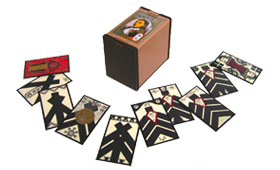
A standard kabufuda pattern deck

Kabufuda (株札かぶふだ) are Japanese playing cards used for gambling games such as Oicho-Kabu mainly used in the Kansai region.

Like the related hanafuda (lit.'flower cards'), kabufuda is a descendant of mekuri karuta, which ultimately descends from 16th-century Portuguese playing cards. Since suits are irrelevant in kabu games, decks used for those games became single-suited during the 18th century.[1] Like in baccarat, the object of most kabu games is to get a total closest to nine.[2] Early kabufuda decks had three ranks of face cards but since they have no value, only the knaves were kept in most variants.

The word kabu is believed to derive from the Portuguese slang cavo meaning a stake, bet, or wager.[3][inconsistent] Closely related are the gabo games played with Korean tujeon cards[4] and the Indian Ganjapa game of komi.[5]

Cards

[edit]

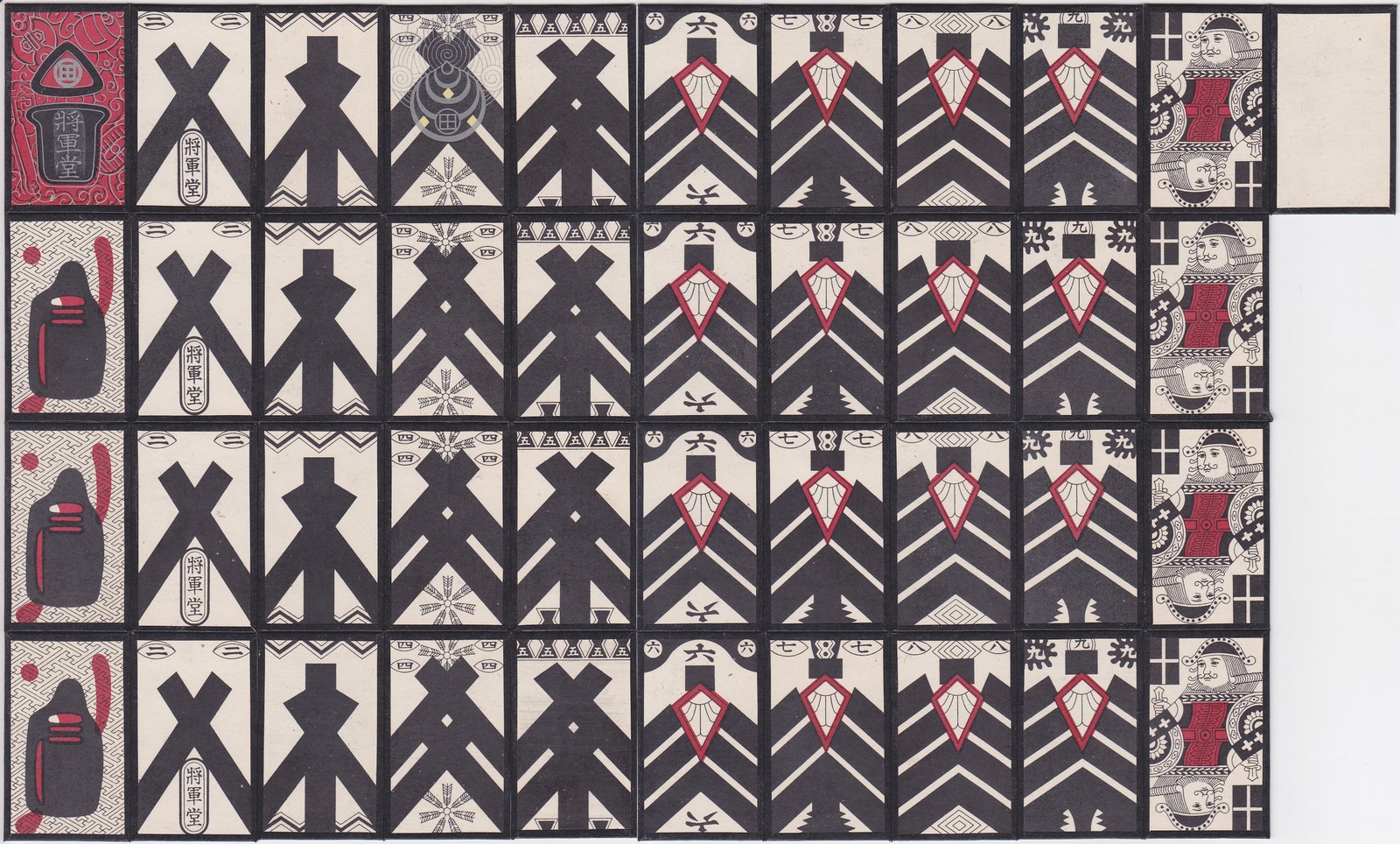
Kabufuda cards, like hanafuda, are smaller and stiffer than Western playing cards. The standard Kabufuda pattern deck contains 40 cards, representing the numbers 1 through 10, with four cards for each number. Additionally, a blank card is often included as a spare. Standard Kabufuda uses only the Latin suit of clubs from mekuri karuta and old Portuguese cards.

One of the 1's has a red background and is decorated gold or silver, called the Aka-pin (赤ピン 'red pin') or Aza-pin (アザピン 'Ace-pin') from Portuguese 'às pintas' ('Ace spots'). The twos often have the manufacturer or distributor's trademark. One of the 4's is also decorated gold or silver, called the Tamashi (玉四 'round four') or Kinshi (金四 'gold four'), which allows it to have a special role in certain games.

Variants

[edit]
Iri no kichi deck, a variant of kabufuda with three different face cards.
Komaru pattern deck. The cards on the bottom are variations on the corresponding cards above.

Iri no kichi (入の吉) is a local variant of kabufuda where all three face cards from mekurifuda are retained, also featuring a knight and king alongside the knave, for a total of 48 cards. Many decks additionally include an oni card that acts as a wild card. Unlike standard kabufuda cards, modern iri no kichi cards typically remain close to the old face card designs from the pre-modern Edo period.

Other small single-suited regional card patterns such as "Komaru" (小丸), "Mefuda" (目札), and "Daini" (大二) may also be classified as Kabufuda.[6] These patterns are based on the Latin coin suit, have one of their 3's specially decorated, and they also have an additional oni wild card.

Games

[edit]

Oicho-Kabu

[edit]

Oicho-Kabu (おいちょかぶ) is similar to baccarat where players add up the numbers and compete based on the size and strength of the cards. There is no limit on number of players. The name comes from kabu game terms for 8 and 9, the two highest scores one can have (disregarding special hands), which are believed to be derived from the Portuguese words oito ("eight") and cabo ("end").

Kyokabu

[edit]

Kyokabu (京カブ) has no limit on number of players and is a variant of Oicho-Kabu with a few distinct differences:

  • The starting first cards for each tableau are always 5, 6, 7, and 8.
  • Players can only bet on one of the four tableaus.
  • For special yaku, the Arashi (アラシ) does not beat the dealer's Kuppin (クッピン). Also, there is no Shippin (シッピン).
  • Combinations resulting in value 0 are considered ties in which the bets are returned to the players.

Hikikabu/Uchikabu

[edit]

Hikikabu (引きカブ) or Uchikabu (打ちカブ) is a game for 2 to 5 players. Players pay an ante and is dealt their own hand of two (or three) cards. Hand values are the same as in Oicho-Kabu, except there is no Shippin. After all cards are dealt, players can either fold or add to the pot. There is a showdown for those who didn't fold, and the pot is split depending on the results.

Bopin/Boni

[edit]

Bopin (ボーピン) or Boni (ボーニ) is a variant of Hikikabu that uses 48 cards (including the horse and the warrior) for two to five players. The twelve face cards are called "Boue" (亡絵 or ぼうえ) and the Ace is called a "Pin" (ピン). All the Boue are value 10. The gameplay is the same as in Hikikabu, except if the dealer draws both a Boue and a Pin, then it is called a "Bopin Kakitakuri" (ボーピン掻きたくり) and the dealer wins unconditionally. If the dealer draws all three Boue, it is called "San Boue Warai" (三亡笑い) and the player with the highest total value wins. There is also an optional rule called "Boni" (ボーニ) in which the dealer wins even if he draws a Boue and a 2.

San-mai kabu

[edit]

San-mai kabu (三枚カブ), like Bopin, uses 48 cards. There is no limit on number of players. Three sets of three cards are placed on the table and players are asked to place their bets. The dealer prepares three cards for themself, and the values are determined. If the player wins, the dealer pays four times the bet. If the player loses, the bet is forfeited to the dealer.

Go-mai kabu

[edit]

Go-mai kabu (五枚カブ) for up to eight people is similar to Pai gow where players are dealt five cards and try to form two hands: one which is a multiple of 10, and the other whose value is closest to 9.

Ju-mai kabu/Sumou-tori kabu

[edit]

Ju-mai kabu (十枚カブ) is mainly played in the Shikoku region and in the Hokuriku region it is called Sumou-tori kabu (相撲取りカブ). There is no limit to the number of players. Ten cards are laid out on the table. Players are asked to place bets on the cards, and the dealer prepares two cards for themself. The dealer deals one card to the table, and the totals are compared. If the players win, the dealer pays four times their bet. If the player loses, the bet is confiscated by the dealer.

Ei-me-tsukuri/Kabu tsukuri

[edit]

Ei-me-tsukuri (エイ目作り) or Kabu tsukuri (カブ作り) is for up to five players, with each player being dealt nine or ten cards.[clarification needed] Each player makes three sets of three cards; for players with ten cards, the remaining card is not used in the game. The three sets are placed face-down vertically in front of each player. Players pay the ante and the cards in their top row are turned face-up so that a winner can be determined. Players do the same with their middle, and bottom rows. Players compete against each other, not against the dealer.

Dare

[edit]

Dare (誰), for two to four players, uses 39 cards (excluding the red pin). Each player is dealt nine cards, and the remaining three are exposed to the table. The sum modulo ten of the cards on the table is the standard value. Players make three sets of three cards, attempting to make each set the standard value. If they fail to do so, the remaining cards' sum modulo ten becomes their value. Players compare results with each other to determine a winner.

Sashikomi/Yubi e

[edit]

Sashikomi (指込) or Yubi e (指絵), like Bopin, uses 48 cards. It is for two players. Each player is dealt three cards, and their totals determine the winner. Players may discard a card to draw a card from the deck.

Takame

[edit]

Takame (高目), like Bopin, uses 48 cards. There is no limit to the number of players. The dealer places two cards face-down and players bets on one of them. In the case of a tie, additional cards are drawn to determine a new total.

Jumoku

[edit]

In Jumoku (十目), players pay an ante before being dealt two cards and comparing results. The sum modulo ten of 0 is the highest, instead of 9.

Karafuto kabu

[edit]

Karafuto kabu (樺太カブ) has no limit on number of players. The game uses cards ranked 1 to 6. The dealer places a card face-down and players try to guess the number by writing it down before placing their bet. If the player wins, the dealer pays four times the bet. If the player loses, the dealer confiscated the bet.

Kachi-Kachi

[edit]

Kachi-Kachi (かちかち) for two to six players uses half the deck and is similar to blackjack mixed with poker where players try to get their total modulo ten closest to nine. Unlike Oicho-Kabu, there are three rounds of betting and players have their own hand of two cards which can be improved upon with a total modulo ten of zero.

King

[edit]

King (きんご) derived from the Portugueze "quinze" (English: "fifteen") for up to seven people that plays the same as blackjack with a goal of 15 instead of 21. There are two special hands: three 5's which triples the players bet, and a 4, 5, and 6 which doubles it.

References

[edit]
[edit]
Revisions and contributorsEdit on WikipediaRead on Wikipedia
from Grokipedia
Kabufuda are a type of traditional Japanese playing cards, consisting of a 40-card deck (plus one blank card) featuring four identical copies each of the numerical ranks 1 through 10, derived from the clubs (batons) suit of 16th-century Portuguese cards imported to Japan.[1][2] These cards are smaller and stiffer than standard Western playing cards, often with simple numerical designs where the rank 1 (known as pin) is marked by a single dot, increasing progressively, and the rank 10 (nicknamed otō-san or "father") depicts a stylized jack figure.[1] Primarily used for gambling games in the showdown family, such as oicho-kabu or point-matching games aiming for totals closest to nine, kabufuda emphasize hand comparison over trick-taking, with regional rules varying across Japan, primarily in the Kansai region.[3][4] The origins of kabufuda trace back to the mid-16th century, when European traders introduced Latin-suited cards to Japan, leading to local adaptations after the Tokugawa shogunate banned foreign imports in the early 17th century to curb gambling and foreign influence.[2] These single-suited decks evolved as mekurifuda (blind cards), focusing solely on numerical values without distinct suits, and became widespread for informal wagering in rural and urban settings.[1] In the late 19th century, the company now known as Nintendo—founded in 1889 by Fusajiro Yamauchi—began mass-producing high-quality hanafuda (flower cards) and kabufuda as its core business, with Nintendo's Daitōryō (Presidential) set remaining a standard modern edition sold for around 1,800 yen (as of 2025).[4][5] Today, kabufuda persist in niche play, particularly in gambling contexts, though less popular than hanafuda, and feature subtle design variations like a red ace (aza-pin) or metallic-overprinted 4 (tama-shi or kin-shi) that do not typically affect gameplay.[1]

Introduction

Overview

Kabufuda is a traditional Japanese playing card deck consisting of 40 cards: four copies each of the numerical ranks 1 through 10, primarily used for gambling games such as Oicho-Kabu in the Kansai region of Japan.[1][2] These cards are designed for quick play in betting contexts, distinguishing them from other Japanese card traditions like hanafuda, which emphasize seasonal motifs over numerical values for matching games.[6] Physically, Kabufuda cards measure approximately 5.3 cm by 3.2 cm, making them smaller, narrower, and stiffer than standard Western playing cards to facilitate rapid shuffling and dealing.[7] They often feature rounded corners and a single-suited design derived from the clubs suit, with minimal artwork focused on pips and ranks rather than elaborate illustrations.[2] The deck traces its origins to Portuguese playing cards introduced to Japan in the 16th century, adapted into a simplified form for local gambling practices.[1] In modern times, Kabufuda production continues through companies like Nintendo, which began manufacturing various Japanese card decks, including Kabufuda, in 1889 as part of its initial business in Kyoto.[4][8]

Cultural Significance

Kabufuda holds a prominent place in Japanese gambling traditions, particularly through its use in games like Oicho-Kabu, which serves as a cultural staple for betting activities.[9] This game is a mainstay in underground gambling parlors associated with the yakuza, Japan's organized crime syndicates, where it embodies high-stakes risk and social hierarchy among players.[9] The term "yakuza" itself derives from the worst possible hand in Oicho-Kabu—8-9-3, summing to zero and pronounced "ya-ku-za"—highlighting the game's deep integration into criminal folklore and identity.[9] Beyond illicit settings, Kabufuda is also enjoyed as a casual social game among friends and family, fostering camaraderie through simple yet strategic play.[4] In Japanese culture, Kabufuda reflects a blend of luck and calculated risk, mirroring broader societal attitudes toward fate and personal agency in uncertain endeavors. While not explicitly tied to festivals in documented traditions, its gambling-oriented nature contrasts with the more benign, seasonal themes of hanafuda, which emphasize matching flower motifs for non-betting games like Koi-Koi. Kabufuda's numerical suits and focus on summing to nine underscore a risk-oriented appeal, appealing to those seeking thrill over hanafuda's poetic, nature-inspired leisure.[4] Kabufuda's influence extends to modern media, notably as a recurring minigame in the Yakuza (Like a Dragon) video game series, where Oicho-Kabu simulates authentic gambling mechanics and reinforces the franchise's ties to Japanese underworld tropes.[10] This portrayal has popularized the game among global audiences, blending traditional elements with digital entertainment. Nintendo's historical production of Kabufuda decks since the late 19th century further links the cards to the company's evolution from card maker to video game pioneer, with sets still available today as nostalgic items.[4] Post-World War II, Kabufuda's popularity waned due to Japan's stringent anti-gambling laws under the 1907 Penal Code, which prohibited most betting activities and pushed traditional card games underground, limiting public play.[11] However, a revival has occurred through tourism and collectibles markets, where authentic decks from manufacturers like Nintendo attract enthusiasts and visitors seeking cultural artifacts, sustaining interest in this enduring gambling tradition.[4]

History

Origins

Kabufuda originated from playing cards introduced to Japan by Portuguese traders in the mid-16th century, with the first European contact occurring in 1543 when a Portuguese ship arrived on Tanegashima Island. These early imports were Latin-suited decks featuring four suits—clubs (batons), swords, cups, and coins—mirroring Portuguese patterns used in Europe and exported globally. Japanese artisans quickly began producing local copies, known as Tensho karuta during the Tensho era (1573–1592), primarily in regions near Nagasaki, the primary port for Portuguese trade since 1571. These decks retained the multi-suited structure but adapted designs to local materials and aesthetics, marking the initial adaptation of Western card technology in Japan.[12] The term "kabufuda" derives from "kabu," meaning stake or wager in Japanese, reflecting the cards' primary use in gambling, combined with "fuda" for card; this etymology traces back to the Portuguese slang "cavo," denoting a bet, highlighting the linguistic influence from early traders. Initially called mekuri karuta (turning cards), referring to the face-down play style, these decks simplified the Portuguese model by emphasizing the clubs suit as the base, reducing to a single-suit system with numerical ranks from 1 to 10 for streamlined gambling. While some scholars note superficial resemblances to Korean hwatu (derived later from similar Japanese adaptations) or Indian ganjifa (an earlier money-suited tradition), the primary lineage remains Portuguese, with no direct evidence of those influences on kabufuda's core structure.[13][14][2] The early 17th-century ban on Christianity, intensified by edicts from 1587 and a full prohibition in 1614 under the Tokugawa shogunate, drove card play underground, as initial designs incorporated Christian iconography like cups resembling the Holy Grail, risking execution for suspected practitioners. This suppression, coupled with broader prohibitions on gambling and foreign imports, compelled clandestine production and play, particularly in urban centers and ports. By the 1700s, adaptations shifted focus to purely numerical values, stripping symbolic elements to evade detection and emphasize betting mechanics, solidifying kabufuda's distinct identity.[12][14]

Evolution in Japan

In the 18th century, Kabufuda underwent a significant transformation as Japanese card games shifted from suit-based mechanics, influenced by European styles like ombre, to numerical games similar to baccarat, where suits held no relevance.[7] This led to the standardization of single-suited decks, typically using the batons (clubs) suit from Portuguese-derived mekuri karuta, repeated four times to form a 40-card set (ranks 1-10, with the 10 often as a court card).[2] The reduction streamlined production and play, focusing on totaling values closest to nine, and reflected broader adaptations under the Tokugawa shogunate's restrictions on foreign imports.[7] By the 19th century, following the Meiji Restoration's easing of isolationist policies, Kabufuda production expanded through local manufacturers, enabling mass output of affordable decks for gambling games like Oicho-Kabu.[2] Nintendo entered the market in 1889, initially focusing on hanafuda but soon incorporating Kabufuda into its lineup, which helped popularize standardized patterns with Western-style court cards.[4] This era saw waves of legalization for card manufacturing, though gambling remained prohibited, positioning Kabufuda as a discreet tool for informal wagering across regions.[15] Post-war economic recovery revived manufacturing, with companies like Nintendo continuing output into the late 20th century, often marketing decks as cultural items or souvenirs amid Japan's modernization.[4] The rise of alternative entertainments in the mid-20th century contributed to a decline in traditional play, shifting Kabufuda toward niche use in rural communities and among collectors.[2] Digital adaptations emerged in the 21st century, with mobile apps simulating Oicho-Kabu using virtual Kabufuda decks, preserving the game for new audiences.[16]

The Deck

Composition

The standard Kabufuda deck consists of 40 playing cards, organized as four identical sets of ten ranks ranging from 1 to 10, all depicted in a single suit of clubs, rendering the suits effectively indistinct. Each set includes the rank 1 represented as a pin or ace, ranks 2 through 9 as numerical values, and rank 10 as a face card (jack) serving as high value in gameplay. Some decks incorporate one additional blank card as a spare, resulting in a total of 41 cards; regional variants expand to 48 cards with additional ranked cards and wilds.[1][2][7][17] Kabufuda cards are traditionally crafted from multiple layers of handmade washi paper, which provides the necessary stiffness and flexibility for repeated handling, though contemporary productions often feature plastic coating for enhanced durability and water resistance. The cards are notably smaller and more rigid than standard Western playing cards, with typical dimensions of 58 mm in height by 35 mm in width. Unlike Western decks with uniform patterned backs for secrecy, Kabufuda cards generally have plain or minimally decorated backs to maintain simplicity.[18][19] Historically, Kabufuda decks were packaged in ornate wooden boxes, such as those made from paulownia wood, to protect the delicate paper cards during storage and transport. Modern decks, however, are commonly housed in practical plastic cases for convenience and portability. These packaging choices reflect the evolution from artisanal production to mass manufacturing while preserving the deck's core structure.[20][19]

Design and Ranks

Kabufuda cards employ a single-suit design derived from the clubs (or batons) suit of Portuguese playing cards, repeated four times to form the deck. Each rank from 1 to 10 is represented numerically, with four identical cards per rank, though the 10 is depicted as a jack-like court card rather than a simple numeral. Low-ranking cards (1 through 9) feature straightforward pip counts of stylized club symbols arranged in a symmetrical pattern, emphasizing functionality over ornamentation, and the rank 10 portrays a warrior or courtier in a simplified, double-ended European style, without the detailed facial portraits or regalia found in Western court cards.[7][2][1] Special distinctions mark two cards within the ranks: one of the four 1s has a red background, known as the Aka-pin (red pin), adorned with gold or silver accents for prominence, while the other three 1s are in black. Similarly, one 4 features gold or silver overprinting, termed Tamashi (round four) or Kinshi (gold four), contrasting the standard black versions of that rank. These unique designs aid in gameplay identification without altering the numerical hierarchy. The overall artistic style is minimalist and practical, with bold lines and minimal shading to suit fast-paced gambling, often printed on stiff, glossy paper for durability and quick visual parsing.[1][7] Unlike hanafuda decks, which use vibrant floral scenes and multi-suit motifs tied to seasons, kabufuda prioritizes numerical pips and monochromatic schemes focused solely on the club suit, reflecting its origins in imported Western cards adapted for Japanese gambling.[1][21]

Variants

Regional variations of the Kabufuda deck exist primarily in the Kansai region and surrounding areas, where expanded 48-card sets incorporate additional elements not found in the standard 40-card deck. For instance, the Kinseizan pattern, used in Tsuruga and Kii provinces, includes three court cards ranked 10, 11, and 12, along with overprinted special cards and a red Onifuda wild card that can substitute for any value in gameplay. Similarly, the Irinokichi pattern, prevalent in Kishu and Shima provinces, features 48 cards with an Onifuda and overprinted 1 and 4 cards, reflecting local adaptations for diverse playing styles in these areas.[21] In the former Japanese territory of Karafuto (now southern Sakhalin Island), a specialized deck known as Dai-ichiroku was employed for games like Karafuto-kabu, featuring a larger card size and the suit of clubs while maintaining numerical values similar to Kabufuda, though adapted for regional play under Japanese administration from 1905 to 1945. Size modifications for practicality include mini decks designed for travel, typically measuring around 4 cm by 2.5 cm, allowing portability without altering the core composition. Luxury editions, often finished with traditional lacquer for durability and aesthetic appeal, cater to collectors and high-end players, emphasizing craftsmanship in their production.[22][15] Modern adaptations by Nintendo, which began producing Kabufuda in 1889 as part of its origins in card manufacturing, include durable plastic versions introduced in 1953 under the NAP line for washability and hygiene, featuring branded backs with company motifs until around 2007 for certain series. Reduced 40-card decks, which omit any blank cards present in fuller sets, facilitate faster gameplay by streamlining draws and reducing setup time. Collectible variants encompass limited-edition reproductions of historical patterns, such as Edo-period designs, and themed art series that incorporate contemporary illustrations while preserving traditional ranks, appealing to enthusiasts and preserving cultural heritage.[4][23][21]

Basic Mechanics

Card Values

In Kabufuda, each card is assigned a numerical value based on its rank, with cards numbered 1 through 9 retaining their face value and the 10-valued cards (often depicted as jacks or "boue") counting as 0 in gameplay calculations.[9] This system ensures that high-ranking cards like 10 do not contribute to the total sum, similar to tens in baccarat, promoting strategic decisions around drawing additional cards to approach the target without exceeding it.[24] The hand's total value is determined by summing the numerical values of the cards and then taking the result modulo 10, discarding any tens digit to yield a single-digit score from 0 to 9.[9] The objective in most Kabufuda games is to achieve a total of 9 (known as "kabu") or 8 ("oicho"), with 9 being the strongest possible standard hand and 8 the next best, while lower totals like 0 represent the weakest outcomes.[9] Suits do not influence these values, as the deck is uniformly based on a single suit pattern derived from clubs, ensuring consistency across all cards of the same rank.[1] Certain cards feature distinctive designs without altering their base numerical worth: the Aza-pin (or Aka-pin), a red-backed 1, and the Tama-shi (or Kin-shi), a specially marked 4 with gold or silver elements.[1] In standard play, these retain values of 1 and 4, respectively, though the deck includes only one of each special variant alongside three standard versions per rank.[1] Pair-based bonuses elevate specific combinations beyond standard totals; for instance, three cards of the same rank form a "three of a kind" (arashi) hand, which automatically wins and typically pays triple the stake, outranking even a natural 9.[9] These special hands emphasize the deck's repetitive structure, where identical ranks across the four series enable such powerful formations.[9]

Common Play Elements

In Kabufuda games, the deck is shuffled thoroughly before play begins, and the dealer typically distributes two or three cards face down to each player, depending on the variant. The banker, often referred to as the one who "deals the hand" (te furu), may rotate clockwise among players in non-banking formats or remain fixed in gambling-oriented banking games to facilitate betting against the house. This setup ensures fair distribution and maintains the game's pace across 2 to 10 participants. While mechanics vary across Kabufuda's diverse games, many follow showdown or banking styles similar to Oicho-Kabu.[3] Betting forms a core aspect of most Kabufuda play, with players posting an initial ante using chips, tokens, or currency into a central pot or directly to the banker. In banking variants, additional side bets are common, allowing wagers on specific outcomes like achieving certain pairs, totals, or bonuses against the banker's hand. Payouts are scaled based on the bet amount, with the banker collecting losses and distributing winnings accordingly. Drawing additional cards follows structured rules to build hands, where players assess their initial total and decide to hit or stand. In variants like Oicho-Kabu, a hit is mandatory if the sum is 3 or less, prohibited if 7 or higher, and optional otherwise, aiming to improve proximity to the target value; some formats limit draws to one extra card. Hand values are determined by the sum of card numbers modulo 10, emphasizing strategic restraint over aggressive drawing. Winning conditions center on achieving the hand total closest to 9, with no busting mechanic since excess values simply wrap around via the modulo calculation. Ties are resolved by comparing special combinations, such as pairs or three-of-a-kind, which take precedence over numerical equality; in banking games, unresolved ties may favor the banker or return bets. The term "teyaku" denotes these natural or bonus hands that secure immediate victory regardless of numerical comparison. Players may fold suboptimal hands through a process akin to "furikomi," surrendering their ante to avoid further losses in showdown formats, though this is less emphasized in fixed-hand banking styles. These elements promote a blend of luck and decision-making, adaptable across Kabufuda's diverse games while upholding the deck's numerical focus.

Games

Rules for kabufuda games vary by region and house; the following describes common versions.

Oicho-Kabu

Oicho-Kabu is the most popular Kabufuda game, a banking-style showdown where multiple players bet against a banker to form the hand closest to a total value of 9, with card totals reduced modulo 10 (e.g., 12 counts as 2, 10 as 0). The name derives from "oicho" for 8 (the second-best hand) and "kabu" for 9 (the best hand).[9] Played with 2 to 10 players facing the banker, the game uses a standard 40-card Kabufuda deck consisting of four copies each numbered 1 to 10 (10 valued as 0).[9] Setup begins with selecting the banker, often by drawing the highest card (closest to 9), after which players seat anti-clockwise around the table. The group agrees on rules for ties (e.g., banker wins or redraw) and a maximum bet limit beforehand.[9] The banker shuffles and a player may cut the deck. The banker deals one face-up card to each of four tableaus (positions) and one face-down card to themselves. Players then place bets on one or more of these positions, with the total bet across all positions not exceeding the limit. One face-down card is dealt to each tableau to form initial two-card hands (revealed for betted positions).[9] For each tableau, a third card may be drawn face-up: mandatory for totals of 0-3, optional for 4-6 (decided by the player closest to the banker), and prohibited for 7 or higher to avoid busting over 9. The banker reveals their initial card, draws a second, and follows similar drawing rules but may choose draw position for advantage.[9] Card values are the numbers printed (1-9 as is, 10 as 0), with dealing alternating between tableaus and banker. To win, the betted tableau's hand must total closer to 9 than the banker's, or exactly 9 for an automatic victory; the banker wins ties unless otherwise agreed. Special hands include Arashi (three-of-a-kind, pays 3:1); Kuppin (banker's 9-1, auto-win for banker); and Shippin (tableau's 4-1, auto-win for player). Bets pay 1:1 for standard wins, with higher payouts for specials; on ties, bets typically return or double for the next round to maintain action.[9] The banker holds a slight edge due to drawing rules and tie resolution favoring the house. Optimal strategy emphasizes conservative play: stand on 7 or higher, always hit on 0-3, and decide on 4-6 based on banker's visible card. After resolution, the banker may rotate if they lose multiple hands, continuing until a limit or consensus ends the session.[9]

Kyokabu

Kyokabu is a streamlined banking variant of Kabufuda designed for rapid play among 2 to 8 players, where the banker deals to fixed positions labeled 5, 6, 7, and 8 (face-up first-field cards), and players bet on these positions against the banker's hand.[25] The game allows for quick resolution with up to three cards per hand and multiple rounds. Players place bets before the second field is dealt, competing individually against the banker's hand.[25] The objective is to achieve a hand total closest to 9, calculated by summing the numerical values and taking the result modulo 10, where totals of 10 or 20 equate to 0.[25] After betting, four face-down cards form the second field for the positions; betted hands are revealed. A third card may be requested following standard rules (mandatory ≤3, forbidden ≥7, optional 4-6). The banker draws similarly. Values of 8 or 9 are strong, while 0 is weak.[25] Special rules include the banker winning all ties and optional side bets on the banker's total. Three-of-a-kind in 5-8 pays 3:1; banker's 9+1 auto-wins all bets.[25] Payouts are 1:1 for main wins, 3:1 for three-of-a-kind; losing bets go to the banker, who rotates after set rounds or losses. The structured first field and drawing enable faster play than standard variants.[25] A notable variant treats Kyokabu as an "extreme" form for high-stakes, with larger bets but unchanged core mechanics.[25]

Hiki-Kabu and Uchikabu

Hiki-Kabu and Uchikabu are variants of Kabufuda played in group settings with 2 to 10 players, typically using a standard 40-card deck, where participants bet on tableaus receiving an initial two cards and possibly a third based on drawing rules. These games emphasize banking against a dealer, with the goal of forming a total closest to 9 using the ones digit of the card sum (e.g., 10 counts as 0). The dealer resolves all hands, paying out winning bets at even money while collecting on losses, with bonuses for specials.[26] In Hiki-Kabu, the "hiki" (pulling) mechanic allows player control: after betting on four face-up field cards and receiving face-down second cards, players assess totals privately. A third card must be pulled if the total is 3, is prohibited if 7 or higher, and is optional otherwise. The dealer then reveals their hand for comparison. This promotes calculated risk.[26] Uchikabu is a related variant with 2 to 5 players, focusing on dealer-controlled distribution rather than individual pulls, but following similar drawing prohibitions and objectives without confirmed unique "pushing" mechanics in standard rules. The banker oversees resolutions, suitable for group play.

Bopin and Similar

Bopin, also referred to as Boni in some regional play, is a banking-style variant of Kabu games using a 48-card extended Kabufuda deck (including horse and warrior ranks) for 2 to 5 players. The dealer competes against players by forming hand totals up to three cards, with strength determined by the ones digit of the sum (e.g., 12 counts as 2), aiming closest to 9. A key feature is the special "Bopin" combination for the dealer—a 10 (horse, "boue") paired with a 1—allowing the dealer to win all bets automatically; an optional "Boni" extension applies to a 10 and 2. Three-of-a-kind provides bonus payouts. San-mai Kabu serves as a close analog to Bopin, supporting any number of players with a 48-card deck such as mekurifuda patterns. The dealer arranges three face-down stacks of three cards each as betting positions and draws their own three-card hand. Players place bets on positions, after which hands are revealed and compared using the ones-digit rule. A winning position pays 2:1, while three-of-a-kind yields 3:1. Ties favor the dealer per house rules.[27] Go-mai Kabu extends to 5-card hands for 2 to 8 players, using a 40-card deck. The dealer deals eight face-down stacks of five cards; players select stacks clockwise, anteing to a pot. Each must form a three-card set summing to a multiple of 10 (10, 20, or 30); the remaining two cards form the scoring hand, where pairs outrank non-pairs and higher totals win ties. Failure to form the set results in folding and losing the ante. The strongest hand wins the pot.[28] These variants are often played to accumulate points toward a target, with San-mai offering quick 3-card play and Go-mai adding set-building complexity.[3]

Other Traditional Variants

Kabu-tsukuri, also known as Ei-me-tsukuri, is a gambling game for 2 to 5 players using a 48-card hanafuda or kabufuda deck, where participants receive 9 or 10 cards and arrange them into three rows of three, betting on row strength sequentially over rounds. The pot goes to the highest row based on sums or formations, with ties carrying over.[29] Sumou-tori kabu, a regional variant of Ju-mai kabu in Hokuriku and Shikoku, uses 10-card hands to simulate sumo matchups against opponents or banker, favoring totals closest to 9. Karafuto kabu is a localized banking game from former Karafuto Prefecture (now southern Sakhalin), for any number against a dealer using a partial hanafuda deck (first six months). Players bet on guessing the dealer's concealed card value, with successful predictions paying up to 4:1. A related Hokkaido variant, Kachi-kachi, uses a half-deck for multi-round betting on ones-digit sums, with draws for zero hands and final showdowns.[30][31] Sashikomi, sometimes alongside Yubi-e, is a two-player game with the full 48-card deck: each gets three cards, optionally discards and redraws once, competing for the highest ones-digit sum (aiming for 9). It includes gesturing for bets. Dare, for 2 to 4, involves antes and discarding three-card sets matching a field value to clear the hand and win the pot.[32][33] Jumoku and King variants adapt kingo-kei fishing games for 2 to 7 players using a 40-card deck (excluding November/December), drawing to total close to 15 without exceeding (bust doubles losses). Jumoku features tree combos like Shigoro (April-May-June=15, double win); King emphasizes high hands like three Mays (triple payout). They focus on drawing and sequences over standard summation.[34]
User Avatar
No comments yet.