



Community hub
Recent from talks
Knowledge base stats:
Talk channels stats:
Members stats:
Kambala
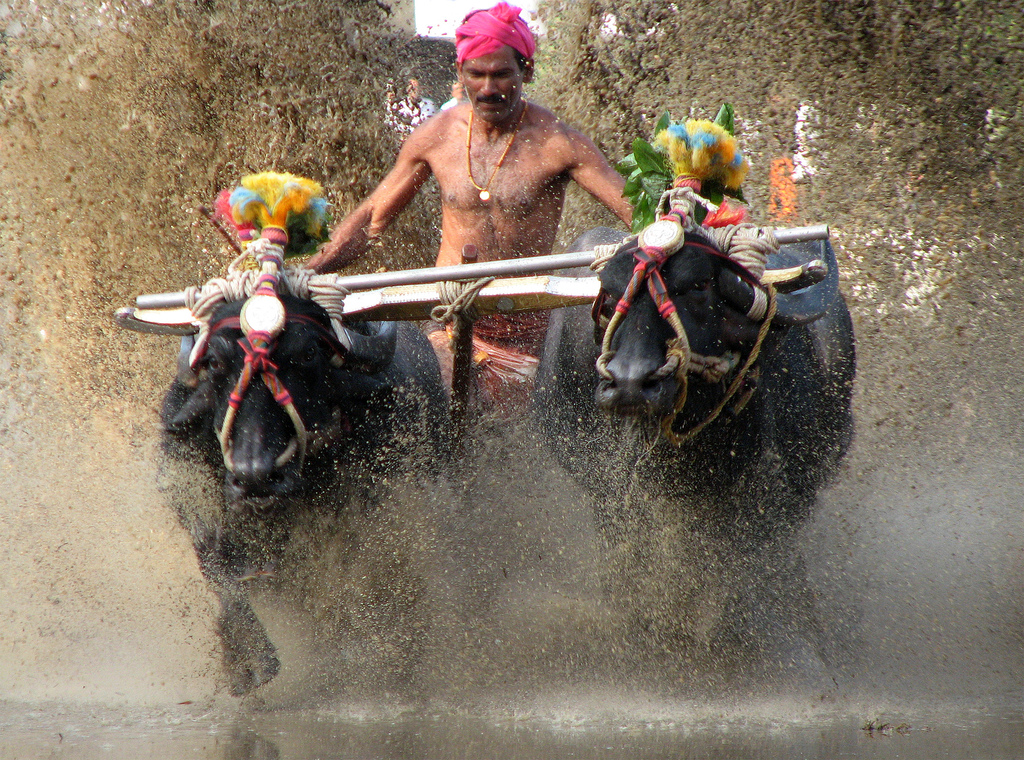
The Kambala, Kambla or Kambula is an annual buffalo race held in the southwestern Indian state of Karnataka. It is similar to Maramadi of Kerala. Traditionally, it is sponsored by local Tuluva landlords and households in the coastal districts of Dakshina Kannada, Udupi and Bhatkal of Karnataka and Kasaragod of Kerala, a region collectively known as Tulu Nadu.
The Kambala season generally starts in November and lasts until March. The Kambalas are organised through Kambala samithis (Kambala associations). Over 45 races are held annually in coastal Karnataka.
Kambala is derived from 'kampa-kala', where the word 'Kampa' relates to a slushy, muddy field. The Dravidian origin of the word Kampa is kan+pa and 'kala' means field, where it is conducted. Another interpretation of modern Kambala is derived from 'Kamba', a pole used for water spurt during race by buffalo pairs.
Kambala is a sport. The Kambala racetrack is a slushy paddy field, and the buffaloes are driven by a whip-lashing farmer.
Traditional Kambala was non-competitive, and the pair was run one by one. In modern Kambala, the contest generally takes place between two pairs of buffaloes. In villages such as Vandar (Vandaru) in Udupi and Chordi (Choradi) in Shivamogga, there is also a ritualistic aspect, as farmers race their buffaloes to give thanks to the deities for protecting them from diseases.
Historically, the winning pair of buffaloes was rewarded with coconuts and bananas. Today, owners of the winning beasts win gold and silver coins. Some organising committees award an eight-gram gold coin to the winner. In some competitions, cash prizes are awarded.
The buffaloes are decorated with coloured jhūls and head-pieces made of brass and silver (sometimes bearing the emblems of the sun and moon), and ropes which make a sort of bridle. The special towel used to cover the buffaloes' back is called the paavade (Tulu:ಪಾವಡೆ).
The Kambla was influenced by Natha pantha, in earlier days. It starts the day before, with traditional dance of Koraga communities - mostly by men. They perform the entire night with the Panchamakara - madya (Alcohol), māṃsa (Meat), matsya (Fish), mudrā (Gesture), and maithuna (Sexual). The Koragas then perform a ceremony called panikkuluni, the meaning of word sitting under the dew. They sing songs to the accompaniment of their special kind of band dudi, about their special spirit daiva Nīcha, and offer toddy and a rice-pudding boiled in a large earthen pot, which is broken so that the pudding remains as a solid mass. This pudding is called kandēl addyē, or pot pudding.
Hub AI
Kambala AI simulator
(@Kambala_simulator)
Kambala
The Kambala, Kambla or Kambula is an annual buffalo race held in the southwestern Indian state of Karnataka. It is similar to Maramadi of Kerala. Traditionally, it is sponsored by local Tuluva landlords and households in the coastal districts of Dakshina Kannada, Udupi and Bhatkal of Karnataka and Kasaragod of Kerala, a region collectively known as Tulu Nadu.
The Kambala season generally starts in November and lasts until March. The Kambalas are organised through Kambala samithis (Kambala associations). Over 45 races are held annually in coastal Karnataka.
Kambala is derived from 'kampa-kala', where the word 'Kampa' relates to a slushy, muddy field. The Dravidian origin of the word Kampa is kan+pa and 'kala' means field, where it is conducted. Another interpretation of modern Kambala is derived from 'Kamba', a pole used for water spurt during race by buffalo pairs.
Kambala is a sport. The Kambala racetrack is a slushy paddy field, and the buffaloes are driven by a whip-lashing farmer.
Traditional Kambala was non-competitive, and the pair was run one by one. In modern Kambala, the contest generally takes place between two pairs of buffaloes. In villages such as Vandar (Vandaru) in Udupi and Chordi (Choradi) in Shivamogga, there is also a ritualistic aspect, as farmers race their buffaloes to give thanks to the deities for protecting them from diseases.
Historically, the winning pair of buffaloes was rewarded with coconuts and bananas. Today, owners of the winning beasts win gold and silver coins. Some organising committees award an eight-gram gold coin to the winner. In some competitions, cash prizes are awarded.
The buffaloes are decorated with coloured jhūls and head-pieces made of brass and silver (sometimes bearing the emblems of the sun and moon), and ropes which make a sort of bridle. The special towel used to cover the buffaloes' back is called the paavade (Tulu:ಪಾವಡೆ).
The Kambla was influenced by Natha pantha, in earlier days. It starts the day before, with traditional dance of Koraga communities - mostly by men. They perform the entire night with the Panchamakara - madya (Alcohol), māṃsa (Meat), matsya (Fish), mudrā (Gesture), and maithuna (Sexual). The Koragas then perform a ceremony called panikkuluni, the meaning of word sitting under the dew. They sing songs to the accompaniment of their special kind of band dudi, about their special spirit daiva Nīcha, and offer toddy and a rice-pudding boiled in a large earthen pot, which is broken so that the pudding remains as a solid mass. This pudding is called kandēl addyē, or pot pudding.