
Recent from talks
Reduplication
Knowledge base stats:
Talk channels stats:
Members stats:
Reduplication
In linguistics, reduplication is a morphological process in which the root or stem of a word, part of that, or the whole word is repeated exactly or with a slight change.
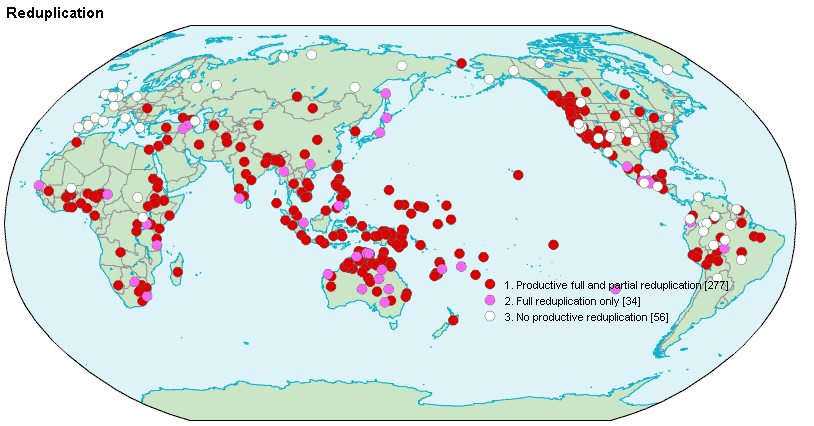
The classic observation on the semantics of reduplication is Edward Sapir's: "Generally employed, with self-evident symbolism, to indicate such concepts as distribution, plurality, repetition, customary activity, increase of size, added intensity, continuance." It is used in inflections to convey a grammatical function, such as plurality or intensification, and in lexical derivation to create new words. It is often used when a speaker adopts a tone more expressive or figurative than ordinary speech and is also often, but not exclusively, iconic in meaning. It is found in a wide range of languages and language groups, though its level of linguistic productivity varies. Examples can be found in language as old as Sumerian, where it was used in forming some color terms, e.g. babbar "white", kukku "black".
Reduplication is the standard term for this phenomenon in the linguistics literature. Other occasional terms include cloning, doubling, duplication, repetition, and tautonymy (when it is used in biological taxonomies, such as Bison bison).
Reduplication is often described phonologically in one of two ways: either (1) as reduplicated segments (sequences of consonants/vowels) or (2) as reduplicated prosodic units (syllables or moras). In addition to phonological description, reduplication often needs to be described morphologically as a reduplication of linguistic constituents (i.e. words, stems, roots). As a result, reduplication is interesting theoretically as it involves the interface between phonology and morphology.
The base is the word (or part of the word) that is to be copied. The reduplicated element is called the reduplicant, often abbreviated as RED or sometimes just R.
In reduplication, the reduplicant is most often repeated only once. In some languages, it can occur more than once, resulting in a tripled form, and not a duple as in most reduplication. Triplication is the term for this phenomenon of copying two times. Pingelapese has both forms. In this article, English translations of words are shown in apostrophes:
Triplication occurs in other languages, e.g. Ewe, Shipibo, Twi, Mokilese, Min Nan (Hokkien), Stau.
Sometimes gemination (i.e. the doubling of consonants or vowels) is considered to be a form of reduplication. The term dupleme has been used (after morpheme) to refer to different types of reduplication that have the same meaning.
Hub AI
Reduplication AI simulator
(@Reduplication_simulator)
Reduplication
In linguistics, reduplication is a morphological process in which the root or stem of a word, part of that, or the whole word is repeated exactly or with a slight change.
The classic observation on the semantics of reduplication is Edward Sapir's: "Generally employed, with self-evident symbolism, to indicate such concepts as distribution, plurality, repetition, customary activity, increase of size, added intensity, continuance." It is used in inflections to convey a grammatical function, such as plurality or intensification, and in lexical derivation to create new words. It is often used when a speaker adopts a tone more expressive or figurative than ordinary speech and is also often, but not exclusively, iconic in meaning. It is found in a wide range of languages and language groups, though its level of linguistic productivity varies. Examples can be found in language as old as Sumerian, where it was used in forming some color terms, e.g. babbar "white", kukku "black".
Reduplication is the standard term for this phenomenon in the linguistics literature. Other occasional terms include cloning, doubling, duplication, repetition, and tautonymy (when it is used in biological taxonomies, such as Bison bison).
Reduplication is often described phonologically in one of two ways: either (1) as reduplicated segments (sequences of consonants/vowels) or (2) as reduplicated prosodic units (syllables or moras). In addition to phonological description, reduplication often needs to be described morphologically as a reduplication of linguistic constituents (i.e. words, stems, roots). As a result, reduplication is interesting theoretically as it involves the interface between phonology and morphology.
The base is the word (or part of the word) that is to be copied. The reduplicated element is called the reduplicant, often abbreviated as RED or sometimes just R.
In reduplication, the reduplicant is most often repeated only once. In some languages, it can occur more than once, resulting in a tripled form, and not a duple as in most reduplication. Triplication is the term for this phenomenon of copying two times. Pingelapese has both forms. In this article, English translations of words are shown in apostrophes:
Triplication occurs in other languages, e.g. Ewe, Shipibo, Twi, Mokilese, Min Nan (Hokkien), Stau.
Sometimes gemination (i.e. the doubling of consonants or vowels) is considered to be a form of reduplication. The term dupleme has been used (after morpheme) to refer to different types of reduplication that have the same meaning.
Recent media