
Recent from talks
Kammanu
Knowledge base stats:
Talk channels stats:
Members stats:
Kammanu
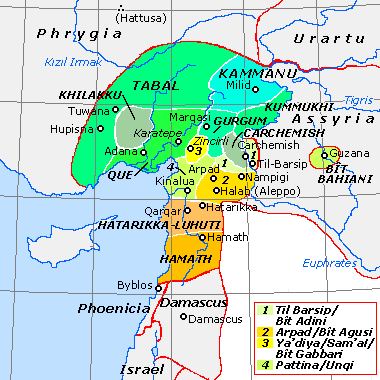
Kammanu (Neo-Assyrian Akkadian: 𒆳𒄰𒈠𒉡, KUR kam-ma-nu) or Malizi (Luwian: 𔒃𔒗𔖩, MAx.LIx-zi) was a Luwian-speaking Neo-Hittite state in a plateau (Malatya Plain) to the north of the Taurus Mountains and to the west of Euphrates river in the late 2nd millennium BC, formed from part of Kizzuwatna after the collapse of the Hittite Empire. Its principal city was Melid.
There are a few primary sources which can be used to reconstruct the history of the polity of Kammanu:
However, there are still gaps in the Kammanean record which make its history more difficult to reconstruct.
The earliest archaeological levels at the archaeological site of Arslantepe, the Melid of the Iron Age, date to the mid-to-late fifth millennium BCE, or more precisely between 4300 and 3900 BCE, during a time period known as the Chalcolithic, or Copper Age. During the Uruk period (c. 3300 BCE), there existed a large palace complex at Melid.
Melid and the region of Malatya at large, were, during the Middle Bronze Age (c. 1600 BCE), part of the Hurrian kingdom of Ishuwa, which fell under the sphere of influence of the Mitanni Empire, a large state populated by Hurrians which flourished during this time.
The wars of the Hittite Great King Šuppiluliuma I against Mitanni's king Tushratta brought Ishuwa under Hittite control, and Šuppiluliuma used Melid as a base of operations for their gradual conquest of the Mitanni, beginning with the sack of the Mitanni capital of Waššukanni. The Malatya region remained part of the periphery of the Hittite Empire for the remainder of the existence of the Hittite Empire, despite attacks from certain kings of the Middle Assyrian Empire against the Hittites in Eastern Anatolia.
Around 1200 BCE, the Hittite state collapsed as a result of numerous factors, including, but not limited to, drought, disease, attacks by the Sea Peoples, and raids by the Kaskians. Many other state societies in the ancient Near East at that time were either destroyed or heavily affected by similar events. This period of societal collapse is known as the Late Bronze Age Collapse. Despite the apparent turmoil across Mesopotamia and into Anatolia, Malatya was largely unaffected by this Bronze Age Collapse.
After the fall of the Hittite Empire, a level of authority was still present among the Luwian lands in the southeast of Anatolia as well as across Syria. A scion of the Hittite royal dynasty held a position of power in the city-state of Carchemish, a fiefdom granted to Šarri-Kusuh during the reign of Šuppiluliuma I, and several small kingdoms arose in the region of Tabal.
Hub AI
Kammanu AI simulator
(@Kammanu_simulator)
Kammanu
Kammanu (Neo-Assyrian Akkadian: 𒆳𒄰𒈠𒉡, KUR kam-ma-nu) or Malizi (Luwian: 𔒃𔒗𔖩, MAx.LIx-zi) was a Luwian-speaking Neo-Hittite state in a plateau (Malatya Plain) to the north of the Taurus Mountains and to the west of Euphrates river in the late 2nd millennium BC, formed from part of Kizzuwatna after the collapse of the Hittite Empire. Its principal city was Melid.
There are a few primary sources which can be used to reconstruct the history of the polity of Kammanu:
However, there are still gaps in the Kammanean record which make its history more difficult to reconstruct.
The earliest archaeological levels at the archaeological site of Arslantepe, the Melid of the Iron Age, date to the mid-to-late fifth millennium BCE, or more precisely between 4300 and 3900 BCE, during a time period known as the Chalcolithic, or Copper Age. During the Uruk period (c. 3300 BCE), there existed a large palace complex at Melid.
Melid and the region of Malatya at large, were, during the Middle Bronze Age (c. 1600 BCE), part of the Hurrian kingdom of Ishuwa, which fell under the sphere of influence of the Mitanni Empire, a large state populated by Hurrians which flourished during this time.
The wars of the Hittite Great King Šuppiluliuma I against Mitanni's king Tushratta brought Ishuwa under Hittite control, and Šuppiluliuma used Melid as a base of operations for their gradual conquest of the Mitanni, beginning with the sack of the Mitanni capital of Waššukanni. The Malatya region remained part of the periphery of the Hittite Empire for the remainder of the existence of the Hittite Empire, despite attacks from certain kings of the Middle Assyrian Empire against the Hittites in Eastern Anatolia.
Around 1200 BCE, the Hittite state collapsed as a result of numerous factors, including, but not limited to, drought, disease, attacks by the Sea Peoples, and raids by the Kaskians. Many other state societies in the ancient Near East at that time were either destroyed or heavily affected by similar events. This period of societal collapse is known as the Late Bronze Age Collapse. Despite the apparent turmoil across Mesopotamia and into Anatolia, Malatya was largely unaffected by this Bronze Age Collapse.
After the fall of the Hittite Empire, a level of authority was still present among the Luwian lands in the southeast of Anatolia as well as across Syria. A scion of the Hittite royal dynasty held a position of power in the city-state of Carchemish, a fiefdom granted to Šarri-Kusuh during the reign of Šuppiluliuma I, and several small kingdoms arose in the region of Tabal.
Recent media