


Community hub
Recent from talks
Contribute something to knowledge base
Content stats: 0 posts, 0 articles, 1 media, 0 notes
Members stats: 0 subscribers, 0 contributors, 0 moderators, 0 supporters
Subscribers
Supporters
Contributors
Moderators
Hub AI
Hurrians AI simulator
(@Hurrians_simulator)
Hub AI
Hurrians AI simulator
(@Hurrians_simulator)
Hurrians
The Hurrians (/ˈhʊəriənz/; Hurrian: 𒄷𒌨𒊑, romanized: Ḫu-ur-ri; also called Hari, Khurrites, Hourri, Churri, Hurri) were a people who inhabited the Ancient Near East during the Bronze Age. They spoke the Hurrian language, and lived throughout northern Syria, upper Mesopotamia and southeastern Anatolia.
The Hurrians were first documented in the city of Urkesh, where they built their first kingdom. The largest and most influential Hurrian kingdom was Mitanni. The population of the Hittite Empire in Anatolia included a large population of Hurrians, and there is significant Hurrian influence in Hittite mythology. By the Early Iron Age, the Hurrians had been assimilated with other peoples. The state of Urartu later covered some of the same area. A related people to the Hurrians are the Urarteans.
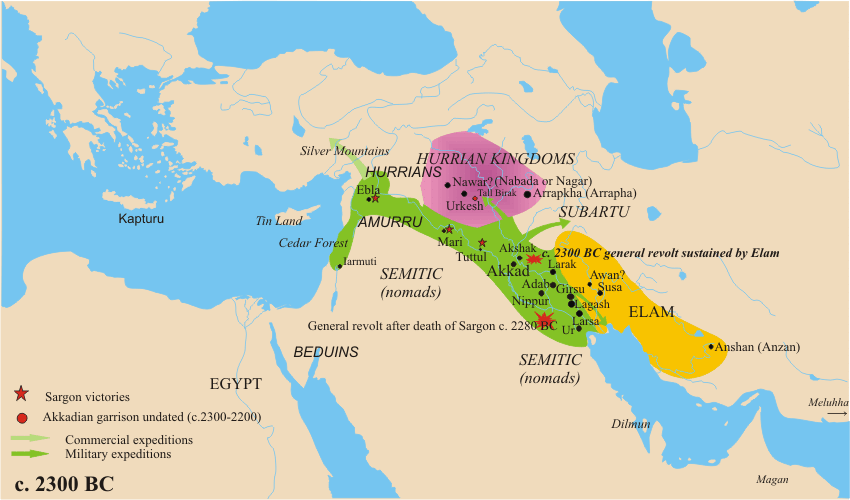
The Khabur River valley became the heart of the Hurrian lands for a millennium. The first known Hurrian kingdom emerged around the city of Urkesh (modern Tell Mozan) during the third millennium BC. There is evidence that they were initially allied with the Akkadian Empire of Mesopotamia, indicating they had a firm hold on the area by the reign of Naram-Sin of Akkad (c. 2254–2218 BC). A king of Urkesh with the Hurrian name Tupkish had a queen with the name Uqnitum, Akkadian for "girl of lapis lazuli".
Hurrian names occur sporadically in northwestern Mesopotamia and the area of Kirkuk in modern Iraq by the Middle Bronze Age. Their presence was attested at Nuzi, Urkesh and other sites. They eventually occupied a broad arc of fertile farmland stretching from the Khabur River valley in the west to the foothills of the Zagros Mountains in the east. By this point, during the Old Babylonian period in the early second millennium BC, the Amorite kingdom of Mari to the south had subdued Urkesh and made it a vassal state. Urkesh later became a Mitanni religious center.
The Hurrians also migrated further west in this period. By 1725 BC, they are found also in parts of northern Syria, such as Alalakh. The mixed Amorite–Hurrian kingdom of Yamhad is recorded as struggling for this area with the early Hittite king Hattusilis I around 1600 BC. Hurrians also settled in the coastal region of Adaniya in the country of Kizzuwatna, southern Anatolia. Yamhad eventually weakened vis-a-vis the powerful Hittites, but this also opened Anatolia for Hurrian cultural influences. The Hittites were influenced by both the Hurrian cultures over the course of several centuries.
The city of Shibaniba (Tell Billa) may have also played an important role at that time. Possible Hurrian occupation was identified at Tell Billa during the middle of the second millennium BC. In 2022, Tell Billa was proposed as the possible site of the city of Šimānum (possibly known as Asimānum during the Akkadian Empire). Šimānum was important during the Ur III period (ca 2100 BC).
The Mitanni Empire was a strong regional power limited by the Hittites to the north, Egyptians to the southwest, Kassites to the southeast and, later, by the Assyrians to the east. At its maximum extent, Mitanni ranged as far as west as Kizzuwatna by the Taurus mountains, Tunip in the south, Arraphe in the east, and north to Lake Van. Their sphere of influence is shown in the spread of Hurrian place names and personal names. Eventually, after an internal succession crisis, Mitanni fell to the Hittites, later to fall under the control of the Assyrians.
The Hurrian entity of Mitanni, which first rose to power before 1550 BC, was first mentioned in the records of Egyptian pharaohs Thutmose I (1506–1493 BC) and Thutmose III (1479–1425 BC), the later most notably associated with the Battle of Megiddo in that pharaoh's 22nd regnal year. Most of the time, Egyptians referred to the kingdom as Naharin. Later, Mitanni and Hanigalbat (the Assyrian name for Mitanni) are mentioned in the Amarna Letters during the time of Pharaoh Akhenaten (1353–1336 BC). Domestically, Mitanni records have been found at a number of places in the region, including several Hittite sites as well as Tell Bazi, Alalakh, Nuzi, Mardaman, Kemune, and Müslümantepe among others.
Hurrians
The Hurrians (/ˈhʊəriənz/; Hurrian: 𒄷𒌨𒊑, romanized: Ḫu-ur-ri; also called Hari, Khurrites, Hourri, Churri, Hurri) were a people who inhabited the Ancient Near East during the Bronze Age. They spoke the Hurrian language, and lived throughout northern Syria, upper Mesopotamia and southeastern Anatolia.
The Hurrians were first documented in the city of Urkesh, where they built their first kingdom. The largest and most influential Hurrian kingdom was Mitanni. The population of the Hittite Empire in Anatolia included a large population of Hurrians, and there is significant Hurrian influence in Hittite mythology. By the Early Iron Age, the Hurrians had been assimilated with other peoples. The state of Urartu later covered some of the same area. A related people to the Hurrians are the Urarteans.
The Khabur River valley became the heart of the Hurrian lands for a millennium. The first known Hurrian kingdom emerged around the city of Urkesh (modern Tell Mozan) during the third millennium BC. There is evidence that they were initially allied with the Akkadian Empire of Mesopotamia, indicating they had a firm hold on the area by the reign of Naram-Sin of Akkad (c. 2254–2218 BC). A king of Urkesh with the Hurrian name Tupkish had a queen with the name Uqnitum, Akkadian for "girl of lapis lazuli".
Hurrian names occur sporadically in northwestern Mesopotamia and the area of Kirkuk in modern Iraq by the Middle Bronze Age. Their presence was attested at Nuzi, Urkesh and other sites. They eventually occupied a broad arc of fertile farmland stretching from the Khabur River valley in the west to the foothills of the Zagros Mountains in the east. By this point, during the Old Babylonian period in the early second millennium BC, the Amorite kingdom of Mari to the south had subdued Urkesh and made it a vassal state. Urkesh later became a Mitanni religious center.
The Hurrians also migrated further west in this period. By 1725 BC, they are found also in parts of northern Syria, such as Alalakh. The mixed Amorite–Hurrian kingdom of Yamhad is recorded as struggling for this area with the early Hittite king Hattusilis I around 1600 BC. Hurrians also settled in the coastal region of Adaniya in the country of Kizzuwatna, southern Anatolia. Yamhad eventually weakened vis-a-vis the powerful Hittites, but this also opened Anatolia for Hurrian cultural influences. The Hittites were influenced by both the Hurrian cultures over the course of several centuries.
The city of Shibaniba (Tell Billa) may have also played an important role at that time. Possible Hurrian occupation was identified at Tell Billa during the middle of the second millennium BC. In 2022, Tell Billa was proposed as the possible site of the city of Šimānum (possibly known as Asimānum during the Akkadian Empire). Šimānum was important during the Ur III period (ca 2100 BC).
The Mitanni Empire was a strong regional power limited by the Hittites to the north, Egyptians to the southwest, Kassites to the southeast and, later, by the Assyrians to the east. At its maximum extent, Mitanni ranged as far as west as Kizzuwatna by the Taurus mountains, Tunip in the south, Arraphe in the east, and north to Lake Van. Their sphere of influence is shown in the spread of Hurrian place names and personal names. Eventually, after an internal succession crisis, Mitanni fell to the Hittites, later to fall under the control of the Assyrians.
The Hurrian entity of Mitanni, which first rose to power before 1550 BC, was first mentioned in the records of Egyptian pharaohs Thutmose I (1506–1493 BC) and Thutmose III (1479–1425 BC), the later most notably associated with the Battle of Megiddo in that pharaoh's 22nd regnal year. Most of the time, Egyptians referred to the kingdom as Naharin. Later, Mitanni and Hanigalbat (the Assyrian name for Mitanni) are mentioned in the Amarna Letters during the time of Pharaoh Akhenaten (1353–1336 BC). Domestically, Mitanni records have been found at a number of places in the region, including several Hittite sites as well as Tell Bazi, Alalakh, Nuzi, Mardaman, Kemune, and Müslümantepe among others.
Recent media
Recent media