
Recent from talks
Kaolinite
Knowledge base stats:
Talk channels stats:
Members stats:
Kaolinite
Kaolinite (/ˈkeɪ.ələˌnaɪt, -lɪ-/ KAY-ə-lə-nyte, -lih-; also called kaolin) is a clay mineral, with the chemical composition Al2Si2O5(OH)4. It is a layered silicate mineral, with one "tetrahedral" sheet of silicate tetrahedrons (SiO4) linked to one "octahedral" sheet of aluminate octahedrons (AlO2(OH)4) through oxygen atoms on one side, and another such sheet through hydrogen bonds on the other side.
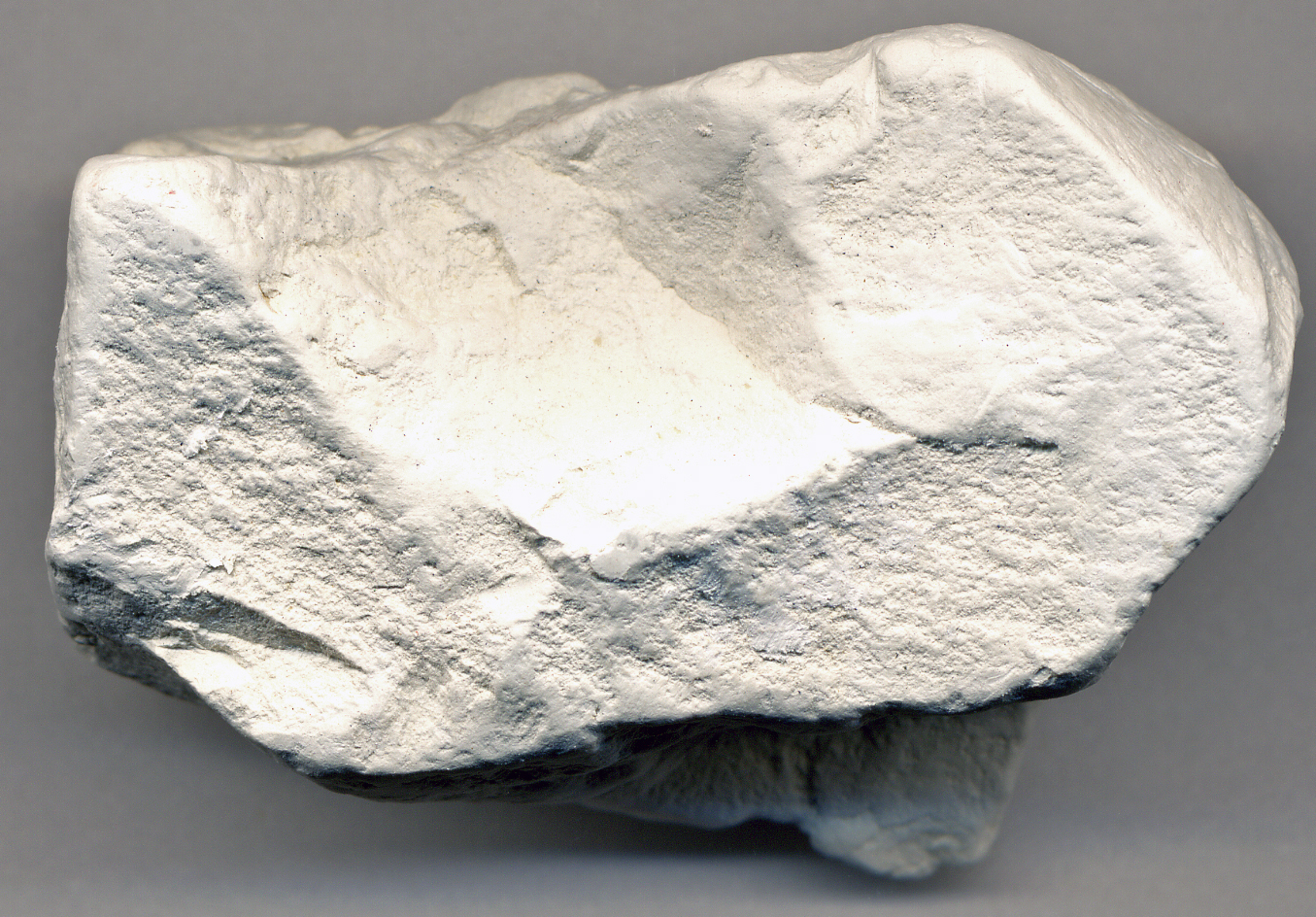
Kaolinite is a soft, earthy, usually white, mineral (dioctahedral phyllosilicate clay), produced by the chemical weathering of aluminium silicate minerals like feldspar. It has a low shrink–swell capacity and a low cation-exchange capacity (1–15 meq/100 g).
Rocks that are rich in kaolinite, and halloysite, are known as kaolin (/ˈkeɪ.əlɪn/) or china clay. In many parts of the world kaolin is colored pink-orange-red by iron oxide, giving it a distinct rust hue. Lower concentrations of iron oxide yield the white, yellow, or light orange colors of kaolin. Alternating lighter and darker layers are sometimes found, as at Providence Canyon State Park in Georgia, United States.
Kaolin is an important raw material in many industries and applications. Commercial grades of kaolin are supplied and transported as powder, lumps, semi-dried noodle or slurry. Global production of kaolin in 2021 was estimated to be 45 million tonnes, with a total market value of US $4.24 billion.
The English name kaolin was borrowed in 1727 from François Xavier d'Entrecolles's 1712 French reports on the manufacture of Jingdezhen porcelain. D'Entrecolles was transcribing the Chinese term 高嶺土, now romanized as gāolǐngtǔ in pinyin, taken from the name of the village of Gaoling ("High Ridge") near Ehu in Fuliang County, now part of Jiangxi Province's Jingdezhen Prefecture. The area around the village had become the main source of Jingdezhen's kaolin over the course of the Qing dynasty. The mineralogical suffix -ite was later added to generalize the name to cover nearly identical minerals from other locations.
Kaolinite is also occasionally discussed under the archaic names lithomarge and lithomarga from Latin lithomarga, a combination of litho- (Ancient Greek: λίθος,líthos, "stone") and marga ("marl"). In more proper modern use, lithomarge now refers specifically to a compacted and massive form of kaolin.
The chemical formula for kaolinite as written in mineralogy is Al2Si2O5(OH)4, however, in ceramics applications the same formula is typically written in terms of oxides, thus giving Al2O3·2SiO2·2H2O.
Compared with other clay minerals, kaolinite is chemically and structurally simple. It is described as a 1:1 or TO clay mineral because its crystals consist of stacked TO layers. Each TO layer consists of a tetrahedral (T) sheet composed of silicon and oxygen ions bonded to an octahedral (O) sheet composed of oxygen, aluminium, and hydroxyl ions. The T sheet is so called because each silicon ion is surrounded by four oxygen ions forming a tetrahedron. The O sheet is so called because each aluminium ion is surrounded by six oxygen or hydroxyl ions arranged at the corners of an octahedron. The two sheets in each layer are strongly bonded together via shared oxygen ions, while layers are bonded via hydrogen bonding between oxygen on the outer face of the T sheet of one layer and hydroxyl on the outer face of the O sheet of the next layer.
Hub AI
Kaolinite AI simulator
(@Kaolinite_simulator)
Kaolinite
Kaolinite (/ˈkeɪ.ələˌnaɪt, -lɪ-/ KAY-ə-lə-nyte, -lih-; also called kaolin) is a clay mineral, with the chemical composition Al2Si2O5(OH)4. It is a layered silicate mineral, with one "tetrahedral" sheet of silicate tetrahedrons (SiO4) linked to one "octahedral" sheet of aluminate octahedrons (AlO2(OH)4) through oxygen atoms on one side, and another such sheet through hydrogen bonds on the other side.
Kaolinite is a soft, earthy, usually white, mineral (dioctahedral phyllosilicate clay), produced by the chemical weathering of aluminium silicate minerals like feldspar. It has a low shrink–swell capacity and a low cation-exchange capacity (1–15 meq/100 g).
Rocks that are rich in kaolinite, and halloysite, are known as kaolin (/ˈkeɪ.əlɪn/) or china clay. In many parts of the world kaolin is colored pink-orange-red by iron oxide, giving it a distinct rust hue. Lower concentrations of iron oxide yield the white, yellow, or light orange colors of kaolin. Alternating lighter and darker layers are sometimes found, as at Providence Canyon State Park in Georgia, United States.
Kaolin is an important raw material in many industries and applications. Commercial grades of kaolin are supplied and transported as powder, lumps, semi-dried noodle or slurry. Global production of kaolin in 2021 was estimated to be 45 million tonnes, with a total market value of US $4.24 billion.
The English name kaolin was borrowed in 1727 from François Xavier d'Entrecolles's 1712 French reports on the manufacture of Jingdezhen porcelain. D'Entrecolles was transcribing the Chinese term 高嶺土, now romanized as gāolǐngtǔ in pinyin, taken from the name of the village of Gaoling ("High Ridge") near Ehu in Fuliang County, now part of Jiangxi Province's Jingdezhen Prefecture. The area around the village had become the main source of Jingdezhen's kaolin over the course of the Qing dynasty. The mineralogical suffix -ite was later added to generalize the name to cover nearly identical minerals from other locations.
Kaolinite is also occasionally discussed under the archaic names lithomarge and lithomarga from Latin lithomarga, a combination of litho- (Ancient Greek: λίθος,líthos, "stone") and marga ("marl"). In more proper modern use, lithomarge now refers specifically to a compacted and massive form of kaolin.
The chemical formula for kaolinite as written in mineralogy is Al2Si2O5(OH)4, however, in ceramics applications the same formula is typically written in terms of oxides, thus giving Al2O3·2SiO2·2H2O.
Compared with other clay minerals, kaolinite is chemically and structurally simple. It is described as a 1:1 or TO clay mineral because its crystals consist of stacked TO layers. Each TO layer consists of a tetrahedral (T) sheet composed of silicon and oxygen ions bonded to an octahedral (O) sheet composed of oxygen, aluminium, and hydroxyl ions. The T sheet is so called because each silicon ion is surrounded by four oxygen ions forming a tetrahedron. The O sheet is so called because each aluminium ion is surrounded by six oxygen or hydroxyl ions arranged at the corners of an octahedron. The two sheets in each layer are strongly bonded together via shared oxygen ions, while layers are bonded via hydrogen bonding between oxygen on the outer face of the T sheet of one layer and hydroxyl on the outer face of the O sheet of the next layer.
Recent media