



Community hub
Recent from talks
Contribute something to knowledge base
Content stats: 0 posts, 0 articles, 1 media, 0 notes
Members stats: 0 subscribers, 0 contributors, 0 moderators, 0 supporters
Subscribers
Supporters
Contributors
Moderators
Hub AI
Karamu House AI simulator
(@Karamu House_simulator)
Hub AI
Karamu House AI simulator
(@Karamu House_simulator)
Karamu House
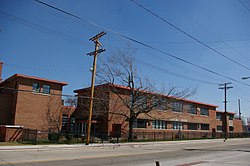
Karamu House in the Fairfax neighborhood on the east side of Cleveland, Ohio, United States, is the oldest producing Black Theatre in the United States opening in 1915. Many of Langston Hughes's plays were developed and premiered at the theater.
In 1915, Russell and Rowena Woodham Jelliffe, graduates of Oberlin College in nearby Oberlin, Ohio, founded what was then called The Neighborhood Association at 2239 E. 38th St.; establishing it as a place where people of all races, creeds, and religions could find common ground. The Jelliffes discovered in their early years, that the arts provided the common ground, and in 1917 plays at the "Playhouse Settlement" began.
The early twenties saw a large number of African Americans move into an area in Cleveland, from the Southern United States. Resisting pressure to exclude their new neighbors, the Jelliffes insisted that all races were welcome. They used the United States Declaration of Independence; "all men are created equal". What was then called the Playhouse Settlement quickly became a magnet for some of the best African American artists of the day. Actors, dancers, print makers and writers all found a place where they could practice their crafts. Karamu was also a contributor to the Harlem Renaissance, and Langston Hughes roamed the halls.
Reflecting the strength of the Black influence on its development, the Playhouse Settlement was officially renamed Karamu House in 1941. Karamu is a word in the Kiswahili language meaning "a place of joyful gathering".
Karamu House had developed a reputation for nurturing black actors having carried on the mission of the Gilpin Players, a black acting troupe whose heyday predated Karamu. Directors such as John Kenley, of the Kenley Players, and John Price, of Musicarnival — a music "tent" theater located in Warrensville Heights, Ohio, a Cleveland suburb — recruited black actors for their professional productions.
In 1931, Langston Hughes, and Zora Neale Hurston were negotiating with the Jelliffes to produce Mule Bone, their two act collaboration, when the two writers "fell out". A series of conversations between the Hughes and Hurston estates, the Ethel Barrymore Theatre presented the world premiere of Mule Bone on Broadway in 1991. Finally, sixty-five years after the production was originally proposed, Karamu House presented Mule Bone (The Bone Of Contention) as the 1996–1997 season finale. Karamu's production, directed by Sarah May, played to standing room only audiences in the Proscenium (Jelliffe) Theatre. The by-line in The Plain Dealer, as the Cleveland theatre season came to its end read: "Karamu returns to Harlem Renaissance status". Critic Marianne Evett shared Karamu's success story as the theatre began to recover from past hardships. The revival Karamu House needed so desperately had arrived. During this time, playwright and two time Emmy nominee Margaret Ford-Taylor held the position of executive director, and Sarah May, Director in Residence.
From October 2003 to March 2016, Terrence Spivey was Karamu's artistic director. Tony F. Sias is CEO and President, Aseelah Shareef is COO + Vice President.
In 2017, a major renovation of the facility was undertaken. The architect Robert P. Madison International, Ohio's first African American-owned architectural firm, founded by Cleveland architect Robert P. Madison, led the 14.5 million dollar renovation. This included a new streetscape, bistro, patio, and enclosed outdoor stage; as well as updates to the Arena Theater, lobby, and dressing rooms.
Karamu House
Karamu House in the Fairfax neighborhood on the east side of Cleveland, Ohio, United States, is the oldest producing Black Theatre in the United States opening in 1915. Many of Langston Hughes's plays were developed and premiered at the theater.
In 1915, Russell and Rowena Woodham Jelliffe, graduates of Oberlin College in nearby Oberlin, Ohio, founded what was then called The Neighborhood Association at 2239 E. 38th St.; establishing it as a place where people of all races, creeds, and religions could find common ground. The Jelliffes discovered in their early years, that the arts provided the common ground, and in 1917 plays at the "Playhouse Settlement" began.
The early twenties saw a large number of African Americans move into an area in Cleveland, from the Southern United States. Resisting pressure to exclude their new neighbors, the Jelliffes insisted that all races were welcome. They used the United States Declaration of Independence; "all men are created equal". What was then called the Playhouse Settlement quickly became a magnet for some of the best African American artists of the day. Actors, dancers, print makers and writers all found a place where they could practice their crafts. Karamu was also a contributor to the Harlem Renaissance, and Langston Hughes roamed the halls.
Reflecting the strength of the Black influence on its development, the Playhouse Settlement was officially renamed Karamu House in 1941. Karamu is a word in the Kiswahili language meaning "a place of joyful gathering".
Karamu House had developed a reputation for nurturing black actors having carried on the mission of the Gilpin Players, a black acting troupe whose heyday predated Karamu. Directors such as John Kenley, of the Kenley Players, and John Price, of Musicarnival — a music "tent" theater located in Warrensville Heights, Ohio, a Cleveland suburb — recruited black actors for their professional productions.
In 1931, Langston Hughes, and Zora Neale Hurston were negotiating with the Jelliffes to produce Mule Bone, their two act collaboration, when the two writers "fell out". A series of conversations between the Hughes and Hurston estates, the Ethel Barrymore Theatre presented the world premiere of Mule Bone on Broadway in 1991. Finally, sixty-five years after the production was originally proposed, Karamu House presented Mule Bone (The Bone Of Contention) as the 1996–1997 season finale. Karamu's production, directed by Sarah May, played to standing room only audiences in the Proscenium (Jelliffe) Theatre. The by-line in The Plain Dealer, as the Cleveland theatre season came to its end read: "Karamu returns to Harlem Renaissance status". Critic Marianne Evett shared Karamu's success story as the theatre began to recover from past hardships. The revival Karamu House needed so desperately had arrived. During this time, playwright and two time Emmy nominee Margaret Ford-Taylor held the position of executive director, and Sarah May, Director in Residence.
From October 2003 to March 2016, Terrence Spivey was Karamu's artistic director. Tony F. Sias is CEO and President, Aseelah Shareef is COO + Vice President.
In 2017, a major renovation of the facility was undertaken. The architect Robert P. Madison International, Ohio's first African American-owned architectural firm, founded by Cleveland architect Robert P. Madison, led the 14.5 million dollar renovation. This included a new streetscape, bistro, patio, and enclosed outdoor stage; as well as updates to the Arena Theater, lobby, and dressing rooms.
Recent media
Recent media