


Community hub
Recent from talks
Contribute something to knowledge base
Content stats: 0 posts, 0 articles, 1 media, 0 notes
Members stats: 0 subscribers, 0 contributors, 0 moderators, 0 supporters
Subscribers
Supporters
Contributors
Moderators
Hub AI
Kariba Dam AI simulator
(@Kariba Dam_simulator)
Hub AI
Kariba Dam AI simulator
(@Kariba Dam_simulator)
Kariba Dam
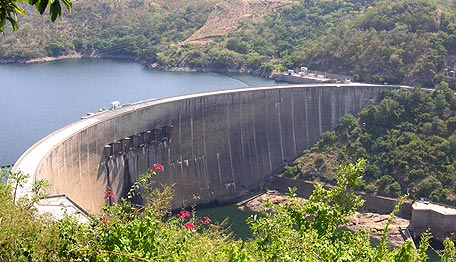
The Kariba Dam is a double curvature concrete arch dam in the Kariba Gorge of the Zambezi river basin between Zambia and Zimbabwe. The dam stands 128 metres (420 ft) tall and 579 metres (1,900 ft) long. The dam forms Lake Kariba, which extends for 280 kilometres (170 mi) and holds 185 cubic kilometres (150,000,000 acre⋅ft) of water.
The dam was constructed on the orders of the Government of the Federation of Rhodesia and Nyasaland, a 'federal colony' within the British Empire. The consulting engineers, who were Gibb, Coyne, Sogei (Kariba) (PVT.) Limited, a joint venture of consulting engineers, which included Sir Alexander Gibb & Partners, whose team was led by Sir Angus Paton, and Coyne et Bellier, whose team was led by André Coyne. The double curvature concrete arch dam was constructed between 1955 and 1959 by Cogefar-Impresit of Italy at a cost of $135,000,000 for the first stage with only the Kariba South power cavern. Final construction and the addition of the Kariba North Power cavern by Mitchell Construction was not completed until 1977, due to largely political problems, for a total cost of $480,000,000. During construction, 86 construction workers lost their lives.
The dam was officially opened by Queen Elizabeth the Queen Mother on 17 May 1960.
The Kariba Dam supplies 2,010 megawatts (2,700,000 hp) of electricity to parts of both Zambia (the Copperbelt) and Zimbabwe and generates 6,400 gigawatt-hours (23,000 TJ) per annum. Each country has its own power station on the north and south bank of the dam, respectively. The south station belonging to Zimbabwe has been in operation since 1960 and had six generators of 125 megawatts (168,000 hp) capacity each for a total of 750 megawatts (1,010,000 hp).
On November 11, 2013 it was announced by Zimbabwe's Finance Minister, Patrick Chinamasa that capacity at the Zimbabwean (South) Kariba hydropower station would be increased by 300 megawatts. The cost of upgrading the facility has been supported by a $319m loan from China. The deal is a clear example of Zimbabwe's "Look East" policy, which was adopted after falling out with Western powers. Construction on the Kariba South expansion began in mid-2014 and was initially expected to be complete in 2019.
In March 2018, president Emmerson Mnangagwa commissioned the completed expansion of Kariba South Hydroelectric Power Station. The addition of two new 150 megawatts (200,000 hp) turbines raised capacity at this station to 1,050 megawatts (1,410,000 hp). The expansion work was done by Sinohydro, at a cost of US$533 million. Work started in 2014, and was completed in March 2018.
The north station belonging to Zambia has been in operation since 1976, and has four generators of 150 megawatts (200,000 hp) each for a total of 600 megawatts (800,000 hp); work to expand this capacity by an additional 360 megawatts (480,000 hp) to 960 megawatts (1,290,000 hp) was completed in December 2013. Two additional 180 MW generators were added.
The Kariba Dam project was planned and carried out by the Government of the Federation of Rhodesia and Nyasaland. The Federation was often referred to as the Central African Federation (CAF). The CAF was a 'federal colony' within the British Empire in southern Africa that existed from 1953 to the end of 1963, comprising the former self-governing British colony of Southern Rhodesia and the former British protectorates of Northern Rhodesia and Nyasaland. Northern Rhodesia had decided earlier in 1953 (before the Federation was founded) to build a dam within its territory, on the Kafue River, a major tributary of the Zambezi. It would have been closer to Northern Rhodesia's Copperbelt, which was in need of more power. This would have been a cheaper and less grandiose project, with a smaller environmental impact. Southern Rhodesia, the richest of the three, objected to a Kafue dam and insisted that the dam be sited instead at Kariba. Also, the capacity of the Kafue dam was much lower than that at Kariba. Initially, the dam was managed and maintained by the Central African Power Corporation. The Kariba Dam is now owned and operated by the Zambezi River Authority, which is jointly and equally owned by Zimbabwe and Zambia.
Kariba Dam
The Kariba Dam is a double curvature concrete arch dam in the Kariba Gorge of the Zambezi river basin between Zambia and Zimbabwe. The dam stands 128 metres (420 ft) tall and 579 metres (1,900 ft) long. The dam forms Lake Kariba, which extends for 280 kilometres (170 mi) and holds 185 cubic kilometres (150,000,000 acre⋅ft) of water.
The dam was constructed on the orders of the Government of the Federation of Rhodesia and Nyasaland, a 'federal colony' within the British Empire. The consulting engineers, who were Gibb, Coyne, Sogei (Kariba) (PVT.) Limited, a joint venture of consulting engineers, which included Sir Alexander Gibb & Partners, whose team was led by Sir Angus Paton, and Coyne et Bellier, whose team was led by André Coyne. The double curvature concrete arch dam was constructed between 1955 and 1959 by Cogefar-Impresit of Italy at a cost of $135,000,000 for the first stage with only the Kariba South power cavern. Final construction and the addition of the Kariba North Power cavern by Mitchell Construction was not completed until 1977, due to largely political problems, for a total cost of $480,000,000. During construction, 86 construction workers lost their lives.
The dam was officially opened by Queen Elizabeth the Queen Mother on 17 May 1960.
The Kariba Dam supplies 2,010 megawatts (2,700,000 hp) of electricity to parts of both Zambia (the Copperbelt) and Zimbabwe and generates 6,400 gigawatt-hours (23,000 TJ) per annum. Each country has its own power station on the north and south bank of the dam, respectively. The south station belonging to Zimbabwe has been in operation since 1960 and had six generators of 125 megawatts (168,000 hp) capacity each for a total of 750 megawatts (1,010,000 hp).
On November 11, 2013 it was announced by Zimbabwe's Finance Minister, Patrick Chinamasa that capacity at the Zimbabwean (South) Kariba hydropower station would be increased by 300 megawatts. The cost of upgrading the facility has been supported by a $319m loan from China. The deal is a clear example of Zimbabwe's "Look East" policy, which was adopted after falling out with Western powers. Construction on the Kariba South expansion began in mid-2014 and was initially expected to be complete in 2019.
In March 2018, president Emmerson Mnangagwa commissioned the completed expansion of Kariba South Hydroelectric Power Station. The addition of two new 150 megawatts (200,000 hp) turbines raised capacity at this station to 1,050 megawatts (1,410,000 hp). The expansion work was done by Sinohydro, at a cost of US$533 million. Work started in 2014, and was completed in March 2018.
The north station belonging to Zambia has been in operation since 1976, and has four generators of 150 megawatts (200,000 hp) each for a total of 600 megawatts (800,000 hp); work to expand this capacity by an additional 360 megawatts (480,000 hp) to 960 megawatts (1,290,000 hp) was completed in December 2013. Two additional 180 MW generators were added.
The Kariba Dam project was planned and carried out by the Government of the Federation of Rhodesia and Nyasaland. The Federation was often referred to as the Central African Federation (CAF). The CAF was a 'federal colony' within the British Empire in southern Africa that existed from 1953 to the end of 1963, comprising the former self-governing British colony of Southern Rhodesia and the former British protectorates of Northern Rhodesia and Nyasaland. Northern Rhodesia had decided earlier in 1953 (before the Federation was founded) to build a dam within its territory, on the Kafue River, a major tributary of the Zambezi. It would have been closer to Northern Rhodesia's Copperbelt, which was in need of more power. This would have been a cheaper and less grandiose project, with a smaller environmental impact. Southern Rhodesia, the richest of the three, objected to a Kafue dam and insisted that the dam be sited instead at Kariba. Also, the capacity of the Kafue dam was much lower than that at Kariba. Initially, the dam was managed and maintained by the Central African Power Corporation. The Kariba Dam is now owned and operated by the Zambezi River Authority, which is jointly and equally owned by Zimbabwe and Zambia.
Recent media
Recent media