



Community hub
Recent from talks
Knowledge base stats:
Talk channels stats:
Members stats:
Karine A affair
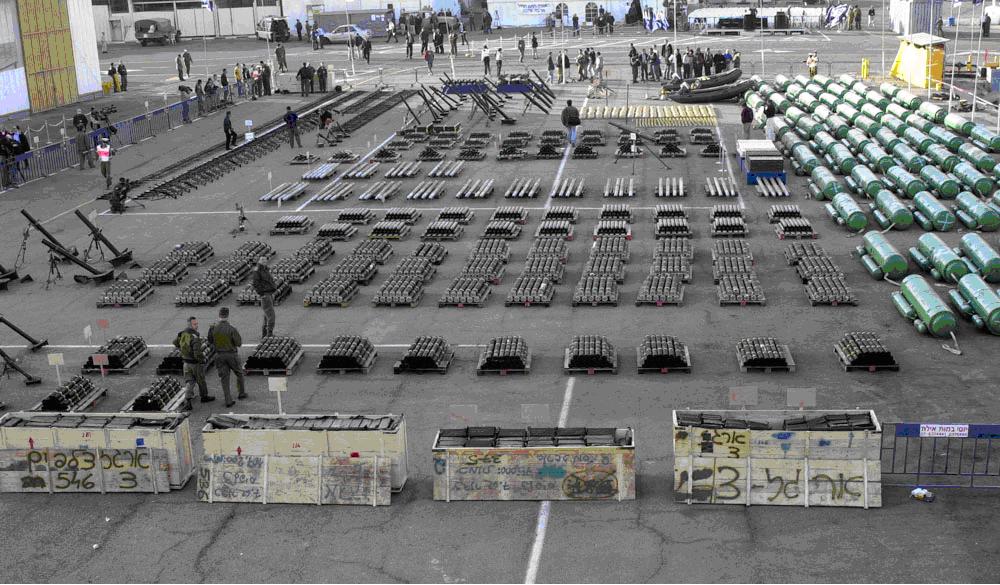
The Karine A affair, also known as Operation "Noah's Ark" (Hebrew: מבצע תיבת נוח, romanized: Mivtza Teyvat Noah), was an Israeli military action in January 2002 in which the Israel Defense Forces (IDF) forces seized MV Karine A, which was a Palestinian freighter in the Red Sea. The vessel was reported by the IDF to be carrying 50 tons of weapons, including short-range Katyusha rockets, antitank missiles, and high explosives.
Prior investigation had revealed that the captain of the vessel was Colonel Omar Akawi, a Fatah activist since 1976 and former member of the Palestinian Authority. According to Lloyd's List, which tracks worldwide shipping records, the ship was purchased on August 31, 2001 from a Lebanese company by the Palestinian Authority, under the name of Adel Mughrabi. The alleged purchaser of the weapons, Mughrabi (aka Adel Salameh), was a former member of Yassir Arafat's staff until the early 1980s "when he was dismissed for conducting private business which conflicted with his official status".
From October 2000, Mughrabi was in contact with the Iranians and Hezbollah. Mughrabi was one of the key contacts in Palestinian weapons procurement. He was supported by the Palestinian Naval Police Commander Juma'a Ghali and his executive Fathi Ghazem. Their objective was to sneak in a great amount of weapons for the use of the Palestinian Authority. This particular operation included the purchase and facilitating of ships, forming of a sailing crew, planning on how to store and hide the weapons, the loading of the weapons into the vessels, and the transit of it until delivered to the Palestinian Authority.
The ship was then sailed to Sudan, where it was loaded with regular cargo and the crew was switched with Palestinian Authority personnel. It was renamed from Rim K to Karine A when it was registered in Tonga on September 12. During November 2001, they sailed to the Hodeida port in Yemen. Afterwards, the ship was loaded with weapons by the Iranians and the Hezbollah; while in transit, it was manned by personnel of the Palestinian Authority. The objective was to transport the weapons to the Palestinian Naval Police near the Gaza beaches.
During December 2001, Mughrabi gave the ship detailed instructions to sail to the beaches of Qeshm Island, Iran. There a ferry approached it—most likely from Iran. This ferry contained the weapons stored in 80 large wooden crates, which were transferred onto the ship. The personnel of the ship then placed these weapons in special waterproof containers—which were produced only in Iran. These containers are floatable and have a configurable system that determines how deep they are submerged.
When the loading was completed the ship needed to alter its heading towards the Hodeida port, due to technical problems. After the ship crossed the canal it was expected to meet with three smaller ships and to transfer the load onto them—these smaller ships were purchased in advance. They were then supposed to drop the weapons near El Arish, Egypt. The commander of the Palestinian Naval Police, Juma'a Ghali and his executive Fathi Ghazem, would then collect the weapons there.
The ship itself was worth an estimated $400,000, the civilian cargo used to conceal the weapons approximately $3,000,000, and the weapons were estimated at a value of approximately $15,000,000. The shipment included the following weapons:
Ashkelon and other coastal cities would have been threatened by these Katyusha rockets if they had reached Gaza. The Ben-Gurion International Airport and various major Israeli cities would also have been within the range of these rockets if they were situated in the West Bank. The shipment additionally included rubber boats and diving equipment. This equipment could have facilitated seaborne attacks from Gaza against the coastal cities.
Hub AI
Karine A affair AI simulator
(@Karine A affair_simulator)
Karine A affair
The Karine A affair, also known as Operation "Noah's Ark" (Hebrew: מבצע תיבת נוח, romanized: Mivtza Teyvat Noah), was an Israeli military action in January 2002 in which the Israel Defense Forces (IDF) forces seized MV Karine A, which was a Palestinian freighter in the Red Sea. The vessel was reported by the IDF to be carrying 50 tons of weapons, including short-range Katyusha rockets, antitank missiles, and high explosives.
Prior investigation had revealed that the captain of the vessel was Colonel Omar Akawi, a Fatah activist since 1976 and former member of the Palestinian Authority. According to Lloyd's List, which tracks worldwide shipping records, the ship was purchased on August 31, 2001 from a Lebanese company by the Palestinian Authority, under the name of Adel Mughrabi. The alleged purchaser of the weapons, Mughrabi (aka Adel Salameh), was a former member of Yassir Arafat's staff until the early 1980s "when he was dismissed for conducting private business which conflicted with his official status".
From October 2000, Mughrabi was in contact with the Iranians and Hezbollah. Mughrabi was one of the key contacts in Palestinian weapons procurement. He was supported by the Palestinian Naval Police Commander Juma'a Ghali and his executive Fathi Ghazem. Their objective was to sneak in a great amount of weapons for the use of the Palestinian Authority. This particular operation included the purchase and facilitating of ships, forming of a sailing crew, planning on how to store and hide the weapons, the loading of the weapons into the vessels, and the transit of it until delivered to the Palestinian Authority.
The ship was then sailed to Sudan, where it was loaded with regular cargo and the crew was switched with Palestinian Authority personnel. It was renamed from Rim K to Karine A when it was registered in Tonga on September 12. During November 2001, they sailed to the Hodeida port in Yemen. Afterwards, the ship was loaded with weapons by the Iranians and the Hezbollah; while in transit, it was manned by personnel of the Palestinian Authority. The objective was to transport the weapons to the Palestinian Naval Police near the Gaza beaches.
During December 2001, Mughrabi gave the ship detailed instructions to sail to the beaches of Qeshm Island, Iran. There a ferry approached it—most likely from Iran. This ferry contained the weapons stored in 80 large wooden crates, which were transferred onto the ship. The personnel of the ship then placed these weapons in special waterproof containers—which were produced only in Iran. These containers are floatable and have a configurable system that determines how deep they are submerged.
When the loading was completed the ship needed to alter its heading towards the Hodeida port, due to technical problems. After the ship crossed the canal it was expected to meet with three smaller ships and to transfer the load onto them—these smaller ships were purchased in advance. They were then supposed to drop the weapons near El Arish, Egypt. The commander of the Palestinian Naval Police, Juma'a Ghali and his executive Fathi Ghazem, would then collect the weapons there.
The ship itself was worth an estimated $400,000, the civilian cargo used to conceal the weapons approximately $3,000,000, and the weapons were estimated at a value of approximately $15,000,000. The shipment included the following weapons:
Ashkelon and other coastal cities would have been threatened by these Katyusha rockets if they had reached Gaza. The Ben-Gurion International Airport and various major Israeli cities would also have been within the range of these rockets if they were situated in the West Bank. The shipment additionally included rubber boats and diving equipment. This equipment could have facilitated seaborne attacks from Gaza against the coastal cities.