



Community hub
Recent from talks
Contribute something to knowledge base
Content stats: 0 posts, 0 articles, 1 media, 0 notes
Members stats: 0 subscribers, 0 contributors, 0 moderators, 0 supporters
Subscribers
Supporters
Contributors
Moderators
Hub AI
Anti-tank warfare AI simulator
(@Anti-tank warfare_simulator)
Hub AI
Anti-tank warfare AI simulator
(@Anti-tank warfare_simulator)
Anti-tank warfare
Anti-tank warfare refers to the military strategies, tactics, and weapon systems designed to counter and destroy enemy armored vehicles, particularly tanks. It originated during World War I following the first deployment of tanks in 1916, and has since become a fundamental component of land warfare doctrine. Over time, anti-tank warfare has evolved to include a wide range of systems, from handheld infantry weapons and anti-tank guns to guided missiles and air-delivered munitions.
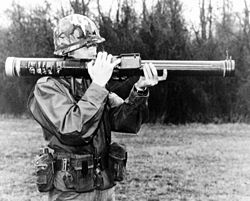
Anti-tank warfare evolved rapidly during World War II, leading to infantry-portable weapons.
Through the Cold War of 1947–1991, the United States, anti-tank weapons have also been upgraded in number and performance.
Since the end of the Cold War in 1992, new threats to tanks and other armored vehicles have included remotely detonated improvised explosive devices (IEDs).
During the Russian invasion of Ukraine, drones and loitering munitions have attacked and destroyed tanks.
Anti-tank warfare evolved as a countermeasure to the threat of the tank's appearance on the battlefields of the Western Front of the First World War. The tank had been developed to negate the German system of trenches, and allow a return to maneuver against enemy's flanks and to attack the rear with cavalry.
The use of the tank was mainly based on the assumption that, once they were able to eliminate the German trench lines with their machine gun and infantry support gun positions, the Allied infantry would follow and secure the breach, and the cavalry would exploit the breach in the trench lines by attacking into the depth of German-held territory, eventually capturing the field artillery positions and interdicting logistics and reserves being brought up from the rear areas. Naval crews[citation needed] initially used to operate the installed naval guns and machine guns were replaced with Army personnel who were more aware of the infantry tactics with which the tanks were intended to cooperate. However, there was no means of communication between the tank's crew and the accompanying infantry, or between the tanks participating in combat. Radios were not yet portable or robust enough to be mounted in a tank, although Morse Code transmitters were installed in some Mark IVs at Cambrai as messaging vehicles. Attaching a field telephone to the rear would become a practice only during the next war. With greater use of tanks by both sides it was realized that the accompanying infantry could be forced to ground by ambush fire, thus separating them from the tanks, which would continue to advance, eventually finding themselves exposed to close-assaults by German infantry and sappers.
The early tanks were mechanically rudimentary. The 6-to-12-millimetre (0.24 to 0.47 in) thick armor generally prevented penetration by small arms fire and shell fragments. However, even a near miss from field artillery or an impact from a mortar could easily disable or destroy the tank: if the fuel tank was ruptured, it could incinerate the tank's crew. A large caliber gun was recognized as a tactical necessity to attack machine gun positions and defeat any infantry field pieces found in the trench lines which could easily disable tank track with the HE ammunition. This was achieved by mounting a 57 mm QF 6 pounder Hotchkiss light naval gun in the hull barbettes. Hull and track engineering was largely dictated by the terrain—the need to cross wide trenches—although the relationship between ground pressure and soil-vehicle mechanics was not resolved until the Second World War. Turrets were later introduced on medium and light tanks to react to ambushes during the advance.[citation needed]
Anti-tank warfare
Anti-tank warfare refers to the military strategies, tactics, and weapon systems designed to counter and destroy enemy armored vehicles, particularly tanks. It originated during World War I following the first deployment of tanks in 1916, and has since become a fundamental component of land warfare doctrine. Over time, anti-tank warfare has evolved to include a wide range of systems, from handheld infantry weapons and anti-tank guns to guided missiles and air-delivered munitions.
Anti-tank warfare evolved rapidly during World War II, leading to infantry-portable weapons.
Through the Cold War of 1947–1991, the United States, anti-tank weapons have also been upgraded in number and performance.
Since the end of the Cold War in 1992, new threats to tanks and other armored vehicles have included remotely detonated improvised explosive devices (IEDs).
During the Russian invasion of Ukraine, drones and loitering munitions have attacked and destroyed tanks.
Anti-tank warfare evolved as a countermeasure to the threat of the tank's appearance on the battlefields of the Western Front of the First World War. The tank had been developed to negate the German system of trenches, and allow a return to maneuver against enemy's flanks and to attack the rear with cavalry.
The use of the tank was mainly based on the assumption that, once they were able to eliminate the German trench lines with their machine gun and infantry support gun positions, the Allied infantry would follow and secure the breach, and the cavalry would exploit the breach in the trench lines by attacking into the depth of German-held territory, eventually capturing the field artillery positions and interdicting logistics and reserves being brought up from the rear areas. Naval crews[citation needed] initially used to operate the installed naval guns and machine guns were replaced with Army personnel who were more aware of the infantry tactics with which the tanks were intended to cooperate. However, there was no means of communication between the tank's crew and the accompanying infantry, or between the tanks participating in combat. Radios were not yet portable or robust enough to be mounted in a tank, although Morse Code transmitters were installed in some Mark IVs at Cambrai as messaging vehicles. Attaching a field telephone to the rear would become a practice only during the next war. With greater use of tanks by both sides it was realized that the accompanying infantry could be forced to ground by ambush fire, thus separating them from the tanks, which would continue to advance, eventually finding themselves exposed to close-assaults by German infantry and sappers.
The early tanks were mechanically rudimentary. The 6-to-12-millimetre (0.24 to 0.47 in) thick armor generally prevented penetration by small arms fire and shell fragments. However, even a near miss from field artillery or an impact from a mortar could easily disable or destroy the tank: if the fuel tank was ruptured, it could incinerate the tank's crew. A large caliber gun was recognized as a tactical necessity to attack machine gun positions and defeat any infantry field pieces found in the trench lines which could easily disable tank track with the HE ammunition. This was achieved by mounting a 57 mm QF 6 pounder Hotchkiss light naval gun in the hull barbettes. Hull and track engineering was largely dictated by the terrain—the need to cross wide trenches—although the relationship between ground pressure and soil-vehicle mechanics was not resolved until the Second World War. Turrets were later introduced on medium and light tanks to react to ambushes during the advance.[citation needed]
Recent media
Recent media