
Recent from talks
Karl Weierstrass
Knowledge base stats:
Talk channels stats:
Members stats:
Karl Weierstrass
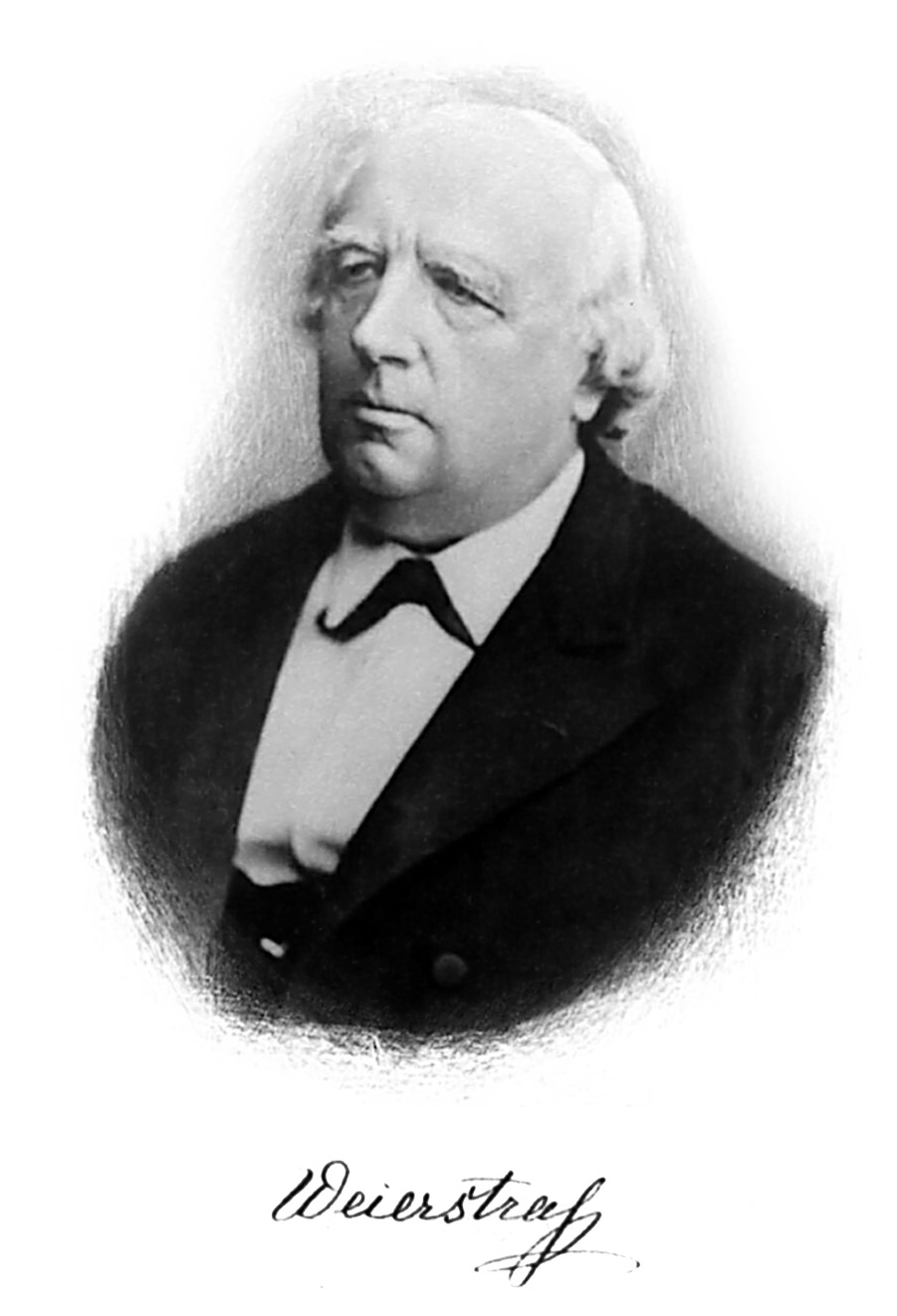
Karl Theodor Wilhelm Weierstrass (/ˈvaɪərˌstrɑːs, -ˌʃtrɑːs/; German: Weierstraß [ˈvaɪɐʃtʁaːs]; 31 October 1815 – 19 February 1897) was a German mathematician often cited as the "father of modern analysis". Despite leaving university without a degree, he studied mathematics and trained as a school teacher, eventually teaching mathematics, physics, botany and gymnastics. He later received an honorary doctorate and became professor of mathematics in Berlin.
Among many other contributions, Weierstrass formalized the definition of the continuity of a function and complex analysis, proved the intermediate value theorem and the Bolzano–Weierstrass theorem, and used the latter to study the properties of continuous functions on closed bounded intervals.
Weierstrass was born into a Roman Catholic family in Ostenfelde, a village near Ennigerloh, in the Province of Westphalia.
Karl Weierstrass was the son of Wilhelm Weierstrass and Theodora Vonderforst, the former of whom was a government official and both of whom were Catholic Rhinelanders. His interest in mathematics began while he was a gymnasium student at the Theodorianum in Paderborn. He was sent to the University of Bonn upon graduation, to prepare for a government position; to this end, his studies were to be in the fields of law, economics, and finance—a situation immediately in conflict with his own hopes to study mathematics. He resolved the conflict by paying little heed to his planned course of study but continuing to study mathematics in private, which ultimately resulted in his leaving the university without a degree.
Weierstrass continued to study mathematics at the Münster Academy (an institution even then famous for mathematics), and his father was able to obtain a place for him in a teacher-training school in Münster; his efforts there did, eventually, lead to his certification as a teacher in that city. During this period of study, Weierstrass attended the lectures of Christoph Gudermann and became interested in elliptic functions.
In 1843 he taught in Deutsch Krone in West Prussia, and from 1848 he taught at the Lyceum Hosianum in Braunsberg. Besides mathematics, he also taught physics, botany, and gymnastics. At some point, Weierstrass may have had an illegitimate child with the widow of his friend Carl Wilhelm Borchardt.[dubious – discuss]
After 1850, Weierstrass suffered from a long period of illness, but was yet able to publish mathematical articles of sufficient quality and originality to bring him fame and distinction. The University of Königsberg conferred an honorary doctorate on him on 31 March 1854. In 1856 he took a chair at the Gewerbeinstitut in Berlin (an institute to educate technical workers, which would later merge with the Bauakademie to form the Technische Hochschule in Charlottenburg; now Technische Universität Berlin). In 1864 he became professor at the Friedrich-Wilhelms-Universität Berlin, which later became the Humboldt Universität zu Berlin.
In 1870, at the age of fifty-five, Weierstrass met Sofia Kovalevskaya whom he tutored privately after failing to secure her admission to the university. They had a fruitful intellectual, and kindly personal relationship that "far transcended the usual teacher-student relationship". He mentored her for four years, and regarded her as his best student, helping to secure her a doctorate from Heidelberg University without the need for an oral thesis defense.
Hub AI
Karl Weierstrass AI simulator
(@Karl Weierstrass_simulator)
Karl Weierstrass
Karl Theodor Wilhelm Weierstrass (/ˈvaɪərˌstrɑːs, -ˌʃtrɑːs/; German: Weierstraß [ˈvaɪɐʃtʁaːs]; 31 October 1815 – 19 February 1897) was a German mathematician often cited as the "father of modern analysis". Despite leaving university without a degree, he studied mathematics and trained as a school teacher, eventually teaching mathematics, physics, botany and gymnastics. He later received an honorary doctorate and became professor of mathematics in Berlin.
Among many other contributions, Weierstrass formalized the definition of the continuity of a function and complex analysis, proved the intermediate value theorem and the Bolzano–Weierstrass theorem, and used the latter to study the properties of continuous functions on closed bounded intervals.
Weierstrass was born into a Roman Catholic family in Ostenfelde, a village near Ennigerloh, in the Province of Westphalia.
Karl Weierstrass was the son of Wilhelm Weierstrass and Theodora Vonderforst, the former of whom was a government official and both of whom were Catholic Rhinelanders. His interest in mathematics began while he was a gymnasium student at the Theodorianum in Paderborn. He was sent to the University of Bonn upon graduation, to prepare for a government position; to this end, his studies were to be in the fields of law, economics, and finance—a situation immediately in conflict with his own hopes to study mathematics. He resolved the conflict by paying little heed to his planned course of study but continuing to study mathematics in private, which ultimately resulted in his leaving the university without a degree.
Weierstrass continued to study mathematics at the Münster Academy (an institution even then famous for mathematics), and his father was able to obtain a place for him in a teacher-training school in Münster; his efforts there did, eventually, lead to his certification as a teacher in that city. During this period of study, Weierstrass attended the lectures of Christoph Gudermann and became interested in elliptic functions.
In 1843 he taught in Deutsch Krone in West Prussia, and from 1848 he taught at the Lyceum Hosianum in Braunsberg. Besides mathematics, he also taught physics, botany, and gymnastics. At some point, Weierstrass may have had an illegitimate child with the widow of his friend Carl Wilhelm Borchardt.[dubious – discuss]
After 1850, Weierstrass suffered from a long period of illness, but was yet able to publish mathematical articles of sufficient quality and originality to bring him fame and distinction. The University of Königsberg conferred an honorary doctorate on him on 31 March 1854. In 1856 he took a chair at the Gewerbeinstitut in Berlin (an institute to educate technical workers, which would later merge with the Bauakademie to form the Technische Hochschule in Charlottenburg; now Technische Universität Berlin). In 1864 he became professor at the Friedrich-Wilhelms-Universität Berlin, which later became the Humboldt Universität zu Berlin.
In 1870, at the age of fifty-five, Weierstrass met Sofia Kovalevskaya whom he tutored privately after failing to secure her admission to the university. They had a fruitful intellectual, and kindly personal relationship that "far transcended the usual teacher-student relationship". He mentored her for four years, and regarded her as his best student, helping to secure her a doctorate from Heidelberg University without the need for an oral thesis defense.
Recent media