Hubbry Logo
KattenstoetKattenstoetMain
Open search
Kattenstoet
Community hub
Kattenstoet
logo
8 pages, 0 posts
0 subscribers
Be the first to start a discussion here.
Kattenstoet
Kattenstoet
from Wikipedia

Kattenstoet
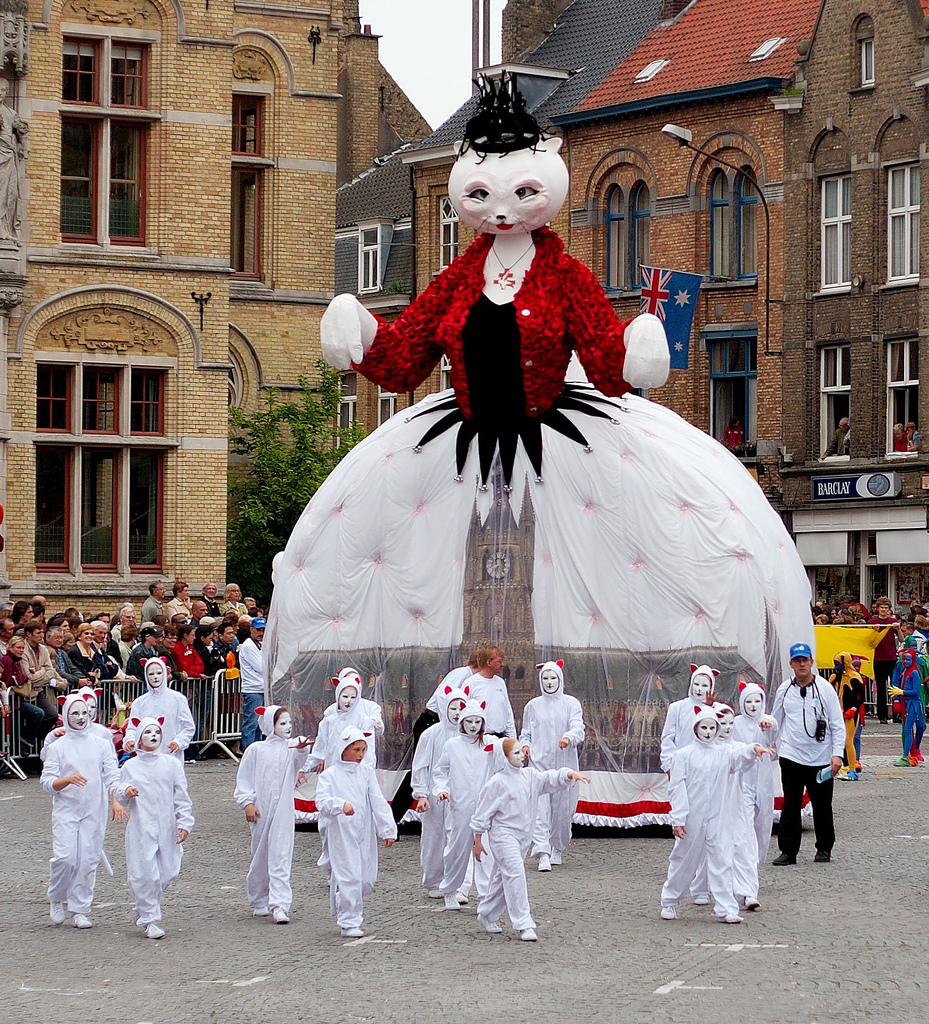
Minneke Poes, one of the giant cats in the Kattenstoet
StatusActive
FrequencyTriennial
LocationYpres
CountryBelgium
Inaugurated1955 (1955)
Most recentMay 12, 2024 (2024-05-12)[1]
Next eventMay 9, 2027 (2027-05-09)[2]

The Kattenstoet (lit. 'Festival of the Cats' or 'Cat Parade') is a parade in Ypres, Belgium, devoted to the cat. It has been running regularly since 1955 and is usually held triennially on the second Sunday of May.[3] The parade commemorates an Ypres tradition from the Middle Ages in which cats were allegedly thrown from the belfry tower of the Cloth Hall to the town square below.

Background

[edit]

There are various legends about how the story of the throwing of cats originated. One possibility is that cats were connected to witchcraft, and the throwing of the cats symbolised the killing of evil spirits.[4] Another story suggests that the cats were brought into the Cloth Hall (Lakenhallen) to control vermin. Before modern heating and storage methods, when it got cold the wool was stored in the upper floors of the Cloth Hall. At the start of the spring warm-up, after the wool had been sold, the cats were tossed out of the bell tower.[5]

Modern festival

[edit]
Kattenstoet in the 1950s

Symbolically reviving this practice for the parade festivities, a jester tosses plush children's-toy cats from the Cloth Hall belfry down to the crowd, which awaits with outstretched arms to catch one. The throwing of the cats from the belfry is followed by a mock witch burning. Participants in the festivities often dress as cats, witches, mice, or townspeople from ages past, and the festival also features brass bands and people riding on horseback. Around 2,000 people participated in the 2012 parade.[6] The festival is a popular tourist event in Belgium and has helped strengthen the local tourist economy around Ypres. 8,000 people visited the event in 2000.[3]

See also

[edit]

References

[edit]
[edit]
Revisions and contributorsEdit on WikipediaRead on Wikipedia
from Grokipedia
The Kattenstoet, or "Cat Parade," is a triennial festival held in (Ieper), , featuring a vibrant of floats, costumes, and performances that honor felines while commemorating the city's medieval history of cat-throwing rituals. Originating from a grim 15th-century tradition in , where live cats—originally introduced to control rodent populations in the cloth trade but associated with and —were hurled from the Cloth Hall's on "Cat Wednesday" during to ward off evil spirits, the practice symbolized cats' association with and . The last recorded instance of live cats being thrown occurred in 1817, after which the ritual evolved into bell-ringing ceremonies until its revival in a festive form. In 1938, local authorities initiated the modern Kattenstoet with a small of children carrying cats from the town hall to the , accompanied by music and a , marking the first step toward transforming the dark custom into a celebration of cats. The festival was paused during but resumed in 1946 with a and symbolic "cat condemnation," gaining momentum under Albert Dehem in the 1950s to boost community spirit and promote beyond its associations. The inaugural large-scale took place on March 13, 1955, drawing 1,500 participants in elaborate costumes, floats, and brass bands, establishing the event's triennial format on the second Sunday of at the time. By the , it had become a nationally renowned spectacle, shifting to the second Sunday in May in later years to align with spring tourism. Today, the Kattenstoet spans two days, beginning with family-oriented activities on , such as workshops and evening events in the town center, culminating in the Sunday parade at 3:00 PM that weaves through ' historic streets. Key highlights include towering cat effigies like the 22-foot-tall Minneke Poes float, costumed marchers portraying witches, mice, and cats, and a climactic moment where a tosses stuffed toy cats from the belfry to the cheering crowd below, evoking the medieval rite without harm. The 46th edition occurred on May 12, 2024, attracting tens of thousands of visitors, including global cat enthusiasts, with free public access and local vendors selling feline-themed souvenirs. The 47th parade is scheduled for , 2027, continuing the tradition under director Bart Cafmeyer since 1997.

History

Medieval Origins

Ypres, known in Dutch as Ieper, emerged as a prominent center of the cloth trade in medieval , , during the 12th and 13th centuries. The city's economy thrived on wool and linen production, attracting merchants from across Europe to its bustling markets. At the heart of this prosperity stood the Cloth Hall (Lakenhalle), a grand Gothic structure begun around 1200 and completed by 1304, with its towering serving as a symbol of commercial power and civic pride. The hall not only housed trade activities but also functioned as a communal focal point for festivals and rituals. The tradition of throwing live cats from the Cloth Hall's belfry originated in this medieval context, with the earliest documented references appearing in city chronicles from 1410 to 1420. Performed annually on "Cat Wednesday," the second Wednesday after (the Wednesday of the second week of ) during the Lenten period, the ritual involved gathering and hurling them to their deaths from onto the market square below. Rooted in Christian , cats were viewed as embodiments of and , making their sacrifice a symbolic act to purge evil spirits and ensure good fortune for the coming year. This superstitious motivation aligned with broader European customs of the era, where felines were often persecuted as agents of the supernatural. Practical considerations may have also contributed to the practice, as Ypres's linen warehouses attracted rodents that threatened stored goods; cats were initially encouraged to control these pests but proliferated, potentially damaging fabrics through scratching or contamination. Over time, the event evolved into a boisterous public spectacle, drawing crowds to witness the chaotic display amid cheers and festivities. Historical accounts from 17th- and 18th-century travelers describe it as a lively communal gathering, highlighting its role in medieval social life. The custom persisted for centuries, with documented occurrences continuing until the early 19th century, the last recorded instance taking place in 1817. This grim tradition laid the groundwork for the modern Kattenstoet festival, revived in the 20th century as a celebratory nod to Ypres's historical past.

Decline and Cessation

By the 18th and 19th centuries, the Kattenstoet tradition of throwing live cats from the Ypres belfry faced increasing opposition due to emerging animal welfare sentiments across Europe, rooted in Enlightenment philosophy that acknowledged animals' capacity for pain and suffering. These ideas, advanced by thinkers like Voltaire and Rousseau, gradually influenced public attitudes, paving the way for early anti-cruelty measures such as Britain's Martin's Act of 1822, the world's first national animal protection law. In Belgium, similar humanitarian concerns emerged in the Penal Code by 1867, though local practices like Ypres' ritual predated formal national legislation. The final documented instance of live cat throwing occurred in 1817, after which the practice was officially banned by authorities, marking the end of the medieval custom. According to a 19th-century archivist, this cessation followed the last event, where the tradition's cruelty could no longer be tolerated amid shifting societal norms. Thereafter, "Cat’s Wednesday"—the former date of the ritual—was observed only through the ringing of church bells, a subdued commemoration without . Parallel to this decline, cat symbolism evolved during the from associations with and evil—fueled by medieval superstitions—to positive roles as efficient pest controllers in burgeoning factories and households, as well as cherished pets symbolizing domestic comfort. This transformation, evident in 19th-century British and European cultural depictions, eroded the ritual's superstitious rationale and cultural relevance. Despite its cessation, the cat-throwing tradition endured as a piece of folklore, preserved in local legends and referenced in 19th-century literature and postcards that romanticized the city's quirky historical customs, ensuring no revivals until the mid-20th century.

20th-Century Revival

The modern revival of the Kattenstoet began in the late 1930s as a lighthearted commemoration of ' medieval folklore involving cats. On March 13, 1938, a small was organized, featuring nine young boys carrying plush cats, accompanied by music and a , marching from the Town Hall to the Cloth Hall's . This initial event also included a children's where plastic cats were tossed and a race dubbed the "Cat Race," marking the festival's playful reintroduction without any reference to the historical cat-throwing practice. The outbreak of interrupted these early efforts, as German occupation from 1940 to 1944 halted public gatherings amid the broader European conflict. A modest resumption occurred on March 17, 1946, with another small procession involving plush cats and a symbolic "cat condemnation" on the Grote Markt, but the event remained limited due to postwar recovery challenges in . The festival's significant post-war revival came in 1955, organized under Mayor Albert Dehem on the second Sunday of , transforming it into a grand spectacle with 1,500 participants in elaborate costumes and floats designed by local artist Frans van Immerseel. This edition aimed to promote ' historical identity and stimulate tourism in the war-ravaged region, establishing the triennial format that continues today. Attendance grew rapidly, reflecting its role in economic revitalization, and by the late , themes like "Cats Around the World" incorporated international , drawing global visitors. The Kattenstoet has since flourished under dedicated leadership, including director Roger Quaghebeur, who oversaw its expansion through the 1970s and 1980s, and current director Bart Cafmeyer since 1997. It is managed by the Kattenstoet organizing committee, with support from the City of and various sponsors such as local businesses and tourism partners, ensuring its status as a key element of ' .

Festival Description

Parade Elements

The Kattenstoet parade features a vibrant procession that winds through the historic streets of , starting and ending at the Cloth Hall in the Grote Markt, the city's central square. The route covers the city center, passing key landmarks and allowing spectators to line the paths on both sides, with the event typically lasting around 2.5 hours. Over 2,000 locals and visitors participate, donning elaborate cat-themed costumes that evoke medieval burghers, witches, mice, and fantastical characters, often handmade to reflect feline folklore and historical motifs. Prominent among the performers are puppeteers maneuvering giant figures, such as the towering Reus Cieper and Minneke Poes, which stand over four meters tall and are carried through the streets as central icons of the procession. These elements create a theatrical spectacle, blending folkloric reenactments with interactive displays, including groups portraying from global cultures and local legends. The parade incorporates dozens of handcrafted floats that depict cat-related myths, scenes from Ypres' medieval past, and satirical takes on contemporary themes, pulled by teams and adorned with vibrant decorations. Accompanying the visuals are lively musical performances from brass bands like the Koninklijke Harmonie Ypriana, folk dancers in coordinated routines, and drum corps that punctuate the rhythm, fostering an energetic atmosphere throughout the march. Held every three years on the second Sunday in May (originally during in its 1955 revival), the event draws 40,000 to 50,000 spectators and remains a free public celebration open to all participants without entry fees.

Key Events and Climax

The Kattenstoet unfolds over a weekend, with pre-parade activities building anticipation and community involvement. The event begins on the Saturday prior to the main , featuring family-oriented programs designed for children and families, often incorporating elements of local to educate participants about the cat's historical role in . These activities contribute to the festive atmosphere in the town center, where evening events further engage visitors. On Sunday morning, the streets of fill with cat-themed decorations, including shop displays and stalls offering specialty items like cat-shaped chocolates and pastries, creating an immersive environment ahead of the afternoon's highlights. The procession commences at 3:00 PM on Sunday, marking the core of the day with a vibrant timeline of segments that showcase feline history, , and humor. Approximately 2,000 participants, dressed in elaborate costumes as cats, witches, mice, and historical figures, march alongside giant , brass bands, and themed floats through the city's streets. Interactive street performances, including stilt-walkers, dancers, and musicians, interact with the crowd of around 50,000 spectators, distributing candies and souvenirs to enhance the celebratory mood. The parade typically lasts about two to three hours, progressing toward the historic Grote Markt square. The climax occurs at the parade's conclusion, around 6:00 PM to 6:15 PM, when a costumed ascends of the Cloth Hall and tosses hundreds of cats into the cheering crowd below. This symbolically references a medieval of throwing cats from the tower to ward off evil spirits, but has been adapted since the festival's revival to use plush toys exclusively, ensuring no harm to animals and aligning with modern animal rights principles emphasized in official descriptions. Following the cat-throwing, post-event festivities extend into the evening with a mock witch-burning reenactment using a , accompanied by concerts and additional performances in the town square. These activities provide a close to the day, reinforcing the festival's commitment to harmless celebration, as no live animals are involved in any part of the proceedings.

Cultural Significance

Symbolism and Themes

The Kattenstoet festival embodies a profound duality in its symbolism, commemorating the medieval superstition that associated cats with omens of misfortune, witchcraft, and evil spirits, while juxtaposing this dark legacy with contemporary reverence for cats as beloved companions and emblems of independence and agility. In the Middle Ages, cats were ritually thrown from the Ypres belfry during "Cat Wednesday" to purge perceived malevolence, a practice rooted in folklore linking felines to the Devil and sorcery, which persisted until the last recorded live throwing in 1817. Today, the festival transforms this history into a celebratory procession, where plush toy cats are tossed harmlessly from the same tower, symbolizing atonement and the shift toward viewing cats as symbols of resilience and affection. Central to the festival's elements are theatrical re-enactments of "witch hunts," including a mock witch-burning that reflects historical persecutions of those accused of sorcery alongside their feline familiars, now presented with humor to promote education on tolerance and the of past prejudices. Participants don costumes as witches, cats, and mice, staging a lighthearted and burning of a fabric puppet witch, which underscores the evolution from brutality to communal reflection on superstition's harms. This satirical portrayal serves as a vehicle for elements, using exaggerated to foster understanding and unity among spectators. The 's themes extend to sharp social satire, with elaborate floats often lampooning current events and employing cats as metaphors for mischief, political cunning, and societal agility. Giant cat effigies and themed tableaux mock contemporary issues, channeling ' humorous spirit to critique power dynamics much like the agile feline evades capture. Over time, the Kattenstoet's meaning has evolved from a post-World War II mechanism for healing and solidarity—positioning cats as survivors amid ' devastation—to a broader affirmation of and preservation, recognized as part of ' immaterial . Revived in 1938 and expanded after 1946, it helped rebuild community bonds in a war-torn city, evolving by the into a major event that celebrates resilience.

Impact on Ypres and Beyond

The Kattenstoet festival provides a significant economic boost to by drawing thousands of tourists every three years, thereby supporting local businesses through increased spending on accommodations, dining, and souvenirs. The event has historically strengthened the local , contributing to ' visibility as a cultural destination beyond its associations. Until the 1980s, the parade was a primary draw for visitors, surpassing war-related in prominence and helping to revive the town's in the post-war period. Within the community, Kattenstoet fosters strong local pride and volunteerism, as residents actively participate by decorating shops with cat-themed displays, baking feline-shaped pastries, and contributing to parade preparations. Over a thousand locals typically engage in the festivities, reinforcing communal bonds and highlighting ' pre-war cultural heritage amid its recovery from devastation. This involvement not only preserves but also aids in the city's ongoing identity-building, emphasizing joyful traditions over . On a broader scale, the festival attracts international media attention, including a 2024 feature in The New York Times that showcased its global appeal to cat enthusiasts from around the world. It has inspired interest in similar whimsical cultural events across Europe, promoting feline-themed celebrations while educating participants on historical animal treatment through modern, humane reenactments.

References

Add your contribution
Related Hubs
User Avatar
No comments yet.