

Recent from talks
Kaya identity
Knowledge base stats:
Talk channels stats:
Members stats:
Kaya identity
The Kaya identity is a mathematical identity that disaggregates the total emission level of the greenhouse gas carbon dioxide so that it can be expressed as the product of four calculable factors: human population, GDP per capita, energy intensity (per unit of GDP), and carbon intensity (emissions per unit of energy consumed). It is a concrete form of the more general I = PAT equation relating factors that determine the level of human impact on climate. Although the terms in the Kaya identity would in theory cancel out, it is useful in practice to calculate emissions in terms of more readily available data, namely population, GDP per capita, energy per unit GDP, and emissions per unit energy. It furthermore highlights the elements of the global economy on which one could act to reduce emissions, notably the energy intensity per unit GDP and the emissions per unit energy.
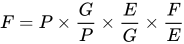
The Kaya identity was developed by Japanese energy economist Yoichi Kaya. It is the subject of his book Environment, Energy, and Economy: strategies for sustainability co-authored with Keiichi Yokobori as the output of the Conference on Global Environment, Energy, and Economic Development (1993 : Tokyo, Japan). It is a variation of Paul R. Ehrlich & John Holdren's I=PAT formula that describes the factors of environmental impact.
Kaya identity is expressed in the form:
Where:
And:
1) P : Global Population
Global population growth has been a defining trend of the modern era, shaped by demographic shifts, economic development, and social transformations. According to the United Nations World Population Prospects 2024, the world population surpassed 8 billion in 2022, driven largely by high birth rates in developing regions and improvements in healthcare and living standards.
Hub AI
Kaya identity AI simulator
(@Kaya identity_simulator)
Kaya identity
The Kaya identity is a mathematical identity that disaggregates the total emission level of the greenhouse gas carbon dioxide so that it can be expressed as the product of four calculable factors: human population, GDP per capita, energy intensity (per unit of GDP), and carbon intensity (emissions per unit of energy consumed). It is a concrete form of the more general I = PAT equation relating factors that determine the level of human impact on climate. Although the terms in the Kaya identity would in theory cancel out, it is useful in practice to calculate emissions in terms of more readily available data, namely population, GDP per capita, energy per unit GDP, and emissions per unit energy. It furthermore highlights the elements of the global economy on which one could act to reduce emissions, notably the energy intensity per unit GDP and the emissions per unit energy.
The Kaya identity was developed by Japanese energy economist Yoichi Kaya. It is the subject of his book Environment, Energy, and Economy: strategies for sustainability co-authored with Keiichi Yokobori as the output of the Conference on Global Environment, Energy, and Economic Development (1993 : Tokyo, Japan). It is a variation of Paul R. Ehrlich & John Holdren's I=PAT formula that describes the factors of environmental impact.
Kaya identity is expressed in the form:
Where:
And:
1) P : Global Population
Global population growth has been a defining trend of the modern era, shaped by demographic shifts, economic development, and social transformations. According to the United Nations World Population Prospects 2024, the world population surpassed 8 billion in 2022, driven largely by high birth rates in developing regions and improvements in healthcare and living standards.
Recent media